Exploring the Mystery of the Nephilim: Who They Were and Their Significance
Who are the Nephilim?
The question of the Nephilim is notorious. Who are the Nephilim and why does it matter? Very briefly, it matters because the Nephilim are in the Bible. It mattered to the Biblical writer, and God had the author include the Nephilim for a reason. We should understand that reason as best as we can.
Here’s Genesis 6:1-5, the text under question:
1 When man began to multiply on the face of the land and daughters were born to them, 2 the sons of God saw that the daughters of man were attractive. And they took as their wives any they chose. 3 Then the Lord said, “My Spirit shall not abide in man forever, for he is flesh: his days shall be 120 years.” 4 The Nephilim were on the earth in those days, and also afterward, when the sons of God came in to the daughters of man and they bore children to them. These were the mighty men who were of old, the men of renown. 5 The Lord saw that the wickedness of man was great in the earth, and that every intention of the thoughts of his heart was only evil continually.
There are three main interpretive options:
Option 1: The Sethite View
According to the Sethite view, the “sons of God” are descendants of Seth and the Nephilim are not supernatural beings. Instead, this passage is about marriages between believers and unbelievers. The distinction in this view is between the godly “sons of God” and wicked “daughters of man.” It is true, as William F. Cook has said, “In the Old Testament, God’s covenant people are sometimes referred to as God’s sons (Deut. 14:1; Jer. 3:19), though the precise phrase ‘sons of God’ is never used of them.”[1] Another point proponents make is that Jesus said, “In the resurrection they neither marry nor are given in marriage, but are like angels in heaven” (Matt. 22:30). Advocates of the Sethite view often say something like, “Jesus says angels don’t marry.”[2]
Option 2: The Human Kings View
This view points out that in the ancient Near East, a king might be viewed as divine or partly divine and referred to as a “son” of the gods. So, in this view, the “sons of God” are merely human kings.[3] According to this view, the offspring of these marriages are the Nephilim. They just happen to be a mighty group of people, but they are not the offspring of fallen angelic beings.
Option 3: The Fallen Angels View
The fallen angels view, which is the view I take, understands “sons of God” to be fallen angels who lusted after women and procreated with them. These women gave birth to the Nephilim. The Nephilim were on the earth before Noah’s flood—“in those days, and also afterward” (v. 4). The text says the transgression of the fallen angels was not a one-time occurrence. This explains why it was “also afterward” that the Nephilim were on the earth, because anytime “the sons of God came in to the daughters of man… they bore children to them” (v. 4).
What Does “Sons of God” Mean?
In Job, the phrase clearly refers to angels (Job 1:6; 2:1; 38:7 cf. Ps. 82:1). The Septuagint, the Greek translation of Genesis 6:2, says, “the angels of God” (οἱ ἄγγελοι τοῦ θεοῦ). Derek Kidner says, “The normal meaning of the actual term ‘sons of God’ is ‘angel.’”[4] Documents between the Old and New Testaments interpret Genesis 6 in this way (See Jubilees 7:25–26; 1 Enoch 6:2–3; 7:1–3; 15:3–10). Also, “The earliest view of the ‘sons of God’ among the church fathers was that these were rebel angels who engaged in sexual sin with human women. This was the prevailing view in the first four centuries of the early church.”[5]
Here are two historical perspectives:
For many angels of God accompanied with women, and begat sons that proved unjust, and despisers of all that was good, on account of the confidence they had in their own strength; for the tradition is, that these men did what resembled the acts of those whom the Grecians call giants (Josephus, Antiquities of the Jews, 1.73).
We are instructed, moreover, by our sacred books how from certain angels, who fell of their own free-will, there sprang a more wicked demon-brood, condemned of God along with the authors of their race. Their great business is the ruin of mankind. So, from the very first, spiritual wickedness sought our destruction. They inflict, accordingly, upon our bodies diseases and other grievous calamities, while by violent assaults they hurry the soul into sudden and extraordinary excesses (Tertullian, Apology, ch. 22).
Mitchell L. Chase says it well:
Clearly in Genesis 6:1-4, the “sons of God” are committing sexual sin in the days of Noah. What ultimately convinced me that the “sons of God” are rebel angels is the evidence from the letters of 1-2 Peter and Jude. They seem to be writing statements that show awareness of the prevailing intertestamental reading of Genesis 6:1-4, and they seem to affirm that reading.[6]
But Didn’t Jesus Say Angels Don’t Marry?
What does Jesus mean when He says, “In the resurrection they neither marry nor are given in marriage, but are like angels in heaven” (Matt. 22:30)? His main point is clearly that there is no marriage in heaven. He does not say that angels are incapable of sexual acts. It is heavenly angels who are not married, and clearly angels are not supposed to take part in sexual acts. But that does not mean that it is not possible. Also, what the fallen angels did in Genesis 6 happened on earth, not in heaven. Matthew 22:30 does not contradict Genesis 6.
The Bible does recount angels engaging in human activities like eating (Gen. 18:1–2, 8; 19:1, 5). In Mark 16:5, an angel at Jesus’ empty tomb appears to be a young man. Angels can clearly do physical things. Jacob wrestled with an angel and Jacob sustained an injury from it. Angels open doors (Acts 5:19) and even hit disciples to wake them (Acts 12:7). In Genesis 19:5, the men of Sodom saw the two angels and wanted to have sexual relations with them.
So, although angels are spiritual beings, they are capable of physical actions. Also, “the craving of demons for a body, evident in the Gospels, offers at least some parallel to this hunger for sexual experience.”[7] It’s possible the fallen angels took on physical form or possessed the bodies of men and engaged in sexual acts in that way.[8]
That is what Jude seems to indicate. “And the angels who did not stay within their own position of authority, but left their proper dwelling, he has kept in eternal chains under gloomy darkness until the judgment of the great day— just as Sodom and Gomorrah and the surrounding cities, which likewise indulged in sexual immorality and pursued unnatural desire, serve as an example by undergoing a punishment of eternal fire” (Jude 6-7). Verse 6 says the angels did not do what they were supposed to do; they did not stay within the boundaries given to them, but left their regular and proper residence. This could clearly refer to sexual boundaries. Especially in light of verse 7, which gives a comparison between the angels’ transgression and Sodom and Gomorrah’s transgression. It says, “likewise” or “in the same way,” Sodom and Gomorrah “indulged in sexual immorality and pursued unnatural desire.”
Though strange to our modern minds, the best interpretive option understands the Nephilim to be the hybrid offspring of spirit beings and human beings. As we have seen, several factors support this interpretation.[9]
Conclusion: Why Does It Matter?
First, the Bible recounts a supernatural story; supernatural things happen in it and in reality. We may not like it; we may think it’s weird, but that’s the real world we live in. We must be comfortable with the way the Bible portrays the world. It’s the true world we live in. If the Bible includes it at all, especially in the beginning, we should pay attention to it.
Evangelicals believe, as Michael S. Heiser points out that “The serpent was actually a divine being, not a mere member of the animal kingdom.”[11] That’s strange and unexpected but most people who believe the Bible believe a divine being took the form of a serpent and spoke. The supernatural approach to the early passages in Genesis derive from other passages that plainly have divine beings in embodied human form.[12] In other words, this view is compatible with and goes right along with the whole of Scripture.
Heiser goes on:
Any viewpoint that strips the account of its supernatural flavor must be discarded. The events described in Genesis 6:1-4 were part of Israel’s supernatural worldview. We cannot pretend they saw things as most modern readers would. Since the Nephilim were part of Israel’s supernatural worldview and their descendants turn out to be Israel’s primary obstacle for conquering the promised land, the conquest itself must also be understood in supernatural terms.[13]
Second, the wild reality of the Nephilim helps explain various mythologies. I don’t think mythologies are true, but I do think there are spiritual beings behind mythologies. That’s what the Bible says, and that’s what the early church said too.
The Bible explicitly states that demons are behind false worship. Paul says “what pagans sacrifice they offer to demons and not to God” (See 1 Cor. 10:14–22). There is a clear connection between idolatry and demonic activity. We see the same type of thing in the Old Testament. Deuteronomy says Israel “sacrificed to demons that were not God, to gods they had never known” (See Deut. 32:16–17). Psalm 106 recounts that people disgustingly “sacrificed their sons and their daughters to the demons.”
Is there a connection between Nephilim and what’s recounted in The Epic of Gilgamesh? It seems likely. They both have to do with angelic, god-like beings interacting with humans in the context of a global flood. Is there a connection between the angels lusting after women and gods like Zeus lusting after mortal women? This seems especially interesting when, as we have seen, behind false gods are demons.
Third, we may not realize it at first, but giants are a character in Scripture. Yes, they’re certainly not the main character or the main point, but they do play a part. The word Nephilim appears only three times in the Old Testament (Gen. 6:2; Num. 13:33). But the related word “giant” appears 10 times in 8 verses in the Bible (Genesis 6:4; Numbers 13:33; 1 Chronicles 20:4,6,8; 2 Samuel 21:18,20,22) and Rephaim, a related term, appear numerous times (Gen. 14:5; 15:20; Deut. 2:11; 3:11,13; I Chron. 20:4).
The Nephilim being “mighty men” and “men of renown” makes sense if they are crossbreeds and there is a supernatural explanation for their size and strength. Options 1 and 2 above don’t really answer why the Nephilim would be giants. There are positive examples in the Bible of the Spirit giving supernatural strength. One thinks of Samson (Judges 14:6; 15:14–15; 16:28–30), Japhthah (Judges 11:29), and Saul (1 Sam. 11:6). So, it could be that if there were spiritual-human crossbreeds, they would be extra big and strong. Also, the idea of a line of descendants who are demon-human mixes could also make sense of God’s people being told to eliminate the inhabitants of the Promised Land if they were demon-brood.
The narrative of giants starts with the mysterious Nephilim in Genesis 6, but it does not end there. The Nephilim are linked with the Anakim and Rephaim, who are referenced more often. Notably, ten of the twelve Israelite spies were scared to go into the Promised Land due to the colossal Anakim. Numbers 13:33 explicitly states that these individuals originated from the Nephilim. Here’s what the spies who were scared said:
We are not able to go up against the people, for they are stronger than we are.” 32 So they brought to the people of Israel a bad report of the land that they had spied out, saying, “The land, through which we have gone to spy it out, is a land that devours its inhabitants, and all the people that we saw in it are of great height. 33 And there we saw the Nephilim (the sons of Anak, who come from the Nephilim), and we seemed to ourselves like grasshoppers, and so we seemed to them (v. 31-33).
Deuteronomy 2:10-11 further establishes the Anakim as a formidable giant group known as the Rephaim. While in the wilderness, God used Moses to defeat the giant Og of Bashan, who was among the remaining Rephaim (Deut. 3:10-11). Then after a four-decade sojourn in the wilderness, Joshua and Caleb, two steadfast spies, successfully expelled the giant Anakim from Canaan. They devoted the Anakim to destruction, although there were some Anakim left in Philistine territory (Josh. 11:21-22). Notably, one of these cities was Gath, which is where Goliath came from.[10]
Giants are an important part of the biblical story because they shed light on how bad the world really is and also provide another element to answer why it is so bad. But they also show us another thing Jesus saved us from. David defeated Goliath, but God disarmed the rulers and authorities and put them to open shame by triumphing over them in Jesus the Messiah (Col. 2:15). Giants show how truly great God’s rescuing grace is. You might say God’s grace is giant.
All of this wild stuff about giants may bring up lizard people and other wild conspiracy theories. But that should never ever be our focus. As Christians, we have reasons to believe that wild, weird stuff goes down in this world; we even have a reputable explanation for why. We live in a world in which sinister spiritual beings lurk. But that should never be our focus. Instead, we should have laser-beam focus on Jesus, not distracting speculation.
Notes
[1] William F. Cook, “The Sons of God in Genesis 6: Sons of Seth, Fallen Angels or Something Else?”
[2] Chase, “Who Are the Sons of God, Daughters of Man, and Nephilim?”
[3] See Chase, “Who Are the Sons of God, Daughters of Man, and Nephilim?”
[4] Derek Kidner, Genesis.
[5] Chase, “Who Are the Sons of God, Daughters of Man, and Nephilim?” He also says, “The ancient Jewish interpretation-as well as the earliest Christian interpretation—of Genesis 6:1-4 is that the “sons of God” are rebel angels who committed sexual sin in unions with human women. And I think this ancient view is correct” (Chase, “Who Are the Sons of God, Daughters of Man, and Nephilim?”).
[6] Chase, “Who Are the Sons of God, Daughters of Man, and Nephilim?”
[7] Kidner, Genesis.
[8] See commentary on the NET Bible.
[9] Rachmat Tony SinjoBantaeng, Candra Gunawan Marisi, “A Hermeneutical-Theological Analysis of the Nephilim in Genesis 6:4: A Pentecostal Systematic Theology Approach.”
[10] See Zachary Garris helpful article, to whom I am indebted to for this paragraph: “Giants in the Land: A Biblical Theology of the Nephilm, Anakim, Rephaim (and Goliath).”
[11] Michael S. Heiser, “Who Are the Nephilim and What Is Their Origin?” See also his book, The Unseen Realm: Recovering the Supernatural Worldview of the Bible.
[12] Heiser, “Who Are the Nephilim and What Is Their Origin?” “The ancient reader would have had no problem with it. But for moderns, it seems impossible that a divine being could assume human flesh and do what this passage describes. The objection is odd, since this interpretation is less dramatic than the incarnation of Yahweh as Jesus Christ… The truth is that Christians affirm the incarnation because they have to—it defines Christianity. Genesis 6:1-4 is set aside as peripheral. But belief in a personal God as the Bible describes means embracing the supernatural” (Ibid.)
[13] Heiser, “Who Are the Nephilim and What Is Their Origin?“
Does Satan exist? And if so…

Does Satan exist? There is trouble for us if Satan exists and if he does not exist. Let me explain…
𝐈𝐟 𝐒𝐚𝐭𝐚𝐧 𝐝𝐨𝐞𝐬 𝐧𝐨𝐭 𝐞𝐱𝐢𝐬𝐭
If Satan does not exist, how then do we think about the existence of evil? If God is dead, as Nietzsche argued and many have quipped, then so is Satan, and so is our concept of good and evil. Personal likes and dislikes, yes, we still have individual tastes and preferences. Some people like lima beans, some don’t. Some think murder is in good taste, and others don’t. But there is no moral high ground, no actual good and evil.[2]
Andrew Delbanco wrote a book called The Death of Satan. In it, he explains that evil used to “have a face, a name, an explanation.”[1] But now, modern refined humanity doesn’t believe in an evil force at work in the world. Yet, this hasn’t been the case for most of history or even for most people across the globe, even now.
Germany went from being the most sophisticated culture to being a killing culture. They went from a people of art, architecture, and invention to the mass murder of some six million Jews. If evil and Satan don’t exist, then we can’t say the mass murder of millions is evil. We can say we personally don’t like mass murder, but we can’t call it “evil.” That’s problematic.
“We live in the most brutal century in human history.” “The work of the devil is everywhere, but no one knows where to find him.” We have a crisis in our culture. We experience evil, but many don’t believe in actual evil. “We feel something that our culture no longer gives us the vocabulary to express.”[3]
If Satan and evil don’t exist, then it’s bad because there is no real category for “bad.” Then there is no explanation for the things that seem evil; they would then just be, be a regular part of the world. Seemingly evil experiences would just be normal. The way the world is. Also, if evil is not real, it can’t be overcome, defeated, or done away with.
“Don’t be evil” used to be Google’s corporate motto. It’s not now. Did they change their motto because there is no longer a real category of “evil”? If evil is not a real category, people can’t be evil.
𝐈𝐟 𝐒𝐚𝐭𝐚𝐧 𝐝𝐨𝐞𝐬 𝐞𝐱𝐢𝐬𝐭
The truth is, however, it sure seems like evil and Satan exist. I’m reading The Others Within Us: Internal Family Systems, Porous Mind, and Spirit Possession. It’s essentially about what various cultures have to say about spirit possession. The author says spiritual possession is found in every major world religion. One of the researchers cited did a study in 488 societies worldwide and found that it is “probably universal and occurs in all societies.”[4] The book said, “spirit possession often gives the possessed physical abilities that are not explainable.” I have credible friends who have told stories of people who were out of their mind, were not on drugs, yet possessed physical strength not explainable from a merely material perspective. Could what they witnessed be spirit possession?
We are very likely to be outwitted by Satan and his fellow conspirators when we are unaware of their schemes, let alone their existence. As the movie The Usual Suspects says, “The greatest trick the Devil ever pulled was convincing the world he didn’t exist.”
In Harry Potter, “Voldemort, Lucius Malfoy, and their associates are bent on hating and destroying the stability and structures of the wizard world. Dumbledore, Hagrid, Harry, and their friends are committed to saving them.”[5] In the real world, there’s also a battle going on. We’re in trouble if we’re unaware.
The world is at war. There is an enemy always seeking to harm. We are in a world of magic, good and bad. As C.S. Lewis has said, “There is no neutral ground in the universe. Every square inch, every split second is claimed by God, and counterclaimed by Satan.” But the Bible says that the boss of the universe is good. And that’s a good thing. The sinister Satan will finally and decisively be defeated, never to work his woe again. If Satan and evil exist, it’s bad because Satan and evil are bad. It’s bad because there are actors in our world who want to inflict harm and intentionally destroy.
(𝐒𝐨𝐦𝐞 𝐨𝐟) 𝐖𝐡𝐚𝐭 𝐭𝐡𝐞 𝐁𝐢𝐛𝐥𝐞 𝐬𝐚𝐲𝐬 𝐚𝐛𝐨𝐮𝐭 𝐒𝐚𝐭𝐚𝐧 & 𝐄𝐯𝐢𝐥
The Bible makes sense of the weird wild world we inhabit. The Bible is a big, amazing story. It surpasses Marvel and the Lord of the Rings. It tells us about God making the universe. It tells us about spiritual beings rebelling against God and starting a cosmic battle.
The Bible says in our world there is not one actor—humanity, but three—God, spiritual beings, and humans. Christians both believe in actual evil and resistance to evil. There’s a danger to not believing in actual evil; if there’s no evil, evil can’t be resisted. If there is no evil, individuals might label this or that thing “bad” or “good” but that’s just opinion.
For Christians, the understanding of evil and Satan is not simplistic. In regards to human beings, there’s not a clear-cut divide between good and evil. I want to do good but often do bad (Rom. 7:15-20). We all stumble in many ways (James 3:2). Yet, there is something beyond human dysfunction. “For we wrestle not against flesh and blood, but against principalities, against powers, against the rulers of the darkness of this world, against spiritual wickedness in high places” (Eph. 6:12).
The Bible says we are in a world where sinister evil lurks. But it also tells us about God’s rescue mission in Christ Jesus. Jesus fought the evil enemy, He defeated and cast out the great dragon’s evil henchmen. Jesus casts out demons like light expels darkness. Jesus, in contrast, to other exorcists “is presented as an authority in control of the unclean spirits. He typically rebuked and commanded them. He relied on the spirit of God and did not use charms or talismans or magical papyri, which were common in his day. He sent out his disciples, clearly stating that he gave them the authority and power to control demons.”[6]
There will come a day when every being will bow, and every entity in the entire universe will publicly acknowledge that Jesus is Lord (Phil. 2:10-11). As humans confess with every breath that we need air, it will be abundantly and eternally clear that Jesus is the boss of every creature. We can withstand anything the world throws at us, not in our power, but through the power of Jesus (Rom. 8; Eph. 6:10).
[1] Andrew Delbanco, Death of Satan, 4.
[2] See J. Daniel McDonald, “Natural Selection and an Epistemology of Evil: An Incompatible Pair.”
[3] Andrew Delbanco, The Death of Satan, 9.
[4] Robert Falconer, The Others Within Us: Internal Family Systems, Porous Mind, and Spirit Possession.
[5] John Killinger, God, The Devil, and Harry Potter, 178.
[6] Falconer, The Others Within Us.
The 10 Most Popular Posts of 2020

Here are the ten most popular posts of 2020.
What if Satan wants to destroy the Church more than the country?

In the book of Revelation the Church is not called to react to the End or the antichrist by moralistic, militaristic, or political means. The Church is called to return to Messiah Jesus, remembering that those who continue faithful to the End will receive the “crown of life.” The way of resistance of evil, is the way of Christ. That is, loving Christ Jesus, and loving others. Taking up our crosses and following Jesus and loving others, even when it hurts, is a sure sign that we don’t and won’t have the “mark of the beast.”… Read More.
Statistics and Comfort in Calamity

Some sources are saying that the mortality rate of COVID-19 looks to be 2%. However, it is too early to say. The percentage will be bigger or smaller depending on various factors (such as the age of the people infected, access to the needed medical treatment, etc.). I think we should acknowledge a few things about the statistic. First, 2% looks like a small number. And it is. At least, relative to a larger number… Read More.
Why do Black Lives & LGBTQ+ Lives Matter?

Why do black lives and LGBTQ+ lives matter? This is an important question because some people have views that don’t support the idea of lives mattering. For example, Charles Darwin, the most famous proponent of evolution titled his book, On the Origin of Species by Means of Natural Selection, or the Preservation of Favored Races in the Struggle of Life. And in his book, The Decent of Man, he says, “The Western nations of Europe… now so immeasurably surpass their former savage progenitors… Read More.
We Harvest what we Plant

“If you sow to the flesh you will reap from the flesh, reap corruption. But if you sow to the Spirit you will reap from the Spirit, reap eternal life” (Gal. 6:8). Sowing and reaping are not things most of us are really familiar with, let alone sewing and weeping. So, what does it mean to sow? To sow means to plant seeds. What does it mean to reap? To reap means to gather, to harvest what was planted… Read More.
Unrest and Our Rest

I have friends that are cops. I have friends that are black. I have friends that think COVID-19 is a hoax and friends that I couldn’t coax out of their house if I tried.
Friends, we are in a time of unrest; economic, social, political, and physical. I’m not trying to be dour or dark. I believe that is an accurate articulation of our current time. And yet people are pining for peace and rest. Where is this peace and rest to be found?… Read More.
The Ten Best Books I Read in 2020
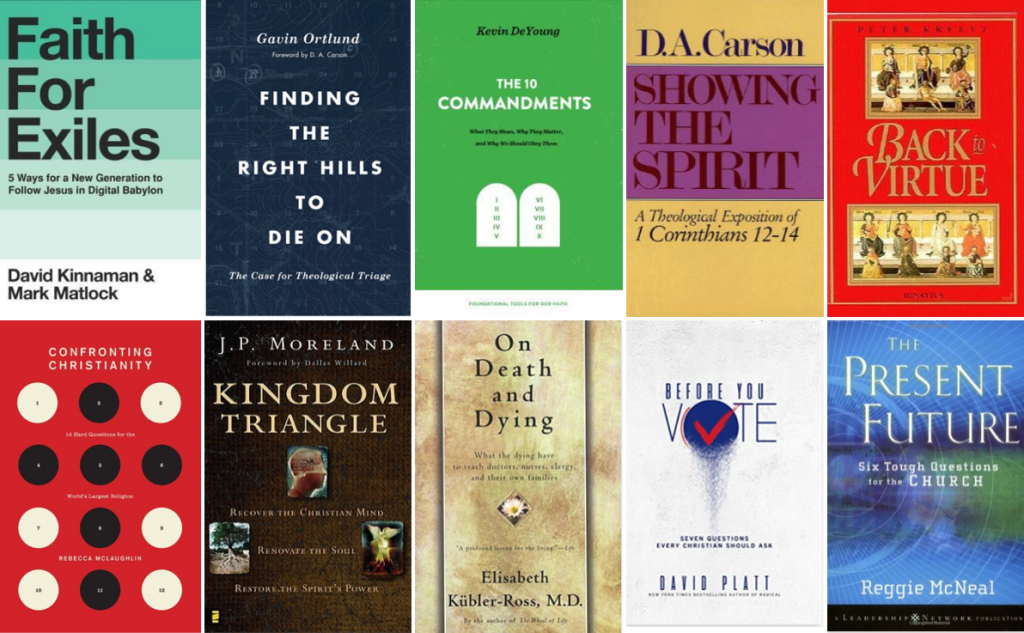
Check out the top ten books I read in 2020 here.
Sometimes life gives you a gift that you want to lose but you have to use.

Do you view singleness as a gift? Sometimes we receive gifts that we don’t want to use, don’t know how to use, or don’t even want to possess. I am afraid many of us feel this way about singleness. We don’t know what to do with it, we don’t know why we’re stuck with it, and we just want to get rid of it.
The Apostle Paul saw singleness as a gift… Read More.
Living as Canceled Christians
 It happened to the elect exiles to whom Peter wrote. Our voice can vanish too. We are not immune. We can be canceled.
But are we ready? Can we stand in the storm or will our house be blown to smithereens? Will it crumble on the sand that it is laid or is its foundation deep and solid? Will our life vanish and wither? Where is our source of life?… Read More.
A few helpful resources before you vote…
 I highly suggest that you check out Jonathan Leeman’s article: “What Makes a Vote Moral or Immoral? The Ethics of Voting.” And I found Justin Taylor’s article “The Case Against Pro-Lifers Voting for Joe Biden” helpful too. Taylor quotes John Piper: “No endorsement of any single issue qualifies a person to hold public office. Being pro-life does not make a person a good governor, mayor, or president. But there are numerous single issues that disqualify a person from public office.”… Read More.
Why did Jesus flip over tables?
 “And He entered the temple and began to drive out those who sold and those who bought in the temple, and he overturned the tables of the money-changers and the seats of those who sold pigeons. And He would not allow anyone to carry anything through the temple” (Mark 11:15-16).
Why did Jesus drive out those who sold and bought in the temple? Why did He flip over tables? That seems pretty extreme. Why was He so worked up?… Read More.
How to Evaluate Christian Leaders?

Recently, I’ve seen a lot of Christian leaders be criticized or criticize, and even call other Christian leaders names because of disagreement on such things as politics, the pandemic, and policies regarding justice. And not surprisingly, those who are not leaders are also jumping into the fray and lobbing grenades too.
How many people actually think through the appropriate way to evaluate Christian leaders?… Read More
*Photo by Aaron Burden
What if Satan wants to destroy the Church more than the country?

In the book of Revelation the Church is not called to react to the End or the antichrist by moralistic, militaristic, or political means. The Church is called to return to Messiah Jesus, remembering that those who continue faithful to the End will receive the “crown of life.” The way of resistance of evil, is the way of Christ. That is, loving Christ Jesus, and loving others. Taking up our crosses and following Jesus and loving others, even when it hurts, is a sure sign that we don’t and won’t have the “mark of the beast.”
What if the clearest mark of the beast is the mark of hatred and hostility? Many have thought it stood for Nero (the numerical value of 666), and perhaps it did in a way. He was, as history showed, marked by the beast. He was, as history showed, like his father the devil. He was proud and unloving, destructive and devilish.
Is not the mark of the Messiah, the mark of beatific love?1 Do not His followers, follow Him? If Jesus is love, should not His followers be loving?!2
“Love is patient, love is kind. It does not envy, it does not boast, it is not proud. It does not dishonor others, it is not self-seeking, it is not easily angered, it keeps no record of wrongs. Love does not delight in evil but rejoices with the truth. It always protects, always trusts, always hopes, always perseveres” (Corinthians 13:4-7).
And would it not make sense that the converse also follows? If the mark of the Messiah is true sacrificial love, is not the mark of the antichrist hatred? And what if the serpent of old, the father of lies, the great deceiver, is adept at what he does? And what if he wants to destroy and divide even what Messiah Jesus died to bring together? And what if he even uses the means of media and the marketplace and various views on certain medical opinions regarding COVID-19? What if?…
And what if the worst thing that can happen to Christians is not that they’d lose earthly freedom(s), but that they’d lose heavenly crowns? not that their earthly country would be divided, but that their heavenly one would be? not that they’d have to wear a mask, but that they’d have a mask put over their eyes? What if Satan’s not primarily trying to destroy a country, but what if he desires to destroy Christians and Christian witness? What if Satan doesn’t want the nation to descend into debauchery, but wants Christians to be desensitized to their hatred and fear?
Revelation also talks a lot about Babylon. Babylon was what a lot of people cared about and had their hopes fixed on. However, Christians, are marked by and are members of a different city. Christians have their hope wrapped up in a city, but it’s a different city, a city that comes down from heaven, a city that couldn’t be built here. It’s beyond and better than here.
Christians live, labor, and love in Babylon, but they’re waiting for something better. They’re waiting for Jerusalem to come down.
Christian brothers and sisters, are you showing the mark of your Savior? The characteristics of Christ? The mark of your true city? Or, are you too wrapped up here? Are you betting on Babylon3 or are you “looking forward to the city with foundations, whose architect and builder is God”?!
We, as Christians, are sojourners here in Babylon. Our time is short. Let’s be a blessing as Scripture exhorts us (Jeremiah 29:7). But, let’s remember, any castle we build with our hoarded cash, will soon wash away with the tide of time. Let’s not lay up hoards here or place our hope here. But in heaven.
1 Ephesians 1:13 tells us that all who are in Messiah Jesus have been sealed (or marked?!) with the promised Holy Spirit. Notice also that it is the Holy Spirit in Jesus followers who produces the fruits of the Spirit, one of those fruits being love.
2 God alone provides access to the Garden of Eden and the pathway there is through the Golgotha of sacrificial love.
3 If politics has you overly down, perhaps it’s because you placed your hope in a ship that must inevitably sink.
Satan Disguises Himself

“And no wonder, for even Satan disguises himself as an angel of light. So it is no surprise if his servants, also, disguise themselves as servants of righteousness. Their end will correspond to their deeds” (2 Corinthians 11:14-15).
Satan disguises himself.
That is a rather scary prospect.
The serpent of old (Rev. 20:2), the great dragon (Rev. 12:9), the one who goes around like a lion just waiting to destroy (1 Pet. 5:8), disguises himself. And his disguise is not what we would expect.
Satan disguises himself as an angel of light. He cloaks himself in radiant dress in order that he may deceive. He once took the form of a serpent (Gen. 3:1). If a snake came up to you and talked and tempted you today you’d probably see right through it. You’d probably run.
We’re not fighting a human war
“For although we live in the flesh, we do not wage war according to the flesh, since the weapons of our warfare are not of the flesh, but are powerful through God for the demolition of strongholds. We demolish arguments and every proud thing that is raised up against the knowledge of God, and we take every thought captive to obey Christ” (2 Corinthians 10:3-5).
The Christian battle is not a battle of the flesh. The Christian’s weapon is not physical and material. But the battle is no less serious. “For our struggle is not against flesh and blood, but against the rulers, against the authorities, against the powers of this dark world and against the spiritual forces of evil in the heavenly realms” (Eph. 6:12).
As Christians, we are to fight. But our fight is the fight of faith (1 Tim. 6:12). Our weapons are not human. We don’t use swords, knives, and guns. Instead, we carry “weapons of righteousness for the right hand and for the left” (2 Cor. 6:7). Our sword is the sword of the Spirit, the word of God (Eph. 6:17).
Our weapons, even though they are not of the flesh are powerful. They’re powerful because they are “through God” (2 Cor. 10:4). We are “strong in the Lord and in the strength of His might” (Eph. 6:10).
Sin is Not Good #5
Sin Looks Really Good
It is a graphic scene, depicted in the most vivid way. A recent celebrated movie shows the character smiling in glee as he takes his own life. This depiction is sad yet we see it week-in and week-out. The movie is The Return of the King and the character is Gollom. Gollom, previously known as Sméagol, use to be a regular hobbit but was corrupted, enslaved by the ring. His infatuation with the ring started slow (a weekend here and there) but ended desperately. Gollom loved and hated the ring. He was torn, he wanted to be free from the ring and yet relentlessly pursued it.
At the end of the movie, Gollom finally has, as he says, “my precious.” But in getting the ring he has destroyed himself and everyone, indeed, everything around him. Yet his refrain is, “my precious.” Gollom’s last scene is one of great joy (for him). Gollom fights Frodo over the ring, another character that was nearly wholly-destroyed by the ring. Gollom is fierce. He wants the ring at any price. He bites off Frodo’s finger and rejoices over his plunder. He embraces his cruel master as his beloved friend. He falls, seemingly, blissfully in the lava and as he sinks he rejoices that he has comfort from pain, he has everything, he has his “precious.” Then he sinks and he and his “precious” are gone.
This scene, though portrayed differently, is a scene I have seen too often. This scene is the climax and conclusion of far too many stories of sin. Sin looks good. It is so sad to see people enraptured in love with their cruel master and executioner.
Sin is ingeniuine. It makes big promises but never delivers. Truly the world and sin “promises happiness, and nothing less… It promises to satisfy our desires, but only increases them; it gives poisoned pills, but wraps them in sugar.”[i]
Satan sells us lies and blinds our eyes. He would have us contended with filth and miss the glorious Lord who is worthy of all praise and can satisfy our longing soul. Truly Satan is crafty and subtle in his lies (recall the way he talked to Eve; Gen. 3:1ff cf. Lk. 4:1). He is a lion that is crouched low (1 Pet. 5:8). We don’t always see him but his desire is to destroy.
Satan is the god of this world (2 Cor. 4:4; Rev. 2:13) and his worship leads to curses and hatred of neighbor. In him is death and he is the futility of man; whoever lives in his influence shall perish and not have life (reverse of Jn. 1:4; 3:16). The world sits on the back of this evil beast of death (cf. Rev. 17:3). The world doesn’t know it but all people follow the course the beast as set, and it’s a funeral procession, that leads to the grave (cf. Eph. 2:1-3).
So Satan, the lord of this age, is rightly called the “deceiver of the whole world,” the “father of lies” (Rev. 12:9; Jn. 8:44 cf. Rev. 13:14; 18:23; 19:20; 20:3; 2 Cor. 11:3; 2 Thess. 2:9-11; 1 Tim. 2:14). He is a dragon that smites many hosts yet not by the fire of his mouth but by the damning effects of his lies. And what do you expect his children to say? “They promise freedom, but they themselves are slaves” (2 Pet. 2:19 cf. Matt. 24:24; Jn. 8:44; Rom. 16:18; Eph. 4:14). Those that know not Christ are blind and would have us wonder around in darkness too (cf. 2 Cor. 4:4-6). Satan and his children boast of good, but it’s all tainted, and leads to death (cf. Prov. 5:1-6; 7).
Thus, sin is not good because although it can look good, it’s not. It damns and destroys the good world God made. The de-creation voice of Satan pulls us toward death and non-being. It may sound good, as it did to Eve, but it is anything but good. It destroys. It curses and creates confusion. It sends us guilty out of Eden, where our good lays, and into Gehenna.
________________________________
[i] Thomas Watson, Heaven Taken by Storm, 44.