The Bible Shows the Worth of Women

The Bible over and over again shows the worth of women. This is in great contrast to the culture of its time. At the time of the writing of the New Testament women did not have equality with men. For example, there was no approved public place for the self-expression of women, and women could be subject to the death penalty if caught in the stands at the Olympics.
Christianity was also different from the surrounding culture in that it demanded holiness and honor not just from the wife but also from the husband, and both partners had sexual rights. This was not the Roman way. Sexual loyalty was required of women but not men, but the Bible counter-culturally taught that both partners were to be exclusively loyal to the marriage partner.
The Bible shows and defends the value of women. It repeatedly defies the expectations of the surrounding society. Christians turned the world upside down in many ways, for one, it showed women have inestimable worth and so their names are written across the word of God.1 There are some 202 women listed in the Bible. This is significant, for example, because the Quran lists just one and the Hindu Bhagavad Gita lists none.
Women have worth not as sexual objects, not as carriers of kids, and not as cooks. Women have worth because God loves them and Jesus died for them. Christianity also teaches that women are not to be mistreated. That, however, was not the expectation in the culture from which Christianity sprang. We see the contrast between Christianity and the culture of the time when we compare the contemporaries Plutarch, the philosopher and historian, and the Apostle Paul.
Plutarch allows husbands to have sexual relations outside of their marriage. It was actually expected that married men would have sexual relations with other women, such as prostitutes, female slaves, or mistresses from lower social classes. Demosthenes even famously said, “Mistresses we keep for our pleasure, concubines for our day-to-day physical well-being, and wives in order to bear us legitimate children and to serve as trustworthy guardians over our households.”
Paul, by contrast, calls for loving marital commitment for both the husband and the wife. Plutarch does not let wives speak in public, but Paul does. Plutarch says a wife should follow the religion of her husband. Paul says both spouses should love their spouse regardless of their religion. “For Plutarch, it is the husband who takes the initiative in sexual matters. For Paul, both partners have mutual obligation and should act in agreement.”2
Plutarch said husbands should rule their wives “as the soul rules the body.” Whereas Paul says in Ephesians 5 that “husbands should love their wives as their own bodies. He who loves his wife loves himself. For no one ever hated his own flesh.” What Paul and Plutarch say about how husbands are to live with wives is very different. Paul’s instructions to the churches he wrote to were subversive. He showed love and respect for both women and wives and told others to do so.
When we read the New Testament we see “Women were among the early churches’ most active and respected members.”3 The Bible shows women in high roles of leadership, compliments them, greets them, and considers them fellow workers in the gospel. Jesus spoke to and cared for the outcast Samaritan woman at the well. Even Jesus’ disciples were surprised. “They marveled that He was talking to a woman” (John 4:27). Yet He was. Jesus loved and cared for women. Of course, He loved women. He created them. And He created women as part of His good design to image Himself through humanity.
The Bible is emphatic that women have worth. Women are precious and made in the image of God. Women do not have less worth than men. Sadly, this has not always been understood or communicated as it should be. But thankfully Jesus once and for all communicated it on the cross when He bled and died for precious women. He never treated them like meat to fulfill His pleasure but died like meat to provide salvation.
Photo by Joel Muniz
- Romans 16 mentions 29 people and 10 of them are women. Here is the list of the females mentioned: Phoebe (Rom. 16:1-2), Priscilla (Rom. 16:3-5), Mary (Rom. 16:6) Junia (Rom. 16:7), Tryphena, Tryphosa, and Persis (Rom. 16:12), Rufus’ mother (Rom. 16:13), Julia and Nereus’ sister (Rom. 16:15). That may not seem like a lot but it is very significant for the time that over one-third of the people Paul greeted were women. Women were valuable colaborers in the early church. Here are some other women Paul mentions in his letters: Claudia (2 Tim. 4:21), Priscilla (Acts 18:25; 1 Cor. 16:19; 2 Tim. 4:19), Chloe (1 Cor. 1:11), Nympha (Col. 4:15), and Apphia (Philemon 1:2). ↩︎
- Benjamin Marx, “’Wifely Submission’ and ‘Husbandly Authority” in Plutarch’s Moralia and the Corpus Paulinum: A Comparison,” 88 in Journal of Greco-Roman Christianity and Judaism. ↩︎
- Sarah Ruden, Paul Among the People: The Apostle Reinterpreted and Reimagined in His Own Time, 86. ↩︎
Should Wives Work Outside the Home?

Titus 2:4-5 and 1 Timothy 5:14 talk about young wives working at home, is this the ideal role God ordained for women? Should women not work outside the home?
To answer those questions, it will be helpful to look at five considerations.
Principles from the Bible
First, it is important to glean principles from the Bible to answer this question. The first principle or truth that I think is relevant is that God made humans gendered. The Bible clearly teaches that males and females are both made in the image of God (Gen. 1:26-27) and yet males and females differ from one another in some respects to various degrees. Scripture also teaches that within the family and within the church God has given complementary roles and gifts. For example, see the table from God, Marriage, and Family by Andreas Kostenberger:
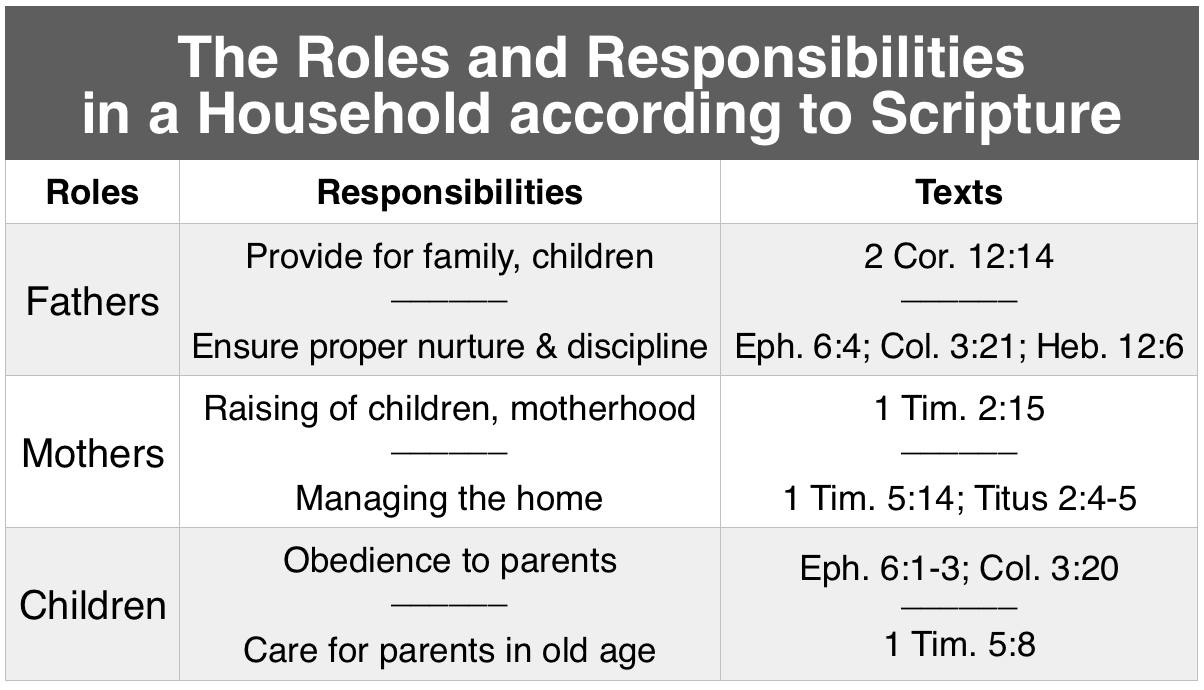
The way that Andreas Kostenberger says it, is that “Women are to place special priority on their God-given calling as mothers and homemakers.”[1] That, I agree, seems to be a biblical principle. Women are especially equipped for that task (even physiologically).
Priorities from the Bible
Next, it is important to consider priorities from a biblical perspective. We want our priorities to lineup with the priorities of Scripture. If they don’t we will have a problem with Scripture wherever it is at odds with our priorities. Our priorities, however, should be aligned with Scripture; we should not seek to align Scripture with our priorities.
Interestingly, “A 1982 Gallup poll showed that more than eight out of ten respondents (82 percent) assigned top priority… to the importance of family life. Families… rated as more important than the possession of material goods.”[2] Scripture agrees with what was the majority assessment in 1982 (see e.g. Deut. 11:19, 21; Ps. 127:3-5).
What, however, do we value?[3] Fortune or family?
Tacitcus, the Roman historian and politician writing around the same time as the Apostle Paul in A Dialogue on Oratory said,
“Our children are handed over at birth to some silly Greek servant maid… The parents themselves make no effort to train their little ones in goodness and self-control; they grow up in an atmosphere of laxity… they come to lose all sense of shame, and all respect for themselves and for other people.”
Tacitcus had a problem with that approach. And I think Christians should too.
We, however, haven’t answered our above question yet, but we’re getting there. But, it’s vital that we consider our motivation and priorities as we ask the question.



 in X
in X 