Awaking Relevance: Death?
How do we face the reality of death?
When I was seven I remember weeping with my mom and dad after hearing that my grandma died. I remember kissing her bodies’ cold dead lips at the open casket. I remember the hardness of her skin.
When I was 13 I remember hearing the news right before Thanksgiving that my best friend had been killed in a tragic hunting accident. I remember the silence. The shock and the pain. The questions. The emptiness. The deep sense that it was not right. It was not supposed to be like that.
When I was in my mid-20s I remember hearing that a dear friend that I had met with a few days before and encouraged to keep fighting against his drug addiction had committed suicide. I remember meeting with his family and sitting with them and crying alongside them. I remember his funeral and how his mother was late because she didn’t want to say bye. I remember his mom and girlfriend weeping at his casket and I remember helping them say their final goodbyes.
I remember hearing that my brother-in-law that taught me how to drive and meant so much to me died. His son found him in the kitchen after a massive heart attack. I remember getting a group text message three months later about one of my other brothers-in-law. I was on the campus of George Mason University and the world stopped. My brother-in-law who had been like a brother and father to me had died.
I remember a dear friend that was struggling with depression. I remember first hearing that he had lost the battle and had taken his own life. I remember deeply wrestling that week with what to say at his funeral.
I remember death. I remember the bitterness. I know it is a dark reality.
Death is coming for us all. One way or another. That’s the cold stark truth.
It is appointed for each person to die once.[1]
As Solomon, the great philosopher said, “The fate of the sons of men and the fate of beasts are the same. As one dies so dies the other.”[2]
My own dear wife, because of various health issues, has a shorter life expectancy than most people her age. However, even the concept of “life expectancy” admits the reality of death but seems to try to hide it. We will all die. It would be more accurate to talk about “death expectancy.” But it’s more palatable to say “life expectancy.”
The truth is though, that we should remember death, and remember death often, because we’re all gonna die. We are all terminal. We have the devastating condition known as mortality.
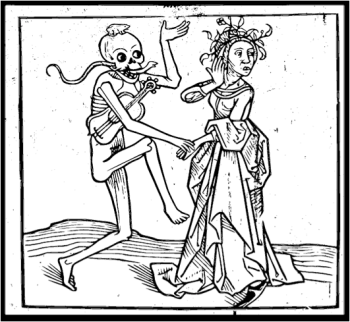
There was a time when danse macabre, or pictures of the “dance of the dead,” were common (see the picture below for an example). The purpose of these pictures “was to remind the viewer not only that death was always close to them and could strike at any moment, but that everyone was equal in the face of it.”[3]
History shows that “What we really need is wisdom for how to truly live and die well.”[4]
 When we live life in light of our coming death, we’ll be better positioned to live well. Death, however, is more distant from our minds than at any other point in history.[5] We try our best to ignore and silence the disturbing reality of our own mortality.[6] So, to the question: “How do we face the reality of death?” The answer is, at least in many cases: We try to avoid thinking about it.
Reality is what it is regardless of if we accept it or think about it. I believe that we are better positioned for life if we consider and live in light of reality.
There’s a local apple orchard where I live. Their cider is the best tasting liquid I think I’ve ever had. But their cider is seasonal. It’s not available year-round. So that reality means that I need to make the most of cider season. I need to cough up the money and enjoy the cider while I can. There will come a day when I won’t be able to enjoy the cider anymore. That reality has a very real impact on the beverage choices I make.
When we realize the reality of death—and not just cognitively with our heads—then it will make a difference in our lives. We will “buy the cider” and we will enjoy every drop. Death can give us profound enjoyment of life. When we grasp and meditate on the fact that death can snatch anyone away in an instant then we will realize that “life exists to be lived to the full, that every moment must be cherished as a gift, that you should make the most of the few years granted to you.”[7]
Death, strangely, can give us the gift of life; a full and fulfilling life.
“Our modern desire to keep death at a distance, to insulate ourselves from its shadowy presence, is a form of collective denial that diminishes our capacity to feel the fragility and fleetingness of our earthly being, and saps us of our life force.”[8]
That’s why we want to consider death here. We are different from animals. We can consider the concept of both life and death. We know that we will die, and that those near us, our loved ones, will die as well.[9] We would do well to take advantage of this ability.
Humans realize “loss is universal, not exceptional. It’s guaranteed, not unexpected. Every relationship is lost to time. So is every penny of everyone’s wealth, and ultimately so is every life. Loss isn’t surprising. It is basic to the course of every life.”[10]
When we consider the constant reality of the presence of death it helps us to see both how precious and precarious life is. If we don’t acknowledge the haunting reality of death, we are unlikely to truly prize life. Just as money is valuable because it is fleeting and limited so is life.
You might be thinking, “Why would we want to consider anything related to death?” First, it is important for me to challenge you to consider death because I don’t think you have a lot of people telling you to do that. And death is a lot more sanitized than it used to be. I’m not saying that’s a bad thing but the truth is “wakes,” “calling hours,” or “viewings” used to take place in homes and death was a lot easier to consider because it was harder to forget.[11] Now, however, it’s easy to put off thinking about death almost entirely.
But remembering death brings a needed perspective change to our lives.
The other day I was on the couch and my favorite baseball team, the Cleveland Indians, were on and I just wanted to chill and watch the game. But, my kids wanted to spend some quality time with me. They wanted to wrestle. So, I lay there for a little bit but then I remembered something… I remembered death. I remembered to think of things in light of death and so you know what I did? I got up and wrestled with my kids. It was great! I hurt my toe. But it was great!
If we remember death, it will absolutely have an impact on us.
Psalm 39 somewhat strangely says, “O LORD, make me know my end and what is the measure of my days; let me know how fleeting I am! Surely all mankind stands as a mere breath!”
This Psalm says, “let me know how fleeting I am.” As far as prayer requests go, this one is a strange one… Imagine some guy in the corner saying, “I really want you to pray that I would know the shortness of my life”? That’s a funny picture.
So, why would the person who wrote Psalm 39 ask God for that?
I think of my kids playing with bubbles in the front yard. They blow bubbles. Pop. Pop. Pop.
The Psalm says we are a mere breath.
Pop, pop, pop, and we’re gone.
We don’t know when, we don’t know how, but just like a bubble we will soon pass away.
When we realize that it changes the way we think, and it changes the way we live. That’s why the person that wrote Psalm 39 asked that they would know how fleeting they are.
“We must all die; we are like water spilled on the ground, which cannot be gathered up again.”[12] Death is the way of all the earth. And we are always but a step from it. “We must all die; we are like water spilled on the ground, which cannot be gathered up again.”[13] Death is the way of all the earth. Even the wise die. “The stupid and the senseless alike perish.”[14]
So, I’m telling us to remember death because we’re unlikely to. I’m telling us to remember death because we’re likely to think we’re the center of the universe, but death reminds us that we’re not.[15] I’m telling us to remember death because death helps us to put things in the right perspective and remember the things that really matter.
When we remember things it helps us chart the right course but when we forget even little things it causes us all sorts of problems. That is why “it is better to go to a funeral than a feast. For death is the destiny of every person, and the living should take this to heart.”[16] Therefore, remember death while you yet have life. Let the reality of death give you perspective and wisdom in life.
You may have an elaborate sandcastle, but the tide is rising. “Death has an unmatched ability to expose the flimsiness of the things we believe give substance to our lives.”[17] We are used to commanding our destiny. We make plans and we accomplish goals. But no one has authority over the day of death.[18]
When you’re on vacation and you have limited time, you ironically wear yourself out making the most of the time. You know the time’s limited so do you refuse to have fun? No! You capitalize on the time and make sure you spend good time with your family… That’s death for us.
Even though flowers wither in the autumn doesn’t mean we shouldn’t enjoy their beauty. If anything, it means we must enjoy their beauty while we can. It’s the same with the beauty of autumn. There’s a short window of time when the sky is ablaze with the color of the trees. That scarcity makes autumn all the more precious and beautiful.
The shortness of life should spur us on to make the most of life. Our time is short. So, we should consider how we should live and why?
What hope is there in the face of death?
The Christian Scriptures say a lot about our coming death. It says a lot about how we should prepare for it and live in light of its reality. Ecclesiastes tells us to enjoy life while we can (9:9-10). This makes sense when we are reminded how amazingly short our lives really are (see e.g. Job 14:2; Ps. 90:2-12; 103:14-17; James 4:13-16). And so, in light of the fleeting nature of life, we are told to “number our days that we may get a heart of wisdom” (Ps. 90:12).
The Christian Scripture points to death as confirmation that something has gone terribly wrong in the world. Thankfully, however, that’s not where Scripture leaves off. Scripture says that death is not the end. It is not the termination of all consciousness.
When Jesus’ close friend Lazarus died, Jesus wept (See Jn. 11:1-54). Jesus did not react with cold detachment. Jesus intimately cares. Jesus is heartbroken. One of the reasons He’s heartbroken is because death is not the way it was supposed to be. That’s partly why we’re repulsed by it.
The Bible teaches that God has no pleasure in death (Ezekiel 18:32; 33:11; 1 Timothy 2:4, 6; 2 Peter 3:9; Titus 2:11). And so He did something about it. He provided a way for people to be saved from death; the death the Bible says that was deserved.
Death is deserved because of sin. Just as a ticket is the wages of speeding, so death is the wages of sin. Just as speeding is dangerous and destructive so is sin. And so it’s taken seriously and punished to minimize its destructive impact.
So “death spread to all, because all sinned.”[19] Because of sin, no one can live and not see death.[20] “Judgment in Scripture,” however, “is anything but arbitrary or capricious… Most often, judgment is a matter of God leaving an individual or a society to the logic of their own settled choices.”[21]
Christ brought rescue from sin’s penalty but its presence remains until He returns. Soon death will be no more, the Christian Scripture teaches. But not until then. Yet, there is rescue from both the penalty and presence of death through Christ.
So, what hope does Christianity give in light of the grim reality of death? The Bible talks about resurrection. It talks about the resurrection of Jesus the Messiah and it talks about the eventual resurrection, to true and everlasting life, for all those who trust and follow Him.
Perhaps this is getting a little out there for you now. Too much like an episode of The X-Files or Stranger Things.
I’d encourage you to at least read on and check out the next post. Partly because I believe, as Matthew McCullough has said, “It is Resurrection or vanity.”[22]
Awaking Relevance Introduction

How should we live and why?
This is written for those who think church is bigoted and bad. It’s written for those who are bitter and done. It’s honestly specifically written for one of my friends. I want to awake them and you to the relevance of Christianity. Will you take some time to consider some important questions with me?
My question over all of this project is, does Jesus, who the Bible claims to be the Messiah, matter? We will not come at that question straight on. Instead, we will consider that question by asking other very important questions. Questions that are important but are often left unasked. Questions that close in on us and surround us and squeeze us. Questions that are there lurking.
Questions about death. About whether or not the world is enchanted. Questions about science and satisfaction. And morality and meaning.
You will answer these questions. We all have to. Will we, however, ask them? Will we think through them? Will we answer them honestly? And thoughtfully and thoroughly?
Socrates, the old and famous philosopher, is reported as saying, “The unexamined life is not worth living.” I personally think that Socrates exaggerated. I think life is worth living even if we don’t think about it. But, I do believe that it’s much better to live an examined life. And it’s much more honest and genuine too.
So, will you consider these questions? Will you ask them and find the real you? Will you find out what you really believe? Will you fight the façade and live the most honest and genuine life you can?
It’s better to consider these questions before it’s too late. To truly ask and answer: Does Jesus matter?—then to assume He does, if doesn’t. The opposite follows too. What if we assume Jesus doesn’t matter when He does? As the adage goes, if we ASSUME it makes an ASS out of U and ME. And as C.S. Lewis said, “Christianity, if false, is of no importance, and if true, of infinite importance, the only thing it cannot be is moderately important.”
If Jesus is not really God in flesh, as the Bible claims, then “what conceivable relevance may the teachings and lifestyle of a first-century male Jew have for us today, in a totally different cultural situation?”[1] So, does Messiah Jesus matter? Consider that question with me through the lens of these other questions. Perspective often allows us to see something we didn’t before. That’s our goal. To gain perspective so that we can come full cycle and be in a better place to ask the question “does Messiah Jesus matter?”
I’m sure it’s apparent to you at the outset, but I’m convinced He does matter. I believe He matters more than the oxygen in my lungs. I want to be totally honest with you. Also, something in the back of my head informing a lot of what I write is a verse from the Bible. It has been very meaningful and challenging to me. It says, “How long will you go limping between two different opinions, if the LORD is God, follow Him; but if Baal, then follow him.”[2]
I want you to be truly convinced one way or the other. To tweak Socrates’ wisdom: the unexamined life is not consistent.
I believe we should examine our convictions about what is true, right, good, and beautiful, and then seek to live consistently with our convictions in every area of our lives.[3]
A couple of years ago my family and I lived outside of Washington, DC. I was grabbing tacos with a friend at a really good local chain. I believed I was at the right place. it was the right taco chain after all. But my friend, who was not normally late, was not there. So I called him. He said he was sitting in the front of the restaurant and waiting for me. But I was there and sitting in the front and waiting for him. And he was nowhere to be found.
I believed I had the right spot, that’s why I was there. But I was wrong. I was at the right taco establishment but not the right location. So, you see, when we get little things wrong, even if we get a lot right, it can have a big impact. Even a devastating impact.
“Little, everyday decisions will either take you to the life you desire or to disaster by default… Stray off course by just two millimeters, and your trajectory changes; what seemed like a tiny, inconsequential decision then can become a mammoth miscalculation.”[4]
When we believe something, like the place we’re meeting a friend, it leads to a corresponding action: going there. We can think we’re right, and even have reasons for thinking we’re right, but still be wrong. Because beliefs inevitably impact our actions it’s important that we be reasonably sure our beliefs are correct.
Of course, my belief in the correctness of the taco joint location is less impactful than my belief about many other things. My point, however, is that even less meaningful beliefs have an impact so how much more beliefs about things that we deem of much higher importance?!
William Kingdon Clifford, the philosopher and mathematician in his essay “The Ethics of Belief” said, “It is wrong always, everywhere, and for anyone to believe anything upon insufficient evidence.”[5] Or, as the philosopher and English writer, G.K. Chesterton said, “An open mind is like an open mouth: useful only to close down on something solid.”
Our beliefs matter. They have an impact on our life and the lives of others. It is important that we consider what we believe and why. We’d be wise to remember, “It doesn’t matter how smart you are unless you stop and think.”[6]
We see this through social media. It’s easy to get duped by fake news. It’s too easy for people to take the bait and believe lies. It’s too easy for people to hype conspiracy theories.
We don’t want to be guilty of living the unexamined life. We don’t want to live a conspiracy theory. We don’t want to build our foundation on the equivalent of fake news. Fake news is no foundation.
If you’re like me, however, you have a built-in mechanism that is like a gag reflex to certain serious questions. I remember when my parents were separated as a kid before they got divorced. We had various “family meetings.” I remember my brother’s and I being the kings of diversion.
We were like the squirrel in the movie “Hoodwinked,” except our mission was distraction. We would wedge in any funny comment. Anything to lighten the mood. We didn’t want to hear and deal with the harsh realities in front of us.
I’m older now. Obviously. But sometimes my inner hyperactive squirrel wants to take over when I’m in a serious conversation. I want to run. I want to do anything to escape.
If it’s not my inner squirrel, sometimes it’s my inner lawyer that wants to come out and defend myself and throw the book at the other party. I don’t want to hear. I want to yell. I want to prove myself in the right.
The way of my inner squirrel and the way of my inner lawyer is not the way of wisdom. I need to listen. I need to learn.
I need to question some of my beliefs. I need to weigh them to see if I really have good reasons for holding them.
Distractions can be devastating. Want if I have a concern that I have cancer but I fear what that would mean. So, I just keep putting it off. I don’t deal with it. I don’t get checked out.
There can come a time when it’s too late. The damage has been done.
I challenge you to consider this question with me: How should we live and why? As well as the questions that accompany this important question. The philosopher Peter Kreeft said,
“If we are at all interested in the question of how to live (and if we are not, we are less than fully human and less than fully honest), then we too must… ask questions. They are inherent in the very structure of our existence.”
Thoughts and questions are important. They shape our destiny. As Samuel Smiles said,
As I alluded to, this series is called Awaking Relevance because I’d love to have you awake to the relevance of Jesus. I’d love for you to come away seeing that Messiah Jesus matters. I’d love for you to find that Jesus shows us a meaningful way to live as well as the motivation for doing so.
But, perhaps you’ll never agree that Jesus matters. Perhaps this will be a decisive death to the relevance of Jesus for you. Regardless, I think it makes sense to really weigh it out. After all, Jesus had and has a big following. He had an impact.
Should He have an impact on your life? That’s what will consider through various questions in the following posts. I hope you will join me. I hope you will examine your beliefs. I hope you will consider: How should we live and why?
Noah’s Ark and the Bible’s Narrative Arc
“…the whole earth was filled with violence. And God saw the earth, and behold, it was corrupt, for all flesh had corrupted their way on the earth” (Gen. 6:11b-12).
The story of Noah and his ark has always been a difficult story. Knowing the context of the story is helpful though.
So, what was going on before God destroys the world with a flood?
Well, just a few chapters earlier we see that God made an incredibly good and beautiful creation (see e.g. Gen. 1:31). We see God made people–all people–with dignity and worth (Gen. 1:26-27; 5:1-2). We see God gave people good things to do (Gen.1:28).
But, we also see, humans didn’t listen. We see that in the Fall of humanity (Gen. 3), the first murder (Gen. 4:8), and the growing corruption and violence (Gen. 6:5). In Genesis, we go from God and good creation to growing corruption very quickly (that’s also representational of my own tendency).
It was not God who “paved paradise and put up a parking lot.” That’s what humans had already done. Humans damaged and defiled the very thing that would have brought them endless delight. Humans turn from fresh fulfilling water to putrid puddles.
But, that’s not it. Humans also hate. They hate humans that were made with the dignity of God. They hate and they hurt. They abuse and injure. And even kill.
Before God destroyed the world in the flood, humans destroyed the world with their sin. In God’s act of destruction, He was actually bringing a type of deliverance. He could have, and in a sense considered, destroying the world completely (Gen. 6:6-7).[1]
Yet, God worked through Noah, a mediator (Gen. 6:8ff)[2], as He does, to bring salvation through judgment.[3] God provided a type of rescue when wrath was deserved.
Ultimately we know, the God-Man, Jesus Christ, took the wrath of God and the violence of the world on Himself. When we understand the whole context of the story of Noah’s ark, we see it is not God at fault. He is not the guilty party for the destruction of the world.
Instead, we see we are at fault. We carry out atrocities. We turn from God, where alone there is life, to trifles and trivialities. We hate humans, who have eternal value and being, and love things that perish in a moment.
When the story of Noah’s ark is understood in context, from the perspective of the whole of redemptive history, we see how amazing it is that the LORD is both just and the justifier of the one who trusts in Jesus alone for rescue (see Rom. 3:25-26).
10 Quotes from Jonathan Pennington’s book, Jesus the Great Philosopher

I appreciated Pennington’s book. He did a good job showing that “Christianity is more than a religion. It is a deeply sophisticated philosophy” (Jonathan T. Pennington, Jesus the Great Philosopher: Rediscovering the Wisdom Needed for the Good Life, 159).
Here are 10 quotes that stuck out to me:
“When we try to live without knowledge of physics and metaphysics—how the would is and how works—then we are foolish, not wise, living randomly, haphazardly, without direction or hope for security, happiness, or peace” (Pennington, Jesus the Great Philosopher, p. 23).
“The Bible is addressing precisely the same questions as traditional philosophy” (p. 53).
“The Old and New Testaments teach people to act in certain ways, knowing that cognitive and volitional choices not only reflect our emotions but also affect and educate them” (p. 120-21).
“Without intentional reflection, we will live our lives without direction and purpose. Or worse, we will live with misdirected and distorted goals” (p. 124).
“Relationships aren’t an add-on to life, they make up our life” (p. 134).
“Jesus himself emphasized that his kingdom is not of this world (John 18:36). This does not mean Christians are free to ignore this world, but instead it frees Christians to relate in a gracious and humble way, knowing their citizenship is ultimately something more and greater and different” (p. 166-67).
“The reason Jesus was so infuriating to both religious and government leaders was not because he was taking up arms and trying to overthrow governments but because his radical teachings were so subversive to society. Jesus was subversive because he sought to reform all sorts of relationships. In his teachings and actions, Jesus continually subverted fundamental values of both Jewish and Greco-Roman society” (p. 172).
“Christianity is a deeply intentional and practical philosophy of relationships” (p. 173).
“Unlike sitcom relationships, the reality is that our lives are broken through sin—the brokenness not only of sin that has corrupted creation itself but also of personal acts of evil, foolishness, and harm. Thus, the Christian philosophy’s vision for relationships within God’s kingdom is not naive or idealistic” (p. 181).
Back to Virtue by Peter Kreeft

I recently read Peter Kreeft’s book Back to Virtue. Kreeft is a Roman Catholic philosopher, theologian, apologist, and a prolific author. He is a professor of philosophy at Boston College and The King’s College.
Here are some quotes from Back to Virtue that stuck out to me:
“We control nature, but we cannot or will not control ourselves. Self-control is ‘out’ exactly when nature control is ‘in’, that is, exactly when self-control is most needed” (Peter Kreeft, Back to Virtue, 23).
“Nothing is so surely and quickly dated as the up-to-date” (Peter Kreeft, Back to Virtue, 63).
“It is hard to be totally courageous without hope in Heaven. Why risk your life if there is no hope in Heaven. Why risk your life if there is no hope that your story ends in anything other than worms and decay” (Kreeft, Back to Virtue, 72).
“The only way to ‘the imitation of Christ’ is the incorporation into Christ” (Ibid., 84).
“There are only two kinds of people: fools, who think they are wise, and the wise, who know they are fools” (Ibid., 99).
“Humility is thinking less about yourself, not thinking less of yourself” (Ibid., 100).
“God has more power in one breath of his spirit than all the winds of war, all the nuclear bombs, all the energy of all the suns in all the galaxies, all the fury of Hell itself” (Ibid., 105).
“We can possess only what is less than ourselves, things, objects… We are possessed by what is greater than ourselves—God and his attributes, Truth, Goodness, Beauty. This alone can make us happy, can satisfy the restless heart, can fill the infinite, God-shaped hole at the center of our being” (Ibid., 112).
“The beatitude does not say merely: ‘Blessed are the peace-lovers,’ but something rarer: ‘Blessed are the peacemakers’” (Ibid., 146).
“There is only one thing that never gets boring: God… Modern man has… sorrow about God, because God is dead to him. He is the cosmic orphan. Nothing can take the place of his dead Father; all idols fail, and bore” (Ibid., 157).
“God’s single solution to all our problems is Jesus Christ” (Ibid., 172).
“An absolute being, an absolute motive, and an absolute hope can alone generate an absolute passion. God, love and Heaven are the three greatest sources of passion possible” (Ibid., 192).
Justice and the Just One

I was considering the word and concept of justice today so I looked up the definition of “justice.” The search returned a few definitions that stuck to me: “moral rightness,” “the quality of being just,” and “moral principle determining just conduct.” To understand or seek justice then, we need to have an idea of what it means to be “just” or “moral.” We have to have a “moral principle” whereby we can measure “just conduct.”
In America today we have calls for justice. Justice is right and good. Christians especially are called to do justice and love mercy (Micah 6:8). Do the majority of Americans, however, know what “moral principle” we are basing our measurements of “just conduct” on? Do most Americans believe that there is a “moral principle” that guides us? If so, can most Americans articulate where our “moral principle” comes from?
It seems to me if the foundation for “moral principle” has eroded then justice does not have a foundation upon which to stand. Thus, I say this not because I am not for justice, I say this because I am for justice.
Perhaps with our calls for justice in America, we should also consider the foundation of justice: moral principle. Perhaps we should consider if justice can have a steady place on which to perch.
Perhaps we should also hear calls to return to moral principle and the bedrock of truth. Without truth, calls for justice ring empty.
I believe there is a basis for justice. Because I believe there is truth.
Jesus Himself actually said, “I am the way, the truth, and the life” (John 14:6). Jesus is truth made tangible. He lived and walked justice. He is in reality what everyone should be and live.
I believe in justice and that we have a “moral principle determining just conduct” because the LORD has given it to us. Because He is righteous and “He loves righteous deeds” (Psalm 11:7) and “hates the wicked and the one who loves violence” (Psalm 11:5).
“O LORD, you hear the desire of the afflicted; You will strengthen their heart; You will incline your ear to do justice to the fatherless and the oppressed, so that man who is of the earth may strike terror no more.”(Psalm 10:17-18).
Why do Black Lives & LGBTQ+ Lives Matter?

Why do black lives and LGBTQ+ lives matter? This is an important question because some people have views that don’t support the idea of lives mattering. For example, Charles Darwin, the most famous proponent of evolution titled his book, On the Origin of Species by Means of Natural Selection, or the Preservation of Favored Races in the Struggle of Life. And in his book, The Decent of Man, he says,
“The Western nations of Europe… now so immeasurably surpass their former savage progenitors [that they] stand at the summit of civilization…. The civilized races of man will almost certainly exterminate and replace the savage races through the world.”
Does a strict Darwinian view of the world lead to all lives mattering? It does not appear so. That’s why this question is important. Why do black lives and LGTBQ+ lives matter?
If we cut off our objective moral legs, we have no way to stand. If we say morality doesn’t matter, then it doesn’t matter. We can’t pick and choose. We can’t both say people are the way they are and have the desires they have and it’s fine and say it’s not okay for people to be certain ways and do certain things. That’s the crucial thing we need to consider.
Black lives matter. LGBTQ+ lives matter. White lives matter. Yes, yes, yes, and yes. But why?
That is a super important question and one that sadly isn’t receiving a lot of sustained thought. Why do black lives matter? Why do lives matter at all? Where do we get this concept? Is it true?
Jesus said, black lives matter.[1] Jesus said, LGBTQ+ lives matter. Jesus said, all lives matter.
“You shall love your neighbor as yourself” (Matthew 22:37-38).
But does Jesus matter? And if He doesn’t on what basis then are we saying all these lives matter? This may seem like a stupid question. We just know all types of lives matter, right? But do we?
The common view that many have is Darwinian evolution, that we came from nothing and we are going to nothing; from purposelessness to purposelessness. Where is meaning, morality, and lives mattering to be found?[2] Is there a basis for human rights?
Also, did the Roman culture, in whose hands Jesus was murdered say, all lives matter?[3] Did Joseph Stalin say all lives matter? Did Friedrich Nietzsche? Did Adolf Hitler? Did Mao Zedong? Is it even possible to say all lives matter or any lives matter when the highest maximum is have it your way and do what’s right for you? Could it be that “just as long as no one gets hurt” has been trampled upon and obliterated by “you can do whatever you want”?  If God is dead, and we killed him, as Nietzsche said, what follows? Perhaps Nietzsche was right, perhaps that makes all things permissible? Each person doing what is right in their own eyes, whatever that might be. Who is anyone, who or what is God, to restrain? …We are who we are and we want what we want and that’s nobodies business, right?
How or where, then, do we get the concept of lives, any lives, ultimately mattering? The concept of lives mattering would be merely imaginary (a social construct). Perhaps good for America right now but not for all people at all times and places.
We can’t deconstruct everything and still have a basis which to say lives matter or to say that we must love others. We can’t both say we can do whatever we want and you can’t do certain things (like be racist or homophobic).
C.S. Lewis on Scientism in Out of the Silent Planet

Have you ever heard of C.S. Lewis’ book series, The Chronicles of Narnia? It’s good. But, Lewis’ Ransom Trilogy is even better. And one of the reasons for that is because he confronts scientism.
Scientism
Scientism exalts the natural sciences as the only fruitful means of investigation. In the words of Wikipedia: “Scientism is the promotion of science as the best or only objective means by which society should determine normative and epistemological values.” In short, scientism is the view that says science, and science alone, tells us what is right and true.
Science, of course, is different. It is the study of the natural world through systematic study (observation, measurement, testing, and adjustment of hypotheses). Scientism goes beyond science and beyond the observation of the physical world into philosophy and ethics.
How can observations about the natural world tell us how to think and live? How can science tell us how to best do science? What can be said about the problems of scientism? C.S. Lewis gives us a few things to think about, and in a very enjoyable way.
Out of the Silent Planet on Scientism
Weston, one of the main characters in C.S. Lewis’ book, Out of the Silent Planet, holds to a form of scientism and belittles other ways of acquiring knowledge. Unscientific people, Weston says, “repeat words that don’t mean anything”[1] and so Weston refers to philology as “unscientific tomfoolery.” The “classics and history” are “trash education.”[2] He also says that Ransom’s “philosophy of life” is “insufferably narrow.”[3]
When science is the sole means of knowledge then we are left without theology, philosophy, and ethics. We are left to decipher ought from is. And it can’t be done. Or not in a way that prevents crimes against humanity. “Intrinsically, an injury, an oppression, and exploitation, an annihilation,” Nietzsche says, cannot be wrong “inasmuch as life is essentially (that is, in its cardinal functions) something which functions by injuring, oppressing, exploiting, and annihilating, and is absolutely inconceivable without such a character.”[4]
Weston concurs. He is ready and willing to wipe out a whole planet of beings. He says, “Your tribal life with its stone-age weapons and bee-hive huts, its primitive coracles and elementary social structure, has nothing to compare with our civilization—with our science, medicine and law, our armies, our architecture, our commerce, and our transport system… Our right to supersede you is the right of the higher over the lower.”[5]
It is about life. Looking at life, looking at survival alone, leads us to think that alone is the goal. My life versus your life, Weston’s life versus the Malacandrian lives. That’s what we get when we derive ought from is. “Life is greater than any system of morality; her claims are absolute.”[6] And so, if it would be necessary, Weston would “kill everyone” on Malacandra if he needed to and on other worlds too.[7] Again, Weston finds agreement in Nietzsche: “‘Exploitation’ does not belong to a depraved, or imperfect and primitive society: it belongs to the nature of the living being as a primary organic function.”[8]
Conclusion
Is Weston’s view correct? No. And we know it. That is the point C.S. Lewis makes. He offers a narrative critique of scientism in Out of the Silent Planet as well as through the whole Ransom Trilogy. He shows the havoc that scientism sheared of theology, philosophy, and ethics can unleash.
The answer is not to discard science, however. That is not what Lewis proposes either, though that is what some protest. The answer is to disregard scientism. Science is great and a blessing from God, but science on its own is not enough as our guide. We cannot, for example, derive ought from is. We cannot look at the natural world around us, at what is, and find out what we should do, how we ought to live.
Notes
____
[1] C.S. Lewis, Out of the Silent Planet (New York: Scribner Paperback Fiction, 1996), 25.
[2] Lewis, Out of the Silent Planet 27.
[3] Ibid.
[4] Friedrich Nietzsche, The Genealogy of Morals.
[5] Lewis, Out of the Silent Planet, 135.
[6] Ibid., 136.
[7] Ibid., 137.
[8] Friedrich Nietzsche, Beyond God and Evil, par. 259.
C. S. Lewis on Longing

Introduction
You can trace the theme of longing through most of Lewis’ writings. In some places, it is explicit in other places it is implicit. For example, Perelandra does not so much make an argument as much as make you desire and long to experience something of what Lewis wrote. When reading some of Lewis, we often find ourselves hoping what he writes about is true. Lewis’ argument is not really cognitive and logical as much as it is “kardialogical,” that is, reasoned from the heart. As Blaise Pascal said, “The heart has its reasons, which reason does not know.”[1]
It is also important here to look at what Lewis meant by longing or desire. Lewis himself said, “From the age of six, romantic longing—Sehnsucht—had played an unusually central part in my experience.”[2] Sehnsucht is a German term that communicates the longing that all of humanity has. It means “longing,” “yearning,” or “craving.” It is a way of saying, “something is intensely missing, there must be more.” Joe Puckett defines Sehnsucht this way:
The aching, and yet pleasurable, intense longing for a life that we cannot yet have but naturally and universally crave. It is the feeling of having lost something that we once had—giving us a sense of homesickness and discontentment with the less-than-ideal world we currently find ourselves in.[3]
Lewis was specially equipped to discuss longing since from a very young age he had experienced such longing and had the ability to write about it with apologetic force in both narrative and essay form. My thesis is that Lewis is correct, our longing does point us beyond this world. Our longing ultimately points us to the Lord and His coming Kingdom.



 in X
in X 