The Task of a Teacher of God’s Word

1.Serious Trust
If the teacher of God’s word does not trust God’s word and trust that it will accomplish what God wants it to accomplish (Is. 55:10-11) they will struggle in their task. And may not be fit for their task. If the teacher does not trust God’s word to be God’s word they are unlikely to teach very well for very long.
So, serious trust in God’s word is foundational.
2.Strenuous Commitment
In Acts 6 we see there were a lot of important distractions for those who were tasked to preach the good news of Jesus. There were lots of important needs that were dear to their hearts and dear to God’s heart. And yet they resolved to devote themselves “to prayer and to the ministry of the word” (v. 4). They knew it was not right for them to be distracted from “preaching the word of God” (v. 2).
In fact, they were so committed to preaching about the glory and goodness of God as seen in Christ, that even when threatened with beatings and imprisonment they continued. They rejoiced that they were worthy to suffer for the Savior and they continued teaching and preaching Jesus as the Christ (Acts 5:41-42).
3.Studious Study
Ezra is an important model for every pastor and minister of the word. And really every Christian. Every Christian, in one way or another, should study the word of God, do it, and teach it (Ezra 7:10). It’s probably good to do it in that order too.
The teacher “must hold firm to the trustworthy word as taught, so that he may be able to give instruction in sound doctrine and also to rebuke those who contradict it” (Titus 1:9). And that requires studious study.
“There is no long-range effective teaching of the Bible that is not accompanied by long hours of ongoing study of the Bible.”[1]
4.Self-Application
A teacher could “understand all mysterious and all knowledge” yet if they have not love it is worth nothing (1 Cor. 13:2-3). Self-application is essential. James even tells us “Not many of you should become teachers, my fellow believers, because you know that we who teach will be judged more strictly” (3:1).
As we saw with Ezra, he did not just study God’s word, or just teach God’s word, he himself did God’s word. He applied it and lived it himself. That is vital.
It’s actually a qualification for Christian leaders. They are to be above reproach. They are to apply Scripture first to themselves. They are to not be hypocrites.
5.Solid Teaching
There is a place of course to adapt the message to the audience. Jesus and Paul themselves did that. That is good. Yet, we also want to give meat, even if we have to cut it up nicely and make it bite-size. Our desire should be solid teaching, not trivial trifles (see Heb. 5:12; 1 Cor. 3:2).
There is a time to give milk and not solid food. Babies need milk because they cannot yet take solid food. They, however, would be stunned if they had to stay with mere milk. So, solid sermons are essential.
It is important to read from the Bible clearly and explain it so that people understood what’s being read (see Neh. 8:8 cf. 1 Tim. 4:13; Mal. 2:7). That’s what expository preaching is. It exposes and reveals the meaning of the passage. That is why pastors must be “able to teach” (1 Tim. 3:1).
6.Specific Application
Scripture has the power to “cut to the heart” (Acts 2:37). So, Scripture should be wielded with careful and intentional precision. It is “sharper than any two-edged sword” and pieces to the depths of our hearts (Heb. 4:12).
Scripture should be applied specifically and carefully. Scripture should call to action but not legalistic action. Saints should be equipped for the work of ministry (Eph. 4:11-12) but it should be through the truth spoken in love (Eph. 4:15).
So, the teacher of God’s word must “preach the word; be ready in season and out of season; reprove, rebuke, and exhort, with complete patience and teaching” (2 Tim. 4:1-2). That is a high and challenging calling.
7.Show Christ
When we preach or teach we are not to use “eloquent wisdom” to make much of ourselves but we “preach Christ and Him crucified” (1 Cor. 1:17; 2:2). It is not us we proclaim. It is Him we proclaim (Col. 1:28).
We show Christ from every passage, Old and New Testament, knowing Scripture is about Him (Jn. 5:39) and every promise finds its “yes” in Him (2 Cor. 1:20).
8.Share the Gospel
Sharing the gospel is needed all of the time, for believers and unbelievers. We all need to be reminded of the best news there is. The Apostle Paul wrote Romans and Ephesians to Christians and yet he didn’t assume the gospel. He expounded on it and applied it.
Believers and unbelievers need the gospel. So we must share the gospel (Matt. 10:6-7; Lk. 25:45-49; Rom. 10:14-17).
___
[1] D.A. Carson, For the Love of God vol. 2, January 7.
*Photo by Carolyn V
What if Satan wants to destroy the Church more than the country?

In the book of Revelation the Church is not called to react to the End or the antichrist by moralistic, militaristic, or political means. The Church is called to return to Messiah Jesus, remembering that those who continue faithful to the End will receive the “crown of life.” The way of resistance of evil, is the way of Christ. That is, loving Christ Jesus, and loving others. Taking up our crosses and following Jesus and loving others, even when it hurts, is a sure sign that we don’t and won’t have the “mark of the beast.”
What if the clearest mark of the beast is the mark of hatred and hostility? Many have thought it stood for Nero (the numerical value of 666), and perhaps it did in a way. He was, as history showed, marked by the beast. He was, as history showed, like his father the devil. He was proud and unloving, destructive and devilish.
Is not the mark of the Messiah, the mark of beatific love?1 Do not His followers, follow Him? If Jesus is love, should not His followers be loving?!2
“Love is patient, love is kind. It does not envy, it does not boast, it is not proud. It does not dishonor others, it is not self-seeking, it is not easily angered, it keeps no record of wrongs. Love does not delight in evil but rejoices with the truth. It always protects, always trusts, always hopes, always perseveres” (Corinthians 13:4-7).
And would it not make sense that the converse also follows? If the mark of the Messiah is true sacrificial love, is not the mark of the antichrist hatred? And what if the serpent of old, the father of lies, the great deceiver, is adept at what he does? And what if he wants to destroy and divide even what Messiah Jesus died to bring together? And what if he even uses the means of media and the marketplace and various views on certain medical opinions regarding COVID-19? What if?…
And what if the worst thing that can happen to Christians is not that they’d lose earthly freedom(s), but that they’d lose heavenly crowns? not that their earthly country would be divided, but that their heavenly one would be? not that they’d have to wear a mask, but that they’d have a mask put over their eyes? What if Satan’s not primarily trying to destroy a country, but what if he desires to destroy Christians and Christian witness? What if Satan doesn’t want the nation to descend into debauchery, but wants Christians to be desensitized to their hatred and fear?
Revelation also talks a lot about Babylon. Babylon was what a lot of people cared about and had their hopes fixed on. However, Christians, are marked by and are members of a different city. Christians have their hope wrapped up in a city, but it’s a different city, a city that comes down from heaven, a city that couldn’t be built here. It’s beyond and better than here.
Christians live, labor, and love in Babylon, but they’re waiting for something better. They’re waiting for Jerusalem to come down.
Christian brothers and sisters, are you showing the mark of your Savior? The characteristics of Christ? The mark of your true city? Or, are you too wrapped up here? Are you betting on Babylon3 or are you “looking forward to the city with foundations, whose architect and builder is God”?!
We, as Christians, are sojourners here in Babylon. Our time is short. Let’s be a blessing as Scripture exhorts us (Jeremiah 29:7). But, let’s remember, any castle we build with our hoarded cash, will soon wash away with the tide of time. Let’s not lay up hoards here or place our hope here. But in heaven.
1 Ephesians 1:13 tells us that all who are in Messiah Jesus have been sealed (or marked?!) with the promised Holy Spirit. Notice also that it is the Holy Spirit in Jesus followers who produces the fruits of the Spirit, one of those fruits being love.
2 God alone provides access to the Garden of Eden and the pathway there is through the Golgotha of sacrificial love.
3 If politics has you overly down, perhaps it’s because you placed your hope in a ship that must inevitably sink.
How to Evaluate Christian Leaders?

Recently, I’ve seen a lot of Christian leaders be criticized or criticize, and even call other Christian leaders names because of disagreement on such things as politics, the pandemic, and policies regarding justice. And not surprisingly, those who are not leaders are also jumping into the fray and lobbing grenades too.
How many people, however, actually think through the appropriate way to evaluate Christian leaders? And how many people know what reasons Scripture gives for concern? How many Christians have a sort of theological triage they use to evaluate and make these important decisions?
There are doctrines of “prime importance and great weight” that we must insist on.[1] “There is a time to fight. There are certain hills that must not be surrendered, even if the cost is losing our lives.”[2] Some of the hills that we must be willing to die on are the deity, life, death, resurrection, and Second Coming of the Lord Messiah Jesus.
Other doctrines, beliefs, and convictions are, or should be, a little further down the list of importance. Just as a doctor would jump to help the patient with a gunshot wound to the chest before she would help someone with a broken pinky finger. It is not that the pinky finger is not important; it is that the gunshot wound is more important and dire.
So, let’s look at some biblical criteria by which to evaluate Christian leaders. It should be understood that these criteria do not have the same weight. The criteria of “Christology,” for example, should be given more weight of importance than “Clarity.”
1. Christology (& sound doctrine)
Christian leaders have the duty to communicate God’s transforming truth, exalt Jesus Christ, teach the Bible so that people understand and apply what God has said, and encourage conformity to Christ (see e.g. Neh. 8:7-8; 1 Tim. 3:2). Faithfulness to the revelation of God and preaching Christ are paramount (Col. 1:28). If the word of God and Jesus the Messiah are not being preached then you have reason for concern.
If false or unhealthy things are said or taught about God, His word, or Jesus the Messiah then you have great reason for concern and should share your concern and likely leave that individual’s leadership. It is important that we are aware that leaders sometimes don’t preach the truth. Peter told us that there will be false teachers among us, who will secretly bring in destructive heresies, even denying the Master who bought us (2 Pet. 2:1).
“If anyone teaches a different doctrine and does not agree with the sound words of our Lord Jesus Christ and the teaching that accords with godliness, he is puffed up with conceit and understands nothing. He has an unhealthy craving for controversy and for quarrels about words, which produce envy, dissension, slander, evil suspicions” (1 Tim. 6:3-4).
So, in evaluating a Christian leader, ask yourself:
- “Does this person preach/teach true, healthy doctrine? Does this person preach/teach the goodness and glory of Messiah Jesus?”
Don’t ask:
- “Do I like the style etc. of the person?”
See also: Deut. 13:1-5; 1 Jn. 4:1-3; 1 Cor. 12:3; Col. 1:28; 2:8 2 Thess. 2:15; 1 Tim. 1:10; 2 Tim. 1:13; 4:3; Titus 1:9, 13.
2. Character
The leaders own life should be in order. That is, the leader should have Christ-like character. Leaders and teachers can “profess to know God” and yet “deny Him by their works” (Titus 1:16). That’s partly why it’s so important that Christian leaders meet the biblical qualifications (1 Tim. 3:1-13; Titus 1:1-9).
Disagreement Over Doctrine

Doctrine matters. Doctrine can cause delight or be very damaging. And sadly, false doctrine is more common than many people realize.
It’s not just me that says deception and damaging doctrine is prevalent though. That’s what Scripture says (see Matt. 24:11, 24; Mk. 13:22; Acts 28:31). False teaching is not a small concern. There is false teaching that is the doctrine of demons (1 Tim. 4:1). Remember, as Ephesians 6:12 says, we are at war not with humans but with unseen spiritual powers. This is serious. Paul says this will happen in “later times.” That’s where we are now. We are in the last days, the days in between the Ascension and the Return of Jesus Christ.
It’s helpful here, however, to consider that not everything we disagree with is the “doctrine of demons.” So, it helpful for us to consider “theological triage.” There are some teachings that are especially connected to the good news of Jesus Christ and there are other things that are further down the list of importance.

There are some things that are absolutes, like the deity and full humanity of Jesus Christ, the Trinity, and the authority of Scripture. There are, however, things that are less critical when it comes to theological triage. For example, what we believe about the end times is not as critical as what we believe about Jesus and how people are saved.
Read More…Living as Canceled Christians

It happened to the elect exiles to whom Peter wrote (here’s a brief overview). Our voice can vanish too. We are not immune. We can be canceled.
But are we ready? Can we stand in the storm or will our house be blown to smithereens? Will it crumble on the sand that it is laid or is it’s foundation deep and solid? Will our life vanish and wither? Where is our source of life?
Soon these questions will meet their answer. We will see the truth with our eyes. Soon we will see our faith—or lack thereof—with sight. Soon the gold, or dross, will be revealed. Soon we will see what our treasure truly is.
Yet, even the scorching brutality of heat can be a blessing of bounty and beauty when it’s sustained by the water of the Spirit. And from the sand, we can find a foundation when from the Word we mix our mortar and ever rely upon the unshifting rock of Christ. It’s when the wind blows that the flag is most clearly waved if it’s tightly tethered. Yes, we can stand and standout if we ever lean on the Savior and not the many would-be-saviors that can’t deliver.
So, will the steep decline of morality make us fall or will we cling tighter to our Master? Notice we must cling to our Messiah and not to morality itself. The law is a stone that crushes and upon which our feet slip. Christ is a sure and steady cornerstone.
If we as canceled Christians are going to make it and obtain the outcome of our faith, the salvation of our souls (1 Peter 1:9) and the inheritance that is “imperishable, undefiled, unfading, and kept in heaven for us” (1 Peter 1:4) then we must set our hope fully on the grace and abundant goodness that will be brought to us at the coming of Messiah Jesus (1 Peter 1:13). We must set our hope on and think often of heaven, and not obsess over making heaven here. Here there is no home, only longing. Only a damp, humid, and stinky tent. Our home is being prepared for us. We are campers.
So, let’s live as campers and let’s long for our true home and for the true bed in which we can finally really rest. We as canceled Christians can flourish if we live like the campers we are.
A reader of this post thought it was gobbledygook. Here’s my response.
The Work of the Spirit | pt. 10
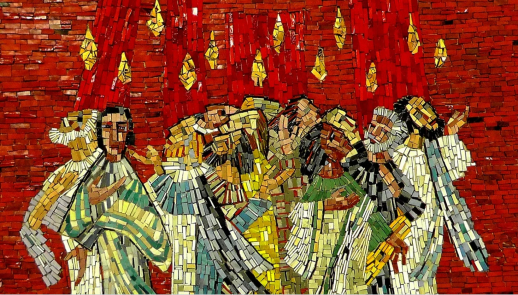
Tongues
Tongues are used in a few overlapping ways in Scripture and should be pursued and practiced as outlined in the Bible. Scripture shows us that the problem is not tongues but the abuse of the gift of tongues.[1] I think it should be admitted that even if we do not completely understand the gift of tongues we should not forbid their practice in private or publically when interpreted (1 Cor 14:27-28) because Paul explicitly says “do not forbid speaking in tongues” (v. 39).
Paul actually tells people to be ready to share a tongue (1 Cor 14:26) and he says, “I want you all to speak in tongues” (v. 5). Further, Paul tells us that he spoke in tongues more than all the Corinthians (v. 18).[2] Paul said all of this even though “one who speaks in a tongue speaks not to men but to God; for no one understands him, but he utters mysteries in the Spirit” (v. 2). Therefore, even though tongues are unintelligible to the human mind unless one is given the gift of interpretation (12:10), to speak in tongues is not wrong or bad (see 14:39); although, it should not be done publicly unless there is an interpreter (v. 28).
Many believe that tongues simply refer to a foreign human language (e.g. Ferguson, MacArthur).[3] Michael Horton says, “We should… understand ‘tongues’ as synonymous with natural languages, which some were miraculously gifted to speak and others to interpret.”[4] This understanding of tongues is simplistic and wrong for at least three reasons. (1) Tongues are used to speak to God. Paul says, the “one who speaks in a tongue speaks not to men but to God; for no one understands him, but he utters mysteries in the Spirit” (v. 2). In this way tongues, at least the way tongues are used here, may be similar to the groans that Romans speaks of (Rom 8:26-27). (2) If tongues are interpreted they seem to function in a similar way as prophecy thus they are different than a foreign speaker coming into a meeting that needs to be interpreted. (3) Paul says there are different types of tongues (1 Cor 12:10, 28). It seems that tongues (glossia) are used in overlapping ways in Scripture. R. P. Spittler points out that in Scripture we see that tongues refer to three types of overlapping phenomena. He says,
‘Kinds of tongues’ (génê glôssôn, 1 Cor. 12:10, 28) can refer to anything on a glossolalic continuum ranging from (1) prayer ‘with groans that words cannot express’ (Rom. 8:26, NIV; preferable to RSV ‘sighs too deep for words’), through (2) tongues speech in a controlled ecstatic jargon that ‘no one understands’ by someone who ‘utterers mysteries to God’ (1 Cor. 14:2), to (3) charismatic use of a recognizable language never learned by the speaker (Acts 2:8).[5]
Regarding tongues, it must also be pointed out that though tongues are good gifts that are given by the Spirit, tongues are not the marker of maturity. Further, tongues are not linked to a “second blessing” or to being filled with the Spirit.[6] Lastly, it must be understood that even if we do not understand something in Scripture does not mean it is wrong or that it does not continue. I, for example, do not understand, the seraphim. But I believe in them. In the same way, just because we may not understand every aspect of tongues does not mean that tongues do not still or cannot function as a blessing to the Church.
Here is a summary of what 1 Corinthians says regarding the gifts of tongues:
(1) There seem to be various kinds of tongues (1 Cor 12:10. 28 cf. 13:1; Acts 2:4).
(2) Tongues are unintelligible and unedifying to the group (1 Cor. 14:2-4, 6, 19) but are edifying to the speaker (v. 4).
(3) Tongues are not a foreign langue but are addressed to God (at least this is the case in 1 Corinthians) (vv. 2, 14-17).
(4) Tongues are not to be shared publically unless interpreted (1 Cor 14:6, 13, 26-33 cf. Acts 19:6).
(5) Tongues themselves are not forbidden but actually encouraged (1 Cor 14:5, 26).
(6) The regulations of tongues show that the tongues speaker is not in “ecstasy” or “out of control” (vv. 27-28).[7]
The Work of the Spirit | pt. 8
Prophecy
The ministry of a prophet does not contradict or add to Scripture but if truly from God is infallible. This is very controversial but it seems to be the correct conclusion when we unbiasedly consider the biblical evidence. It is helpful here to consider what Sam Storms has said, “If noncanonical revelation was not a threat to the ultimate authority of Scripture in its emerging from, neither should it pose a threat to Scripture in its final form.”[1] Many, however, do not buy that.
For example, John MacArthur says, “extrabiblical revelation always leads to error!”[2] Then he proceeds to look at cults and mentions the Book of Mormon as an example. It is true that there are many false claims to revelation but that in itself does not mean that there is not still revelation. If we truly believe in solo Scriptura we need to show where the Bible says there is no longer revelation.
Schreiner, in his helpful book Spiritual Gifts, argues that prophecy no longer continues because the prophecy in the New Testament was infallible and what is happening now is not infallible.[3] He never demonstrates, however, that all of what is called “prophecy” today is not at least in some cases from God and thus infallible. Further, this is not an argument grounded in Scripture. Instead, Schreiner is simply making an assertion about all modern claims to prophecy.[4] That, we should see, is a big sweeping claim.
I believe Schreiner actually helps the case for the continuance of prophecy because he makes a strong argument that not all prophecy is inscripturated. That is a big part of what I believe regarding prophecy. I believe infallible prophecy continues today but just like in the Old and New Testaments, not all infallible prophecy is included within the canon.
Schreiner shows that New Testament prophecy does not differ from Old Testament prophecy.[5] He says,
New Testament prophets spoke authoritatively and with complete truth to the situations in their churches. The fact that most prophecies weren’t written down and preserved is completely irrelevant as far as the truth of the prophecies is concerned. It is a category mistake to think that if prophecies are without error, then they must be written down and included in the Scriptures. And it doesn’t logically follow that prophecies must contain errors if they aren’t preserved and written down. God spoke authoritatively and truly through the prophets, even if their prophecies weren’t recorded and preserved. They spoke the infallible word of God to their contemporaries, who needed to hear these true and authoritative words of God.[6]
Further, in chapter 7, Schreiner makes a convincing case for infallible prophecy. He argues that “the idea that New Testament prophecies are mixed with error is mistaken.”[7]
I believe that what the prophets of today share is similar to what Agabus shared. Of course, some claim that Agabus’ prophecy in Acts 11 was wrong. They, however, are mistaken.[8] Ferguson concludes, “Paul’s testimony assumes its accuracy. We have no reason to believe that Agabus’ prophecy failed. Luke gives no indication that Paul thought it had done so.”[9]
Prophecy is never produced by human will[10]; instead, the person with the prophecy speaks what God gives them to say by the Spirit (2 Pet 1:20-21).[11] Thus, prophecy is infallible because prophecy gives the words of God and God always speaks the truth (Titus. 1:2; John 17:3,17; Heb 6:18; Prov 30:5).[12] Of course, we can misunderstand or disobey but God’s words are always without error.
So we see prophecy in the New Testament was both accurate and highly significant for the actions of the church[13] but it was not on par with Scripture in the sense that it was not to be inscripturated.[14] It is not the type of revelation to be inscripturated. It is not didactic revelatory teaching but pertains to the local body or a local situation. As in disclosing someone’s heart (as in the Spurgeon’s real-life example[15]) and that encourages the local body because they see the Lord at work. It is not something that would add to the canon.
The Work of the Spirit | pt. 7
The Gifts Must Function in Accordance with Scripture
When the gifts of the Spirit are carried out and employed within the parameters of Scripture then a lot of the concerns that cessationists have should be able to be set aside. So, first, let us consider some of the parameters that Scripture puts in place for us. The gifts must function in a way that serves others (1 Pet 4:10-11), edifies (1 Cor 14:3, 12), is clear and ordered, not confusing or chaotic (14:23, 29, 33, 40), is loving (1 Cor. 13),[1] and exalts Christ (Eph 3:21; 1 Cor 12:3).[2]
Scripture further says that tongues must be interpreted if they are shared in the gathering (1 Cor 14:27-28), prophecy must be weighed (v. 29 cf. 1 John 4:1; John 7:24), only two or at most three prophecies or tongues can be shared at a public gathering (1 Cor 14:27-29), and all things should be carried out in an orderly way (vv. 30-33, 40) for the express and emphatic purpose of building up the body of Christ (e.g. v. 12). Paul says, “When you come together, each one has a hymn, a lesson, a revelation, a tongue, or an interpretation” (v. 26). Why? “For building up” (v. 26). Thus, Paul tells us to “earnestly desire” (12:31; 14:1, 39) the Spirit-empowered gifts and “strive to excel in building up the church” (14:12).
Second, let’s ensure we have a biblical understanding regarding the more controversial issues related to the gifts of the Spirit. I created an acronym to help us consider this subject more effectively. The acronym is G.I.F.T.S. Here is a summary of the acronym:
- God continues to give gifts to build up the church.
- Individuals with the gift of prophecy do not contradict or add to Scripture but if what they share is truly from God then it is infallible.
- Fallible apostles still exist and are gifted men of God but the office of Apostle does not continue.
- Tongues are used in two overlapping ways in Scripture and should be pursued and practiced as outlined in the Bible.
- Scripture is to always be obeyed as the final authority.
We will now look at each of those bullet points in order.
The Work of the Spirit | pt. 6
You can see the previous post in the series here.
There is no exegetical reason for believing the gifts have ceased. Ninth, despite what many believe, there is no convincing exegetical argument for the cessation of the grace gifts.[1] 1 Corinthians 13:10 plays a prominent role in many cessationists’ arguments. It did for me when I was taught as a kid. There is another hermeneutical issue, however. Thomas R. Schreiner says,
To see ‘the perfect’ as referring to the New Testament canon is an example of anachronism…
Instead of referring to spiritual maturity or to the canon of the New Testament, ‘the perfect’ most likely refers to the second coming of Christ, the end of the age. The perfect is equivalent with seeing God face to face (1 Cor. 13:12).[2]
John MacArthur says although many “scholars [e.g. B.B. Warfield, Richard Gaffin, Robert Thomas, Thomas Edgar, Simon J. Kistemaker] disagree on the identification of the ‘perfect,’ they all reach the same conclusion—namely, that the miraculous and revelatory gifts have ceased.”[3] He goes on to say that “we must look elsewhere than 1 Corinthians 13:10, to passages like Ephesians 2:20, where Paul indicated that both the apostolic and prophetic offices were only for the foundational age of the church.”[4]
Many, such as John MacArthur, Richard B. Gaffin, along with Schreiner, end up making the argument that the gifts of the Spirit have ceased because they claim, otherwise, the canon of Scripture would be in jeopardy.[5] That, however, is rather a different issue than if the gifts of the Spirit continue or not. For one, the canon of Scripture, as well as the very existence of the Church, has been in jeopardy since the outset. The way to defend Scripture, as well as the church, is a more robust understanding of what Scripture teaches, not fear.
The Work of the Spirit | pt. 3
In the last post, we looked at “God the Spirit and the Filling of the Spirit.” In this post, we will be looking at…
Grace Gifts
Next, we need to understand that God the Spirit gives “grace gifts.”[1] God’s abundant grace that we see demonstrated all throughout redemptive history issues in grace gifts.[2] God expresses His grace concretely in the rich number of grace gifts He bestows upon the Church for its upbuilding.[3] Schreiner observes this and says, “I would define spiritual gifts as gifts of grace granted by the Holy Spirit which are designed for the edification of the church.”[4]
The Spirit was vital at the beginning of the church and He continues to be on through to the consummation. He brought the birth of the Church, He hovered over the Church like He hovered over the water at the beginning. The Spirit does not bring charismatic chaos but the creation of order. That was the Spirit’s work at the beginning and it is the Spirit’s work today. There is no biblical warrant for believing in some big discontinuity between the work of the Spirit then and the work of the Spirit now in the last days. Actually, Scripture says, “in the last days I will pour out my Spirit on all flesh” (Acts 2:17). We are in those latter days today and we still need the empowering presence of the Spirit.
The hodgepodge, unlearned, and often unimpressive group of Jesus followers did not see the messianic movement die. Instead, the people of the way (Acts 9:2) actually exploded in growth, this group of people that followed a crucified and cursed man who claimed to be God, this group of people who had no leader on earth. How did this group survive let alone thrive?
Because Jesus did not leave His disciples without what they needed. Jesus sent the Helper.
Jesus said, that it was better that He go. That seems shocking. As it should. And as it did for the first disciples. We are left asking, how could it be better that Jesus’ bodily presence not be with us?
Thankfully Jesus answers that question. He tells us that He will not leave us as orphans. He gives us the Helper, the Holy Spirit, to be with us (See John 14).
The Grace Gifts Continue Today
“You shall receive power when the Holy Spirit comes upon you; and you will be My witnesses” (Acts 1:8[5]). Will we? Will we receive power?



 in X
in X 