Q&A: Many churches adopt confessions, why then do leaders and laypersons often stray from orthodoxy? What lessons can we learn from this?

Q. Many churches adopt confessions, why then do leaders and laypersons often stray from orthodoxy? What lessons can we learn from this?
A. Confessions are good and have biblical precedent. Humans, however, are fallen and as 1 Timothy 4:1 says, “some will abandon the faith and follow deceiving spirits and things taught by demons.” People are lovers of self rather than lovers of God (2 Tim. 3:2-4). That is why there are problems with heterodoxy and heresy, even where there are solid confessions in place. Confessions may not keep false teaching from emerging but it is helpful to have them in place to quench the spread (like gangrene) of unhealthy teaching.
One lesson we learn from the prevalence of unhealthy belief and teaching is the importance of qualified leaders. It is vital that pastors/elders be able to teach (1 Tim. 3:2) and correct opponents of the truth (2 Tim. 2:25). We also see the important place of church discipline. The church is set apart as the light of the world and the “pillar and buttress of the truth” (1 Tim. 3:15) if the truth is not proclaimed and protected by the church how dark will the darkness be?!
The second lesson is that churches must work hard to be watchful and stand firm in the faith (1 Cor. 16:13). If someone is contradicting orthodox teaching and causing division then they should be removed from the church community (1 Tim. 6:20-21; 2 Tim. 3:5; Titus 3:10). The church is to be the set apart people of God (Eph. 1:4; 5:27). Thus, Paul writes “stand firm and hold to the traditions that you were taught by us, either by our spoken word or by our letter” (2 Thess. 2:15).
Baptism

What does baptism mean?
In Scripture, we see that believers are called to be baptized (Matt. 28:19; Mark 16:16; Acts 2:38; 22:16) but what does baptism mean? First, let’s consider the etymology; where the word came from and what it means. The English word “baptize” comes from the Greek word baptizo. Many believe that this word is correctly translated as “immerse” or “dip.” That is, in part, why we practice baptism by immersion. Also, submersion under water and raising out of it best pictures what baptism represents. What does baptism represent? Let’s look at Romans 6:3-8:
“Do you not know that all of us who have been baptized into Christ Jesus were baptized into his death? We were buried therefore with him by baptism into death, in order that, just as Christ was raised from the dead by the glory of the Father, we too might walk in newness of life. For if we have been united with him in a death like his, we shall certainly be united with him in a resurrection like his. We know that our old self was crucified with him in order that the body of sin might be brought to nothing, so that we would no longer be enslaved to sin. For one who has died has been set free from sin. Now if we have died with Christ, we believe that we will also live with him.”
Baptism is a proclamation of the believers union with Christ, in His death and resurrection. When the believer goes under the water it shows that in Christ they have died to sin. When they raise out of the water it shows they have been resurrected to a new pure (Acts 22:16; 1 Cor. 6:11) life in Christ. Baptism is an outward sign of an inner reality. Baptism pictures many things.
- Death with Christ, death to sin
- Union with Christ
- Identification with the body of Christ, the church
- Proclamation of the work of the Trinity (“In the Name of…” cf. Matt. 28:19)
- Purification, the washing away of sins
- It looks forward to the resurrection, new creation, and going through the waters of judgment and being raised to new life justified
Should I be baptized?
Like many areas of baptism, there has not been uniform understanding on who should be baptized. We believe, however, that a clear case can be made biblically and historically for believer’s baptism. “Believer’s baptism” means only those who believe in Jesus and repent of their sins should be baptized (i.e. credobaptism instead of paedobaptism).
We see no scriptural support leading us to believe that non-believers were baptized. On the other hand, we have clear scriptural support to baptize believers. Peter preaches in Acts chapter two and says, “Repent and be baptized every one of you in the name of Jesus Christ for the forgiveness of your sins, and you will receive the gift of the Holy Spirit… So those who received his word were baptized” (38, 41 see also 8:12-13).
Church Leadership

“The synagogue was under the management of “elders” (Luke 7:1–5) who seem to have had disciplinary and administrative authority as well as religious…Because of their heritage, New Testament leaders likely knew and used the synagogue models for the organization of the church… This might explain the fact that the New Testament gives no historical record of the institution of the eldership as it does with the Seven (Acts 6). Much of the church’s organization is assumed in the New Testament rather than argued… However, development in the church’s organization is found in the New Testament.Christian elders are first mentioned in Acts 11:30 as an existing institution. It is possible that some of the first Christians were already (Jewish) elders and continued in a similar capacity in the early church… Throughout the Book of Acts the elders are seen to be leaders of the church (Acts 14:23, 15:2, 20:17, 21:18).”
On the Frequency of the Lord’s Supper

There are a variety of practices regarding the frequency of the Lord’s Supper. Some celebrate the Lord’s Supper every Sunday and others only once a year. The Westminster Directory of Public Worship says “The communion, or supper of the Lord, is frequently to be celebrated; but how often, may be considered and determined by the ministers… of each congregation, as they shall find most convenient for their charge.” I agree that the Lord’s Supper is to be frequently celebrated and I appreciate the leeway that the Directory acknowledges.
With that being said, I think it’s ideal that the Lord’s Supper be celebrated every Sunday.[1] There is no command in Scripture for this but it seems from my reading of Scripture to be the practice of the early church (see Act 2:42, 46; 20:7; 1 Cor. 10:14ff; 11). It is also a vital element of the gathered worship of the church and is a picture of the gospel so I think we would be wise to include it in the gathered worship of the church every Lord’s Day.
Notice that in Acts 2:42, it says “the bread” (the definite article in Greek precedes the noun bread) and so this seems to refer to more than just eating together. It should also be noted that “breaking of the bread” is listed along with other practices that were common or characteristic of the early church.[2] Also, upon studying 1 Corinthians 11 my understanding of the text is that Paul expected that the Corinthians were and should partake of the Lord’s Supper every Lord’s Day. But they should do it in a worthy manner.
Church Liturgy

We will worship so we must worship wisely. Intentional liturgy is vital. As the gathered church we purport to worship the Lord, we must do so in an intentionally biblical and wise way.
By my calculations, most Christians probably spend around half a year of their life participating in the gathered worship of the church. It’s important that we make the best use of that time! Especially when it’s time that’s intentionally set aside to worship the LORD. Further, the Sunday gathering is one of the primary ways that the church gathered can be equipped to be the church scattered.
It is of utmost importance that the liturgy of the gathered church be very deliberate.[1] Even simple, seemingly insignificant, things in worship communicate doctrine and teach people. This is true of terminology (e.g. “priest” or “pastor”), architecture (simple or elaborate; God’s people are the temple or the building is the temple), positioning (where the person stands when doing the Lord’s Supper or the prominence of the pulpit), and furniture (altar or table). These are all important things to consider and have implications because they communicate certain things even if not explicitly.
The Meaning of Liturgy
Liturgies have been in use in Christian worship from the earliest of times[2] so it’s important that we consider what liturgy means and its place in the life of the church. Allen P. Ross says “liturgy is a perfectly good biblical word and need not be avoided as something foreign to historic Christianity. The noun is leitourgia, literally ‘the work of the people’; it means a service or a ministry.”[3] The Pocket Dictionary of Theological Terms says, “Liturgy came to designate the church’s official (or unofficial) public and corporate ritual of worship, including the Eucharist (or Communion), baptism and other sacred acts. Certain ecclesiastical traditions (such as Roman Catholic, Eastern Orthodox, Anglican) follow a set pattern of worship (the liturgy), whereas many Protestant churches prefer a less structured style. This gives rise to the distinction sometimes made between ‘liturgical’ and ‘nonliturgical’ churches.”[4]
Spectrum of Liturgy
All churches have a liturgy but some churches seem to be less intentional about their liturgy. It seems some churches operate on a default liturgy. A pastor may inherit a liturgy from the previous pastor and it remains essentially unchanged for a few generations. That, however, is problematic for a few reasons. As Timothy C.J. Quill has said, “Worship practice reflects and communicates the beliefs of the church. Liturgy articulates doctrine.”[5]
What is Expository Preaching?

What is expository preaching? What are the duties of the pastor and the role of the congregation?
Expositional preaching has three main characteristics. First, the passaged that is preached on is a single passage rather than various passages put together. Second, the main point or theme of the sermon is derived from the theme or main point of the passage. That is, expositional preaching seeks to exposit the text that is preached. Third, expositional preaching is typically lectio continua—that is, it is preaching that consecutively works through passages of Scripture in their biblical context.[1]
Here are two of my favorite definitions:
“Expository preaching is that mode of Christian preaching that takes as its central purpose the presentation and application of the text of the Bible. All other concerns are subordinated to the central task of presenting the biblical text. As the Word of God, the text of Scripture has the right to establish both the substance and the structure of the sermon. Genuine exposition takes place when the preacher sets forth the meaning and message of the biblical text and makes clear how the Word of God establishes the identity and worldview of the church as the people of God” (R. Albert Mohler Jr., He is Not Silent: Preaching in a Post-Modern World, 65).
“To expound Scripture is to bring out of the text what is there and it expose it to view. The expositor pries open what appears to be closed, makes plain what is obscure, unravels what is knotted and unfolds what is tightly packed. The opposite of exposition is ‘imposition,’ which is to impose on the text what is not there. But the ‘text’ in question could be a verse, or a sentence, or even a single word. It could equally be a paragraph, or a chapter, or even a whole book. The size of the text is immaterial, so long as it is biblical. What matters is what we do with it. Whether long or short, our responsibility as expositors is to open it up in such a way that it speaks its message clearly, plainly, accurately, relevantly, without addition, subtraction or falsification” (John Stott, Between Two World, 125-26).
Is Numerical Church Growth a Biblical Mandate?

Churches don’t necessarily have the mandate to grow but they do have a mandate to deploy all their resources to advance the message of the good news of Jesus Christ. Churches must utilize all that God has given them to make disciples, it’s why they exist. It’s a matter of stewardship.
Churches are not unfaithful if the chairs are not filled but they are unfaithful if those who fill the chairs are not working at telling the broken world about Jesus in word and deed. So what churches must evaluate is not merely if they are reaching the lost community around them but if they are even intentionally thinking in that way. Jesus came to seek and to save the lost and He has called us to carry out His mission of making disciples.
Winston Churchhill used to give out commands labeled “Action This Day.” These tasks were to be done with urgency and intentionality. How much more our Lord’s command?! It is labeled “Action This Day!” It is high priority.
So, is numerical church growth a biblical mandate? Not exactly. After all, it’s the Spirit who gives life. Yet, intentional discipleship and ministry of the Word very often leads to numerical church growth. So, we must work to intentionally love and reach people with the good news of Jesus but not merely for numerical church growth.
The question churches must ask is not simply “how can we grow this church?” but “how can we best deploy all our resources for the furtherance of the gospel and the growth of God’s Kingdom?”[1] So, as we strategize about our church we must not forget about the Church.
______________
[1] I have found Jeff Christopherson’s book Kingdom First: Starting Churches that Shape Movements very helpful on this subject.
Theology of Public Worship

Worship must be carried out according to God’s revealed will. We want to worship God in the way that He has prescribed as best as we possibly can.[1] So, we want our worship to be drenched in Bible. We want every aspect to pour out biblical truth.
Public worship must succeed as much as possible in carrying out what God has given us in His word to do. We should acknowledge, however, that “The New Testament does not provide us with officially sanctioned public ‘services’ so much as with examples of crucial elements.”[2] Even though it is true that the New Testament does not give us “a complete manual of liturgics,”[3] it does gives us clear things that we are to do.[4]
The Great Commission in Matthew 28 tells us a few things that are essential for disciples of Jesus. Matthew 28:19-20 says: “Go therefore and make disciples of all nations, baptizing them in the name of the Father and of the Son and of the Holy Spirit, teaching them to observe all that I have commanded you.” We will look at implications from the Great Commission first and then turn to other crucial aspects of what it means to be the called out ones of God.
First, the church is given a command. Something we must collectively work at carrying out. We must make disciples and that includes sharing the good news of Jesus with others (Matt. 28:19-20; Acts 1:8). Public worship then is to facilitate discipleship (which includes encouraging evangelism).
The Regulative and Normative Principles of Worship

Brief History of the Principles
Humans have been worshiping and thinking about worship since the beginning. We see this, for instance, by looking at the narrative of Cain and Abel in Genesis 4. Further, all of life is about worship.[1] The question we are considering here, however, is how are we to formally worship God as the gathered church?
The two classic Protestant views of worship are the normative principle of worship and regulative principle of worship. There is a lot of confusion as to what these principals mean and how they are worked out in the life of the church. For example, an article online said that those who hold to the regulative view do not use instruments in their church services.[2]
Why celebrate the Lord’s Supper?
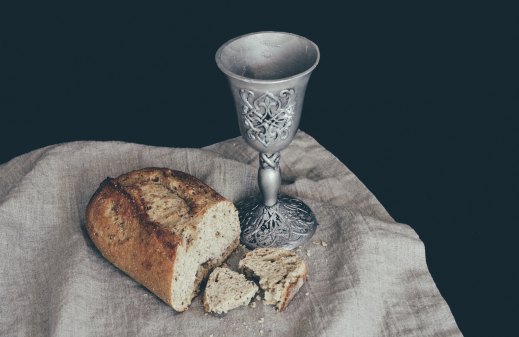
Jesus commands us to together partake of the bread and the cup in remembrance of Him, and so that is why we celebrate Lord’s Supper. We see this in a few different passages (Matt. 26:26-29; Mk. 14:22-25; Lk. 22:17-20; 1 Cor. 11:23-25).
We partake together and first remember Jesus’ propitiatory death for us and so the Lord’s supper causes us to reflect on the past. Second, the Lord’s Supper causes us to reflect on the current fellowship we together experience through union with Christ. And third, we look ahead to the future when we shall feast with Jesus after His return (we “proclaim the Lord’s death until he comes,” 1 Cor. 11:26). Scripture also points us to the importance of self-examination so that we do not take the Lord’s Supper in an unworthy manner and thus bring condemnation upon ourselves (1 Cor. 11:28ff).
The New City Catechism says, “Christ commanded all Christians to eat bread and to drink from the cup in thankful remembrance of him and his death. The Lord’s Supper is a celebration of the presence of God in our midst; bringing us into communion with God and with one another; feeding and nourishing our souls. It also anticipates the day when we will eat and drink with Christ in his Father’s kingdom” (Q46).
The Lord’s Supper is a beautiful and amazing picture of the gospel for us. Jesus’ body was broken and His life was poured out so that we could have life. When we partake of the Lord’s Supper we are reminded of the amazing truth that Jesus—God in flesh—is the Lamb of God that takes away our sin. The Holy Spirit uses the God-ordained and Christ instituted means of the Lord’s Supper to help us remember with thankfulness Christ’s finished work on the cross.



 in X
in X 