How can we refuse to bow like Daniel’s friends?

How can we refuse to bow like Daniel’s friends? How can we as the Church in exile stand strong and share the love of Christ?
Dandelions
I was reading about and thinking about dandelions the other day. I want to warn y’all, what I’m about to say is a little controversial and some of you may disagree. But, I think dandelions are cool. And actually pretty.
Dandelions, and this may not surprise you, have one of the longest flowering seasons of any plant. And, did you know, every part of the dandelion is useful? The root, leaves, and the flower. They can be used for food, medicine, and dye for coloring.
Dandelions have had quite an impact and have actually helped a lot of people. Birds, insects, and butterflies consume the nectar or seed of dandelion. Dandelions can be used to make wine and used as a substitute for coffee.
There have been times when dandelions have been appreciated for what they are, but that is not the season we’re in right now in America. We’re in the season of trying to kill dandelions and we spend a lot of money collectively on pesticides to do so.
But, as we know, dandelions are very resilient.[i]
The Church
In some ways, church history parallels the history of the dandelion. The church has had its season when it’s been celebrated. When people have seen the benefits of the church. The church, however, has also had its seasons when people have wanted to kill the church, even willing to use pesticides.[ii]
The Church in America is in exile. And more and more that is being made empirically clear. Of course, theologically it’s always been clear.
The book of Daniel has a lot to teach the Church in exile. How can we stand tall and bright like a dandelion when the whole world bows?
How can we be like dandelions? How can we be like Daniel and his friends? How can we stand when many want to cut us down? How can we adapt and even populate and grow in this often hostile climate? (Timothy Keller has some very helpful thoughts on that question here)
How are we, as Shadrach, Meshach, and Abednego, to be faithful in a faithless world? Answering these questions is one of the main purposes of the book of Daniel.[iii]
How can we refuse to bow like Daniel’s friends?
Romans 15:4 tells us that “whatever was written in former days was written for our instruction.” Daniel has a lot to instruct us about living in exile. We’ll particularly be considering Daniel chapter 3 here.
In Daniel 3 we see the King, Nebuchadnezzar, sets up a huge idol. It’s ironic because God, the true King, is the one who sets up kings. We see 8 times in Daniel chapter 3 that the king “set up” the idol (Dan. 3:1-3, 5, 7, 12, 15, 18). But in Daniel 2:21 we see that it is God, the real King, that sets up kings:
“He changes times and seasons;
He removes kings and sets up kings;
He gives wisdom to the wise
and knowledge to those who have understanding.”
So, the first lesson for us if we are to stand is to see that it is God, the true Lord, who is Sovereign.
Second, we must see the prevalence of idolatry.
We may not see actual idols all over in America, but they are there. The truth is: an idol is most massive and mighty when never mentioned. Satan, the father of lies, would like to cover our eyes to our culture of idolatry. We’ll continue to bow if we don’t know we’re bowing.
So, we must see that idolatry is the cultural air we are breathing. We are not immune. We are not untouched. Idolatry is not just out there. It is very often in our own hearts. Therefore, we must search and destroy every idol in operation in our hearts.
What even is idolatry? The New City Catechism says, “Idolatry is trusting in created things rather than the Creator for our hope and happiness, significance and security.”
Four questions to help you find your idols:
-
- What brings negative emotional responses?
- Where do you put your hope when things go well and when things go wrong?
- Who do you compare yourself to?
- How have you turned good things into ultimate things?
Third, be present to bless.
Notice Shadrach, Meshach, and Abednego refuse to comply with idolatrous practice but they aren’t wholesale against Babylon. They worked hard in the government and were a blessing to Babylon. That’s us too. We need to “come out of Babylon” as it says in Revelation 18:4. But, that means we need to not partake of Babylon’s value system. We’re not to partake of the sins of the world as Paul says in 1 Corinthians 5:10, we are not to leave the world.
We’re in Babylon, to bless Babylon. We have different values than Babylon but were not to always just bash Babylon or the Babylonians.
Fourth, die rather than partake in idolatry.
Shadrach, Meshach, and Abednego are explicitly commanded to bow an idol, which is a clear violation of the 2nd of the 10 Commandments (Ex. 20:4-6). Listen to Shadrach, Meshach, and Abednego’s response: “Be it known to you, O king, that we will not serve your gods or worship the golden image that you have set up” (v. 18).
They were willing to die rather than take part in idolatry. Very often I’m afraid we might be closer to the opposite of that. We’re more than willing to die for our idolatry.
We, like Shadrach, Meshach, and Abednego, should die rather than partake in idolatry. As it says 1 Corinthians 10:14, “Dear friends, flee from idolatry”!
Fifth, we may face various fires.
Shadrach, Meshach, and Abednego faced literal fire and each remained strong in the Lord. You have or will face fire as well—mockery, judgment, or various other obstacles—but as Christians, we can stand because we know Jesus stands with us.
We can stand when we stand in Him. We can refuse to bow, when we bow to Him.
Further, our fellowship with Christ is often nearest and dearest in the furnace of affliction; I suppose that is because all distractions are burned away. In those moments we can know, deeply know, the One who matters most.
But, sixth, no matter what we face, we know God is with us.
Over and over we may be cut down but because of Christ’s sacrifice, we can stand tall like a dandelion; strong, resilient, and bright. And point to the One who is the One True Lord of the universe.
Dear Christian brothers and sisters, remember: God doesn’t promise that He will necessarily keep His people from the fire. But, He does promise that He will be with His people in the flame (Ex. 3:12; Is. 43:2; Matt. 28:18-20; Heb. 13:5; 1 Pet. 4:12-14). Ultimately we see Christ faced the ultimate fire so no matter the fire we face, we can face it with hope. We can face it standing on His promises. God’s promise to be with us finds its fullest fulfillment in Jesus, who is Immanuel—God with us.
How should we respond to the God who is with us through the fire and through the flame? How should we respond to Jesus who waded into the fire of affliction? How should we respond to the One who went through the furnace of the wrath of God completely alone? How should we respond who did all that for us?
We should bow to Him in reverent submission and we should lovingly share the news with “all the peoples, nations, and languages” that He alone is worthy of our worship.
Conclusion
Remember dear brothers and sisters, today the world says bow to every idol, but on the last day everyone—every tribe, language, nation, and tongue—will bow to Christ the King (Phil. 2:10-11).
Let’s bow now. Let’s bow in reverent submission. Jesus is worthy of our worship—of all worship!
So, as you drive around or mow and see dandelions, think about God’s sustaining and persevering power that He gives. He is with us no matter what we face! So, we can stand like resilient dandelions, unbending, pointing to the Creator who alone is worthy of worship.
Notes
[i] Most of this was taken from Jen Kerr.
[ii] And actually, in the world today, each of those things is a reality simultaneously depending on where you are. We just happen to live in a place and time in America where “dandelions” seem to be less and less popular.
[iii] The narrations in the book of Daniel of God’s power in the midst of severe opposition serve an important purpose: the encouragement of exiles.
*Photo by Amy Earl
4 Points to Pop Pride

The last thing Christians should be is puffed up with pride. Below are four points to pop pride.
Pride is damaging and is at the heart of what damned the devil himself. We would be wise to destroy pride before it destroys us (Prov. 16:18).
1. Group Connection
Pride protects us from the penetrating eye of others, at least, until it is too late. To kill pride we must let at least a select group pry; pry into our lives and our inner motivations. We must let them lovingly dive-in and help dig out roots of sin that we can’t see because the seed hasn’t yet sprouted and blossomed its poisonous plume (see 1 Tim. 5:24; Heb. 12:15).
When I drive with my wife you can often hear me say, “Clear right?!” As soon as she says, “Clear!” I’m making that lefthand turn. I’m squealing the tires (in our minivan…).
I ask her because I can’t see what’s coming. And I know that blind spots can cause big problems. So, I need her help.
Blind spots are no less dangerous on the road of life. We need each other to see what we don’t see ourselves. What’s going on in our own hearts is hard to truly understand. We need wise brothers and sisters to help us discern what’s going on (cf. Prov. 20:5).
Connection in an honest and loving community is vital for health. We need spiritual wellness exams. We want to kill cancerous sin before it grows and brings forth death (cf. James 1:15). We need to be sharpened (Prov. 27:17) and we need the occasional friction of rebuke (1 Tim. 5:20; 2 Tim. 4:2).
Like a horse, we need a goad to guide us to good works (Heb. 10:24-25). Like a rope, we need to be interlaced with others to be strong (Eccl. 4:12). Like a general, we need counsel to wage war wisely (Prov. 24:6).
Ironically, if we’re going to pop pride, we need people in our bubble.
2. Gifts are a Gift
Gifts are given. They are not deserved. If we have a gift, it’s because we received it. We didn’t own it on our own. Therefore, we shouldn’t boast as if we did not receive it (1 Cor. 4:7). And no matter what we have—strength or smarts, artistry or arithmetic, wealth or wisdom—it’s all a gift given by God (Jn. 3:27; James 1:17).
And gifts are given, not for our own good, but for the good of others (1 Pet. 4:10; 1 Cor. 12:7). Gifts are given with an understanding from God that there will be a return on His investment. It is required of servants that they be faithful (1 Cor. 4:2). But, that is nothing out of the ordinary. A servant is supposed to be faithful (Lk. 17:10).
If they are a servant with more gifts entrusted to their care, they are just being faithful with what God has given them, which is really not much different than the other servants. Except that they may go through more pain and have more of a demand on their life.[1]
Also, it should be remembered that no body part, whatever that body part is and how gifted it is, functions on its own. In the same way, the quarterback may lead the team but he’s not the only one on the team. If he were, he would be crushed.[2]
We all have different parts to play in the body (1 Cor. 12:12-31). The different parts have different roles, different gifts, as God assigned. But, notice, it is God that arranged and appointed it that way (v. 18, 28). It is not as if anyone earned their particular gift or role in the body.
So, since gifts are given they should never be a cause of pride.
3. Given Identity
The Bible teaches us that we don’t earn an identity, we are given an identity. Anyone in Christ, for example, is a new creation (2 Cor. 5:17). That is who they are. They are new. They are an adopted son or daughter of God (Eph. 1:5).
Paul David Tripp’s book on leadership is very helpful here. I shared a few quotes from his book recently. Here’s one that’s especially applicable here:
“Ministry leadership identity produces fear and anxiety and will never produce the humility and courage that come with identity in Christ. Looking horizontally, as a leader, for your identity, meaning, purpose, and internal sense of well-being asks people, places, and position to do for you what only your Messiah can do.”
We don’t boast in who we are, we boast in the Lord (Jer. 9:23-24; 1 Cor. 1:31)! Therefore, we don’t falter when we fail and we don’t overly seethe with success. And we don’t compare ourselves with others because we’re not looking for commendation from others (2 Cor. 2:12, 17-18). We’re looking for a smile on our Father’s face, even if it brings a frown from others (Matt. 25:21; Rom. 2:29; 1 Cor. 4:5).
So, we rest in our God-given identity—who we are in Christ—and not in any merely earthly identity.
4. God’s Glory
Everything we have, we have been given. And everything we have been given is to be given back to God in the form of praise. All we do is to be to His praise and glory, even when we eat (1 Cor. 10:31).
Everything is about Him, it is the height of folly and stupidity when we make it about us. That’s worse than an ant that thinks it deserves praise for moving a speck of sand. The ant is nothing and its work is nothing compared to the might and majesty of God. To think that God would owe us is worse still (see Job 35:7; 41:11; Rom. 11:35)!
All things are about Him (Col. 1:16) and the fact that He chooses to use mere humans only highlights His glory (2 Cor. 4:7 cf. 2 Cor. 12:8-10).
So, we pop pride when we see that it’s all about God and His glory.
—
[1] See “The Pastoral Long-Suffering of Spurgeon and Boyce”
[2] The success of the body rests on the individual parts of the body and not on any one part on its own, no matter how gifted that part is. Tom Brady knows this. He gave up millions so that the other important parts of the team could get filled up.
*Photo by Hamed darzi
Are We Brokenhearted Over Our Societies’ Idolatry?

Are we brokenhearted over our societies’ idolatry? The Apostle Paul was.
Paul was in Athens and he saw that it was full of idols (Acts 17:16). When he saw that there were idols everywhere, he was cut to the heart. Paul was visibly grieved. He was greatly troubled.
In Paul’s day, Athens was home to a stadium and a large concert hall. Athens’s most prominent feature, however, was its numerous pagan temples.
One author around the time of Paul said that it was easier to find a god than a man in Athens. There was a great temple to Athena (the Parthenon), a temple dedicated to multiple deities, and the temple to the goddess Roma. There were other pagan sacred sites that have been found as well.
Then, as now, there is a lot of idolatry. There is a lot of suppressing the truth about God for a lie. There is a lot of worshiping what is created rather than the Creator who alone is worthy of worship (Rom. 1:25).
So, how did Paul respond and how do we respond when we see rampant idolatry?
Paul was not consumed with anger or with amazement as to how stupid people are for their idolatry. No. His heart was broken for them. He had compassion for them.
And his compassion pushed him to winsome conversation…
“So he reasoned in the synagogue with the Jews and the devout persons, and in the marketplace every day with those who happened to be there” (Acts 17:17).
Paul apparently shared in a winsome way. People were interested in hearing from him. We see this because they took him to the Areopagus and said, “May we know what this new teaching is that you are presenting?” (Acts 17:19).
Paul had a heart for the lost and won a hearing with the lost.
It says that Paul walked around and looked carefully at their objects of worship. And something he saw gave him an opportunity to share the good news of Jesus. He saw “an altar with this inscription: ‘To the unknown god.’” So, Paul was able to say: “What therefore you worship as unknown, this I proclaim to you” (Acts 17:23).
In sharing Paul even quotes from two of the “rappers” of the day. They actually were long since dead but his audience would have been familiar with them.[1] Paul took the time to meet people where they were.
Paul had a heart for the lost. He wept over their idolatry. And he also studied how to effectively speak into their lives. He “looked carefully at their objects of worship” and could even quote their authors.
Yet, he did so not just to be on the in with them, but to point something out. He wanted to see what they see so he could show them how to see.
We too deal with idolatry today. It’s perhaps all the more insidious because it’s less apparent. We have no temple to Aphrodite;[2] but we carry the equivalent in our pocket on our phone. Idolatry is alive and well. We just don’t see it well.
Do we have broken hearts over societies’ idolatry? And are we willing to wisely, winsomely, and lovingly wade into the fray? Are we willing to reason in the religious meeting places as well as the marketplace? Are we willing to be “in the know,” so we can help people to know?
___
[1] Epimenides of Crete (c. 600 B.C.) and the Stoic poet Aratus (c. 315–240 B.C.).
[2] Aphrodite was known as the Ancient Greek goddess of beauty, desire, and all aspects of sexuality. Aphrodite was known to be able to entice both gods and men into illicit affairs because she was so attractive. Aphrodite was honored as a protector of prostitutes.
*Photo by Douglas O
Helpful takeaways from Paul David Tripp’s book Lead

I really enjoyed Paul David Tripp’s book, Lead: 12 Gospel Principles for Leadership in the Church. There were a lot of good takeaways. Here are some of my highlights but you should read the book for yourself, especially if you are in church leadership.
“The gospel of Jesus Christ is meant to be your life hermeneutic, that is, the means by which you understand and make sense of life” (Paul David Tripp, Lead, p. 12).
“Every human being is a meaning maker, a theologian, a philosopher, or an anthropologist, always taking things apart to understand what they mean. As a ministry leader, you are doing theological work not just when you preach, teach, or lead but also in the ways that you think about yourself, understand your ministry, and relate to fellow leaders” (Tripp, Lead, p. 12).
“If sin blinds, and it does, and if sin still remains in us, and it does, then, even as ministry leaders, there are pockets of spiritual blindness in us. So it is vital that we all forsake the thought that no one knows us better than we know ourselves. If there are places where we still suffer from spiritual blindness, then there are inaccuracies in the way we see ourselves and interpret our words and behavior. If, as a leader, you deny the possibility of personal spiritual blindness and trust the accuracy of your self-view, you are not humbly open and approachable to fellow leaders whom God has placed near you to help you see what you won’t see on your own” (Tripp, Lead, pp. 67-68).
“Leaders must push the gifts of others forward, willing to listen and willing to submit to the wisdom of others who are gifted in ways that they are not. Humble leaders surround themselves not with ministry clones but with leaders who have gifts that they do not and are therefore smart in ways they are not and strong in areas they are weak. This kind of community will always produce a quality and longevity of fruit that won’t ever be produced by a domineering leader” (p. 75).
“Every leader needs to be the object of ongoing discipleship, every leader needs at moments to be confronted, every leader needs the comforts of the gospel, every leader needs help to see what he would not see on his own, and every leader needs to be granted the love and encouragement to deal with the artifacts of the old self that are still within him. If this is so, then we cannot be so busy envisioning, designing, maintaining, evaluating, and reengineering ministry that we have little time to care for the souls of the ones who are leading this gospel work. A spiritually healthy leadership community participates in the ongoing personal spiritual growth of each one of its members” (p. 86).
“A leader whose heart has been captured by other things doesn’t forsake ministry to pursue those other things; he uses ministry position, power, authority, and trust to get those things. Every leadership community needs to understand that ministry can be the vehicle for pursuing a whole host of idolatries. In this way, ministry leadership is war, and we cannot approach it with the passivity of peacetime assumptions” (pp. 109-110).
“If ministry leadership is your identity, then Christ isn’t… Ministry leadership identity produces fear and anxiety and will never produce the humility and courage that come with identity in Christ. Looking horizontally, as a leader, for your identity, meaning, purpose, and internal sense of well-being asks people, places, and position to do for you what only your Messiah can do. This will produce either pride in success or fear of failure but never the kind of humility and courage of heart that results in humble, willing, confessing approachability. Ministry as a source of identity will never result in healthy gospel-shaped relationships in your leadership community, the kind of relationships in which candor is encouraged, confession is greeted with grace, and bonds of love, appreciation, affection, understanding, and respect grow strong” (p. 156).
“If identity in ministry is a battleground for every ministry leader, and if the exchange from identity in Christ to identity in ministry is often subtle and usually takes place over an extended period of time, then it is important to identify some of the symptoms you will see when a leader is looking to get from his ministry leadership what he was meant to get from Christ” (p. 168).
“Because of the dynamic of spiritual blindness, we don’t always see ourselves with accuracy, so we all need instruments of seeing to help us. We must not let ourselves think that we’re grace graduates or that no one knows us better than we know ourselves. Because we as leaders have been welcomed by God’s grace, we can be humble and approachable, thereby protected and able to grow” (p. 204).
“If we are not living with the presence and glory of God always in focus and always as the primary motivator of all we say and do, what we say and do will be driven by the glory of self. Every human being is glory oriented, because that orientation is meant to drive us to God. So we are all always living for some type of glory” (p. 214).
The Task of a Teacher of God’s Word

1.Serious Trust
If the teacher of God’s word does not trust God’s word and trust that it will accomplish what God wants it to accomplish (Is. 55:10-11) they will struggle in their task. And may not be fit for their task. If the teacher does not trust God’s word to be God’s word they are unlikely to teach very well for very long.
So, serious trust in God’s word is foundational.
2.Strenuous Commitment
In Acts 6 we see there were a lot of important distractions for those who were tasked to preach the good news of Jesus. There were lots of important needs that were dear to their hearts and dear to God’s heart. And yet they resolved to devote themselves “to prayer and to the ministry of the word” (v. 4). They knew it was not right for them to be distracted from “preaching the word of God” (v. 2).
In fact, they were so committed to preaching about the glory and goodness of God as seen in Christ, that even when threatened with beatings and imprisonment they continued. They rejoiced that they were worthy to suffer for the Savior and they continued teaching and preaching Jesus as the Christ (Acts 5:41-42).
3.Studious Study
Ezra is an important model for every pastor and minister of the word. And really every Christian. Every Christian, in one way or another, should study the word of God, do it, and teach it (Ezra 7:10). It’s probably good to do it in that order too.
The teacher “must hold firm to the trustworthy word as taught, so that he may be able to give instruction in sound doctrine and also to rebuke those who contradict it” (Titus 1:9). And that requires studious study.
“There is no long-range effective teaching of the Bible that is not accompanied by long hours of ongoing study of the Bible.”[1]
4.Self-Application
A teacher could “understand all mysterious and all knowledge” yet if they have not love it is worth nothing (1 Cor. 13:2-3). Self-application is essential. James even tells us “Not many of you should become teachers, my fellow believers, because you know that we who teach will be judged more strictly” (3:1).
As we saw with Ezra, he did not just study God’s word, or just teach God’s word, he himself did God’s word. He applied it and lived it himself. That is vital.
It’s actually a qualification for Christian leaders. They are to be above reproach. They are to apply Scripture first to themselves. They are to not be hypocrites.
5.Solid Teaching
There is a place of course to adapt the message to the audience. Jesus and Paul themselves did that. That is good. Yet, we also want to give meat, even if we have to cut it up nicely and make it bite-size. Our desire should be solid teaching, not trivial trifles (see Heb. 5:12; 1 Cor. 3:2).
There is a time to give milk and not solid food. Babies need milk because they cannot yet take solid food. They, however, would be stunned if they had to stay with mere milk. So, solid sermons are essential.
It is important to read from the Bible clearly and explain it so that people understood what’s being read (see Neh. 8:8 cf. 1 Tim. 4:13; Mal. 2:7). That’s what expository preaching is. It exposes and reveals the meaning of the passage. That is why pastors must be “able to teach” (1 Tim. 3:1).
6.Specific Application
Scripture has the power to “cut to the heart” (Acts 2:37). So, Scripture should be wielded with careful and intentional precision. It is “sharper than any two-edged sword” and pieces to the depths of our hearts (Heb. 4:12).
Scripture should be applied specifically and carefully. Scripture should call to action but not legalistic action. Saints should be equipped for the work of ministry (Eph. 4:11-12) but it should be through the truth spoken in love (Eph. 4:15).
So, the teacher of God’s word must “preach the word; be ready in season and out of season; reprove, rebuke, and exhort, with complete patience and teaching” (2 Tim. 4:1-2). That is a high and challenging calling.
7.Show Christ
When we preach or teach we are not to use “eloquent wisdom” to make much of ourselves but we “preach Christ and Him crucified” (1 Cor. 1:17; 2:2). It is not us we proclaim. It is Him we proclaim (Col. 1:28).
We show Christ from every passage, Old and New Testament, knowing Scripture is about Him (Jn. 5:39) and every promise finds its “yes” in Him (2 Cor. 1:20).
8.Share the Gospel
Sharing the gospel is needed all of the time, for believers and unbelievers. We all need to be reminded of the best news there is. The Apostle Paul wrote Romans and Ephesians to Christians and yet he didn’t assume the gospel. He expounded on it and applied it.
Believers and unbelievers need the gospel. So we must share the gospel (Matt. 10:6-7; Lk. 25:45-49; Rom. 10:14-17).
___
[1] D.A. Carson, For the Love of God vol. 2, January 7.
*Photo by Carolyn V
10 Ways to Read More Books in 2021

I read 70+ books in 2020.[1] Below I’ll tell you how.
“If you ain’t cheating, you ain’t trying.” I don’t think you should cheat. Cheating is wrong. But you should, however, make the most of every advantage you have as best as you can.
That’s what I seek to do with reading. I take advantage of everything I can.
I read all sorts of books for all sorts of reasons. Depending on the reason for reading and the type of book, I will read it in a different way. Some people shun audiobooks. But, I personally don’t get that. There are all sorts of reasons for reading and all sorts of ways that people retain things best.
As I said, I think we should wisely take advantage of everything we can as best as we personally can.[2]
Here are nine things I’ve used to my advantage:
1) Time
Time is the most precious commodity there is. Even little bits of gold have value, how much more small slots of time!
You can get a lot read when you make the most of small time slots. Waiting can easily turn into productive reading. I always have a book on hand. And my wife often listens to audiobooks while doing dishes or laundry.
2) Old fashioned books
Always have one with you. You never know when you’ll be able to get a few paragraphs or a few pages read.
3) Kindle app on my phone
It’s always with me. I always have a book I’m reading on Kindle.
4) Hoopla or Libby
Hoopla and Libby are free apps and one of them should be available through your local library. I’ve used them both at different times to listen to tons of books.
5) Audible
Audible is an audiobook service. My wife and I had a membership for a long time. It was great.
6) ChristianAudio
ChristianAudio is an audiobook service that provides Christian audiobooks. You can signup for a free audiobook a month.
7) Speechify
Speechify is an amazing app. It was created by Cliff Weitzman, someone with dyslexia, to help people with dyslexia.
With Speechify you can take a picture of a page in a book and it will convert it to audio. I will sometimes buy a book on Kindle and take a screenshot of each page of the Kindle book and load it on to Speechify. In this way, I can listen to the book.
I can also still make notes. If something sticks out to me that I want to capture I’ll take a screenshot on the Speechify app. Then I’ll search the keywords from the screenshot on the Kindle book and highlight and make any notes I want to make.
Speechify has been a huge blessing to me. I read very slowly but when I use Speechify I can read over 650 words per minute. Speechify probably triples my reading speed but I’m still able to retain what I read and make notes.
8) A community of book lovers
I have multiple friends (including my wife!) that love to talk books and encourage the reading of good books.
9) Goodreads
Goodreads is a social media site for reading. Goodreads allows you to track and review books you’ve read as well as receive recommendations from friends. You can see my Goodreads account here.
10) Pocket (very helpful but not for books)
Pocket is an app that allows you to save articles to your “pocket.” It’s a great way to save and organize articles. But, the thing I enjoy most is that it has a function that allows you to listen to articles.
Pervasive Peace through the Second Advent

In Christmas, we celebrate the advent or coming of Christ. The first coming enabled a way for peace to be realized. Humans can, through Christ, have renewed fellowship with God. Yet, as Jesus Himself said, in the world we will have trouble and tribulation.
So, if that’s the case, if in the world we will have difficulty and distress, then how can we have peace? This Sunday I get to preach on the “Pathway to Peace” from Isaiah chapter 11. I’m excited and thankful to be able to do that.
I, however, have too much material. So, I thought I’d share here, part of how that peace is possible.
First, Isaiah paints a beautiful and powerful picture of peace (see Isaiah 11:1-9). A little baby can play with a king cobra without fear (v. 8). How is this possible?
Isaiah 11:9 tells us: the knowledge of God is intimately experienced. And so: nothing will “harm nor destroy on all [the Lord’s] holy mountain.” Instead of harm, “the earth will be filled with the knowledge of the Lord as the waters cover the sea.”
The Messiah will make it so not only the knowledge of the LORD is pervasive but intimacy with the LORD is too. Knowledge in the Old Testament is not merely head knowledge, but it is experiential (When Adam “knew” Eve, Genesis 4:1, it was not mere cognitive knowing, it was experiential).
Also, we should ask, how is it that the waters cover the sea? The waters cover the sea by filling it to the fullness of capacity. God and His goodness will be experienced and known to maximum capacity! We will have the strength together with all the saints to comprehend and know “the breadth and length and height and depth” of the “love of Christ that surpasses knowledge” and we will be “filled with all the fullness of God” (see Ephesians 3:18-19).
Look at what’s going to happen when Jesus reigns on earth!:
“Of the greatness of his government and peace
there will be no end.
He will reign on David’s throne
and over his kingdom,
establishing and upholding it
with justice and righteousness
from that time on and forever” (Isaiah 9:7).
Of peace, there will be no end!
Justice and righteousness forevermore!
Of course, this is not yet a reality. First, Christ came as a Lamb to be slain. Next, He’s coming as the Lion of the tribe of Judah (see Revelation 5:5).
In that day, when perfect peace comes upon the earth, the LORD says, “my chosen ones will long enjoy the work of their hands” (Is. 65:22). The most precious moments that we experience on earth—whether that’s a Thanksgiving dinner, a beautiful sunset, or being lost in a song or prayer of praise—will be multiplied infinitely.
“What no eye has seen, nor ear heard, nor the heart of man imagined, what God has prepared for those who love Him” (1 Corinthians 2:9).
How ironic, how sad, that the Rejected One, is the One who brings renewal of the whole earth.
Fellow Christians, please share the message that is so needed in these days of distress. And pray for your neighbors, that they would have peace that surpasses understanding.
Please pray that the Rejected One, the one alone who brings perfect and pervasive peace, would no longer be rejected.
10 Quotes on Preaching

“Expository preaching is the best method for displaying and conveying your conviction that the whole Bible is true… A careful expository sermon makes it easier for the hearers to recognize that the authority rest not in the speaker’s opinions or reasoning but in God, in his revelation through the text itself… Expository preaching enables God to set the agenda for your Christian community… Expository preaching lets the text set the agenda for the preacher as well… Exposition can prevent us from riding our personal hobbyhorses and pet issues… A steady diet of expository sermons also teaches your audience how to read their own Bibles” (Timothy Keller, Preaching, 32-38).[1]
“Expository sermons help us let God set the agenda for our lives…. Secondly, expository preaching treats the Bible as God treated it, respecting particular contexts, history and style of the human authors” (Peter Adams, Speaking God’s Words: A Practical Theology of Preaching, 128).
Read More…“An expository sermon may be defined as a message whose structure and thought are derived from a biblical text, that covers the scope of the text, and that explains the features and context of the text in order to disclose the enduring principle for faithful thinking, living, and worship intended by the Spirit, who inspired the text” (Bryan Chapell, Christ-Centered Preaching, 31).
Should Wives Work Outside the Home?

Titus 2:4-5 and 1 Timothy 5:14 talk about young wives working at home, is this the ideal role God ordained for women? Should women not work outside the home?
To answer those questions, it will be helpful to look at five considerations.
Principles from the Bible
First, it is important to glean principles from the Bible to answer this question. The first principle or truth that I think is relevant is that God made humans gendered. The Bible clearly teaches that males and females are both made in the image of God (Gen. 1:26-27) and yet males and females differ from one another in some respects to various degrees. Scripture also teaches that within the family and within the church God has given complementary roles and gifts. For example, see the table from God, Marriage, and Family by Andreas Kostenberger:
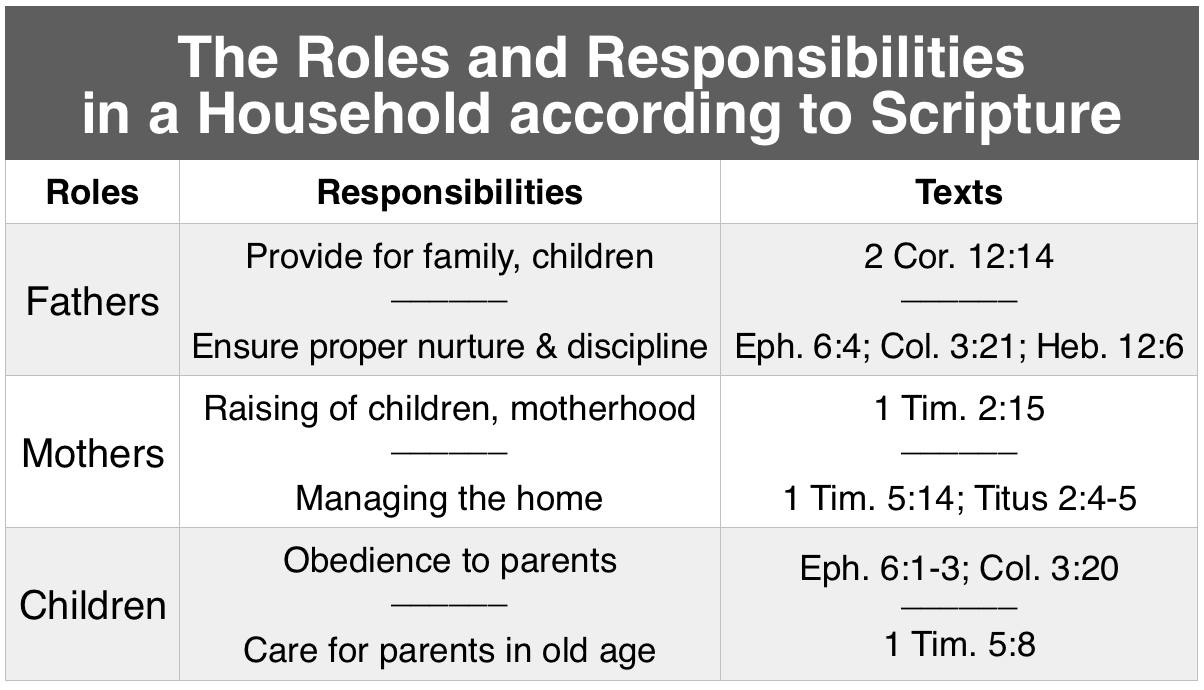
The way that Andreas Kostenberger says it, is that “Women are to place special priority on their God-given calling as mothers and homemakers.”[1] That, I agree, seems to be a biblical principle. Women are especially equipped for that task (even physiologically).
Priorities from the Bible
Next, it is important to consider priorities from a biblical perspective. We want our priorities to lineup with the priorities of Scripture. If they don’t we will have a problem with Scripture wherever it is at odds with our priorities. Our priorities, however, should be aligned with Scripture; we should not seek to align Scripture with our priorities.
Interestingly, “A 1982 Gallup poll showed that more than eight out of ten respondents (82 percent) assigned top priority… to the importance of family life. Families… rated as more important than the possession of material goods.”[2] Scripture agrees with what was the majority assessment in 1982 (see e.g. Deut. 11:19, 21; Ps. 127:3-5).
What, however, do we value?[3] Fortune or family?
Tacitcus, the Roman historian and politician writing around the same time as the Apostle Paul in A Dialogue on Oratory said,
“Our children are handed over at birth to some silly Greek servant maid… The parents themselves make no effort to train their little ones in goodness and self-control; they grow up in an atmosphere of laxity… they come to lose all sense of shame, and all respect for themselves and for other people.”
Tacitcus had a problem with that approach. And I think Christians should too.
We, however, haven’t answered our above question yet, but we’re getting there. But, it’s vital that we consider our motivation and priorities as we ask the question.
Disagreement Over Doctrine

Doctrine matters. Doctrine can cause delight or be very damaging. And sadly, false doctrine is more common than many people realize.
It’s not just me that says deception and damaging doctrine is prevalent though. That’s what Scripture says (see Matt. 24:11, 24; Mk. 13:22; Acts 28:31). False teaching is not a small concern. There is false teaching that is the doctrine of demons (1 Tim. 4:1). Remember, as Ephesians 6:12 says, we are at war not with humans but with unseen spiritual powers. This is serious. Paul says this will happen in “later times.” That’s where we are now. We are in the last days, the days in between the Ascension and the Return of Jesus Christ.
It’s helpful here, however, to consider that not everything we disagree with is the “doctrine of demons.” So, it helpful for us to consider “theological triage.” There are some teachings that are especially connected to the good news of Jesus Christ and there are other things that are further down the list of importance.

There are some things that are absolutes, like the deity and full humanity of Jesus Christ, the Trinity, and the authority of Scripture. There are, however, things that are less critical when it comes to theological triage. For example, what we believe about the end times is not as critical as what we believe about Jesus and how people are saved.
Read More…


 in X
in X 