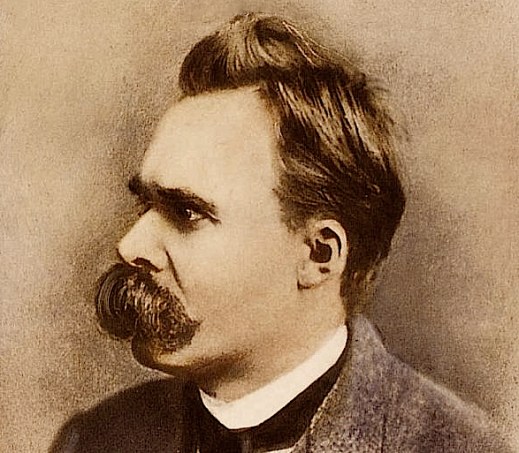
Nietzsche: Prophet of Doom (Part 2)

Nietzsche was Right, but He was also very Wrong
What I hope to show in my paper is that Nietzsche’s philosophy was either very accurate or very wrong. That is, Nietzsche’s conclusions if God is “dead” lead inevitably to certain conclusions. In my evaluation, I take three of Nietzsche’s late period writings (1886-88) as my main point of interaction.[1] This is for a two reasons. First, Nietzsche’s writings are large and this paper is not. Second, because his philosophy is more likely to be further established in his later writings.
In Nietzsche’s writings, he shows over and over again that his thought is the converse of Christianity; this is true if we look at his doctrine of eternal recurrence or his writings on slave morality. And as Nietzsche said, philosophy “always creates the world according to its own image, it cannot do otherwise”[2] and for Nietzsche’s thought, when extrapolated and applied, it makes hell. That is what I hope to argue, I hope to show how Nietzsche’s thought, when applied, makes a world in its own image, one that is terrible, filled with war, rape, and violence. I want to show this because I believe it is the inevitable outcome of the path he started. Since the beginning, it has been true that when we turn away from God we turn to our own destruction (Ps. 16:2; Jer. 2:5; Rom. 1; 3:12; etc.).
So, how is Nietzsche right? Nietzsche is right in that he paints a powerful portrait for us of what it means to be given up to our own devices (cf. Rom. 1). Nietzsche shows us the fallout from the Fall of humanity. But, Nietzsche was also gravely wrong. God is not dead!
Nietzsche’s philosophy is most clearly the converse of Christianity. Nietzsche says God is dead.[3] He says there is no truth. He says to assert yourself and make your own way. He says there is no heaven so live each moment today like it will occur eternally. In short, I hope to show that in the throwing off the “shackles” of morality and the hope of heaven Nietzsche has fettered those who follow him to hell on earth. Nietzsche’s writings and subsequent history show us that a world where right and wrong do not exist, is a world where lots of pain and oppression do.[4]
Ideas and beliefs have consequences, profound consequences. Paul says in 1 Corinthians 15 that if Christ has not been raised then let us eat and drink for tomorrow we die. Elijah says in 1 Kings 18:21 that if God is not God then don’t live for Him, live for whatever it is that you believe is true, whether Baal or, I believe he would say, whatever applicable philosophy. So, as we look at Nietzsche’s thought, which is the converse of Christianity, we can begin to understand and better appreciate Christianity.
__________________
[1] That is, Beyond Good and Evil: A Prelude to the Philosophy of the Future (1886), On the Genealogy of Morality (1887), and The Antichrist (1888).
[2] Nietzsche, Beyond God and Evil, par 9.
[3] Friedrich Nietzsche, The Gay Science, par. 108, 125, 343. Cf. e.g. Friedrich Nietzsche, Thus Spake Zarathustra, “Zarathustra’s Prologue,” par. 2 and 3.
[4] “By denying human equality and human rights, and by devaluing the lives of the masses, Nietzsche’s philosophy is really a loveless, forlorn philosophy of death, cruelty, and oppression” (Weikart, Richard, The Death of Humanity: and the Case for Life [Regnery Publishing], Kindle Locations 3394-3395.
Nietzsche: Prophet of Doom (Part 1)
Introduction
What follows is important and relevant for individuals, society, and the world. The water is deep at places but must be forded for us to get to solid ground. The world, I fear, is in a swamp of uncertainty, but the water is rising, every day the need for solid ground is more apparent but harder to reach. Wade through this with me, and perhaps we can find something solid to build upon. Something that will stand through the next wave, whatever that wave may be. As we set out, we will use Friedrich Nietzsche as our marker, though he is no North Star, he helps us map the mire.
First, we should know some about Nietzsche. Friedrich Wilhelm Nietzsche was born on October 15th, 1844 and died on August 25th, 1900. Nietzsche lived a sickly life and died at the age of 55 of pneumonia.[1] Nietzsche’s father was a Lutheran pastor. “Nietzsche’s uncle and grandfathers were also Lutheran ministers, and his paternal grandfather, Friedrich August Ludwig Nietzsche (1756–1826), was further distinguished as a Protestant scholar.”[2] Nietzsche faced many difficulties from a young age. His father died when Nietzsche was only four years old and just six months after the death of his father his younger brother died.
Nietzsche must have been gifted intellectually from a young age. For example, he composed piano, choral, and orchestral music as a teenager. He also received a good education at a first-rate boarding school. As a teenager, he read “David Strauss’s controversial and demythologizing Life of Jesus Critically Examined”[3] and it had a big impact on him. Early on Nietzsche considered himself devout, he was even called “little preacher” when he was young, but eventually, he would deny the faith, though at first not publically.[4]
Second, it should be understood, that in my mind, Nietzsche’s ramblings are closer to rhetoric than to philosophy. Nietzsche often employees ad hominem arguments and attacks a person (e.g. the Apostle Paul[5]) rather than their arguments. Nietzsche also seems fond of constructing straw man fallacies for his argumentative flame.
Third, Nietzsche wrote in a very unique and even enjoyable style. However, his lack of precision in writing is dangerous; people can construe his writings in many ways, and they have. There is much disagreement over Nietzsche and his work, which must to a large degree, must be because Nietzsche seems to have communicated often more like a poet, using words to paint, and not as much for precision.[6] It is true that Nietzsche at times is very hard to discern and it is also true that his body of work is large and there is much disagreement upon what place Nietzsche’s unpublished work should play in Nietzschean scholarship. However, all that being the case, Nietzsche is still responsible for what he wrote and the way he wrote.
Yannick Imbert has said,
In the history of Western thought, Nietzsche most likely holds the distinction of being the most misunderstood and misrepresented philosopher. Understanding him represents a particular challenge for Christians, given Nietzsche’s radical criticism of anything related to Christianity. Let us consider more closely the philosophy of the so-called father of nihilism.[7]
________________
[1] See e.g. D. Demelsoet, K. Hemelsoet, and D. Devreese, “The neurological illness of Friedrich Nietzsche,” 9-16 in Acta neurologica Belgica (April 2008).
[2] Robert Wicks, “Friedrich Nietzsche” in The Stanford Encyclopedia of Philosophy ed. Edward N. Zalta (Fall 2016 Edition)(https://plato.stanford.edu/entries/nietzsche/#Life1844 accessed on December 5th, 2016).
[3] Ibid.
[4] “From his early boyhood, Nietzsche was expected to follow the family tradition and become a minister himself. As late as 1864, when he studied classics and theology at Bonn University, he seems to have adhered to his family’s expectations (if no longer wholeheartedly). When one year later he finally dropped theology, he proved a family crisis” (Jörg Salaquarda, “Nietzsche and the Judaeo-Christian tradition,” 90-118 in The Cambridge Companion to Nietzsche [Cambridge: Cambridge University Press, 1997], 92).
[5] E.g. Nietzsche says, “In Paul is incarnated the very opposite of the “bearer of glad tidings”; he represents the genius for hatred, the vision of hatred, the relentless logic of hatred. What, indeed, has not this dysangelist sacrificed to hatred!… The life, the example, the teaching, the death of Christ, the meaning and the law of the whole gospels—nothing was left of all this after that counterfeiter in hatred had reduced it to his uses. Surely not reality; surely not historical truth!… He simply struck out the yesterday and the day before yesterday of Christianity, and invented his own history of Christian beginnings… The figure of the Saviour, his teaching, his way of life, his death, the meaning of his death, even the consequences of his death—nothing remained untouched, nothing remained in even remote contact with reality. Paul simply shifted the centre of gravity of that whole life to a place behind this existence—in the lie of the “risen” Jesus… The figure of the Saviour, his teaching, his way of life, his death, the meaning of his death, even the consequences of his death—nothing remained untouched, nothing remained in even remote contact with reality. Paul simply shifted the centre of gravity of that whole life to a place behind this existence—in the lie of the “risen” Jesus… What he himself didn’t believe was swallowed readily enough by the idiots among whom he spread his teaching.—What he wanted was power…” (Nietzsche, The AntiChrist, par. 42).
[6] So, Alvin Plantinga has said, Nietzsche “writes with a fine coruscating brilliance, his outrageous rhetoric is sometimes entertaining, and no doubt much the extravagance is meant as overstatement to make a point. Taken overall, however, the violence and exaggeration seem pathological; for a candidate for the sober truth, we shall certainly have to look elsewhere” (Alvin Plantinga, Warranted Christian Belief [Oxford: Oxford University Press, 2000], 136).
[7] Class notes from Yannick Imbert’s lecture in “History of Philosophy and Christian Thought” on Oct. 12th, 2016.
America’s Trump Morality

The difference between Donald Trump and his explicit exploits and many guys on the street is not one of morality. It’s one of power and publicity. Sadly, there are many “average Joe” versions of Donald Trump and Anthony Weiner.[1] I have heard many “men” nearly quote Trump and recount worse exploits in various work environments.
Welcome to America. Welcome to our morality: “Life, Liberty, and the Pursuit of Pleasure,” wherever and however it might be found. This is our county’s mantra, even if not said in so many words.
Much of the American economy is marketed to our lust. Just look at advertising. We all know it, sex sells. Pornography is a booming market and so, sadly, is sex-trafficking.
To hear that Trump has appeared in XXX films and said a lot of bad and very inappropriate stuff is sad. But, it is sadly not surprising.
Are we really shocked by Trump’s inappropriate comments? No. Concerned? Yes.
“Grabbing women by…” whatever is, sadly, much of today’s culture. As a culture, we care about the quick and exciting. We care about bursting bosoms and one night stands. We care about quick fixes, porn, and pleasure at someone else’s expense (especially if no one knows and we can get away with it).
We care about having it our way. We care about following our passions, no matter what they are. We care about people’s freedom to do what feels right. We care about the right for no one to tell us what is right.
Pornography, Tinder, and all the advertisements that feed us represent where we are as a country. It represents the underlying desires of much of America. There’s many mainstream magazines and media forms–Men’s Health, GQ, and many musicians and movies (e.g. Fifty Shades of Grey),–that embody Trump’s morals even if they don’t say it outright.
So, are Trump’s words that surprising? For a presidential candidate, it’s unprecedented but it’s not surprising. That’s where we are as a country. Porn use to be something only under people’s beds and available at seedy XXX theaters but now it’s in our pockets, piped into our living rooms, and greeting us on billboards.[2]
Trump is vocalizing what many men view, say, and others often think. Obviously, I don’t agree with Trump. I think it’s sickening. But I also think we as a country have almost lost grounds on which to critique him. I clearly condemn Trump’s actions but I am afraid that much of America’s moral outrage is a hypocritical contradiction: Trump is made in our own image.
How can America say pornography is perfectly normal and acceptable and yet condemn the person that lives out what is idolized on the screen? You know what I think?! I think that Trump is not the only problem or the biggest problem; he is a harbinger of things to come and an echo of what has gone before. He is a visualization of many people’s secret sins and inner hearts.
Trump is not excused obviously! He is despicable. However, as has been said, “we see that all the time in movies” and we hear it and watch it on our phones. Trump is a problem but he is not the problem. Trump is fruit from what has been sown for quite some time. He is in many ways, I’m afraid, the personification of many people’s dreams.
What is morality after all? Isn’t it might that makes right? And Trump has plenty of “might.” Or if we measure morality by the social construct theory Trump, sadly, wouldn’t be wrong. The social environment has basically said his actions are not wrong time and time again. After all, aren’t we as people just “matter in motion” and isn’t sex just “an exchange of fluids”?[3]
In Trump’s own words “when you’re a star, they let you do it. You can do anything… Grab ’em by the @#$*!…” And sadly, that is often true. We often do anything for a star, or for money. And sadly, when someone “consents,” when someone lets someone else do… or whatever, we look at it as okay because there was consent.
Perhaps, we can all agree that it’s a shame that Trump made those comments since it reflects poorly upon the USA and offends some, but from a moral point of view on what foundation can America criticize him?
This, friend, is our world. This is where we are. And most people are fine with it.
However, doesn’t Trump’s example make it clear that it is wrong to ever look at a woman as an object in that way? Don’t we see how depraved his statement is? Don’t we see how debauched much of American society is?!
Women are not objects. Men are not objects. Pornography is wrong. And by implication, much of our advertising is wrong too. And many of us are wrong. It’s not just Trump. It’s the way we look at the Kardashians. It’s the way we idolize sexy bodies and always having it our way. It’s the way we forget what’s right and just want what we want. The problem is not just external (Trump), it’s likely to a large part internal (in our own heart).
America, wake up! We made Trump. We are Trump and Trump is us. We can’t have our cake and eat it too. We can’t indulge in licentious sexual “freedom” without the forging of certain “fetters.”
John Adams once said, “Our Constitution was made only for a moral and religious people. It is wholly inadequate to the government of any other.” Why did he say that? He said it at least in part because if we are not a moral people, a people who believe in a divinely given morality, then we will elect very corrupt officials. We will create and elect people who reflect our own character.
We will, in the words of the Old Testament prophet Jeremiah, pursue worthlessness, and become worthless (Jer. 2:5).
[[Two Postscripts: Please note that I do not support either candidate. 1) I loathe Hilliary Clinton and her pro-abortion stance (see here for example) and don’t trust her. 2) I don’t trust Trump either. Two verses to consider for those trusting Trump because he will (supposedly) “save” the Supreme Court: Ps. 118:9, “It is better to take refuge in the Lord than to trust in princes [or their modern equivalent]” (cf. Ps. 146:3) and Ps. 40:4, “Blessed is the man who makes the Lord his trust, who does not turn to the proud [certain political candidates], to those who go astray after a lie!” These verses are true even when considering such serious subjects as the future of America and unborn babies.]]
______________________
[1] Actually, it is sadly my own disposition. I am myself not beyond struggling with lust. However, by God’s grace, I am not enslaved to it and loathe porn. I have seen the chaos and curse that sexual sin brings to individuals and society through people close to me.
[2] The porn industry is one of the biggest industries and has the largest presence online. In fact, porn sites get more visitors each month than Netflix, Amazon, and Twitter combined. Pornography is also very potent. I’ve read that it’s as addictive or more addictive as heroin or cocaine. Social media very often, even if it’s not officially labeled pornographic, is teaching and influencing how we think about sex and act out sexually (see e.g. Gail Dines, “Is porn immoral? That doesn’t matter: It’s a public health crisis” in The Washington Post).
[3] E.g. Richard Dawkins has said, “There is a bottom no design, no purpose, no evil, not good, nothing but pointless indifference… We are machines for propagating DNA” (Dawkins, Unweaving the Rainbow).
A Brief Exploration of Paul’s Use of “All”

There are some things in Paul’s writing that can be hard to understand, as Peter said (2 Pet. 3:16). Here we’re looking at how Paul’s use of “all” can be hard to understand (esp. when it seems like Scripture teaches particular atonement see e.g. Jn. 6:37-39; 10:11, 15; 17:9, 20; Acts 20:28; Rom. 5:8, 10; 2 Cor. 5:21; Gal. 1:4; 3:13; Eph. 1: 3-5, 7; 5:25). Does Paul’s use of “all” have universal implications?[1]
A.A. Hodge’s words are instructive,
“Particular and definite expressions must limit the interpretation of the general ones, rather than the reverse. It is plainly far easier to assign plausible reasons why, if Christ died particularly for his elect, they being as yet scattered among all nations and generations, and indistinguishable by us from the mass of fallen humanity to whom the gospel is indiscriminately offered, he should be said in certain connections to have died for the world or for all, than it can be to assign any plausible reason why, if he died to make the salvation of all possible, he should nevertheless be said in any connection to have died for the purpose of certainly saving the elect.”[2]
It’s important to understand that to Jews all the rest of the world, the whole world, were basically just Gentiles. There were two sets up people in their mind, God’s people and everyone else. So as we think of the use of the words “all” and “world” we must be conscious of how Jews thought about the world and other people groups. Remember, the Jews are the people of promise. No other people in the whole world were. So Thomas R. Schreiner says, “We are apt to forget how shocking the inclusion of the Gentiles was to many in the first century because of our historical distance from the text.”[3]
Notice that Galatians 3:8 says that the OT Scriptures foresaw that God would justify the Gentiles (τα εϑνη). When Paul uses Gentiles here he means not all Gentiles without exception but rather all Gentiles without distinction. That is, Paul is saying that it’s not just Jews that can be justified. It’s not just one other group that can be justified. It’s not just Samaritans and Romans that can be justified but Babylonians, Egyptians, and everyone (i.e. “all,” “world”) can be justified. So, all people (παντα τα εϑνη), that is, all types of people can be justified. That is how Paul is using “all” (παντα).
Also, notice that Greek does not function the same way as English. Greek, for instance, has a different grammatical case system as well as word order. There is also different ways to say “all.” However, I am not saying that Paul did not say all in the passages in question. He did, in fact, say “all.” I only mean that for Paul to say “all” meaning one group in one place and “all” to mean another group in another place (even in very close proximity) may have been completely normal.
“Interpreters commonly assume that a word must have the same meaning it is used within the same context… However, this is not always true. A work in ancient Greek (as well as in modern languages) may very well have different meaning whether uttered in one breath or not.”[4]
Context is king in any language, but especially when written in all-caps with no punctuation.
So although Universalists frequently appeal to “Paul’s use of the word ‘all’ (e.g. in Rom. 5 and 11, and in 2 Cor. 5),” N.T. Wright points out that there is apparently no “realization of the different shades of meaning that must be understood in the particular contexts… The word ‘all’ has several clearly distinct biblical uses (e.g. ‘all of some sorts,’ ‘some of all sorts,’ etc.), and to ignore this frequently-noted fact is no aid to clear thinking.”[5] The word must be understood in context.[6] We must understand not only the immediate context at the sentence level but also how the word is being used at the next level of context (e.g. paragraph, chapter, book, etc.). That is, we need to understand what is being communicated or the argument that is being made (see Figure 1 below).

Figure 1: Understanding Words in Context
In reference to Romans 5:15-19, Schreiner says,
“Paul deliberately used the word all to describe the work of Christ as the second Adam. Our task as readers is to ferret out the significance of this decision. Two reasons for the terminology are possible. First, Paul did not want to use a less-inclusive term because he wanted to emphasize that Christ was as great as Adam. The use of the word all reminds the reader that the grace of Christ is so powerful that it supersedes what Adam did.
Second, one of the prominent themes of Paul’s theology, and of Romans in particular, is the inclusion of the Gentiles. We have seen that the folding of the Gentiles into God’s saving purposes was the distinctive element in Paul’s call to the apostleship. He often emphasizes in Romans that God has called the Gentiles, not just the Jews, to be his people (Rom 1:5, 7, 13-14, 16; 2:11, 26-29; 3:23, 29-30; 4:9-12, 16-17; 9:24-26, 30; 10:11-13, 20; 11:12, 15, 17, 19-20, 30; 15:9-12; 16:26). Recognizing this assists us in comprehending Romans 11:32, “God has enclosed all under disobedience, so that he should show mercy to all.” The first all must include all people without exception, for Paul leaves no room for the idea that some people are obedient and hence need no room for the idea that some people are obedient and hence need no mercy from God! But if the second all is of the same breadth as the first, then Paul is a universalist, teaching that God’s saving mercy will be poured out on every single human being. The interpretation is doubtless attractive, but the context reveals its improbability. Romans 9-11 often speaks of the future punishment of those who are unsaved (Rom 9:3, 6-7, 13, 18, 21-22, 31-33; 10:2-4; 11:7-10, 20-23, 28). These chapters oscillate between the salvation promised for the Gentiles and the salvation pledged to the Jews. Any attentive reader of Romans 11 is aware that it features God’s saving plan relative to both Gentiles and Jews. When Paul says, therefore, that God shows mercy on ‘all,’ the idea is that God’s mercy extends to both Jews and Gentiles, Thus, we need not conclude that ‘all’ refers to all people without exception. More likely, when Paul considers Christ’s work, the referent is all people without distinction. Both Jews and Gentiles are recipients of Christ’s gracious work.”[7]
Schreiner goes on to say,
“Such an interpretation is also a sensible reading of 2 Corinthians 5:14-15. The love of Christ controls Paul, and he concludes that ‘one died for all, therefore, all died’ (2 Cor 5:14). The ‘all’ for whom Christ died are not all without exception but all without distinction, including both Jews and Gentiles… All those for whom Christ died ‘actually’ died—they died in the death of Christ to the power of sin… those living refers to those who are spiritually alive. Those who are spiritually alive are the ‘all’ for whom Christ died in 2 Corinthians 5:14”[8] (cf. Rom. 6).
John Piper helpfully adds to our conversation,
“It would be an incorrect, superficial reading of this text [i.e. 1 Corinthians 15:21-23], as well as Romans 5:17-19, to assume that it is teaching universalism in the sense that all human beings will be saved. The ‘all’ who are acquitted in Romans 5 are defined in Romans 5:17 as ‘those who received the abundance of grace.’ And the ‘all’ who are made alive in 1 Corinthians 15:22 are defined as ‘those who belong to Christ.’ Moreover the other texts cited in this chapter [here are some of them: Dan. 12:2; Matt. 3:12; 18:8; 25:41, 46; Mk. 9:43-48; Rev. 14:11; 19:3; 20:10] make it highly unlikely that Paul means to teach here that all humans are saved.”[9]
Mark Rapinchuk demonstrates
“It seems reasonable to conclude that a major emphasis of Paul’s through out Romans is the universal nature of sin and salvation. But this universal nature is defined as without ethnic distinction rather than without exception. When Paul speaks of “all men” he speaks in the sense of both Jews and Gentiles, not in the sense of every individual. This understanding of “all men” is not only consistent with the use of πάς and άνθρωπος in Biblical Greek, it is entirely consistent with the flow of Paul’s argument and emphasis in Romans.”[10]
We can also look at other examples where it doesn’t make sense to use “all” with the sense of “all without exception.” For instance, did Paul really preach to “all creation” and to the “whole world” (see Col. 1:6, 23)? No. We know that he did not. So “all” does not always mean all without exception. Also when Paul in Acts 22:15 “speaks of being a witness to all people” (πρὸς πάντας ἀνθρὼους), he clearly does not mean all people without exception; ‘all’ refers to the inclusion of the Gentiles in his mission (Acts 22:21).”[11]
Ephesians 5:20 says we are to give “thanks always and for everything to God the Father in the name of our Lord Jesus Christ.” Does “always” (παντων) here mean all times without exception? It doesn’t seem like it. For instance, when Lazarus died we see “Jesus wept,” not “Jesus gave thanks.”
Klyne Snodgrass says this in his commentary on Ephesians,
“When the Bible uses “all” or “every,” we must ask whether it is meant with or without qualification. Paul’s intent is not that we are to be thankful for evil or tragedy. John Stott is correct in saying “everything” in verse 20 is hyperbole. We are not asked to thank God for evil. Rather, we are asked to live out our awareness that all of life, even the “bad,” is lived out under his control and in relation to him.”[12]
Thus we see that “all” does not always (or very often) mean all without exception. The extent of what “all” is meant to convey must be understood through an understanding of the context and the intention of the author.
Thus, Schreiner looking at the context concludes that “the reason Paul can speak of the Christ’s death in expansive, all-inclusive terms in 1 Timothy 2:6 is because he sees his ministry as worldwide (2:7; cf. Acts 22:15), his soteriology is universal in the right sense (2:5; cf. Rom. 3:28-30), and he is confronting an elitist heresy that was excluding certain kinds of people from God’s salvation (1 Tim. 1:4). Paul wants to make it clear: Christ died for all kinds of people, not just some elite group.”[13]
Titus 2:11 says “For the grace of God has appeared, bringing salvation for all people” (᾿Επεφάνη γὰρ ἡ χάρις τοῦ θεοῦ σωτηριος πᾶσιν ἀνθρπὼοις). Some believe that “all people” (πᾶσιν ἀνθρπὼοις) refers to all people without exception, however, it more likely refers to all people without distinction.[14] Schreiner goes on to explain that “a good case can be made for such a judgment, because Paul refers to people from various groups earlier in chapter 2: older men (v. 2), older women (vv. 3-4), younger women, younger men (v. 6), and slaves (vv. 9-10).”[15] We also see in verse 12 and 14 that it talks about “us” and not all without exception. It says Jesus “gave Himself for us [not all without exception] to redeem us from all lawlessness and to purify for Himself a people for His own possession who are zealous for good works” (v. 14). This verse reminds us of 1 Peter 2:8-9 where it talks about two different groups of people. The first group stumbles and disobeys the word because that is what they were destined to do (v.8). The second group is a chosen race, a royal priesthood, a holy nation, a people for God’s own possession (v. 9).
What about Romans 11? Some people use Romans 11 to support their views on universalism. However, as has been said and as John Piper demonstrates, context is king.
“In [Romans] 11:30–31 the two groups in view (Israel and Gentiles) do not have reference to every individual Jew and Gentile that exist. The same corporate groups are in view that have been in view since 11:7. The stumbling (11:11), failure (11:12), rejection (11:15), hardening (11:7, 25), and disobedience (11:30–31) of corporate ethnic Israel lead to the mercy (11:31), salvation (11:11), riches (11:12), reconciliation (11:15), and coming in (11:25) of a “full number” of Gentiles. This in turn leads to the mercy (11:31), acceptance (11:15), and salvation (11:26) of “all Israel,” the same corporate entity that had to be temporarily hardened (11:7, 25) and rejected (11:15)… There is no exegetical warrant for construing the two “all’s” of 11:32 to refer to anything other than the complete number of Jews and Gentiles in the corporate entities referred to throughout the chapter. A universalistic reading of Romans 11:32 is not exegetically defensible.”[16]
Romans 9 should also be looked at. Paul anticipates that God’s righteousness will be called into question. He asks, “Is there injustice on God’s part?” Paul answers, “By no means!” (v.14). God elects and has mercy on whoever He choses (9:11, 15-16). Who are we to tell God what He can and cannot do?! (v. 20). “Has the potter no right over the clay, to make out of the same lump one vessel for honorable use and another for dishonorable use?” (v. 21 cf. 22-23).
Also, remember the way the Jewish community would have understood “all.” For example, let’s briefly look at the last part of Isaiah 66. I would argue that Isaiah has the most eschatology in it of the OT books. Isaiah 66:22:23 says,
“For as the new heavens and the new earththat I makeshall remain before me, says the LORD,so shall your offspring and your name remain.From new moon to new moon,and from Sabbath to Sabbath,all flesh shall come to worship before me,declares the LORD.”
It says, “all flesh shall come to worship before me, declares the LORD.” And it says they shall “remain before me.” Wow! It seems these verses teach universalism! However, remember our phrase: Context is king!
Look at verse 24: “And they [referring to ‘all flesh’ v. 23] shall go out and look on the dead bodies of the men who have rebelled against Me. For their worm shall not die, their fire shall not be quenched, and they shall be an abhorrence to all flesh.” It’s clear here that “all,” even “all flesh,” does not mean all without exception. The Jews reading Romans would have been familiar with this passage and the theology behind it. Also, notice how emphatic verse 24 is and notice how the NT authors picked up on this same language.
On the topic of universal salvation 2 Peter 3:9 is often a favorite verse. It says God does not wish that any should perish, but that all should reach repentance. Yet, we must note the context. The immediate context tells us what God does in response to His desire. It does not say that because He desires that all should reach repentance He will one day mysteriously (and against all the Bible seems to say) pull people out of the hell (into which He cast them) so that they won’t finally perish. Instead, we see, in light of God’s desire, He is patient and does not bring judgment right away (cf. v. 15; Rom. 2:4-11). Yet, nevertheless, heaven and earth are waiting for the “day of judgment and destruction of the ungodly” (2 Pet. 3:7).
So, this text is saying God is patient and does not wish that any should perish so God has refrained His judgment for a time so that all types of people can repent. However, it also reminds people to repent while they still can. It says, “But the day of the Lord will come like a thief…” (v. 10) when it will be too late to repent. “Therefore,” it says, “since you are waiting for these, be diligent to be found by Him without spot or blemish, and a peace” (v. 14).
The second thing to consider with this verse is the two different senses in God’s will. Theologians helpfully and accurately discuss the two different senses in God’s will as the decretive will of God and the permissive (or perceptive) will of God. I suggest John Frame’s treatment in The Doctrine of God.[17]
It seems true in one sense that God desires that none should perish but that all should come to repentance but it is also true that God desires to pour out His wrath on the wicked. See 2 Thessalonians 2:8-12:
“And then the lawless one will be revealed, whom the Lord Jesus will kill with the breath of his mouth and bring to nothing by the appearance of his coming. [9] The coming of the lawless one is by the activity of Satan with all power and false signs and wonders, [10] and with all wicked deception for those who are perishing, because they refused to love the truth and so be saved. [11] Therefore God sends them a strong delusion, so that they may believe what is false, [12] in order that all may be condemned who did not believe the truth but had pleasure in unrighteousness.”
Notice also that Romans 9 tells us that God is glorified through vessels of wrath (ὀργή[18]) prepared for destruction (Rom. 9:22). God has set His affections on some and not on others. And that is His prerogative alone and He is just in all His judgments.[19]
________________________
[1] While the “all” texts do need to be explained “the onus lies with proponents of a universal atonement to explain why Paul would employ limited or definite language, if there really was no limitation in the intended object of the atonement” (Jonathan Gibson, “For Whom Did Christ Die?: Particularism and Universalism in the Pauline Epistles” 293 in From Heaven He Came and Sought Her: Definite Atonement in Historical, Biblical, Theological, and Pastoral Perspective [Wheaton: Crossway, 2013). Further, “Paul has the linguistic arsenal to state unambiguously that there was no one for whom Christ did not die, he chose not to use it. The terms ‘many,’ ‘all,’ and ‘world’ remain undefined and ambiguous, dependent on context for their meaning” (Ibid., 329).
[2] A.A Hodge, The Atonement (1867; repr., London: Evangelical Press, 1974), 425.
[3] Thomas R. Schreiner, Paul, Apostle of God’s Glory: A Pauline Theology, 185. Hedrick explains Paul’s use of “all” in Romans 5:18 by saying that “among other things Paul is combating the ever-present tendency of Jews to regard themselves as being better than Gentiles” (Romans, 183).
[4] S. M. Baugh, A First John Reader: Intermediate Greek Reading Notes and Grammar, 19.
[5] N.T. Wright, “Universalism and the World-Wide Community,” Churchman 89 (July-September 1975), 200.
[6] In understanding the context it is important to understand the Pauline context; that “in the whole of Paul’s preaching it is unthinkable to refer to justification to all men without distinction” (Ridderbos, Paul, 341n32).
[7] Schreiner, Pau l, Apostle of God’s Glory in Christ, 184. See also Schreiner, Romans, 292.
[8] Ibid., 186.
[9] John Piper, Let the Nations be Glad: The Supremacy of God in Missions (Grand Rapids: Baker Books, 1993), 129n20.
[10] Mark Rapinchuk, “Universal Sin and Salvation in Romans 5:12-21” 441 in JETS 42/3 (September 1999) 427-41.
[11] Thomas R. Schreiner, “’Problematic Texts’ for Definite Atonement in the Pastoral and General Epistles.”
[12] Klyne Snodgrass, The NIV Application Commentary: Ephesians, 311.
[13] Schreiner, “’Problematic Texts’ for Definite Atonement.”
[14] Ibid., 8.
[15] Ibid.
[16] John Piper, “Universalism in Romans 9-11?” (http://www.desiringgod.org/articles/universalism-in-romans-9-11).
[17] See 528-42; he even has a section titled “Does God Desire the Salvation of All?”
[18] See William V. Crockett, “Wrath that Endures Forever” in JETS 34/2 (June 1991) 195-202. E.g. “When we examine orgê in Paul we find no reason to assume that it has reformative elements” (198). And on page 199 he says, “orgê in Paul excludes any notion of divine love” (199).
[19] See John Piper, The Justification of God: An Exegetical and Theological Study of Romans 9:1-23 (Grand Rapids: Baker Academic, 1993).
Is Love God’s Main Attribute?

“Unequal weights are an abomination to the Lord,” Proverbs tells us (20:10, 23). And this is no less true when it comes to theology. When we give more weight to God’s love then to His other attributes we are not correctly representing who He is. We are being deceiving. Deceit when it comes to earthly treasure is an abomination. How much greater an abomination when He that is infinitely worthy is falsely treated?!
God’s attributes must not be incorrectly understood. The Bible does clearly teach that God is a God of love (e.g. 1 Jn. 4:8) and continued faithfulness or covenant loyalty (Ex. 34:7; Num. 14:18; Deut. 7:9; Ps. 86:15; 119:90; Lam. 3:22-23; Nahum 1:3; 1 Cor. 1:9; 2 Thess. 3:3; Heb. 10:23). However, the Bible also clearly and repeatedly teaches that God is a God of righteous jealousy (Ex. 20:4-6; 34:14; Num. 25:11; Deut. 4:24; 5:8-10; 6:15; 29:20; 32:16, 21; Josh. 24:19-20; 1 Kings 14:22; Is. 42:8; 48:11; Ezek. 8:3-5; 16:38, 42; 23:25; 36:5-7; 38:19; 39:25; Joel 2:18; Nahum 1:2; Zeph. 1:18; 3:8; Zech. 1:14: 8:2; Ps. 78:58; 79:5; 1 Cor. 10:22; James 4:5) and unrestrained wrath (cf. e.g. Is. 13:6-11; Jer. 7:20; Nahum 1:2-8; Matt. 3:12; Rom. 2:5). The Bible clearly shows that God will not clear the guilty that spurn His grace and patience (cf. e.g. Ex. 34:7; Num. 14:18; Deut. 7:9-11; Lam. 3:22-23, 64-66; Nahum 1:3). Further, the Bible never says that love is God’s main attribute or that God has a main attribute. Rather, God is; and He is perfect in all ways. “Attributes,” such as love, wisdom, etc. are anthropological, they are given so that we can understand God. Thus, these attributes should not and cannot be understood when striped from their connection to the whole of who God is.
Also, though God’s attribute of love is clearly and very much on display through the whole of Scripture other attributes, such as God’s holiness (cf. the emphatic “holy, holy, holy” Is. 6:3; Rev. 4:8), could be agued to be God’s central attribute. We also see in different places in Scripture that God pours out judgment on people, clearly not to show His love, but to be glorified (cf. e.g. Ex. 9:13-16, 34-10:2;14:4; 8:13-18; 2 Sam. 24:1, 10-11; 1 Chron. 21:1, 7-8; Is. 6:9-13; Ps. 92:7 [NASB]; Rom. 9:22-24). Actually, we see various times in Scripture that God’s motivation for salvation is His glory (cf. e.g. Ps. 23:3; 25:11; 31:3; Ezek. 36:16-32 [esp. v. 21, 22, 32]; Rom. 9:22-24). James M. Hamilton Jr. persuasively argues that the story of redemption history and the Bible is not about God loving all people without exception but about “God’s Glory in Salvation through Judgment” (the title of his book).[1]
The Universalist extrapolation that since God is love He will not finally allow people to be damned eternally in hell is unfounded. Some Universalists have extrapolated that God’s glory is seen in that He has mercy and compassion and thus will display His glory more when He repeals His judgment on sinners in hell (some wrongly cite Ex. 33:19). However, these Universalists incorrectly understand the Exodus passage. Instead, through a closer look at the text we see that “God’s glory and his name consist fundamentally in his propensity to show mercy and his sovereign freedom in its distribution. Or to put it more precisely, it is the glory of God and his essential nature mainly to dispense mercy (but also wrath, Ex 34:7) on whomever he pleases apart from any constraint originating outside his own will. This is the essence of what it means to be God. This is his name”[2] (cf. Rom. 9:6-24).
God does not bow to any of His “attributes” but He is continually perfect in a unison of perfection. Wrath does not hold a place over love or love over wrath, the Son does not fight with the Father nor the Spirit with the Son, God’s Name and ways are always and forever perfect. His Name, who He is, His character, is holy (cf. Lk. 1:49). He is I AM. We do not determine who He is or what He should do. He is. And He is perfect in all His ways.
So, no. I don’t think love is God’s main attribute.
____________________
[1] See Hamilton’s book length treatment God’s Glory in Salvation through Judgment: A Biblical Theology where he goes from Genesis to Revelation to argue his case or see his much smaller article “The Glory of God in Salvation through Judgment: The Centre of Biblical Theology?” in Tyndale Bulletin 57.1 (2006), 57-84. Also Jonathan Edwards argues the same point in The End for Which God Created the World (see John Piper, God’s Passion for His Glory).
[2] John Piper, The Justification of God: An Exegetical and Theological Study of Romans 9:1-23 (Grand Rapids: Baker Academic, 1993), 88-89. Italics his.
The Thesis and Anti-Thesis on Life and it’s Negation

Life is futile. A senseless waste. We live, we die. That is it.
We squeeze out meaning. Or inject it into our veins. We run, but we know not for what, and then expire. We build our castles and pile up things. Then we die.
The sun rises and sets or spins and spins. Seasons come, seasons go. We grow old. We die. The same remains until the sun burns out and we grow cold.
All is futile.
There is no meaning, accept what we make. So fill your coffer, kill the pain. Feed your pleasure, though a monster it becomes.
Thus is life if there’s no hope beyond the grave.
Yet, if this is the sleepy land and we wait for what is true life then this is but the testing ground. We plant what grows for us there. If we make our meaning here, then we destroy it there. If we are lethargic and vague in pursuit then we’ll obtain the wind.
“Genetic Homosexual?” and our morality…

John is attracted to men. Jane is attracted to women. And so, our cultural says, “Go for it! If that’s the way you feel (the culture’s only form of “objective” truth). After all, that’s the way you were born. It’s in your genes.”
I, Paul, am attracted to women (pl.) and yet I am married, to a singular woman. I also have the tendency, bent, disposition, because of innumerable factors (nature, nurture, etc.) to be angry and act out in anger. If I left myself unchecked and just did whatever I felt like, I, sad to say, would be an abusive adulterer. Something that would not be good for me, my wife, my children, or society.
So, even if I am by nature a genetic abusive adulterer is that ok? Should I be content with that? Promote that?
I do not see how that is admirable. Many people would lead me to believe that is the higher good; to be something akin to animals. To do whatever we want, whatever our natural self would want to do. It sounds like many would sniff the wind and follow their inner impulse. However, does anyone realize that our inner impulse, whatever it might be, will often lead to some very bad places?
We all have many dispositions: selfishness, pride, boastfulness, etc. but that does not make it right; even if natural. If we want to just say that everyone should just do whatever their genetic disposition has given them, then we should just do away with the penal system and society in general. For what, in that line of thought, would allow us justification to repress any inner and natural desire?
Many studies, for instance, show that many drug addicts, whether meth, heroin, or cocaine, have a genetic disposition to drug addiction. However, we don’t say, or most of us don’t say, that drug addiction is okay. Why? Many would say because it harms the body and harms society. Just because someone has a disposition for something does not justify that disposition.
The logic that says homosexuality is fine because people have a disposition towards it is faulty. That just does not follow. People have dispositions in all sorts of ways. But that does not make it morally good.
People say: “To your own self be true” and other such phrases. But where does our deepest self lay? In our pants? Or does our mind and our convictions play a pretty big part? Maybe being “true to our self” also, and more fundamentally, means being true to our convictions, to what we think and believe at the core of our being. If I ask, “Is love more than bodily fluids?” This will be answered not unbiasedly but according to other deeper and more fundamental questions. The real issue at stake in this conversation is about fundamental convictions; how we see the world, our ultimate desires, our view of life and our view of “the good.”
People, for instance, compare sex to eating. Yes, sex is like eating in some ways. It is a natural enough thing (although much more significant psychologically, relationally, etc.), yet if we don’t eat we die. That is not the case with sex. Yet sex, under certain belief systems, e.g. naturalistic hedonism, will be seen as close to ultimate. Whereas the Christian sees sex as a good gift from God. A gift that must be enjoyed in the right way to the right end. In the Christian’s belief system there is something more awesome more significant than sex, infinitely more.
When the Christian, whether their tendency is more towards heterosexual, homosexual, or bisexual temptation, has found that there is something more significant, lasting, and satisfying than sex (yes, something better than sex!) it obviously impacts them. They can be recreated and desire what is more significant than some of their inner dispositions.[1] Through relationships, whether with friends, a spouse, or God, we see that we are not just sexual animals; that is one part of our constitution. It is not, or I don’t think we should let it be, the fundamental and driving part. That view is shallow, problematic, and simply just not accurate to reality.
What we are seeing in our culture is two worldviews colliding. One says we are fundamentally animals and thus expects us to live according to our innate animal desires. And from that worldview, it’s consistent. Only why stop with adultery or homosexuality?… whatever one finds to do, whatever the desire, it should be allowed in that system.[2] The other worldview says we are not animals and we should not live simply according to our desires. Our desires can be wrong, very wrong. The Christian says that we were created in the image of God but have been marred through sin. We need to be remade in God’s image by listening to His Word. The problem happened in the beginning exactly because we were not listening and did what we (wrongly) desired.
Our desire must be shaped, informed, led by He who knows; namely God. God has all wisdom. Not us. He, as our good Father, knows how to give good gifts, even if we think we want something else. He knows what we ultimately need and what will ultimately satisfy.
So, there may be “genetic homosexuals” that are not practicing homosexuals. I myself am a “genetic adulterer” yet, by God’s empowering grace, I am not a practicing adulterer.
___________________________________________
[1] Of course, here, if someone sees humans as fundamentally just sexual animals then what I am saying will be scoffed at. However, I will also rightfully scoff at their shallow, sad, and bankrupt view. If we are mere animals then what of love, what of society, what of the penal system? Obviously, “non-Christian presuppositions will lead to non-Christian interpretations and ultimately to non-Christian conclusions” (Michael J. Kruger, “The Sufficiency of Scripture in Apologetics,” 87 in The Master’s Seminary Journal, Vol. 12, No. 1, Spring 2001). Yet, those conclusions are chaotic, problematic, and wrong.
[2] “Logic, science, and morality make no sense within the non-Christian worldview. For example, how can the atheist justify and explain the origin and universal applicability of moral absolutes? He simply cannot. Consider philosopher William Lane Craig as he explains the impossibility of moral absolutes in an atheist worldview: If there is no God, then any ground for regarding the herd morality evolved by homo sapiens as objectively true seems to have been removed. After all, what is so special about human beings? They are just accidental by-products of nature which have evolved relatively recently on an infinitesimal speck of dust lost somewhere in a hostile and mindless universe and which are doomed to perish individually and collectively in a relatively short time. Some action, say incest, may not be biologically or socially advantageous and so in the course of human evolution has become taboo; but there is on the atheistic view nothing re ally wrong about committing incest. If, as Kurt states, ‘The moral principles that govern our behavior are rooted in habit and custom, feeling and fashion,’ then the non-comformist who chooses to flout the herd morality is doing nothing more serious than acting unfashionably (William Lane Craig, The Indispensability of Theological Meta-Ethical Foundations for Morality, located at http://www.leaderu.com/offices/billcraig/meta-eth.html, 4)” (Michael J. Kruger, “The Sufficiency of Scripture in Apologetics,” 83n35 in The Master’s Seminary Journal, Vol. 12, No. 1, Spring 2001).
Our Chronological and Geographical Snobbery and Our Need for a Standard Beyond Ourselves

Science is about what is and can never be about what ought be. Thus, left to our own devices, left to science and our subjective view of what ought to be, we are left with a “might makes right” morality. We are left to Nietzsche and Nazism, to Stalin and suffering. We need a standard that science with all its greatness cannot give us. We need a salvation that science with all its greatness cannot give us. Science, what is, without what ought be, a moral standard beyond us, will inevitably lead to the moral atrocities committed in concentration camps.
Hitler and Nazism justified extermination camps based on what they thought was a good rationale. The U.S. Supreme Court ruling on Dread Scoot vs. Sandford shows that humans are not omniscient. Even now in the 21st century. We will continue to make grave mistakes if we continue in our historical snobbery and arrogant pride and disregard all previous history. As we say “we’ve arrived, we know,” we quote many dead civilizations. I guess we might say with those civilizations, “we’ve arrived” …to our tomb.
We can look down our nose at the Aztecs for their bloody sacrifices. But then, they didn’t know any better. We can look in disdain at Baal worshipers and their practice of baby sacrifice. Perhaps we can even look to Africa, India, and Islam and disdain some of their practices. But, here in the States, here where we lay more babies down each day then what the U.S. lost on D-Day, here where “have it your way” is the moral mantra, here there is nothing to be gained. We’ve arrived. We don’t need a moral compass. We are the moral compass.
We’ll follow our impulses. “Might will make right” and “have it your way” will hold sway. We’ll wade in blood. We’ll turn away. Until we drown.
We don’t need the light of history or God’s word. We are god. We make the rules.
We walk in the darkness we’ve created (cf. Is. 59:10ff). We walk on bodies through the cemetery we’ve created. No wonder we don’t want a light.
Is it not plain that we need Truth, Jesus the Lord of life and the Great Light of the world, to shine away our darkness (Is. 35:5)? We need the Lamb to set on the throne and be our Shepherd (Rev. 7:14-17). All other leaders fail. Scientists and Presidents cannot and will not bring salvation or what finally ought be. The One in the beginning that said it was very good (Gen. 1:31) alone can make it good again (Rev. 21:1ff). The LORD in the face of Jesus Messiah is our sure hope.
there’s not enough white paint

In 1939 there was a maintenance building in Germany not too far from Munich that looked real nice; it had white-washed paint and a motto on the roof that said: “There is one path to freedom. Its milestones are obedience, honesty, cleanliness, sobriety, hard work, discipline, truthfulness and love of the fatherland.” Inside, however, behind the thin veneer, there were dead men’s bones.
Dachau, the home of Germany’s first concentration camp, bustled on by and life went on, for some. Apparently, it’s easy to conceal atrocities with thin paint. It’s especially effective to paint over blood with politics. It’s easy to not see things for what they are; or, not care.
It’s easy to bustle on by Dachau. It’s easy to remember “choice,” “planning.” It’s easy to paint.
But, blood is thick. And it lasts.
The haunting halls of Dachau won’t soon be forgotten.
Yet will we still paint our thin veneer and still preach our motto?!
Because as we paint “choice,” the blood shows through.
Caution and Culturing Unborn Baby Body Parts

We live in a country that says, “have it your way.” And if we want warm coffee that’s what we get. But if it’s too hot, we sue. And we win. We live in a country that is extremely cautious about labeling everything; least something so terrible happens as someone burning his tongue.
We live in a country where the height and depth of steps are regulated, where your building and property isn’t up to code if it doesn’t have a certain height of handrail. We are a cautious people.
We enforce speed limits and fine jaywalkers. We take and enforce caution. We have an administration that monitors our food. We do this to protect our tongues, our bellies, and our lives.
Yet, we also throw caution to the wind as a country. We say we don’t know when a human baby becomes a human baby and so abortion has free reign. Somewhere along the way we lost our caution. It seems wiser and more inline with what would seem is the American conviction to say if we don’t know when life begins we should be cautious. After all we enforce the height of handrails and fine jaywalkers so it doesn’t seem so unreasonable to be cautious in regard to the most vulnerable. However, it seems in our country that “have it your way” is more important then caution when it comes to unborn humans.
People so often bring up the fact that “we don’t know when life begins” but in light of the precautions we take all across America that is really a non-issue. Our government regulates where we can cross the road for safeties sake but is not safe or cautious with regard to the “intersection” of abortion. Actually, it would seem we’ve removed all traffic lights. We’re free to “fly on by,” “let come what may.”
We must take “due diligence” in other matters or be held morally responsible, because if we don’t we are morally responsible. To not be “safe” and “cautious” in regard to human life we know (and see though our legal system) isn’t a light thing. In America we have reduced speed limits outside of schools because we desire to do due diligence and protect our children and youth. We enforce those lower speed limits not because we know someone will get killed if we drive above them but because life is precious and thus we take precautions to protect it.
There is such a thing as child endangerment, as there should be. Parents can (rightly) get in trouble for merely endangering their child. Why? Because human lives are innately precious and we must take precautions to protect human life. We do not even have to talk about the destruction of innocent human life; the endangering, or failure to take “due diligence,” be cautious, with human lives alone is a moral atrocity. And yet our country sanctions it and our tax money supports it.
We pay taxes to enforce no jaywalking to protect people from potentially getting hit, we are cautious to enforce lower speed limits outside of schools, and we pay Planned Parenthood $540 million to disregard caution and disassemble human bodies within their mother’s protective womb. We are anything but cautious, in contradiction to so much of the American way, when we literally go into (i.e. proactively act upon) the protective life-sustaining womb and destroy the unborn baby.
The sentence for vehicular manslaughter in a school zone is obviously a worse offense then if the manslaughter happened outside of the school zone. In fact, if the manslaughter happened in a school zone it can take the charge from second degree to first degree. Yet, in the example of the first degree and second degree manslaughter the guilty person did not necessarily proactively act upon or intentionally kill yet they failed to do due diligence and be cautious and thus they are rightly held accountable. In other words, what should stop “pro-choice” people from being “pro-speeding-in-school-zone” people? There are some choices we don’t have. And shouldn’t have. We shouldn’t be able to eradicate millions of people in concentration camps. We shouldn’t have the right, and don’t have the right, to speed in school zones. We shouldn’t, but do, have the right to destroy unborn babies. We sadly have the right to abandon caution and crush small human skulls within the enshrouded womb of their mother.
Some things, we know, we don’t have the right to do, and shouldn’t have the right to do. We are a cautious contradictory people. Will we be “cautious” or will we continue to culture unborn baby body parts?



 in X
in X 