What if Satan wants to destroy the Church more than the country?

In the book of Revelation the Church is not called to react to the End or the antichrist by moralistic, militaristic, or political means. The Church is called to return to Messiah Jesus, remembering that those who continue faithful to the End will receive the “crown of life.” The way of resistance of evil, is the way of Christ. That is, loving Christ Jesus, and loving others. Taking up our crosses and following Jesus and loving others, even when it hurts, is a sure sign that we don’t and won’t have the “mark of the beast.”
What if the clearest mark of the beast is the mark of hatred and hostility? Many have thought it stood for Nero (the numerical value of 666), and perhaps it did in a way. He was, as history showed, marked by the beast. He was, as history showed, like his father the devil. He was proud and unloving, destructive and devilish.
Is not the mark of the Messiah, the mark of beatific love?1 Do not His followers, follow Him? If Jesus is love, should not His followers be loving?!2
“Love is patient, love is kind. It does not envy, it does not boast, it is not proud. It does not dishonor others, it is not self-seeking, it is not easily angered, it keeps no record of wrongs. Love does not delight in evil but rejoices with the truth. It always protects, always trusts, always hopes, always perseveres” (Corinthians 13:4-7).
And would it not make sense that the converse also follows? If the mark of the Messiah is true sacrificial love, is not the mark of the antichrist hatred? And what if the serpent of old, the father of lies, the great deceiver, is adept at what he does? And what if he wants to destroy and divide even what Messiah Jesus died to bring together? And what if he even uses the means of media and the marketplace and various views on certain medical opinions regarding COVID-19? What if?…
And what if the worst thing that can happen to Christians is not that they’d lose earthly freedom(s), but that they’d lose heavenly crowns? not that their earthly country would be divided, but that their heavenly one would be? not that they’d have to wear a mask, but that they’d have a mask put over their eyes? What if Satan’s not primarily trying to destroy a country, but what if he desires to destroy Christians and Christian witness? What if Satan doesn’t want the nation to descend into debauchery, but wants Christians to be desensitized to their hatred and fear?
Revelation also talks a lot about Babylon. Babylon was what a lot of people cared about and had their hopes fixed on. However, Christians, are marked by and are members of a different city. Christians have their hope wrapped up in a city, but it’s a different city, a city that comes down from heaven, a city that couldn’t be built here. It’s beyond and better than here.
Christians live, labor, and love in Babylon, but they’re waiting for something better. They’re waiting for Jerusalem to come down.
Christian brothers and sisters, are you showing the mark of your Savior? The characteristics of Christ? The mark of your true city? Or, are you too wrapped up here? Are you betting on Babylon3 or are you “looking forward to the city with foundations, whose architect and builder is God”?!
We, as Christians, are sojourners here in Babylon. Our time is short. Let’s be a blessing as Scripture exhorts us (Jeremiah 29:7). But, let’s remember, any castle we build with our hoarded cash, will soon wash away with the tide of time. Let’s not lay up hoards here or place our hope here. But in heaven.
1 Ephesians 1:13 tells us that all who are in Messiah Jesus have been sealed (or marked?!) with the promised Holy Spirit. Notice also that it is the Holy Spirit in Jesus followers who produces the fruits of the Spirit, one of those fruits being love.
2 God alone provides access to the Garden of Eden and the pathway there is through the Golgotha of sacrificial love.
3 If politics has you overly down, perhaps it’s because you placed your hope in a ship that must inevitably sink.
How to Evaluate Christian Leaders?

Recently, I’ve seen a lot of Christian leaders be criticized or criticize, and even call other Christian leaders names because of disagreement on such things as politics, the pandemic, and policies regarding justice. And not surprisingly, those who are not leaders are also jumping into the fray and lobbing grenades too.
How many people, however, actually think through the appropriate way to evaluate Christian leaders? And how many people know what reasons Scripture gives for concern? How many Christians have a sort of theological triage they use to evaluate and make these important decisions?
There are doctrines of “prime importance and great weight” that we must insist on.[1] “There is a time to fight. There are certain hills that must not be surrendered, even if the cost is losing our lives.”[2] Some of the hills that we must be willing to die on are the deity, life, death, resurrection, and Second Coming of the Lord Messiah Jesus.
Other doctrines, beliefs, and convictions are, or should be, a little further down the list of importance. Just as a doctor would jump to help the patient with a gunshot wound to the chest before she would help someone with a broken pinky finger. It is not that the pinky finger is not important; it is that the gunshot wound is more important and dire.
So, let’s look at some biblical criteria by which to evaluate Christian leaders. It should be understood that these criteria do not have the same weight. The criteria of “Christology,” for example, should be given more weight of importance than “Clarity.”
1. Christology (& sound doctrine)
Christian leaders have the duty to communicate God’s transforming truth, exalt Jesus Christ, teach the Bible so that people understand and apply what God has said, and encourage conformity to Christ (see e.g. Neh. 8:7-8; 1 Tim. 3:2). Faithfulness to the revelation of God and preaching Christ are paramount (Col. 1:28). If the word of God and Jesus the Messiah are not being preached then you have reason for concern.
If false or unhealthy things are said or taught about God, His word, or Jesus the Messiah then you have great reason for concern and should share your concern and likely leave that individual’s leadership. It is important that we are aware that leaders sometimes don’t preach the truth. Peter told us that there will be false teachers among us, who will secretly bring in destructive heresies, even denying the Master who bought us (2 Pet. 2:1).
“If anyone teaches a different doctrine and does not agree with the sound words of our Lord Jesus Christ and the teaching that accords with godliness, he is puffed up with conceit and understands nothing. He has an unhealthy craving for controversy and for quarrels about words, which produce envy, dissension, slander, evil suspicions” (1 Tim. 6:3-4).
So, in evaluating a Christian leader, ask yourself:
- “Does this person preach/teach true, healthy doctrine? Does this person preach/teach the goodness and glory of Messiah Jesus?”
Don’t ask:
- “Do I like the style etc. of the person?”
See also: Deut. 13:1-5; 1 Jn. 4:1-3; 1 Cor. 12:3; Col. 1:28; 2:8 2 Thess. 2:15; 1 Tim. 1:10; 2 Tim. 1:13; 4:3; Titus 1:9, 13.
2. Character
The leaders own life should be in order. That is, the leader should have Christ-like character. Leaders and teachers can “profess to know God” and yet “deny Him by their works” (Titus 1:16). That’s partly why it’s so important that Christian leaders meet the biblical qualifications (1 Tim. 3:1-13; Titus 1:1-9).
Societal Analysis

It’s very interesting and perplexing to me that as a society we want and we are begging for and demanding what is good. We are acknowledging that things are very wrong in society. That seems to be the case no matter where you are politically, whatever side you find yourself on.
We acknowledge there’s a problem, but as Plato pointed out a very long time ago, good people make for a good society. That seems to make clear sense. Yet, society seems soiled. Thus, we have found the problem, and it’s me.
When someone is sick there’s a medical analysis. This entails five different elements:
- The Ideal (of what’s healthy)
- Observation (of symptoms/signs)
- Diagnosis (or analysis of disease/disorder)
- Prognosis (or prediction of cure/remedy)
- Prescription (or instruction for treatment/action for a cure)
I believe that society is in need of an analysis. What are we observing? What’s the problem? Can it be fixed? If so, how?
We are observing a lot of problems or symptoms: violence, racism, inability to patiently discuss important issues, pride, etc. What is the disease? The disease seems to be a problem with people. Many people lack goodness. What’s the cure? We must be good. What then is the solution? We must learn to be good. That is the prescription. That is the treatment.
This seems very shallow and very simple. But it is not. Stick with me.
If we want a good society, we must have good people. Yet, I’m not sure we even have an understanding of what “good” or healthy even is. Do we even have a starting place for what constitutes good or healthy? If not, how could we possibly arrive at a prognosis or prescription let alone be in a place to give a diagnosis?!
The English writer and philosopher, G.K. Chesterton, once said, “What is wrong is that we don’t ask what is right.” We have no way by which to measure what is wrong and what is right. That is an obvious problem. You can’t build much with a standard that’s not standard.
If good individuals make for a good society, as seems to make sense. Perhaps the first and foundational prescription is to return to the conviction that there is such a thing as “good.” And not merely what is good for the subjective individual, but a good beyond and above us that corrects us.
In any field of work you have to have a standard, a means to measure; a way to know what is healthy and what is not. We have an idea of when one is overweight because we understand that there is a range of healthy weight. How can we prescribe a cure when there is no standard for what is good or healthy? And how can there be hope when there is no standard of healthy?
We, as a society, for the most part, don’t have a clear way to say what is good. And we don’t have a pathway to make good people. If anything, we have many conflicting things shaping people. Porn is prevalent and it makes objects of people and materialism is too and it plays down the importance of people in place of the value of objects. Ours is a conflicted society.
I believe the disorder in society comes from a plague more destructive than any pandemic, and that plague is sin. Its signs are everywhere. In my heart and actions, and yours too.
The diagnosis is deadly if not dealt with. The plague exponentially increases if not dealt with. It wreaks havoc on the scale of the Tsar Bomb. It leaves devastating effects on generations. It leaves gaping holes in individuals and is the downfall of society if not dealt with.
The prognosis, however, thankfully reveals that progress is possible. But it will be slow and painful. And it entails admitting there’s a problem; a problem, a plague, not just out there in the world, out there in others, but in me.
When someone observes a ghastly problem and knows the cure we inherently know the right thing to do in that case. It is to cure. Humans often fumble around talking about problems and we hustle around trying to cure. But all the while only grasping at what it meant to be truly healthy. We half see and so we get the diagnosis, prognosis, and prescription wrong. We always have.
I believe, however, that hope is not lost. I believe Messiah Jesus, the Healthy One, has brought the cure. He who did not have the plague took our problems, our sin, upon Himself on the cross. He showed us the cure, it is Himself. It is love. Death is the only answer. Death to self. We must die to self, we must love.
We must turn from our prideful and sinful ways and trust in Jesus our loving cure. Jesus gives us 1) the ideal of healthy, 2) the observation about what’s wrong, 3) the diagnosis, 4) the prognosis, and 5) the prescription. Without the provision of those five elements the only prognosis is death.
Why do Black Lives & LGBTQ+ Lives Matter?

Why do black lives and LGBTQ+ lives matter? This is an important question because some people have views that don’t support the idea of lives mattering. For example, Charles Darwin, the most famous proponent of evolution titled his book, On the Origin of Species by Means of Natural Selection, or the Preservation of Favored Races in the Struggle of Life. And in his book, The Decent of Man, he says,
“The Western nations of Europe… now so immeasurably surpass their former savage progenitors [that they] stand at the summit of civilization…. The civilized races of man will almost certainly exterminate and replace the savage races through the world.”
Does a strict Darwinian view of the world lead to all lives mattering? It does not appear so. That’s why this question is important. Why do black lives and LGTBQ+ lives matter?
If we cut off our objective moral legs, we have no way to stand. If we say morality doesn’t matter, then it doesn’t matter. We can’t pick and choose. We can’t both say people are the way they are and have the desires they have and it’s fine and say it’s not okay for people to be certain ways and do certain things. That’s the crucial thing we need to consider.
Black lives matter. LGBTQ+ lives matter. White lives matter. Yes, yes, yes, and yes. But why?
That is a super important question and one that sadly isn’t receiving a lot of sustained thought. Why do black lives matter? Why do lives matter at all? Where do we get this concept? Is it true?
Jesus said, black lives matter.[1] Jesus said, LGBTQ+ lives matter. Jesus said, all lives matter.
“You shall love your neighbor as yourself” (Matthew 22:37-38).
But does Jesus matter? And if He doesn’t on what basis then are we saying all these lives matter? This may seem like a stupid question. We just know all types of lives matter, right? But do we?
The common view that many have is Darwinian evolution, that we came from nothing and we are going to nothing; from purposelessness to purposelessness. Where is meaning, morality, and lives mattering to be found?[2] Is there a basis for human rights?
Also, did the Roman culture, in whose hands Jesus was murdered say, all lives matter?[3] Did Joseph Stalin say all lives matter? Did Friedrich Nietzsche? Did Adolf Hitler? Did Mao Zedong? Is it even possible to say all lives matter or any lives matter when the highest maximum is have it your way and do what’s right for you? Could it be that “just as long as no one gets hurt” has been trampled upon and obliterated by “you can do whatever you want”?  If God is dead, and we killed him, as Nietzsche said, what follows? Perhaps Nietzsche was right, perhaps that makes all things permissible? Each person doing what is right in their own eyes, whatever that might be. Who is anyone, who or what is God, to restrain? …We are who we are and we want what we want and that’s nobodies business, right?
How or where, then, do we get the concept of lives, any lives, ultimately mattering? The concept of lives mattering would be merely imaginary (a social construct). Perhaps good for America right now but not for all people at all times and places.
We can’t deconstruct everything and still have a basis which to say lives matter or to say that we must love others. We can’t both say we can do whatever we want and you can’t do certain things (like be racist or homophobic).
Who is Jesus?

Who is Jesus? That is the all-important question. That is the hinge on which history hangs.
That question has been a question for centuries. John the baptizer even said, “Are you the one who is to come, or should we expect someone else?” (Matt. 11:3). Islam says Jesus is a prophet. Jehovah’s Witnesses say Jesus is a mighty being, even a god. But not God. They do not believe in the Trinity.[1]
So, who is Jesus?
For us to answer that question, it’s important that we consider what Jesus Himself said. So, who did Jesus Himself say He was? Jesus is asked about His identity in the Gospel of John. People asked Jesus, “Aren’t we right in saying that you are a Samaritan and demon-possessed?” (John 8:48).
The Coronavirus and the Christian

How should Christians think about and respond to the coronavirus? Here are some initial thoughts…
Plague and the Problem of Evil
Christians see the world in a way that makes sense of the world. We have an understanding of why plagues and the problem of evil exist.
That leads us to acknowledge something else that’s super important to focus on: Jesus. Jesus did not leave us to our problems. He did not leave us to simply wallow in plagues. Instead, He Himself plunged headlong into our sorrow.
“The God of The Bible becomes completely human and hurts in every way that we do—from physical pain to social rejection, misunderstanding, hatred, violence, and death. He endures it all. And because he suffers all of this with us, he can empathize with our sorrow and pain. Even more amazingly, Jesus’ death on the cross and his resurrection are the avenues through which he overcomes all evil, pain, and misery and is able to offer us the promise that disappointment will give way to joy, brokenness to eternal healing, and evil to good. Because of Christ’s agony, death will die and life will live on forever.”[1]
Therefore, even in the midst of plague and the problem of evil we can point people to Jesus. We can point people to hope, no matter what happens. Therefore, Christian, continue to worship Christ as Lord and always be ready to tell everyone the reason you have hope even in the midst of the chaos of the curse and the coronavirus (1 Pet. 3:15).
Why did Jesus flip over tables?
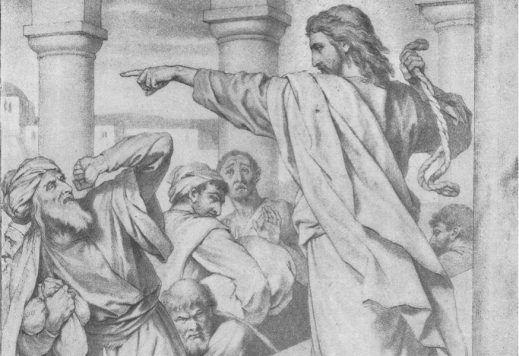
“And He entered the temple and began to drive out those who sold and those who bought in the temple, and he overturned the tables of the money-changers and the seats of those who sold pigeons. And He would not allow anyone to carry anything through the temple” (Mark 11:15-16).
Why did Jesus drive out those who sold and bought in the temple? Why did He flip over tables? That seems pretty extreme. Why was He so worked up? What was such a big deal? I mean in some ways the moneychangers actually helped people it would seem.
When I was in Germany, for instance, I had to go to the “moneychangers” to get euros. Without the moneychangers, after all, I would have had no schnitzel. Further, pigeons were sold. That is actually pretty convenient. Because who wants to have to haul a pigeon halfway across the known world? Not me. So, what was the deal with Jesus getting upset?
It seems that money was not the only issue. In fact, maybe not the biggest issue. Though, Jesus does mention that the moneychangers were essentially robbers (again, reminds me of the bank in Germany where I got my euros). But I think the bigger issue is what the Temple was intended to be and what it had become. It clearly was never meant to be “a den of robbers” but “a house of prayer.” A house of prayer “for all peoples,” it says.
The moneychangers were in the “Court of the Gentiles,” that’s basically equivalent to where Gentiles (non-Jews/”the nations”) would worship. As you can imagine that would obstruct worship. It would be a hindrance from Gentiles, “the nations,” from worshiping the Lord. This is the converse, as Jesus pointed out, of what Isaiah said: “my house shall be called a house of prayer for all peoples” (Is. 56:7).
Jesus brings blessing and salvation to all peoples but at the temple people were hindered from worshiping. That is why Jesus was furious. And rightly so. May we never be worthy of Jesus’ wrath for that same sin.
May we never prevent or hinder people from coming to the LORD, even if they are convenient or important things that we don’t want to give up. May we work to destroy unnecessary stumbling blocks. And may the church be a house and family that welcomes all people in!
Why is it important to sing hymns in worship?

Scripture exhorts us to sing “psalms and hymns and spiritual songs” (Eph. 5:19-20; Col. 3:15-17). The Westminster Directory of Public Worship concurs with Scripture and says, “It is the duty of Christians to praise God publickly, by singing of psalms together in the congregation.”
“Why do Christians sing when they are together?” Dietrich Bonhoeffer answers: “The reason is, quite simply, because in singing together it is possible for them to speak and pray the same Word at the same time; in other words, because here they can unite in the Word” (Life Together, 59). I think that’s an important point.
Notice that right before Paul says to sing “psalms and hymns and spiritual songs,” he says, “Let the word of Christ dwell in you [pl.] richly, teaching and admonishing one another in all wisdom” (Col. 3:16). So, singing ought to be part of the ministry of the word. We ought to sing the Bible. We ought to sing Psalms and we ought to also sing biblically rich songs. So, that’s in part why the Directory says our “chief care must be to sing with understanding.”
When we sing songs to God, however, we are not just thinking. We are not just singing for the sake of singing or just edifying each other. We are recounting God’s truth and goodness and being moved anew to thanksgiving (cf. Ps. 78).
Q&A: Many churches adopt confessions, why then do leaders and laypersons often stray from orthodoxy? What lessons can we learn from this?

Q. Many churches adopt confessions, why then do leaders and laypersons often stray from orthodoxy? What lessons can we learn from this?
A. Confessions are good and have biblical precedent. Humans, however, are fallen and as 1 Timothy 4:1 says, “some will abandon the faith and follow deceiving spirits and things taught by demons.” People are lovers of self rather than lovers of God (2 Tim. 3:2-4). That is why there are problems with heterodoxy and heresy, even where there are solid confessions in place. Confessions may not keep false teaching from emerging but it is helpful to have them in place to quench the spread (like gangrene) of unhealthy teaching.
One lesson we learn from the prevalence of unhealthy belief and teaching is the importance of qualified leaders. It is vital that pastors/elders be able to teach (1 Tim. 3:2) and correct opponents of the truth (2 Tim. 2:25). We also see the important place of church discipline. The church is set apart as the light of the world and the “pillar and buttress of the truth” (1 Tim. 3:15) if the truth is not proclaimed and protected by the church how dark will the darkness be?!
The second lesson is that churches must work hard to be watchful and stand firm in the faith (1 Cor. 16:13). If someone is contradicting orthodox teaching and causing division then they should be removed from the church community (1 Tim. 6:20-21; 2 Tim. 3:5; Titus 3:10). The church is to be the set apart people of God (Eph. 1:4; 5:27). Thus, Paul writes “stand firm and hold to the traditions that you were taught by us, either by our spoken word or by our letter” (2 Thess. 2:15).



 in X
in X 