Free e-Book
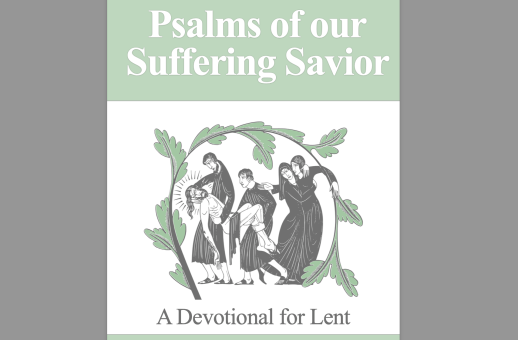
In preparation for Easter, I put together a devotional book. If you don’t have something to go through, I encourage you to check it out.
Here’s the link to the free e-book, I hope you find it helpful: Psalms of Our Suffering Savior
Crying On Christmas Day

A lot of us know the cheery and upbeat Christmas song, “I Heard the Bells on Christmas Day.” Many people don’t know Henry Wadsworth Longfellow’s story and poem behind it. Longfellow heard the bells ringing out from a nearby church on Christmas Day, 1863, and heard the happy chatter of the crowds and composed his poem. But the world seemed anything but peaceful and cheery. It was shattered. He had recently lost his second wife to a fire, the Civil War was raging, and his son had just been wounded in battle.[1]
Longfellow said, “How inexpressively sad are all holidays!” “Perhaps some day God will give me peace.”[2] The song versions of Longfellow’s poem don’t capture the bleak despair he was facing but the Civil Wars version comes close. Here are the two last verses of the poem:
And in despair I bowed my head;
“There is no peace on earth,” I said;
“For hate is strong,
And mocks the song
Of peace on earth, goodwill to men!”Then pealed the bells more loud and deep:
“God is not dead; nor doth he sleep!
The Wrong shall fail,
The Right prevail,
With peace on earth, goodwill to men!”
Many bow their heads in despair and say, “There is no peace on earth.” Many people are sad on Christmas Day for various reasons—whether death, divorce, or some other devastation—but sadness is no stranger to Christmas.
Other than “It’s A Wonderful Life,” most Christmas movies are silly, not very serious, and not sad. But the original Christmas story, the true Christmas story, is anything but silly. Jesus was born in an animal troth and was thought by many to be an illegitimate child.
The very reason the Bible says Jesus had to come to earth is sad. Jesus’ very name means, “the Lord saves.” And that is indeed what Jesus came to do, save His people from their sins and the sad situation they had gotten themselves into.
Jesus came into the brokenness and blight of the world. As the Christmas song, “O Holy Night,” says,
The King of kings lay thus in lowly manger,
In all our trials born to be our Friend.
He knows our need— to our weakness is no stranger.
Jesus can sympathize with us (Hebrews 4:15). Jesus understands death and devastation, not just in the way that He knows everything as God, but by experience. Since human beings are made of flesh and blood, Jesus Himself became flesh and blood (John 1:14; Hebrews 2:14), and is acquainted with the stress and sorrow we face.
We don’t always have to be happy-clappy at Christmas. Rather, the Bible says:
There is a time for everything,
and a season for every activity under the heavens:
a time to weep and a time to laugh,
a time to mourn and a time to dance,
a time to tear and a time to mend,
a time to be silent and a time to speak (Ecclesiastes 3:1,4,7).
More Christmas songs than you might realize, understand our plight and pleas for rescue. Here are a few lines from one of my favorite songs, “O Come, O Come Immanuel”:[3]
…free Thine own from Satan’s tyranny
From depths of hell Thy people save
And give them victory o’er the grave
…Disperse the gloomy clouds of night
And death’s dark shadows put to flight
…open wide our heavenly home
Make safe the way that leads on high
And close the path to misery
…O come, desire of nations, bind
In one the hearts of all mankind
Bid Thou our sad divisions cease
And be Thyself our King of peace
We don’t know the exact timing of Jesus’ birth, but it would be fitting if it was a dark cold night. This world is often dark and cold. But Christmas is about Jesus coming into that cold black darkness, relating to us, and bringing life, light, and warmth. In Jesus, “The people who walked in darkness have seen a great light; those who dwelt in a land of deep darkness, on them has light shone” (Isaiah 9:2).
The reality is, that Christmas is about light in darkness and hope amid grief. But Christmas is not lite, and it’s not just about laughter and “ho, ho, ho.” The Bible tells a gritty, realistic story about this broken world. But it also gives hope. It gives:
a bell ringing out in the silence
a light in the midst of darkness
snow silently falling on the black muddied earth
sunrise cresting the top of the trees
reminders that there is change
a new day ahead.
The Bible says that God does not sit idly by, but rather enters the fray. Christmas proves that God so loves the world. We may not always feel light, but He gives the offer of life. When we feel heavy and hollow, He offers to lift our load and give purpose.
Longfellow was sorrowful. His life was shattered. But what if Jesus came to earth to be shattered so that one day you could be mended and whole? And what if He promises to help pick up the pieces and make a masterful mosaic?
What if, in our muddled mess, Jesus the Messiah came? Came to love us and help us heal? What if He loves us? And says, “Come to Me, all who are weary and heavy laden. Come to Me, I have walked the weary road of life, I get it, I understand your strife.” Jesus says, “Come to Me, all who are empty and exasperated. I will give you rest for your souls.”
May God bless each of you this Christmas and in time, help you make a beautiful mosaic out of the shattered shards of life.
Notes
[1] He lost his friend, Nathaniel Hawthorne, around a year later.
[2] See “I heard the bells on Christmas Day.”
[3] Immanuel means “God with us.”
Photo by Abigail
How I Survived My Divorce

By Becky O’Brien
For a long time, I didn’t think I’d make it.
I was scared, not knowing how I could manage without a husband and dad in the home for our 10 kids. I was angry. This was not the way it was supposed to be. I prayed that God would help our marriage but didn’t really believe it. So, then I felt guilty.
It is hard to really go back to remember the pain and the rejection I felt. Today I am sitting far down the road—25 years after the separation. I am at the midpoint. I was married just short of 25 years.
We were separated for a long time, 6 years. When we were first separated, I had been a Christian for 11 years. But I loved the Lord and desired to follow Him with all my heart. Every time I read the Word, I would write down verses that spoke to me, memorizing or hiding His word in my heart as I could.
God’s Word
I knew God is sufficient and His power is made perfect in weakness (2 Cor. 12:9). Really getting a hold of that truth was so helpful. I would also often read and meditate on Zephaniah 3:17:
The Lord your God is in your midst,
a mighty one who will save;
he will rejoice over you with gladness;
he will quiet you by his love;
he will exult over you with loud singing.
God’s word was the light in my darkness. God’s word was the steady rhythm of truth, amongst a cacophony of lies.
The Church
Because of the situation, we (my children and I) went to a new church. It was mandatory. My husband had been the pastor of the church we had been attending. Not everyone liked the new church at first, but we grew to love it and became a vital part of it. I am so thankful that we were loved and well cared for. We were included, involved, and blessed in many ways.
I am thankful that I have the gift of hospitality and used it by inviting church brothers and sisters to my house, which provided a way to bond and share burdens (because we all have them). It was a way that I felt included in relationships with men and women, both in healthy ways. I missed relating with and communicating with a man. I also enjoyed a mixed Sunday School class where I could have fellowship with families which also provided an example to my children.
In our new church, the pastor and saints loved on us, prayed for us, engaged us, and helped us with physical needs (in very big ways!). I remember standing in the parking lot after church talking and being ministered to; our children played, as we prayed.
Joy
During the long, lonely nights, I would pray—drawing close to my friend who is closer than a brother (Prov. 18:24). I still pray a lot at night.
In the hardest of times, I felt the greatest joy. “The joy of the Lord is my strength” (Neh. 8:10).
I hated the hurt but loved the joy. I knew God was with me. You could not ask for more—but then the “nuts and bolts” of life! It was a roller coaster at times.
Later, when I was farther down the road, and things were going well, and I was more secure, I would long for the joy I experienced when things were so difficult. I experienced the reality of Psalm 46:1, “God is our refuge and strength, a very present help in trouble.” I experienced the joy of knowing that the God of the universe was carrying me and caring for me.
Contentment
I was always looking for my husband to return. I remember one time, early on, I thought I heard him come in—someone was talking in the kitchen. I went in expectantly and was crushed when it was the neighbor.
I would always be looking for his car to turn into the driveway. That went on for years. Finally, that is only a memory.
I also remember him picking up the kids for a visit or calling them, and I was jealous sometimes, even angry, because I wanted him to want to see me.
Remembering my yearning for love and care and desire to have a mate… It took a long time to be “content in all things.” It took longer than I now remember. That leads me to share another verse:
Not that I am speaking of being in need, for I have learned in whatever situation I am to be content. I know how to be brought low, and I know how to abound. In any and every circumstance, I have learned the secret of facing plenty and hunger, abundance and need. I can do all things through him who strengthens me (Phil. 4:11-13).
How I clung to this verse. It became my focal verse to remind myself of all the time! I worked hard to cast all my cares on the Lord, remembering that He cares for me (1 Pet. 5:7). And I looked to Jesus (Heb. 12:2); oh, how I looked to Jesus.
Jesus the Great Healer
God used my hurting, emptiness, and desperation to draw me into an intimate love relationship with Him. I was not an easy case. For a while, I looked for God in all the wrong places (including another man, food, and other people) to fill what I was really seeking—that intimate relationship with the God of the universe. The God that was real to Moses, David, and Noah. The road was rough, but it was how I grew in intimacy with my Father, my Abba Daddy.
I sorrow over hurting people and desire their salvation. No wonder people turn to the bottle and drugs. I understand—to numb the pain. I am so thankful I had and have Jesus!
We have a Great Healer. I remember having a decorative wood heart that was in two pieces with some kind of metal piece holding the two pieces together. It was very symbolic to me of my broken heart and of the Great Physician’s healing work. He does great heart surgery, by the way. But the healing period is very slow and there’s still some pain along the way.
Incidentally, after hearing of a sweet friend (not close, but dear) who had a broken heart, I passed that on to her. I rarely see her, but recently, after many years, she told me she still has it and thinks of me still. A broken heart will do that. Sometimes the Great Physician uses us as His nurses in His healing work.
Blessed be the God and Father of our Lord Jesus Christ, the Father of mercies and God of all comfort, who comforts us in all our affliction, so that we may be able to comfort those who are in any affliction, with the comfort with which we ourselves are comforted by God (2 Cor. 1:3-4).
So, how did I survive my divorce? I clung to Jesus and His Word. Or rather, they clung to me. They held me although my husband didn’t.
Is the world broken?

Have you ever thought about the problem of evil and suffering? Have you ever asked, “Why is the world so cruel?”
My daughter came to me crying. “Why do Mom and Lyla have to be sick? If God exists and is good, why is there suffering?”
As I thought about how to answer, tears came to my eyes and an image came to my mind, a shattered platter. By looking at the shattered shards you could tell the platter used to be ornate and beautiful. Upon reflection, that seems like an accurate picture of the world. It certainly seems broken, but yet it has clear traces of beauty.
What happened? How did the platter get that way? If the platter is broken, it seems to make sense that it was previously whole. Otherwise, it would not be broken; it would just be. The shattering, the brokenness, is just the way the world is. There, then, was no previous better state, nor should we expect a future better state.
So either the brokenness of the world assumes a previous state of the world that was whole and good, or there is no wholeness, only shattered shards that were never part of a whole and never will be. Everything is either light with little pockets of darkness, or everything is darkness with little pockets of light.1
Are beauty, goodness, and love innate, or are they random meaningless sparks in a universe that is growing cold? A world without God may have a few pockets of light, but chaos should be expected.2 If God exists, however, and Christianity is true, then chaos is not the final state of the world.
We intuitively sense that the world is broken. We feel it in our bones metaphorically, and some of us feel it literally. How could the world be broken if it was not at some point whole? It seems, therefore, we can make a deduction from the broken state of the world to the original good design. Or else our hope and intuitive sense that something is wrong is wrong.
Whole
The Bible says God created the world whole. The original creation was very good (Genesis 1:31). The platter was ornate and beautiful, so to speak. No disease or need for dentures. No sin or suffering. No turmoil or tears. No fighting or fears. No death and no destruction.
Christians believe “the bedrock reality of our universe is peace, harmony, and love, not war, discord, and violence. When we seek peace, we are not whistling in the wind but calling our universe back to its most fundamental fabric.”3 Christians believe in evil, and they believe it’s a problem. The world was not supposed to be a place of suffering. Evil and suffering are not a hoax, but they don’t have a place in God’s good intentions. The world is broken.
Broken
The platter shattered. The world broke. Sin unleashed suffering, disease, destruction, and death. The brokenness of the world and the messed up nature of humans are teachings of Christianity that can be confirmed by turning on the news.
Christianity explains the origin of the problem of evil and suffering and makes it clear that it is a problem. That is, Christianity says suffering is not innate in the way the world was supposed to be. And Christianity traces the problem of suffering to a historical cause.
Christianity not only says there’s something wrong with the world, it says there is something wrong with humans, with you, and with me.4 It’s not easy to admit our faults, but to deny there is anything wrong with humanity is to say that this is as good as it gets.5 That, also, is not a happy conclusion. Better to face reality head-on than to stumble in a land of make-believe.
Naturalism, in contrast, does not seem to give a sufficient answer, other than suffering is just the way of the world. We’re essentially animals, so we’re going to be animalistic, and so suffering will result. We’re in a world of chaos and chance, so the world will be chaotic. There is no real problem of suffering, there’s an expectation of suffering. Or, there should be. And for naturalists, there is no category for evil.6 Evil gives off no kinetic energy. There is no entity to evil. Various people may have opinions, likes, and dislikes, but from a strictly naturalistic perspective, there is no evil.
Another problem is that “modernity cannot understand suffering very deeply because it does not believe in suffering’s ultimate source.”7 Modernity will then never find the true answer to suffering. If I fix a leaky sink in my house because I notice a puddle and mold, that may be helpful, but it will not fix the problem if the problem is a leak in the roof. If we don’t know the origin of a problem, there is no hope of fixing the problem. We will be left with external shallow bandages. As I say elsewhere, naturalism cannot truly identify evil as a problem because evil, for naturalism, does not exist. If evil is not seen as a real problem then it certainly can’t be solved.
As Peter Kreeft has said, “If there is no God, no infinite goodness, where did we get the idea of evil? Where did we get the standard of goodness by which we judge evil as evil?”8 Or here’s how C.S. Lewis said it: “My argument against God was that the universe seemed so cruel and unjust. But how had I got this idea of just and unjust? A man does not call a line crooked unless he has some idea of a straight line. What was I comparing the universe to when I called it unjust.”9
The Bible says sin and suffering are not original to the world; sin and suffering have a beginning in history, and they are not a feature of humanity or the world as originally created.10 That is good news. We do not have to be left in our broken state. We sense that not all is right in the world or in our own hearts and lives. The Bible agrees. Yet, that is not all; it says there is a solution.
The Broken Healer
While writing this, my daughter came into the room and said her bones hurt. That is part of her condition. She has CRMO, which stands for chronic recurrent multifocal osteomyelitis. Basically, her body attacks her own bones, inflammation causes liaisons and fractures her bones, which can lead to deformity. It could stop harming her body when she stops growing, or it could continue her whole life. She currently gets infusions at Nationwide Children’s Hospital in hopes of putting it in remission.
How does Jesus relate to her pain? As Jesus’ biographies relate, “Jesus on the night that He was betrayed took the bread and broke it and said, ‘This is my body which is broken for you’” (1 Corinthians 11:23-24). Jesus was broken for her. Jesus’ bones did not break (John 19:36; Exodus 12:46; Psalm 34:20), but His body did. He did writhe in pain. Jesus may not heal all our brokenness now, but He was broken so that the fractured world could be healed.
The Bible says God took on human flesh (John 1:1-3, 14) partly to experience suffering Himself. God, therefore, understands suffering, “not merely in the way that God knows everything, but by experience.”11 Jesus became fully human in every way so that He could be faithful and merciful, and provide rescue and forgiveness to people (Hebrews 2:17). The Bible may not completely answer the mystery of suffering and evil, but it does give an answer: Jesus. Amid the struggles and psychological storms of life, the cross of Christ is a column of strength and stability. It signals out to us in our fog: “I love you!” The cross is the lighthouse to our storm-tossed souls.
Christianity teaches that the Potter made the platter and was heartbroken over it breaking. So, because of His love for the platter, the Potter allowed Himself to be broken to fix the broken platter (John 3:16). The Bible does stop with the Potter being broken. The Bible concludes with resurrection. Jesus dies, yes. But He does not stay dead. The shattered shards are mended and whole. Jesus is the foretaste, and His rising proves that the whole world will be put back together.
Healed and Whole
The mathematician, scientist, and philosopher Blaise Pascal wrote this thought, which, at first, is a little confusing: “Who would think himself unhappy if he had only one mouth, and who would not if he had only one eye? It has probably never occurred to anyone to be distressed at not having three eyes, but those who have none are inconsolable.”
What does Pascal mean by this? He means that we only miss something if it’s missing. We only miss something if it’s gone. We don’t notice an absence of things that were never there. Hunger points to food, thirst points to water, and a sense of brokenness points to a previous wholeness. As Peter Kraft has said, “We suffer and find this outrageous, we die and find this natural fact unnatural.” Why do we feel this way? “Because we dimly remember Eden.”12
Within our very complaint against God, there is a pointer to God and the reality of Christianity. Christianity gives a plausible explanation as to how the brokenness of the world happened in space and time history. But it also gives us a credible solution; the Potter who made the world and died for the world, promises to one day fix the world.
Christianity gives a logically consistent explanation for the brokenness of the world. And it supplies the solution. We certainly long to be healed and whole. Every dystopia, true and fictional, starts with a desire for utopia. But inevitably dissolves into dystopia. Jesus, however, is not only all-powerful and thus able to bring about a different state of things, He is also all-good so He actually can bring about a utopia. He can heal and make the world whole.
The Bible says that the Potter who formed the platter will reform and remake it in the end. The shattered shards will be put back in place, and everything will be mended and whole. The last book of the Bible says this:
‘Look! God’s home is now among people! God will live together with them. They will be his people. God himself will be with them and he will be their God. God will take away all the tears from their eyes. Nobody will ever die again. Nobody will be sad again. Nobody will ever cry. Nobody will have pain again. Everything that made people sad has now gone. That old world has completely gone away.’ God, who was sitting on the throne, said, ‘I am making everything new!’ (Revelation 21:3-5)
For now, we make mosaics out of the shattered shards of life. We paint as best we can with the canvas and colors we have.
Conclusion
We started with a few questions. Here are a few to consider at the end. What if you are not the only one that has walked your path of pain? What if you are not the only one that has faced your terrible trauma? What if there was someone who, because of their experience, knowledge, wisdom, empathy, sympathy, and their own suffering of trauma, could relate to all that you have gone through? What if that person loved you? What if they wanted to help you heal from your pain and protect you? What if they would go to any length to free you from what you have suffered?
What if the problem of evil gives a plausible argument for the reality of Christianity? What if naturalism does not even have a way to believe in the reality of evil? What if we do not like God because of all the bad things in the world, but God Himself actually took the bad things of the world on Himself to fix the broken world?
What if Jesus was shattered so that one day you could be mended and whole? And what if He promises to help pick up the pieces and make a masterful mosaic?
Photo by Evie S.
- Peter Kreeft, Making Sense Out of Suffering. ↩︎
- As Christopher Watkin has said, “in a world without the sort of god the Bible presents, there is no necessary stability to reality because nothing underwrites or guarantees the way things are” (Biblical Critical Theory: How the Bible’s Unfolding Story Makes Sense of Modern Life and Culture, 225). ↩︎
- Watkin, Biblical Critical Theory: How the Bible’s Unfolding Story Makes Sense of Modern Life and Culture, 55. ↩︎
- As N. T. Wright has said, “The ‘problem of evil’ is not simply or purely a ‘cosmic’ thing; it is also a problem about me” (N. T. Wright, Evil and the Justice of God, 97). ↩︎
- Watkin, Biblical Critical Theory, 166. ↩︎
- Consider that “Physics can explain how things behave, but it cannot explain how they ought to behave. If the universe is the result of randomness and chance, there’s no reason to think things ought to be one way as opposed to another. Things just are.” (Michael J. Kruger, Surviving Religion 101: Letters to a Christian Student on Keeping the Faith in College, 116-17). ↩︎
- Peter Kreeft, Making Sense out of Suffering. ↩︎
- Ibid. ↩︎
- C. S. Lewis, Mere Christianity (London: Fontana, 1959), 42. ↩︎
- See Watkin, Biblical Critical Theory, 168. ↩︎
- D.A. Carson, How Long, O Lord?: Reflections on Suffering & Evil, 179. ↩︎
- Kreeft, Making Sense out of Suffering. ↩︎
Health and Healing, Sickness and Suffering

Health and Healing, Sickness and Suffering
When it comes to health and healing, and sickness and suffering, there are a lot of questions and a lot of confusion.
This topic hits home for me because I serve as Care Pastor at Crossroads Church. But, more than that, it hits home because it is home. All the time. My wife has various diagnoses all adding up to making her chronically ill.* That is, she’s sick. She’s sick a lot; more or less all the time.
Does God want us to be healthy and happy? Then why is there suffering and sickness? And why are some people healthy and some people sick? Why is my wife sick? Did she do something to deserve it? Did I do something? Do we lack faith?
The answers to these questions are not simplistic. They are complex. And they are mysterious. It’s always good to remember that God as God is not like us. His ways are higher than our ways, and His thoughts are higher than our thoughts (Is. 55:8-9). That shouldn’t be surprising for us since He’s God, but it is vital that we remember that truth.
So, why sickness and suffering?
Sickness and suffering?
First, we should acknowledge how big and how relevant that question is. People have been asking this question for eons. The Bible gives some very valid and convincing reasons (especially when understand in the context of redemptive history).
Why sickness?
The Fall (sin in general, natural evil)
Sickness was introduced into the world as a result of sin (Gen. 3). When God made the world, it was very good (Gen. 1:31). So, sickness is an intruder. Sickness is not welcome and will not always be in the world. But it is certainly here now. Now in the natural course of the fallen world, people get sick and they die, and people die as a result of old age (Gen. 5 [notice the refrain of “and he died”], 48:1, 21).
Individual Sin (specific personal sin, moral evil)
Sometimes sickness is a result of a specific personal sin (1 Cor. 11:28-30). Of course, all sin leads to separation from God and death. But some sins bring especially pungent consequences. Some sins, as 1 Corinthians says, are against our own bodies (1 Cor. 6:18). Some sickness results from disobeying God (Ex. 15:26). It seems king David himself experienced the physical consequences of sin (Ps. 32:3-4; 38:3-5).
Demonic Forces
From reading the New Testament it seems clear that some sickness is a result of demonic forces. The Gospel of Mark talks about a young boy that has “a spirit that makes him mute” (Mk. 9:17-18 cf. Lk. 11:14). The Gospel of Luke talks about a woman that had a disabling spirit for 18 years (Lk. 13:11). Acts 10:38 tells us that Jesus “went about doing good and healing all who were oppressed by the devil” (cf. Matt. 8:16). Yet, Luke also distinguishes between the casting out of demons and healing (see Lk. 4:40-41) and thus shows that not all sickness is due to demonic forces. When we take into account the points below, it is clear that not all sickness comes from demonic forces.
For God’s Glory
Scripture also explicitly tells us that some sickness is for the glory of God. The most cogent and explicit is the story of the man born blind. Jesus says that the man was not born blind because of sin but instead “so that the works of God would be displayed in him” (Jn. 9:3).
Even the death of Lazarus was for the glory of God, so that Jesus might be glorified through it (Jn. 11:4). And Paul’s “thorn in the flesh,” whatever it was, was so that the power of Christ would rest upon him (2 Cor. 12:7-9).
In these examples, sickness was not a result of sin or a lack of faith. Sickness was for the glory of God.
We don’t always know why
At other times we simply do not know for sure what the reason for the sickness is. In Philippians 2:25-30 we see that Epaphroditus, a faithful co-laborer of Paul, was so sick he nearly died. Yet, we are not given a reason for his sickness. And we have no hint at all that it was because of lack of faith or because of a personal sin. And in 2 Timothy 4:20 we see that Trophimus is left in Miletus.
Paul was an apostle, had faith, and had healed others (Acts 19:11-12; 2 Cor. 12:12) and yet that didn’t guarantee that people—even his close and faithful co-workers—would be healed. We know God, by His Spirit, can heal and we can certainly pray that He will. But prayer and even the gift of healing is not a mechanism that we can simply push and guarantee that healing will be the result. God is sovereign over sickness. And for whatever reason, He doesn’t always heal. We don’t always know, as Paul the Apostle didn’t know, why some are healed, and others aren’t. But, just like Paul, we must trust God. He is good. And He has explicitly and repeatedly demonstrated His goodness.
So, sickness is clearly not always a result of sin or a lack of faith.
What should we do when we’re sick?
Look at James 5:13-18. Notice first that before it talks about healing it talks about patience in suffering (v. 7-11). So, even in the context of asking for healing, there is an expectation of suffering.
Next, notice that whatever situation we are in, good or bad, we are always to go to the LORD in it, with praise or lament (v. 13). Then we see what we are to do if we’re sick. First, we need to realize our need. That is what leads to the calling of the elders. So, humility is necessary. When we are sick, we should realize our need.
Second, we are to realize that our need is not just physical, but spiritual. That is why we call for the “elders of the church.” And that is why we ask for prayer. Prayer is a supernatural beseeching of God; it’s going to God as Father and asking for help.
Third, I think the “anointing” with oil could have at a least a twofold significance. In the Old Testament the king would be anointed with oil and that symbolized the Spirit’s presence and blessing. Oil was also used for medicinal purposes (Mk. 6:13) or used as shorthand for medicine as we see when the Good Samaritan took care of the wounded man (Luke 10:34). Therefore, in anointing with oil we are calling on the Spirit to work and we are also confirming the goodness of medicine and imploring God to make it effective to heal.
Fourth, sickness uniquely reveals that we are but dust, that we soon pass away and are no more (Ps. 39). Yet, the “prayer of faith will save the one who is sick, and the Lord will raise him up” (v. 15), even if it is on the last day that he is raised up (Jn. 6:39-40, 44, 54). I don’t believe this passage means that just because the elders prayed over someone, and they had faith, they will be healed. But I do believe the prayer of faith saves. I believe this because that’s what the Bible teaches elsewhere (Jn. 3:16; 1 Jn. 1:9). Also, as we have said, some sins uniquely lead to sickness. If someone commits one of those sins, they too can be forgiven (v. 15), but that doesn’t necessarily mean they will be healed.
But, fifth, we do have a strong encouragement to confess our sins and pray for one another that we may be healed (v. 16). We know from elsewhere that sin can hinder our prayer (1 Pet. 3:7). It is the prayer of a righteous person that has great power (James 5:16). Just because people are not always healed when we pray does not at all mean they cannot be healed when we pray. James 5:17-18 goes to great lengths to tell us that Elijah was a normal enough guy and yet God moved mightily through his prayers.
So, when we’re sick, we must realize our utter need; we certainly cannot heal ourselves. We should realize the nature of our need as well as who it is we need help from: supernatural help from God. And we should realize that medicine although good, is no good apart from God’s intervening grace. So, even in our use of medicine we must be reliant and thankful to the Lord. If we have unconfessed sin we should confess and repent, knowing that sin can lead to sickness. Lastly, we should pray in faith knowing that God can and does heal.
We should seek the Lord and medical help
I believe that it’s important that we seek the Lord and medical help. We must remember that every good gift comes from the Father (James 1:17). And so, we should receive our Father’s good gifts with thanksgiving (1 Tim. 4:4).
Yet, it is vital that we not just seek out medical help and not seek the help of God. He’s God! He holds every molecule together. It would be utterly foolish to seek out the help from a person who has limited knowledge on a limited number of things, and not seek out God—the All-Knowing-One.
As great as Asa king of Judah was, this was one of his main sins. Second Chronicles 16:12 tells us that “Asa was diseased in his feet, and his disease became severe. Yet even in his disease he did not seek the LORD, but sought help from physicians.” That’s sad. And that’s foolish.
We should not follow Asa’s example. Rather, we should follow what I propose is the biblical example. We should seek the Lord and we should seek out the good physicians He has graciously provided. Paul even tells Timothy to make use of wine for help with a stomach problem (1 Tim. 5:23).
Does God promise health and healing?
Yes and no
In the story of Scripture, the story of Christ’s cosmic rescue, it starts out and the world is flawless, there’s no suffering or sin. But then the cosmic problem comes in. There’s a tear in time, a warp in the world, a curse in the cosmos. And it’s all because of sin.
Yet, the story of Scripture is the story of Jesus—God in flesh—coming to fix the broken world. The story starts in the Garden with God, and it ends in the Garden with God. It starts with no pain, suffering, sin, or sickness, and it ends that way.
Revelations 21 tells us of the glorious reality of God the Father wiping ever tear from all of His children’s faces. We, however, are not at that place in this true cosmic story.
Yes, that will happen—no suffering, sin, sickness, sadness, or death. But we are not there yet.
Yes
Yes, the LORD both forgives iniquities and heals our diseases (Psalms 103:3-5), but that doesn’t mean that the effects will be fully felt at the same time. For instance, the LORD has not yet brought “justice for all the oppressed” (v. 6). But that will happen. Jesus will bring complete justice. Jesus will satisfy His people with good thingsand He will renew our youth (v. 5). But not yet.
We are forgiven and welcomed into the Kingdom in and through Jesus Christ and yet we are not yet in the full realization of the Kingdom. It is true that Jesus has “took our illnesses and bore our diseases” (Matt. 8:16-17; Is. 53:4). And our main illness and disease is that of sin and in taking that on Himself He enables access to the New Creation in which there is no illness or disease.
As Sam Storms has said, “To whatever degree we experience healing in this life, it is the fruit of Christ’s atoning death.” It is by Jesus that we receive the undeserved grace of God, and God taking our illnesses and diseases is certainly undeserved. “But it doesn’t necessarily follow that where there is atonement there is immediate healing.”
That’s a biblical and verifiable reality. Paul, Epaphroditus, Trophimus, and many other faithful Christian brothers and sisters have had their sins bore by Jesus and thus been accounted righteous (Is. 53) and yet died with various sicknesses. Therefore, Jesus’ atoning and propitiatory death does not equal healing in this life.
There’s also another real sense in which “yes, God wants us to be healthy and happy.” That’s part of why God gives His good commands, so that it may go well with us (Deut. 4:40; 5:29, 33; Eph. 6:3). Yet, following God’s commands does not in any way guarantee that things will go well with us from an earthly perspective. Just look at Jesus’ 12 disciples…
No
Does God promise health and healing? No. Not in this life. However, because of the love of God in Christ Jesus we know that in spite of sickness we have a surpassing hope. We know that all things will actually work together for good (Romans 8:28, in context).
“This light momentary affliction is preparing for us an eternal weight of glory beyond all comparison, as we look not to the things that are seen but to the things that are unseen. For the things that are seen are transient, but the things that are unseen are eternal. For we know that if the tent that is our earthly home is destroyed, we have a building from God, a house not made with hands, eternal in the heavens. For in this tent we groan, longing to put on our heavenly dwelling, if indeed by putting it on we may not be found naked. For while we are still in this tent, we groan, being burdened—not that we would be unclothed, but that we would be further clothed, so that what is mortal may be swallowed up by life” (2 Cor. 4:17-5:4).
God does not promise health in healing in this life. In fact, persecution and plague are very likely to await us. That’s what Jesus repeatedly said (see The New Testament on Suffering). Yet, we are “waiting for new heavens and a new earth in which righteousness dwells” (2 Pet. 3:13). This place is not our home. And our current bodies are not our final bodies (1 Cor. 15:35-49).
Conclusion
As you can see, a simplistic answer to the question of sickness and healing will not suffice. Yet, God gives the answer. And the answer is Jesus Christ the Lord. But the answer may be “yes” now, and it may be “no” now, but for all who trust Jesus it’s a “yes” later. Healing will happen. Suffering will cease. But that doesn’t mean it will happen now.
____
*Lyme disease, POTS, EDS. And as of this writing, she has COIVD-19 which is not good to mix in with all of her other health issues.
The Chasm of Being a Latino Christian

Why am I Latino?
There have been many moments in my life where I have wondered, “Lord, why am I Latino?” Maybe it is not a common question, but for me, it made the difference in me understanding the core of who I am and who I should be. I have wondered. I have waited and sought answers from people, books, and reflected—hoping and yearning, to understand why. Being Mexican, coming to faith in a Chinese heritage church, pastoring at a majority white church, I have always felt different. Different simply because I did not always look the same as my brothers and sisters around me, and I felt like something was missing.
People often talk about how culture often influences being able to feel at home in a church, but in my case with my ethnic heritage, I have been able to look past those things and have found a home in the unknown and new. Going from big city to rural, I have remained open to all in which God has called me to. And I have found comfort in the new and have become more aware of how my upbringing allows me to minister to the body of Christ in ways that only I can, and that is a blessing.
Without trying to sound proud, I am grateful and humbled that Jesus would choose a sinner like me, broken and in the process, to serve Him and His people in this capacity despite whatever my upbringing might have been. But I still desire to understand why.
The Chasm
In my seeking, I was meeting with one of my professors and he pointed me to Mañana by Justo Gonzalez. The book examines different beliefs in theology through the lens of the life and history of Latin America and the Latinos that inhabit it. I had not met many Latino Protestant Christians and I was looking to see if there were any authors who could provide insight into my question. Surprisingly, I was drawn to tears by this statement made about Latinos converting to Protestantism: “It is often a traumatic break that brings about much suffering.” I had no idea how true this statement was for me. From the very moment of conversion, I have felt something like this.
I had to tear myself from the customs of my family that had persisted through generations. Having been brought up Catholic I had to remove myself from things like the veneration of Mary, praying to the saints, praying the rosary, and attending mass. These things and more, had more stock in my life than I had realized because in rejecting those things I no longer was able to share that part of life with my family.
This is where the chasm formed between the culture in which I grew up in and the road I walk as a believer. I separated myself from the things that go against Christ’s sacrifice for me and that would pull me away from Him and in the process, it tore me from the generations of traditions of my heritage. I never knew how to navigate that and am still in the process of figuring those things out. However, in the intersection of culture and Christianity, I have found Christ’s redemption of it. Christ is the author and perfecter of all the happenings that led to the point of my conversion and beyond. All the events that transpired before even my birth were somehow to bring God glory in the renewed life I would one day have. I’m grateful and I’m privileged to think that I have the honor of being the first Christian in my family. And I look forward to continuing this journey and refining the idea of what it means to be Latino in light of Jesus Christ.
I know that the seeking does not end here. Nor does it simply end in the reflection of a single blog post. It will probably take an entire lifetime of hardship, unpacking baggage, pressing into the uncomfortable to understand how my ethnicity will influence my life. I rest assured, however, knowing I have the hope that Christ will see me through all of it, even if I do not get to the bottom of why I am Latino. Only the Lord knows.
In Christ,
A.R.
*Photo by Tiago Aguiar
Songs for the Suffering

Here’s a list of songs that my family has found helpful and comforting as we’ve faced various forms of suffering:
It Is Well
Be Still My Soul
He Will Hold Me Fast
Relief
Sustainer
Reckless Love
Lead Me To The Rock
I Will Never Leave You Alone
__
If you’re interested here’s my thoughts on singing songs of ministries that you disagree with.
*Photo by James Barr
How to Die Well

We are all going to die. But that does not mean that we are all going to die well. If we are going to die well, first we must remember death (memento mori).[1]
Second, we must look to and learn from Jesus. Jesus, as the perfect Son of God, lived and died well. We’d be wise to take our cues in life and death from Him. Below are eight ways we can die well.
Anticipate
“…Jesus knew that His hour had come to depart out of this world to the Father…” (John 13:1).
We don’t always know when we’re going to die, but we do know we will die (Heb. 9:27). It is wise to anticipate and expect it and try as best we can to be ready for it by God’s grace and for His glory.
I think we best anticipate our death by living each day as if today may be our last day. The truth is, we could meet our Maker today.
Believe
“Believe in the Lord Jesus, and you will be saved” (Acts 16:31).
That’s number one. That’s most important. Amazingly, God loved the world, the broken, fallen world, so much that He sent Jesus into the fractured world, so that whosoever believes in Him would not forever perish but rather of eternal and abundant life (John 3:16). So, if you have not trusted in Jesus and repented of your sins, do so today. Today is the day of salvation. Tomorrow is not guaranteed.
Love
Jesus “loved His own who were in the world” and “He loved them to the end” (John 13:1).
Being ready to die well means living in love. Jesus loved to the end. Dying well for us too means loving until the end.
Forgive
Jesus, from the cross, said, “Father, forgive them, for they know not what they do” (Luke 23:34).
How can we hold unto hurts in life, when Jesus forgave from the cross? How can we hold unto hurts in life, when Jesus forgave at the cost of His life?
Jesus modeled forgiveness from first to last—He came to earth to forgive and left forgiving. How can we who have been forgiven, not forgive (Matt. 6:7-15; 18:21-35)?
Tell
Jesus said, “Truly, I say to you, today you will be with me in paradise” (Luke 23:43).
Even as Jesus took upon Himself the worst ordeal that we can fathom and that was completely undeserved, He still had the good news of salvation on His lips. The one true King hung on the cross—a perfect rose between two criminal thorns—and shared the message of salvation with the underserving.
If the message of salvation was on the King’s lips on the cross, how much more should it be on ours?! So, if we are to die well, we must tell well. We must share the reason for the hope within us (1 Peter 3:15). We must share the reason why even while we grieve, we have hope (1 Thess. 4:13-18).
Provide
“When Jesus saw His mother and the disciple whom He loved standing nearby, He said to His mother, ‘Woman, behold, your son!’ Then He said to the disciple, ‘Behold, your mother!’ And from that hour the disciple took her to his own home” (John 19:26-27).
Jesus cared for His mother and so He made provisions for her. If we are to die well, we, like Jesus, will make the necessary provisions to care for our loved ones. This does not mean that those provisions need to be lavish and lush, but I do think we should do what we can to help those in our care.
Trust
Jesus called out with a loud voice: “’Father, into your hands I commit my spirit!’ And having said this He breathed His last” (Luke 23:46).
In Jesus’ dying breath He did what He had always done, He breathed in and breathed out trust (Matt. 6:25-34). God has proven Himself in life, we can trust Him in death. Further, Jesus died and was raised to life to bring us to God and thereby Jesus proved that God is truth worthy.
When we trust God in life, it prepares us to trust Him in death. We must all pass through “the Jordan” but we’re helped when we recall God has been with us the whole journey. So, may our dying breath and our last mind glimmer be one of trust. May our faith not fail when are frame is frail and our skin is pale, like an anchor deep may our trust be tethered to the lamb who is the conquering lion.
Receive
“Jesus, knowing that all was now finished, said (to fulfill the Scripture), ‘I thirst.’ A jar full of sour wine stood there, so they put a sponge full of the sour wine on a hyssop branch and held it to His mouth. When Jesus had received the sour wine, He said, ‘It is finished,’ and He bowed His head and gave up His spirit” (John 19:28-30).
Jesus shared a need. He said, “I thirst.” In part, this is connected to a prophecy about Jesus the Messiah (see Ps. 69:21). But I believe another application is it shows us that it is okay to for people that are suffering to seek alleviation of suffering. Proverb 31:6 says to “give strong drink to the one who is perishing.”
So, we see it is okay, and I believe even right, to receive medical help to lessen pain and provide comfort.
—
[1] I found Matthew McCullough’s book, Remember Death: The Surprising Path to Living Hope, really helpful and eyeopening.
Hinduism & New Age Spirituality on Suffering

Hinduism & New Age Spirituality on Suffering
What does Hinduism say about suffering?
The most prominent of the six schools of Hindu philosophy is Vedanta Hinduism. It teaches that suffering comes from ignorance (maya). This view teaches that we can be freed from suffering when we recognize our oneness with the Divine. This form of Hinduism thus says since all is divine, there is truly no sin and no suffering. Salvation is thus through knowledge, the knowledge that one is actually God.[1]
It is important to realize that Hinduism “does not technically name one religion but is a broad term that includes the various religious beliefs and practices of India. Hinduism has no founder and no single authoritative text.” But, “all Hindus share some core beliefs, including the eternality of the cosmos, reincarnation, karma, the caste system, affirmation of Vedic scriptures, and liberation from the cycle of death and rebirth as the ultimate goal of life.”[2]
A second view of suffering from Hinduism is that our suffering comes from a previous life in which wrong was done. As the Dalai Lama and Howard C. Cutler say in The Art of Happiness, “In the Buddhist and Hindu models… suffering is a result of our own negative past actions and is seen as a catalyst for seeking spiritual liberation”[3]
We, in this life, are thus paying for the wrongs we did in our previous lives. All suffering thus has its antecedent sin, somewhere.[4] We may not understand it but all suffering is thus just.[5] This is the doctrine of karma: people get what’s coming to them.[6]
A few questions come to mind. What acts of compassion to alleviate the suffering of others do you expect from Hinduism that does not believe in the reality of suffering? Also, as we have seen, Hinduism teaches Karma, people get the suffering that they deserve in this life. Does that lead to compassion for those who are suffering? Sadly, often it does not.
Think of the caste system. If someone was born into poverty that’s what they must deserve. If someone gets sick and dies that’s what they must deserve. Hinduism holds that humans “are directly responsible for the suffering (physical, mental, spiritual, existential, and so on) that they are experiencing.”[7]
That’s very briefly what Hinduism says about suffering.
The Bible as we will see teaches that we are not divine, we are not God; we are made in the image of God (Gen. 1:26-27). Ignorance is a problem but it is not the problem.
The Bible teaches the decisiveness of this life, we had no other life in the past.[8] What we do matters more than we can know. It does not just affect the next life where we get a retry. It affects eternity. So, the way people live and how they treat people has a lot of significance.
Also, from a Christian perspective, there is judgment. People will get what they deserve, we can be assured of that, but it’s not through Karma. It’s through Jesus, the good and just Judge (Rev. 22:12).
Lastly, Christianity places huge importance on compassion (Col. 3:12-13). Jesus came and suffered for us to ultimately alleviate our suffering even when we didn’t deserve it. Therefore, Christians are to be compassionate and even sacrificial.
What does New Age Spirituality about suffering?
First, what is New Age Spirituality?[9] It is a mix of Buddhism and Hinduism and personal feelings. It is kind of the “mix n’ match” of religions.
It’s basically impossible to distill down what New Age Spirituality says about suffering because you’d probably get a different answer from each adherent to the many forms of New Age Spirituality. I hope here, however, to give a general perspective.
It seems suffering in this view is a result of not being awakened to our inner power. We need to relinquish negativity so that “the universe’s healing power might flow unimpeded.”[10] If someone is in your life that you’re having trouble with, then the solution is to cut them off. They are not helping your inner calm so they need to go. New Age Spirituality seems to teach that the solution to suffering is to focus on yourself.
New Age Spirituality seems very self and inward-focused. Of course, they say they are very inclusive and accepting of everyone. So, New Age Spirituality is also very pluralistic. ‘You have your truth and I have my truth. And that’s fine.” That’s what proponents of this view would likely say.
Primarily, though, suffering is something to be avoided. What is messy and unlikable is to be avoided. New Age Spirituality in that sense seems to be an escapist mentality. In contrast, “the Christian path of obedience, sacrifice, and suffering can seem foolish, even masochistic.”[11]
Suffering exists for various reasons, but Christianity teaches that it is primarily a result of sin. Sin is not really a category for the New Age Spiritualists. Christianity also differs in that it says suffering is not always to be avoided.
Jesus waded into our suffering to provide salvation. And Jesus very often calls us to also take up our crosses. And love people. Even when it is difficult. Even when it means sacrificial suffering. Christians believe that they cannot agree with everyone (for example, Jesus is the only way to God) but they are to love and sacrifice for anyone—even when they disagree with that person and caring for them requires sacrifice (think of the Good Samaritan).
Notes
[1] E. Stanley Jones, Christ and Human Suffering [New York: The Abingdon Press, 1937], 58.
[2] Tawa J. Anderson, W. Michael Clark, and David K. Naugle, An Introduction to Christian Worldview: Pursuing God’s Perspective in a Pluralistic World [Downers Grove, IL: IVP Academic, 2017], 269.
[3] The Dalai Lama and Howard C. Cutler, The Art of Happiness, 200.
[4] Jones, Christ and Human Suffering, 51.
[5] Some would take this to mean that we should not relieve the sufferings of others because it really is not helping them. They are getting their just desserts for their wrongdoing. If we relieve them in one way they will just suffer in another.
[6] Jones says, “There is a deep and abiding truth in the law of Karma. We do reap what we sow” (Jones, Christ and Human Suffering 54). See Galatians 6:8. However, the doctrine of karma is wrong although God does justly mete out justice.
[7] Scott J Fitzpatrick, Ian H Kerridge, Christopher F C Jordens, Laurie Zoloth, Christopher Tollefsen, Karma Lekshe Tsomo, Michael P Jensen, Abdulaziz Sachedina, Deepak Sarma, “Religious perspectives on human suffering: Implications for medicine and bioethics” in Journal of Religion and Health 2016; 55:159–173.
[8] The Bible says that it is appointed for man to die once, and after that comes the judgment (Heb. 9:27).
[9] See also “Is the world enchanted?”
[10] Nicole Watt, “A Reiki Master’s Redemption,” 95 in Christianity Today.
[11] Watt, “A Reiki Master’s Redemption,” 95 in Christianity Today.
*Photo by Min An
Suffering? What does Buddhism say about it?

Suffering? What does Buddhism say say about it? Why does it happen and what hope is there in the midst of it? How should we respond to the reality of suffering?
Why does suffering happen?
Why does suffering happen? What hope do we have in the midst of suffering? And what do the major views of the world say about these questions?
There are a bunch of different forms of suffering. Suffering because of the actions of others, because of our own choices, from loneliness, from financial distress, from the death of a loved one. Statistics say there have been millions of deaths worldwide from COVID-19 alone. Suffering is sadly part of our world.
But, why? And did it have to be this way? Does it have to be this way?
In the upcoming posts we’re going to briefly look at what Buddhism, Hinduism, New Age Spirituality, Islam, Naturalism, and Christianity say about suffering.[1]
What does Buddhism say about suffering?
Buddha said, “Existence and suffering are one.” And Buddha explains, through the four noble truths,[2] that suffering is a result of desire. Therefore, Buddhism says, the solution, the way to end suffering, is for us to end desire. To get to our resting place then, to get to Nirvana, where we no longer suffer, we must cut the root of all desire.
Issa, an eighteenth-century poet from Japan, went to a Buddhist Zen Master for help. He was grieving. He tragically lost his wife and all five of his children. In Issa’s distress and grief he went to the Zen Master. The Zen Master said: “Remember the world is dew.” That was the solution that was given, “Remember the world is dew.”
Dew is fleeting. “The sun rises and the dew is gone. So too is suffering and death in this world of illusion, so the mistake is to become to engaged. Remember the world is dew. Be more detached, and transcend the engagement of mourning that prolongs the grief.”[3]
The answer given, then, is basically, “Be more detached. Care less.” After Issa received his consolation he composed one of his most famous poems:
I appreciate something E. Stanley Jones said:
“Buddha was right in diagnosing our difficulty as ‘desire.’ It is the desires of men reaching out to this thing and that thing that return to them disillusioned, pained, suffering. We seem to be infinite beings trying to find satisfaction with finite things. The result—suffering! Yes, Buddha was right in finding the root of our difficulty to be in desire, but he was wrong in the remedy. He would try to get rid of all desire, when the fact is that there is no possible way to get rid of one desire except to replace it by a higher desire.”[4]
What’s the Christian View?
The Bible actually agrees that we have desire and that it is strong. For example, Ecclesiastes 3:11 tells us that we have eternity in our hearts. Therefore, the Bible as well as Augustine and Aquinas say we have great desire but they also say our desire can be met, but only by God Himself.[5]
So, let’s think through the implications of the Buddhist view of suffering. The Buddhist view leaves people wanting to leave earthly existence altogether and arrive at the passionless state of Nirvana; that is the true solution from the Buddhist approach.
One of the problems with this kind of belief is that it does away with the significance of good and evil. And thus it also does away with rescue. C.S. Lewis said it this way: “Confronted with a cancer or a slum the Pantheist can say, ‘If you could only see it from the divine point of view, you would realise that this also is God.’ The Christian replies, ‘Don’t talk damned nonsense.’”[6]
The Christian view of suffering looks at suffering as much more multidimensional. From a Christian perspective, there are many reasons for suffering:
- sin and wrong desire
- war and human conflicts
- living in a fallen and cursed world in which there are physical calamities such as hurricanes and pandemics
- health issues and physical infirmities
- economic distress
- humans sinning against other humans in various ways
- the abuse of secular and religious authorities and even at the hands of parents within the family structure
- Suffering, for the Christian, can also happen as result of living for Jesus the Lord[7]
For the Christian, the solution is much different too. The solution is not leaving earthly existence, the solution is Jesus coming to earth. And Him always having the right desire and doing the right thing and suffering in the place of humans.
Notes
[1] Of course, in the space we have, we cannot come close to an exhaustive account of each view. Instead, we’ll look at what I believe is a fair representation.
[2] This is what the four noble truths say: (1) Suffering is an innate characteristic of existence with each rebirth and (2) the cause of that suffering is desire. (3) We can therefore end all suffering by ending all desire. And (4) we can end all desire by following the eightfold path.
[3] Os Guinness, Fool’s Talk, 126.
[4] E. Stanley Jones, Christ and Human Suffering (New York: The Abingdon Press, 1937), 49-50.
[5] As Psalm 16:11 says, “In the LORD’s presence there is fullness of joy. At His right hand our pleasures forever more.”
[6] C.S. Lewis, Mere Christianity.
[7]See Apologetics at the Cross.
*Photo by JD Mason



 in X
in X 