The Work of the Spirit | pt. 2
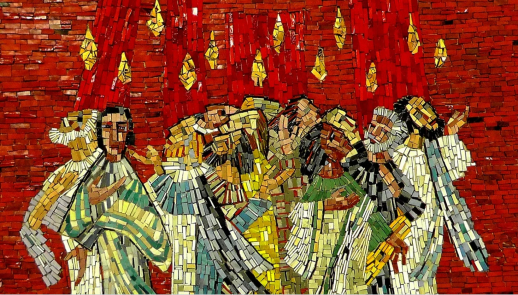
God the Spirit and the Filling of the Spirit
God the Spirit. Since we are considering the work of the Spirit within the church, it is important that we consider God the Spirit, who He is and what He does. First, without going into any detail, the Holy Spirit is the third person of Trinity. The Spirit is fully God.[1] The Holy Spirit also has personhood; He is not an impersonal force.[2] That is who the Spirit is.
Second,[3] it is important that we briefly consider what it is that the Spirit does. The Old Testament teaches us various things about the Holy Spirit. The Spirit molds creation into shape and gives life to created beings (Gen 1:2; 2:7; Ps 33:6; Job 26:13; 33:4). The Spirit controls the course of nature and history (Ps 104:29-30; Isa 34:16). The Spirit teaches and reveals God’s truth and will to His messengers.[4] The Spirit elicits personal response to God.[5] The Spirit equips individuals for leadership.[6] We also see that the Spirit equips individuals with skill and strength (Exod 31:1-11; 1 Kgs 7:14; Hag 2:5; Zech 4:6).
The Spirit is given as our Helper (John 14:24). He takes what belongs to the Son and shares it with those who believe (John 16:14), beginning with the new birth (John 3:6), teaching and guiding (John 16:14), and transforming (2 Cor 3:5-18) in ways that surpass human capacity (1 Cor 2:10-14). He empowers believers to be Jesus’ witnesses to the end of the earth (Acts 1:8) and to the end of the age (Matt 28:20). By indwelling believers (Rom 8:9; 1 John 2:27), the Spirit washes and renews (Titus 3:5), pours out divine love in our hearts (Rom 5:5), reproduces the divine virtues (Gal 5:22-23; Rom 14:17), enables us to resist sin (Rom 8:13) and pursue holiness (2 Thess 2:13), and build unity among the church (Eph 2:22; 4:3, 13; Phil 2:1-2).[7] The Spirit hears, speaks, witnesses, convinces, shows, leads, guides, teaches, commands, forbids, desires, gives speeches, helps, and intercedes with groans.[8] It is vital that we not leave out the most miraculous work that the Spirit works within people; He makes them new creations in Christ (2 Cor 5:17; 3:3, 6, 18; Titus 3:5-6; Ezek 36:25-28; Rom 2:28-29).
The Work of the Spirit | pt. 1
Introduction and Thesis
The Apostle Paul said, “Now concerning spiritual gifts: brothers and sisters, I do not want you to be unaware” (1 Cor 12:1).[1] This is a very important subject yet sadly very divisive. The reality is “there is one body and one Spirit” and “one Lord, one faith, one baptism” (Eph 4:4-5) but there are many divergent views on the work of the Spirit within the Church. So we have all the more reason to carefully evaluate this subject.[2]
This subject is important to consider because we want Christ’s church to be as healthy as it can possibly be, we want it to be adorned as Christ would have it. If there are good gifts that are available to the church for it’s upbuilding then we should want to and should make use of them.[3] Especially because 1 Corinthians 12:31 tells us we are to eagerly desire the greater grace gifts.
I believe that all the good gifts that were available at the outset of the church continue to be available and will be until the consummation when the Lord Jesus comes back to get His bride. So my thesis is that God the Spirit continues to empower and provide various grace gifts[4] to the Church for its upbuilding and these gifts should be earnestly desired and practiced in accordance with Scripture. This is very important to consider because “despite the affirmations in our creeds… and the lip service paid to the Spirit in our occasional conversations, the Spirit is largely marginalized in our actual life together as a community of faith.”[5]
Setting the Context
I have a number of questions that are important for us to honestly consider.[6] Could it be the case that some people have a bias against the continuation of the gifts of the Spirit?[7] Could it be that people do not have solid biblical reasons for believing that the “more miraculous” gifts of the Spirit have ceased? Could it be that most people’s beliefs in this regard are simply based upon what they have heard someone else say? Could it be that in this case, people have failed to check what was taught to ensure it was in accordance with Scripture (See Acts 17:11)?
Could it be that the Western enlightenment worldview has crept into our own view of the world and impacted the way we think about spiritual things?[8] Many have adopted a view of reality that sees “the universe as a uniform system based strictly on the cause-and-effect relationships between its constituent parts, each in a determinate relationship one to the others, utterly closed to any dimensions of reality that transcend the natural.”[9] Of course, many Christians rightly confess with Abraham Kuyper, that “there is not a square inch in the whole domain of human existence over which Christ, who is sovereign over all, does not cry: ‘Mine!’” But, could it still be the case that “naturalism nonetheless deeply influences our view of the daily events of our lives”[10]?
Can we concede that the continuation of the gifts would be a good thing? Should not we want all the grace that our good Father has availed to us? How can we say something is bad that our Father has called good?[11] If the grace gifts are part of the “every good and perfect gifts” (Jas 1:17) that God has graciously given us then should we not receive them gratefully?[12] If spiritual gifts are as bad and unhelpful as many make them seem, then why would the gifts have ever existed at all?
Who is Jesus?

Who is Jesus? That is the all-important question. That is the hinge on which history hangs.
That question has been a question for centuries. John the baptizer even said, “Are you the one who is to come, or should we expect someone else?” (Matt. 11:3). Islam says Jesus is a prophet. Jehovah’s Witnesses say Jesus is a mighty being, even a god. But not God. They do not believe in the Trinity.[1]
So, who is Jesus?
For us to answer that question, it’s important that we consider what Jesus Himself said. So, who did Jesus Himself say He was? Jesus is asked about His identity in the Gospel of John. People asked Jesus, “Aren’t we right in saying that you are a Samaritan and demon-possessed?” (John 8:48).
Statistics and Comfort in Calamity

Photo by Ben White
Does the 2% death rate statistic comfort you? What does the Bible say about comfort during calamity?
Some sources are saying that the mortality rate of COVID-19 looks to be 2%. However, it is too early to say. The percentage will be bigger or smaller depending on various factors (such as the age of the people infected, access to the needed medical treatment, etc.). I think we should acknowledge a few things about the statistic. First, 2% looks like a small number. And it is. At least, relative to a larger number.
Second, to put it into perspective, 2% of the population of the world is around 140 million people. That, as we can see, is a lot of people. COVID-19 could rival the AIDS epidemic. Of course, it seems highly unlikely that everyone in the world will get the virus. But even a fraction of that number is a lot of people. And it’s important for us to see the numbers from this vantage point so that we don’t play the numbers down.
He is the Faithful God

“Know that the LORD your God is God, the faithful God who keeps His gracious covenant loyalty for a thousand generations with those who love Him and keep His commands” (Deuteronomy 7:9).
How surprising and sad that we need to be reminded so often of God’s truth. And yet we do. I’m thankful that God accommodates to our forgetful ways.
We are told to know something. Our knowledge is not to be merely intellectual. Though it is intellectual. We need to know actual things about God. In this verse, we are to grasp with our minds that the LORD God is actually God.
It is not only that the LORD is really God but that the LORD your God is really God. There is a relational aspect to our knowledge of God. The LORD your God is the supreme being and Creator of the universe. The LORD is not distant and uncaring, He is not a god, but our God.
Wow. That’s a game-changer.
It doesn’t stop there, though.
The supreme being and Creator of the universe that is our God is also faithful. Amazingly faithful.
Deuteronomy 7:9 heaps good news upon good news. If you have the LORD as your God then that means that God—The supreme being and Creator of the universe—is your God. It means the Faithful One is your God.
Our intellectual knowledge of God has a huge practical impact on our lives. It means we do not need to be afraid because the LORD our God is powerful (Deut. 7:18).
So, fight forgetfulness. Work to remember and intimately know your faithful God. And don’t be terrified because the LORD your God, a great and awesome God, is among you (Deut. 7:21).
Proof of God’s Grace #3: Overcoming Grace

Scripture teaches that it is the Spirit that overcomes people’s hardness of heart and gives spiritual life. So, John 6:36 says, “It is the Spirit who gives life; the flesh is no help at all” (see also Ezek. 11:19-21; 36:25-27).[1] Notice it says, “the flesh is no help at all.” The Apostle Paul also says it is “the Spirit that gives life” (2 Cor. 3:6). Thus, salvation does not come from “human will or exertion, but on God, who has mercy” (Rom. 9:16). So Paul says, “It is God who works in you, both to will and to work for His good pleasure” (Phil. 2:13).
James 1:18 says, “Of His own will He brought us forth by the word of truth, that we should be a kind of firstfruits of His creatures.” Whose will was it? It was “His will.” Of course, God uses means to accomplish His will. People are brought to new life through “the word of truth” (cf. Rom. 10:14; 1 Pet. 1:23).[2]
Jesus said, “Truly, truly, I say to you, unless one is born again he cannot see the kingdom of God” (Jn. 3:3). That is because, “That which is born of the flesh is flesh, and that which is born of the Spirit is spirit” (v. 6). It is the supernatural work of God that makes a person a new creation in Christ (2 Cor. 5:17). “No one can say, ‘Jesus is Lord,’ except by the Holy Spirit” (1 Cor. 12:3). That is why we “must be born again” (Jn. 3:7). And of course, no one can make himself or herself be born, let alone born again. It is the Spirit’s prerogative; the Spirit works the way He works (Jn. 3:8). We also see that even faith is a gift from God (1 Chron. 29:14; Jn. 3:27; 1 Cor. 4:7; James 1:17). No one would believe without God first giving the gift of faith. Therefore, Jesus says, “You did not choose me, but I chose you” (Jn. 15:16 cf. v. 19).
So, we say with Peter, “Blessed be the God and Father of our Lord Jesus Christ! According to His great mercy, He has caused us to be born again to a living hope through the resurrection of Jesus Christ from the dead” (1 Pet. 1:3). Peter says that God “has caused us to be born again.”
Proof of God’s Grace #2: Resurrecting Grace

In this series of posts we are looking at proof of God’s grace (Planned, Resurrecting, Outrageous, Overcoming, and Forever grace [1]). In the previous post we looked at Planned Grace. In this post we are looking at…
Resurrecting Grace
The Bible teaches that people need resurrected or brought to life spiritually because they are spiritually dead and don’t go to God apart from the work of the Holy Spirit. Why is this the case? And where does the Bible teach this?
People do not turn to God apart from the Spirit’s intervening grace of regeneration because they are dead (Eph. 2:1-5), slaves of sin (Rom. 6:20), deceitful and desperately wicked (Jer. 17:9 cf. Gen. 6:5; Ps. 51:5), and blinded by Satan so they don’t see the glory of God in the face of Christ (2 Cor. 4:4ff).
In our natural state since the Fall we are dead in trespasses and sins (Eph. 2:1). We follow “the course of this world,” “the prince of the power of the air,” and “the spirit that is now at work in the sons of disobedience” (v. 2). That is how “we all once lived in the passions of our flesh” (v. 3).
Proof of God’s Grace #1: Planned Grace

The Bible shows us over and over again proof of God’s abundant grace. Here we are going to look at the acronym PROOF[1] to look at God’s grace. We are going to look at: Planned grace, Resurrecting grace, Outrageous grace, Overcoming grace, and Forever grace.
Why is it important that we consider the proof of grace? First, because when we understand all the proof of God’s grace we praise and glorify God for His abundant grace. Second, anything that is the teaching of Scripture is important and profitable for us to understand (2 Tim. 3:16-17). Third, when we understand the extent of God’s grace it humbles us. Fourth, when we understand more of the extent of our desperation we will (or should) love God more (Lk. 7:47).
First Corinthians and the Continuation of the Gifts of the Spirit

I have written on this subject elsewhere but here we’re going to look at the text of 1 Corinthians and evaluate what it’s says regarding the continuation of the gifts of the Spirit.
First, it’s important that we acknowledge that this is a controversial issue. And it’s important that we consider these questions from an unbiased perspective.
What we were taught in the past should not determine our beliefs. We also should not let misapplications or extremes that people have that hold a certain belief dissuade us from holding a certain belief. The validity of a theological truth must be determined by what the Bible itself says. It’s important that we first agree on that.
Scripture is the final say on wether or not the gifts of the Spirit continue, not whether or not we understand each of the gifts perfectly or whether or not those who believe the gifts of the Spirit continue practice everything in a way that builds up the body of Christ in accordance with Scripture. Those other things are distractions (in logical argumentation they are referred to as the red herring fallacy).
So, what does 1 Corinthians itself say about the continuation of the gifts of the Spirit?
A Pre-Civil War “Conversation” on Slavery

Introduction
In writing this I read and analyzed two pre-Civil War articles.[1] The first article we will look at argues in favor of the continuation of slavery. The second article is written in response to the first and argues for immediate abolition. After looking at both articles we will look at the differences between the two articles.
My thesis is that some, like Buck, advocated for the continuance of slavery mainly based upon the belief that slavery was permitted because it was similar to the slavery permitted in the Old Testament. Others, however, like Pendleton, argued against slavery because they believed it was inherently dissimilar to Old Testament slavery.
In Favor of the Continuation of Slavery
Since “the subject is one of great moment in its moral, social and political bearings”[2] Buck decided to write on the subject. “So that… [people] may be prepared to act conscientiously and intelligently, and have no occasion to repent of their action when it is too late to undo it.”[3] So, it was “under… these considerations [that Buck] consented to prepare a series of articles.”[4]
Buck says, “God approves of that system of things which, under the circumstances, is best calculated to promote the holiness and happiness of men; and that what God approves is morally right.”[5] Buck then talks about the “nature and design of Human Governments.”[6] He says, “In searching the divine record, therefore, we shall find that form of government which, under the circumstances, was best calculated to promote the moral and social happiness of the people, was sanctioned and approved by God.”[7]
The first form of government was the patriarchal, which Buck gives a brief analysis of. Next he lays out what he sees as being established through his belief that God has a good purpose for human governments. First, he says, “God has beneficent and gracious designs to be accomplished in behalf of the human family.”[8] Second, God is happy to use human and governmental instruments. Third, it is in accord with God’s infinite wisdom “to promote his beneficent and gracious designs in behalf of our lapsed and degenerate world.”[9] Fourth, a very powerful and enlightened leader is best suited to bring about the good that God intends for humanity.



