A Prayer Thanking God for Adoption in Christ

Father, we thank You that through Jesus Christ we can come to You as Father.
We thank You that we have been adopted through Jesus and are even fellow heirs with Him. Because if we are children, then we are heirs—heirs of God and co-heirs with Christ.
We thank You that to all those who have believed in Jesus’ name,
You have given the right to become children of God.
And we acknowledge that we are born not of natural origin, nor of human will,
but we are born anew by Your will.
It is You God who chose us in Christ before the foundation of the world for adoption.
God, we thank You for sending Your Son,
to redeem us that we might receive adoption to sonship.
We thank You also for the Holy Spirit.
We know and rejoice that those who are led by the Spirit of God are the children of God. We thank You that the Spirit we have received brought about our adoption to sonship.
And by Him we cry, ‘Abba, Father.’
The Spirit Himself testifies with our spirit that we are God’s children.
O’ God we thank You.
We are amazed that You God care for us and welcome us in through Jesus.
We are amazed that You, the Lord Almighty, say that You will be a Father to us,
and we will be Your sons and daughters.
You, the LORD, are the One who defends the cause of the fatherless and the widow.
And You are our God, and through Christ Jesus, You are our Father.
We confess together that we do not count on anyone or anything else to save us.
We will never again say ‘Our gods’ to what our own hands have made,
for in You the fatherless find compassion.
God, we trust You.
You are the One who cares for us.
We trust You who we cannot see,
and not what we can see.
You God, are our good Father.
It is those who hope in You, LORD, who will renew their strength.
They will soar on wings like eagles;
they will run and not grow weary,
they will walk and not be faint.
So Father, we trust in You.
As Your children, we know we need You.
LORD, we know it is You that watches over us,
but You frustrate the ways of the wicked.
You see our trouble when we are afflicted;
You consider our grief and take it in hand.
And so, we commit ourselves to You;
You are the helper of the fatherless.
We come to You Father, in Jesus’ name.
Amen.
Some of the most significant theological books I have read…

Here is a list (in no particular order) of some of the most significant theological books I have read.*
- God’s Glory in Salvation Through Judgment By James Hamilton
- From Eden to the New Jerusalem and The Servant King by T. D. Alexander
- The Imitation of Christ by Thomas A Kempis
- The Cost of Discipleship by Dietrich Bonhoeffer
- The Doctrine of God and The Doctrine of the Word of God by John Frame
- Knowing God by J. I. Packer
- Money, Possessions, and Eternity by Randy Alcorn
- Systematic Theology by Wayne Grudem
- Desiring God, Don’t Waste Your Life, God is the Gospel, Future Grace and Let the Nations be Glad by John Piper
- The Knowledge of the Holy by A.W. Tozer
- New Testament Theology and The King in His Beauty by Thomas R. Schreiner
- Foundations of Soul Care by Eric Johnson
- The Cross of Christ by John Stott
- Mere Christianity by C.S. Lewis
- Death by Love by Mark Drisscol
- The Universe Next Door by James Sire
- Dangerous Calling by Paul Tripp
- The Resurrection of Jesus by Michael Licona
- Desiring the Kingdom by James K. A. Smith
- Radical by David Platt
- Center Church by Timothy Keller
___________________________
*This is a personal list of books that helped me in a particular way at a particular time. This is not a list on the best and most significant theological books; that list would look different.
“Does God love all humanity, every single person?”

“Does God love all humanity, every single person?” My natural inclination right off the bat is to say, “Yes. Yes, God loves all humanity, every single person.”
But we do not want what I want to think but we want to look at what the Bible says and wrestle with its teaching. So, what does the Bible say?
This may be a harder question than it would first appear. This is because this question is never explicitly asked in Scripture and thus is never explicitly answered. It is difficult because we are vying for certain answers. We so often want to make God like ourselves (Ps. 50:21). It is also a difficult question because the Bible seems to teach that God at the same time loves the whole world and yet hates all the rebellious.
In Scripture, we see that God has made man in His image (Gen. 1:26-27), so in as much as each person still reflects God’s image, God, I believe, loves that aspect of them.
In Matthew 5:43-48, Jesus tells His disciples to love their enemies and gives God the Father as an example. God “makes His sun rise on the evil and on the good, and sends rain on the just and on the unjust.” Matthew, in this passage says that He does this in love.
God, therefore, clearly has this kind of love for all humanity. He is the example that we are to imitate. We are to “love our enemies” in imitation of God Himself. Thus, I conclude, yes, God does love all humanity, every single person. In a similar way, Psalm 145 says, “The LORD is good to all, and His mercy is over all that He has made” (Ps. 145:9).
Yet, the Bible also says that God hates all workers of iniquity (see for example Ps. 5:5; 11:5b-6; Rom. 1:18ff; Jn. 3:36). As we look at this question, it is important to remember that the LORD is God and He is good even if we cannot understand His ways. We must remember that although God has revealed Himself and we can truly know Him yet we cannot exhaustively grasp Him.
The Ascension

As we saw in the previous post on the resurrection, Peter looked at Psalm 16 and showed how Jesus’ resurrection was foretold. In Acts 2 Peter goes on to show that Jesus is now at God’s right hand, as Psalm 110 foretold. Jesus Himself had quoted from Psalm 110 and stomped His critics (see e.g. Matt. 22:41-46). And when you look at 110:1 it’s not surprising that they were stomped.
So, we see that Jesus is at God’s right hand until… Until He makes His enemies His footstool. That means that Jesus is coming back—and the New Testament repeatedly says soon—to bring judgment, and pervasive peace through that judgment.[1]
Jesus’ death and resurrection shows that He is indeed the Lord and Messiah.[2] As the Lord and Messiah, He is coming back soon to vanquish every foe and establish His forever reign of peace. In His second coming, He will bring the Kingdom that was expected at His first coming. Read More…
The Resurrection

Peter refers to this Davidic Psalm in Acts chapter 2. He said: “Fellow Israelites, I can confidently speak to you about the patriarch David: He is both dead and buried, and his tomb is with us today” (Acts 2:29). In short, David’s dead and his body rotted. David did, however, as a prophet tell us that one of his descendants would sit on his throne (v. 30). So, David seeing that in advance “spoke concerning the resurrection of the Messiah: ‘His body was not abandoned to the realm of the dead, nor did His body see decay’” (v. 31).
Paul says it a little differently. He says King “David, after he had served the purpose of God in his own generation, fell asleep and was laid with his fathers and saw corruption” (Acts 13:36). King David saw corruption. His body decomposed. So, David is not the “Holy One” that the Psalm refers to.
Paul goes on to say, “But He whom God raised up did not see corruption” (v. 37). Ding, ding, ding! Jesus is the Holy One! He is the long-awaited Messiah and forever King!
David knew that the LORD would place one of his descendants on the throne. How did he know this? Because…
The Death
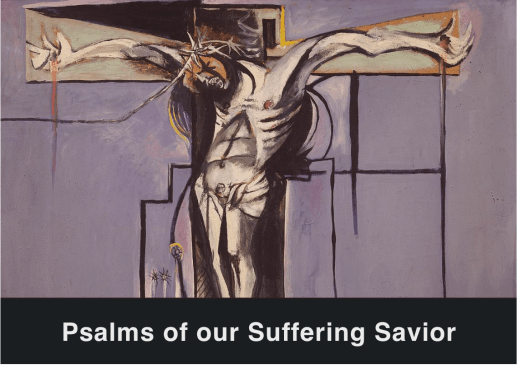
The Righteous One was not delivered. The Righteous One was afflicted and slayed. The Righteous One was condemned, condemned to die the terrible death of a criminal and slave.
Jesus was slaughtered. But it was not a senseless slaughter.
As the centurion nearby Jesus acknowledged, something more was going on behind the scenes. The centurion would have observed many deaths and many crucifixions. And so, he is in a unique position to recognize the purity and power of Jesus. The centurion said, “Certainly this man was innocent and the Son of God! (Lk. 23:47/Matt. 27:54; Mk. 15:39)
The centurion responded in that way after he saw Jesus call out and say, “It is finished. Father, into your hands I commit my spirit!” and breathe his last (Jn. 19:30/Lk. 23:46). The centurion must have been amazed by Jesus’ composure and everything else that had taken place surrounding Him. The centurion may have seen the way Jesus treated His enemies (Lk. 23:34), His promise to the criminal on the cross (v. 43), His prayer to God (v. 46), not to mention the ominous darkness (v. 44).[1]
Jesus’ death was not senseless, but according to Scripture. The Righteous One was slain in between two criminals. Jesus was, as Isaiah says, “numbered with the transgressors.” Yet in being cursed Jesus was carrying out a rescue plan that had long since been written (Rev. 13:8). “When He was hung on the cross, He took upon himself the curse for our wrongdoing. For it is written in the Scriptures, ‘Cursed is everyone who is hung on a tree’” (Gal. 3:13).
The Committal
Jesus’ life was bathed in the language of the Psalms. Yet, when Jesus quotes Psalm 31 He doesn’t quote it exactly. Instead, He says, “Father, into your hands I commit my spirit” (Lk. 23:46).[1] And so, Jesus’ dying moment was one of trust in His Father. Jesus trusted as He taught us to pray (“Our Father in heaven…”—Matt. 6:9-15). Jesus trusted as He brought a way for us too to go to the Father (Jn. 14:6).
And so we see that Jesus who cries out in despair—trusts God.[2] And we see He laid His life down. Jesus committed Himself into the care of His Father[3] and said, “It is finished” (Jn. 19:30) and breathed His last. Jesus was in control of His life, and He laid it down. The fact that no one took His life from Him but that He laid it down[4] also implies that He is able to “take it up again” (Jn. 10:17).
It is because Jesus trusted God His Father in His life and in His death, and because He freely laid His life down, that we have access to the Father. Jesus makes a way for us by being the perfect sacrifice. Jesus always perfectly trusted God.
So, through Jesus we can have God as our Father. We can go to Him in prayer as Jesus taught us (Matt. 6:9-15). We don’t have to be anxious like unbelievers because we know that we have a heavenly Father who knows all that we need (v. 32). And we can be assured of our Father’s love and care for us because He loved us so much that He sent Jesus (Jn. 3:16).
The Forsaken

On the cross Jesus cries out and quotes from Psalm 22: “My God, my God,[1] why have Thou forsaken me?!”[2] This is especially pungent because Jesus, unlike all other humans, did not deserve to be forsaken.[3]
Jesus’ forsaken cry comes at the end of three hours of darkness (Matt. 27:45). This is in great contrast to other momentous occasions in Jesus’ life. At Jesus’ birth, the star led the way and angels announced His arrival (Lk. 2:8-14).[4] At Jesus’ baptism, the heavens were torn open and a voice from heaven said, “You are my beloved Son; with You I am well pleased” (Matt. 3:17). At Jesus’ transfiguration “a cloud overshadowed them,[5] and a voice came out of the cloud, ‘This is my beloved Son; listen to Him’” (Mk. 9:7).
The Insults

“But I am a worm and not a man,
scorned by mankind and despised by the people.
7All who see me mock me;
they make mouths at me; they wag their heads;
8’He trusts in the LORD; let him deliver him;
let him rescue him, for he delights in him!'”
—Ps. 22:6-8 (Matt. 27:35-44)
It is hard and painful to think of Jesus being mocked. And yet He was mocked and mocked ruthlessly. Jesus was mocked by the chief priests, the scribes, the elders (Matt. 27:41), by robbers (v. 44), and by soldiers (Lk. 23:36).
It didn’t stop there, though. The condemned would be crucified naked. The cross was an instrument of shame as well as pain. Much of the mocking that Jesus underwent occurred as He was vulnerable and stretched out on the cross.
The Righteous One becomes the Rejected One. The Great Exchange took place, the righteous for the unrighteous. Barabbas goes free and the beautiful Savior is bludgeoned. So in Barabbas’ deliverance, we see our own.[1]
The Crucifixion
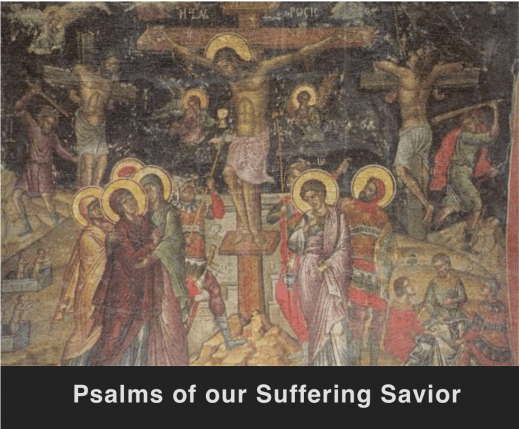
Psalm 22 has an amazing amount of parallels with Jesus’ experience on the cross on Good Friday. It says he is surrounded by rough enemies that want to harm him (v. 12), he is attacked by their words (v. 13), he is exhausted and close to death (v. 14), he experiences fatal dehydration (v. 15), his hands and feet are pierced (v. 16), his bony frame is exposed (v. 17), and his garments are divided and cast lots for (v. 18 cf. Matt. 27:35).[1]
Reading this Psalm you almost expect David to say something close to “Father, forgive them”[2] because the account of Jesus’ crucifixion is foreshadowed so many times (see also Ps. 69:4, 9, 21). Instead, in somewhat of a parallel passage to this Psalm and in great contrast to Jesus, David calls for God’s burning anger to overtake his enemies (69:24), he pleads that God would “add to them punishment upon punishment” (v. 27), and that they would be “blotted out of the book of the living” and “not be enrolled among the righteous” (v. 28).
Messiah Jesus instead Himself receives punishment upon punishment, His life is blotted out, and He joins the unrighteous on a cursed cross (see Is. 53:9 and Matt. 27:38) to save His enemies, those who are far from Him. Jesus is the perfect lamb of God, the lamb without blemish, that takes away the sin of the world (Jn. 1:29; 1 Pet. 1:19).[3]



 in X
in X 