Genesis
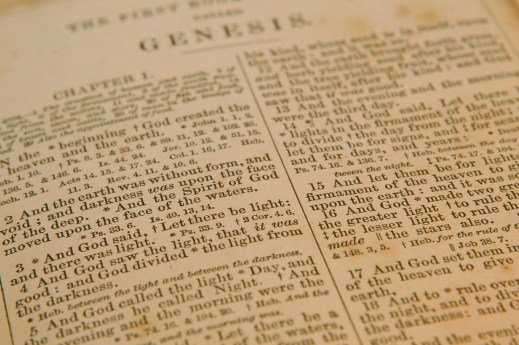
Introduction
I use to do construction and I remember my boss telling me that if you get something plumb, straight up and down, then it would go all the way up to the moon forever. But if you get it wrong by just a little bit than you are going to be off by a lot in the end. What you do in the beginning has a big impact on where you end up. It is the same with the Bible. The book of Genesis is very foundational. Without a good grasp of Genesis the rest of our theology will likely crumble to the ground and be worth nothing. So much is built on it. If we are off here, we are going to be way off down the road of the Bible.
There are many “plot conflicts” in the book of Genesis. They will serve as our compass to find our way through the huge book that is Genesis. Leland Ryken has wisely said “Stories are always built around plot conflicts. These conflicts progress toward some type of resolution… Noting plot conflicts is one of the best ways to organize a story, either in the actual process of reading or when talking about the story” (How to Read the Bible as Literature, 41). So, there are three things I want to pay careful attention to and note their expansion in the rest of Scripture and their fulfillment through or in Jesus the Christ.
Here are a few of the themes that are the building blocks of the theology of Genesis (NDBT, 140) and in many ways the whole Bible: (1) The promise of seed, i.e. offspring, (2) the promise of land, and (3) the promise of being a blessing to the nations (see esp. 12:1-3). All of these themes are in embryonic form in Genesis chapter three and expand through the rest of the book. They continue to expand through the Old Testament but don’t find their true fulfillment until the New Testament and the coming of the Promised One. Truly, even then, in the New Testament, there is still an element of the “not yet” until in Revelation all things are made new.
Practice Unproductivity (part 3)

Commanded to Rest
The concept of Sabbath is almost entirely gone.[1] It is one thing to enforce sabbatarian “blue laws” on a whole country,[2] it is another thing to think we are self-sufficient and have no need for any type of Sabbath.
This is not the place to have a big argument on the Sabbath so I don’t intend to do that here. But, I think it should be clear that we must honor the Sabbath in some way. We must at least set aside time to intentionally rest and reflect…
The Bible says we are commanded to rest.[3] It says, “Honor the Sabbath and keep it holy.” The Sabbath was primarily a day of rest. So, we could paraphrase, “Honor the day of rest, set it apart, keep it.” So, “We do not rest because our work is done; we rest because God commanded it and created us to have a need for it.”[4]
Why should I believe the Bible? (pt 9)

Some doubt the authority of the Bible but as we have already seen there are actually a lot of reasons to believe the Bible. The Bible itself also claims to be necessary and…
Authoritative
The Bible claims repeatedly to be more than mere human words. The Bible says it is inspired—breathed out—by God (2 Tim. 3:16-17). The Bible has the authority, not as words from men, but as words from God (1 Thess. 2:13). “When the Bible speaks, God speaks.”[1] Wayne Grudem says, “The authority of Scripture means that all the words of Scripture are God’s words in such a way that to disbelieve or disobey any word of Scripture is to disbelieve or disobey God.”
The Bible is not merely a record of what God has said in the past but a means of God speaking today. That is a good thing. We need to hear what God has to say. We need God’s guidance and we need an authority. God alone is equipped to be that authority.
A Brief Theology of Emotions

We all have emotions. How often do we consider emotions from a biblical perspective though?… Yet, what better place to turn than God’s word! So, what does the Bible say about emotions?
Emotions are part of God’s good design
First, it is important to realize that “Our emotional capacities are part of our nature as personal beings created in the image and likeness of God.”[1] Second, Emotions are part of God’s good design.[2] Third, We often don’t think about it but we are actually commanded to be emotional. For example, Psalm 2:11 says “Serve the LORD with fear, and rejoice with trembling.” And there’s a bunch of other examples (Deut. 28:47-48; Ps. 51:17; 97:10; 100:2; Matt. 6:25-34; Rom. 12:9, 15; Eph. 4:32; Col. 3:15).
So, Jay Adams says:
“The fact is that there are no damaging or destructive emotions per se. Our emotional makeup is totally from God. All emotions of which He made us capable are constructive when used properly (i.e., in accordance with biblical principles)… All emotions, however, can become destructive when we fail to express them in harmony with biblical limitations and structures.”[3]
You may have heard: “Don’t follow your emotions” or “don’t let your feelings get the best of you,” or “use your head.” But emotions are not bad in themselves. God created us with emotions.
Even our negative emotions are not always wrong. It’s not always bad to feel bad. Sometimes feeling sad and angry is good and right. It’s important to realize that in the Psalms the genre of lament is most common.[4] It is also important to remember that there is no book of Joys but there is a book of Lamentations.[5] We don’t always have just “good” feelings and that’s okay. On the other hand, God made us at least in part to experience profound joy and to experience this forever, Psalm 16:11 says. So, our first take away is for us to realize that emotions are not bad in themselves.
But what’s wrong with emotions? Or, why is it that sometimes we can’t or shouldn’t trust our emotions? Because…
Emotions are broken by sin
A lot of us remember the (true) story of Adam and Eve. John Frame has said, “the fall… was rebellion of the whole person—intellect as much as emotions, perception, and will—against God.”[6] After looking at Genesis 3:1-6 (notice the highlighting) we can agree with what Frame says:
Is Homosexuality Part of God’s Good Design?

“Why does a person’s sexual preference matter? If a guy loves another guy why can’t they hook up? Why would God have a problem with that? God created everything, right? So, did He create homosexuality?”
I appreciate those questions. They are important because sex and sexual identity are deeply personal as well as powerful.[1] So, the main question seems to be: Did God create homosexuality, is it part of God’s good design? In order to answer this question, I need to ask you a question. Do you consider yourself a tolerant person?[2] Will you hear me out and listen to my perspective?
If you answered that you are a tolerant person, that’s great. That will be helpful as we look at this controversial subject. So, I ask you to kindly consider my perspective on this question.
I want to be faithful to what I believe the Bible teaches because through it God shows His love and grace. So, as we consider this question, I deeply want the love and compassion of Christ to come through. He loves us all and wants us to have abundant life here and now and forever. Yet, life holds many struggles and temptations.[3]
As we consider this question, we are all caught up in God’s story, a story that can be summed up as creation, fall, redemption and new creation. What does the Bible have to say about this issue? The Bible provides directions to protect us and help us thrive. This is part of God’s good design. The directions include prohibitions against certain types of sexual activity. Those that violate the directions God has given often suffer for it. Individuals that struggle with homosexuality need to realize that natural disposition does not justify it any more than any other sin. And the fact that society elevates sexual fulfillment to the point of communicating that it is the purpose of life does not exempt it from God’s prohibition any more than any other sin. If you are struggling with this issue, then join the rest of us sinners and turn to Christ, who is good. God has given us the means to live within His good design.
“The Lesser of Two Evils”?

“Lesser of two evils” is a fairly common phrase but how helpful is it? Is there really a situation when we would have to choose between the lesser of two evils? That is a contested ethical issue and an important one.
In answering this difficult question we are dependent. We need wisdom outside of ourselves. John Frame points us in the right direction through his meditation on Scripture. He offers us some helpful theological reflections (See Frame, DCL, 230-34). I share just two of them.
Why should I believe the Bible? (pt 7)

We have already looked at many reasons why we can believe the Bible. Yet, there are still many more. Here we briefly look at the Bible being trustworthy because it is…
Prophetic
The Bible contains all sorts of fulfilled prophecies (see e.g. “The Prophecy of Daniel 8”), particularly about Jesus. These attest to the Bible’s uniqueness, truthfulness, and authority.
“Whatever one may think of the authority of and the message presented in the book we call the Bible, there is a world-wide agreement that in more ways than one it is the most remarkable volume that has ever been produced in these some five thousand years of writing on the part of the human race.
It is the only volume ever produced by man, or a group of men, in which is to be found a large body of prophecies relating to individual nations, to Israel, to all the peoples of the earth, to certain cities, and to the coming of One who was to be the Messiah. The ancient world had many different devices for determining the future, known as divination, but not in the entire gamut of Greek and Latin literature, even though they use the words prophet and prophecy, can we find any real specific prophecy of a great historic event to come in the distant future, nor any prophecy of a Savior to arise in the human race…”[1]
The Christ of the Cosmos

The Massive Size of the Universe
The heavens scream out and tell us of God’s surpassing worth (Ps. 19:1; Rom. 1:20). God’s glory is beyond our comprehension.
Do you know how far away the closest star is (besides the sun)? It is approximately 4 light-years away. A light-year is the length that light travels in one year. Light travels fast! 186,000 miles per second and there are 31,536,000 seconds in a year. A light year is really really really far. One light year is almost 6 trillion (6,000,000,000,000) miles! So, it takes four years for the light from the closest star to get to us.
And did you know that the sun is so big that about 1,300,000 earths could fit inside of it?[1] The universe is vast beyond comprehension.
The Astrophysicist, Hugh Ross has said, “Somewhere around 50 billion trillion stars make their home in the observable universe.”[2] That is impossible to conceive of. “A comparison may make it more comprehensible: if that same number of dimes were packed together as densely as possible and piled 1,500 feet high (as high as some of the world’s tallest skyscrapers), they would cover the entire North American continent.”[3]
Wow.
Jesus’ Massive Glory
And God—the One who created each star, named each one of them, and holds the entire universe together (Is. 40:26; Col. 1:16-17; Heb. 1:3)—cares about you! He cares so much that He sent His Son to die for you. Jesus, God in flesh, humbled Himself, came, and died for anyone who turns to Him for salvation.
Christ who created the cosmos and holds all things together (Col. 1:16-17) made Himself nothing, took the form of a servant, was born in the likeness of men, and humbled Himself to the point of death, even death on a cross (Phil. 2:7-8). Jesus, the Holy One, the spotless Lamb of God, became sin, so that in Him we might become the righteousness of God (2 Cor. 5:21).
The One who died on the cross for us died as He held the planets in orbit. He died, though He is the one that held the very nails together that pinned Him to that tree (Heb. 1:3).
He calls the host of stars by name and He knows your name! His judgments are just, His Word is true, and He is a God of sacrificial love. His faithfulness is never stopping, always and forever.
“Love so amazing, so divine
Demands my soul, my life, my all.”
The Christ of the cosmos deserves our praise!
Notes
[1] To get a visual of the expanse of the universe, use a tennis ball to represent the sun (2.7 inches in diameter) and the edge of a dime to proportionally represent the earth (0.02 inches), then place the tennis ball and dime twenty-four steps apart. That will help you see the distance between the sun and the earth (Jeffrey D. Arthurs, Preaching as Reminding, p. 76). Arthurs goes on to explain that “To explain the distance to Alpha Centauri, the nearest star: the tennis ball would be in Boston and Alpha Centauri would be in Memphis” (Ibid.).
[2] Hugh Ross, Why the Universe is the Way it Is, p. 31.
God’s Sovereignty and our Responsibility to Evangelize

Introduction
How should we understand the relationship between God’s sovereignty and our responsibility to evangelize? J.I. Packer’s book, Evangelism and the Sovereignty of God, is a helpful book for those considering this important question.
God’s Sovereignty and our Responsibility
Packer gives various examples of the sovereignty of God. He points out that just by praying to God we acknowledge His sovereignty.[1] Packer points out that God’s sovereignty and man’s responsibility are taught side by side in Scripture.[2] And “far from making evangelism pointless, the sovereignty of God in grace is the one thing that prevents evangelism from being pointless. For it creates the possibility—indeed, the certainty—that evangelism will be fruitful.”[3]
God’s sovereignty is a great means of encouragement to us in our evangelism. Packer helpfully says that in our evangelism we
have every reason to be bold, and free, and natural, and hopeful of success. For God can give His truth an effectiveness that you and I cannot give it. God can make His truth triumphant to the conversion of the most seemingly hardened unbeliever. You and I will never write off anyone as hopeless and beyond the reach of God if we believe in the sovereignty of His grace.[4]
So, we are responsible for sharing the gospel but God is sovereign. A proper understanding of God’s sovereignty and our responsibility is important and practical. It is important for us to realize, as Packer says, that “it is God who brings men and women under the sound of the gospel, and it is God who brings them to faith in Christ. Our evangelistic work is the instrument that He uses for this purpose, but the power that saves is not in the instrument: It is in the hand of the One who uses the instrument.”[5] So, “the belief that God is sovereign in grace does not affect the necessity of evangelism.”[6] Will Metzger, in agreement with Packer says, “We should not consider… sovereignty and responsibility as enemies but rather see them the way the Bible does—as friends!”[7] So, God’s sovereignty and man’s responsibility may seem at odds but they are really not, although we may not understand.[8] We must remember that the secret things belong to the LORD but the things that have been revealed belong to us that we may do what God has called us to do (see Deut. 29:29).
7 Things for Universalists to Consider

Some have claimed that all people will be finally saved, even after torment in hell. However, there are all sorts of inherent problems with that view. Here’s a brief list of problems to consider.
Consider…
1. There Is No (Clear) Scripture That Teaches Universalism
The doctrine of universalism goes against the clear teaching of Scripture and finds no clear teaching supporting what it argues. Yes, I understand that there are a few passages that if you pull out of context and place into a certain system of thought, can seem to support the doctrine but it is not the texts natural meaning in context.



 in X
in X 