Is there a basis for Human Rights?

“The cruelty of atheism is hard to believe. When a man has no faith in the reward of good or the punishment of evil, there is no reason to be human. There is no restraint from the depths of evil which is in man. The communist torturers often said, ‘There is no God, no hereafter, no punishment for evil. We can do what we wish.’ I heard one torturer say, ‘I thank God, in whom I do not believe, that I lived to this hour when I can express all the evil in my heart.’ He expressed it in unbelievable brutality and torture inflicted on prisoners.”[3]
A Few Thoughts On Genetic Engineering (part three)

The Need for Biblical Ethics
Many agree that “If we do adopt a policy of human genetic engineering, we ought to do so with extreme caution.”[1] I believe that a biblical and Christ exalting ethical system is necessary to provide bedrock convictions. Without the Bible we are left to our own devices, to do what is right in our own eyes.
The Bible does not address the subject of genetic engineering directly. You will not find “genetic modification” in a Bible concordance. The Bible does, however, provide foundational principals that are vital for us to consider and apply. The storyline of the Bible and of reality provides some very important insights.
First, in the beginning of the story of Scripture we see that God created everything, and He created it very good (Gen. 1:31). God is the Great Creator but we also see that we are made in His image and are also creative (Gen. 1:26-27). We also see from the fact that we are made in the image of God that all human life is precious and should be protected. This is where we get the concept of the sanctity of life. We also see from the beginning of Genesis that humans are called to subdue the earth, we are to reign under God as His vice-regents. So, we are to obey His will and bring blessing and flourishing to all we can.
This is important to remember when we consider gene editing because we learn a number of things. 1) God made us creative and made us to bring flourishing and blessing. 2) God also made us to obey Him, He is the Lord. We should never do anything that is outside of His will. 3) The fact that God is the Creator of all provides a basis for the reasonableness of the laws of science. We can make logical deductions and seek out God’s creative design because God has designed things in a reasonable way.
A Few Thoughts On Genetic Engineering (part two)
Types of Genetic Engineering
As you read this, remember, “The best insurance against possible abuse is a well-informed public.”[1] So, with that in mind, let’s look at four types of genetic engineering.
First, and lest controversial, is somatic gene therapy.[2] The way I remember what somatic refers to is by remembering that soma is the Greek word for “body.” Somatic gene therapy involves the manipulation of gene cells within the body that are non-reproductive.[3] So somatic genes that are edited do not get passed on to future generations.
Second, germline gene therapy involves the genetic modification of the germline cells (eggs or sperm). So germline therapy changes the genetic make up of the individual and is thus carried on to future generations. That is one of the reasons that “No aspect of gene therapy is more highly charged than that of germline or germ-cell therapy.”[4] One of the questions that is important to ask regarding germline gene therapy is: “Will a ‘deleterious’ gene of today be considered a ‘deleterious’ gene tomorrow?”[5]
This discussion, I must remind you, is not some sci-fi dream, “Many assure that within our decade, depending upon the family and the circumstances, height, weight and even eye color will become elective.”[6]
A Few Thoughts On Genetic Engineering (part one)

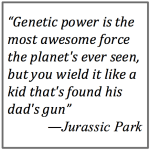 The topic of genetic engineering makes me think of the movie Universal Soldier where the soldiers were genetically engineered to have superior strength and heal quickly. The Boys from Brazil is another movie that has genetic engineering as part of the plot. In this movie there are ninety-four clones made of Adolf Hitler and sent to different parts of the world. Examples of plot twists and possible plot twists could be multiplied. Those examples are all fictious.
What is not fictious, however, is the reality of genetic engineering. So we must realistically consider genetic engineering and its ethical implications. Specialists from varied backgrounds agree. Take these examples:
Megan Best has said: “Genetics will have an important role in shaping society in the future because it increases our understanding of how disease occurs and how treatments work differently between individuals. It promises new ways to improve the health of the population.”[1] “Full of promise, full of challenges—we will all be involved in the genetic revolution before we know it.”[2]
George Church, professor of genetics at Harvard Medical School, said in 2016 regarding genetic engineering that “It is urgent that citizens around the world inform themselves and participate in this rapidly moving set of decisions.”[3]
“Prominent voices in the genetic technology field believe that mankind is destined for a genetic divide that will yield a superior race or species to exercise dominion over an inferior subset of humanity. They speak of ‘self-directed evolution’ in which genetic technology is harnessed to immeasurably correct humanity—and then immeasurably enhance it. Correction is already underway. So much is possible: genetic therapies, embryo screening in cases of inherited disease and even modification of the genes responsible for adverse behaviors.”[4]
The way we think deeply matters. Adam S. Cohen says this in his essay, “Harvard’s Eugenics Era”: “There are… forward-looking reasons to revisit this dark moment in [Harvard’s] past. Biotechnical science has advanced to the brink of a new era of genetic possibilities. In the next few years, the headlines will be full of stories about gene-editing technology, genetic ‘solutions’ for a variety of human afflictions and frailties, and even ‘designer babies.”[5]
How should Christian art be informed by the Christian worldview? (part 6)
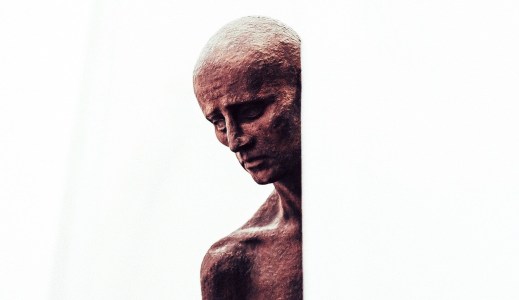
In the last post in this series we considered Christ. In this post, we are going to…
Consider our Current Condition
It is important for us to correctly situate ourselves within our current condition. We, for instance, do not want to place ourselves within the new creation when we are still reeling from the crash. In the same way, we don’t want to forget that Christ has came. We need to understand our current condition. We do not want to have an “over-realized eschatology” or an “under-realized eschatology.” We want to correctly grasp our situation and communicate the struggles and hopes that we have to the world.
Steve Turner has said, “It is not Christian to make art that assumes that the world is unblemished.”[1] It’s certainly true that the Kingdom has come in God’s Son. The light is shining and the darkness is passing away (1 Jn. 2:8) but it hasn’t passed away yet. We still live in a fallen world. Soon the darkness will be forever gone (Rev. 22:5) but for now it’s an element in our reality so to paint or portray reality means including “darkness.” Read More…
20 Observations from Genesis 1-3

Gen. 1:1—We see the answer to our and the universes origin (and logic, math, science, etc.).
Gen. 1:24-25—We see where the different “kinds” of animals came from. It sounds like God made each different “kind” or type of animal with enough genetic code to produce all the different types of that kind but that they would stay with that “kind” or genetic code. There are similar genetic trademarks between each “kind” yet don’t overstep their kind. This is because they are made by the same Maker and He left the same stamp of intelligence on each of them.
Gen. 1:26-27—Humans have worth and should not be disregarded. From here we see humans have great potential. We also see grounds here for the immorality of mistreating humans. (People have argued that the idea of human rights came from the Christian understanding that all humans are made in the image of God).
Gen. 1:28-30 cf. 2:15—We see a call to stewardship and industry; something that has always been important for survival and compassion.
How should Christian art be informed by the Christian worldview? (part 4)

We have already made some important observations about how the Christian worldview impacts Christian art. In this post, we are going to…
Consider the Crash
Man disobeyed and rebelled (Gen. 2:16-17; 3:6) and this brought spiritual and physical death (Gen. 2:17; 3:19), pain (3:16-17), difficulties (3:18-19), and separation from God (3:23-24). This is the bad news that we all live in (so, in a future post, we’ll consider our current condition).
In Genesis 3:1-24 we see the Fall of humanity. We see various forms of death given birth to. We see “’an ever-growing avalanche of sin, a continually widening chasm between man and God’. It progresses from disobedience, to murder, to indiscriminate killing, to titanic lust, to total corruption, and uncontrolled violence.”[1] Sin truly brings a litany of death. “Disease, genetic disorders, famine, natural disasters, aging, and death itself are as much the result of sin as are oppression, war, crime, and violence. We have lost God’s shalom—physically, spiritually, socially, psychologically, culturally. Things now fall apart.”[2] Sin opens Pandora’s box and unleashes a horde of evil.
As we have seen, God’s creation was intended to be good, beautiful, and aesthetically pleasing to our senses, emotions, and intellect beyond what we can imagine. So, in the Fall, we see we have marred more than the mediocre; we have marred the Michelangelos of the world. We have marred superb beauty and made it unbelievably hideous.
How should Christian art be informed by the Christian worldview? (part 3)

In the last post, we considered that creation was once very good and we made some observations about how that impacts the way we look at certain forms of art. Now we are going to…
Consider that we are Creative Creatures
Humans are made in the image of God. We see this teaching–the doctrine of the image of God,[1] the imago Dei–in various places in Scripture (Gen. 1:26-27; 5:1-3; 9:6; 1 Cor. 11:7 Col. 3:10; James 3:9). The most prominent is Genesis 1:27: “God created man in His own image, in the image of God He created him; male and female He created them.”[2] “The ‘image (likeness) of God’ refers to a permanent aspect of our created nature, which was not affected by the fall. It is the special characteristic of the human race, which distinguishes us from other creatures.”[3]
So, “We are created in the likeness of the Creator… So we are, on a finite level, people who can create.”[4] We also see that humans–all humans–have great worth! We have worth beyond what we do, we have worth in who we are. But what we do is important.
How should Christian art be informed by the Christian worldview? (part 1)

Introduction: How should we think about art? Why has art had such a varied history? What explains why we can relate to both “sad reflective art” as well as “joyous exuberant art”? How does art in its various forms sometimes make us yearn for something that seems out of reach?
I believe as we look to God’s Word as our guide we will be able to make some significant observations that will better position us to answer some of those questions.[1] In the coming posts, we’ll consider seven ways the Christian worldview informs how we think about art…
First, Consider the Creator
“In the beginning, God created the heavens and the earth…” (Gen. 1:1). He made atoms and oceans, sunsets and frogs, butterflies and hogs. He made matter and motion, the stars in space and every trace of sand. He made my hands and yours too. God made flowers and bees. God thought up nectar and the neurons that make emotion.
A Brief Theology of Emotions

We all have emotions. How often do we consider emotions from a biblical perspective though?… Yet, what better place to turn than God’s word! So, what does the Bible say about emotions?
Emotions are part of God’s good design
First, it is important to realize that “Our emotional capacities are part of our nature as personal beings created in the image and likeness of God.”[1] Second, Emotions are part of God’s good design.[2] Third, We often don’t think about it but we are actually commanded to be emotional. For example, Psalm 2:11 says “Serve the LORD with fear, and rejoice with trembling.” And there’s a bunch of other examples (Deut. 28:47-48; Ps. 51:17; 97:10; 100:2; Matt. 6:25-34; Rom. 12:9, 15; Eph. 4:32; Col. 3:15).
So, Jay Adams says:
“The fact is that there are no damaging or destructive emotions per se. Our emotional makeup is totally from God. All emotions of which He made us capable are constructive when used properly (i.e., in accordance with biblical principles)… All emotions, however, can become destructive when we fail to express them in harmony with biblical limitations and structures.”[3]
You may have heard: “Don’t follow your emotions” or “don’t let your feelings get the best of you,” or “use your head.” But emotions are not bad in themselves. God created us with emotions.
Even our negative emotions are not always wrong. It’s not always bad to feel bad. Sometimes feeling sad and angry is good and right. It’s important to realize that in the Psalms the genre of lament is most common.[4] It is also important to remember that there is no book of Joys but there is a book of Lamentations.[5] We don’t always have just “good” feelings and that’s okay. On the other hand, God made us at least in part to experience profound joy and to experience this forever, Psalm 16:11 says. So, our first take away is for us to realize that emotions are not bad in themselves.
But what’s wrong with emotions? Or, why is it that sometimes we can’t or shouldn’t trust our emotions? Because…
Emotions are broken by sin
A lot of us remember the (true) story of Adam and Eve. John Frame has said, “the fall… was rebellion of the whole person—intellect as much as emotions, perception, and will—against God.”[6] After looking at Genesis 3:1-6 (notice the highlighting) we can agree with what Frame says:



 in X
in X 