Quotes from Richard Bauckham’s The Theology of the Book of Revelation

Here are ten quotes from Richard Bauckham’s book, The Theology of the Book of Revelation, that especially stuck out to me. And if you’re interested in eschatology (the doctrine of last things) you can also see my post “Eschatology and Ethics.”
“Revelation provides a set of Christian prophetic counter-images which impress on its readers a different vision of the world… The visual power of the book effects a kind of purging of the Christian imagination, refurbishing it with alternative visions of how the world is and will be” (Richard Bauckham, The Theology of the Book of Revelation, p. 17).
“Creation is not confined for ever to its own immanent possibilities. It is open to the fresh creative possibilities of its Creator” (Bauckham, The Theology of the Book of Revelation, p. 48).
“A God who is not the transcendent origin of all things… cannot be the ground of ultimate hope for the future of creation. It is the God who is the Alpha who will also be the Omega” (Bauckham, The Theology of the Book of Revelation, p. 51).
“The polemical significance of worship is clear in Revelation, which sees the root of the evil of the Roman Empire to lie in the idolatrous worship of merely human power, and therefore draws the lines of conflict between worshippers of the beast and the worshippers of the one true God” (p. 59).
“Who are the real victors? The answer depends on whether one sees things from the earthly perspective of those who worship the beast or from the heavenly perspective which John’s visions open for his readers” (p. 90).
“The perspective of heaven must break into the earthbound delusion of the beast’s propaganda” (p. 91).
“There are clearly only two options: to conquer and inherit the eschatological promises, or to suffer the second death in the lake of fire (21:8)” (p. 92).
If Christians are to “resist the powerful allurements of Babylon, they [need] an alternative and greater attraction” (p. 129).
“God’s service is perfect freedom (cf. 1 Pet. 2:16). Because God’s will is the moral truth of our own being as his creatures, we shall find our fulfillment only when, through our free obedience, his will becomes also the spontaneous desire of our hearts” (p. 142-43).
“Only a purified vision of the transcendence of God… can effectively resist the human tendency to idolatry which consists in absolutizing aspects of this world. The worship of the true God is the power of resistance to the deification of military and political power (the beast) and economic prosperity (Babylon)” (p. 160).
United in a Time of Disunity

Christians are united and need to be united. This is especially important in this time of disunity as a country.
In Christ Jesus all—Jew and Gentle, rich and poor, black and white, republican and democrat, Clemson and Ohio State, Steelers and Browns, young and old—are one. That is what Scripture teaches. That is reality.
In Christ, we are one. That is what the Bible tells us. And that’s reality.
Paul highlights that in his letter to the Ephesians. The Ephesian church faced similar difficulties that we face. They lived in divisive days too.
Acts 19 talks about a riot in Ephesus and there may have been divisions when it came to sporting events too. Ephesus had the largest theater in Asia Minor with accommodation for up to 25.000 people. The theater housed sporting events. So, people probably fought about sports then too. Not sure, though, if gladiator games count…
Christians are united in Christ
Jesus’ Kingdom is not divided. Although Jesus’ Kingdom is made up of people from Sierra and Senegal, Armenia and America, China and Chad, Portugal and Pakistan, Mexico and Malaysia (and many many more). In Christ, we are all one. And so, “The Christian’s primary solidarity is not with those who pledge allegiance to a particular flag, but those who confess Jesus as the Lord, regardless of their nationality”[1]

We may not always feel like we’re together or unified, we may not always want to be together, but the reality is that we are. We are united and one in Christ Jesus (Eph. 4:4-7).[2] Believers in Africa and America, Iraq and Iran, Canada and Cambodia, all have the one Spirit in them. Although we look and act and think differently, we all have this in common: We are temples of the living God. More significant than our culture and country is that God lives in us believers.
All Christians have one Spirit and all Christians have one Lord (Eph. 4:5).[3] It reminds me of marching in the army. As we marched together, there was no distinction, in a whole company of 200 soldiers. No matter who you were or where you were from, there was no distinction… When our commander said, “left” we put our left foot down. When he said, “right” we put our right foot down.
We were a lot different, but we all had the same commander and so there was no distinction.
That’s the same for Christians. We all have “one Lord.”[4] And we all march the same.
Christians are to be United
In Christ we are united and we are to be united (Eph. 4:1-3). Paul says, “keep the unity of the Spirit.” In fact, he says, “make every effort to keep the unity.”
Paul knows it will take effort. That’s why he says, “make every effort.” So, what is the motivation for making this effort? The good news of Jesus.[5]

Our motivation is important because unity can be very difficult.[6] Imagine the context and challenges for Paul’s audience: Jew, Gentile, slave, free, lawbreaker, law keeper all in the same church.
That’s actually a good thing though. And a beautiful thing. As Scot McKnight has said, “The church God wants is one brimming with difference.”[7]
Imagine the context now… These are very divided and divisive times. The apparent reality is that Christians have a ton to divide over. But, the theological reality is that Christians are united and one in Christ.
People will know we are Christians by our love for one another. When we have both glaring differences and yet radiant unity we become a mosaic of Jesus’ transforming beauty.
What does it look like to “make every effort”? Paul tells us. Paul gives us five things that are necessary if we are going to be untied. John Stott rightly says that these are the “foundation stones of Christian unity. Where these are absent no external structure of unity can stand.”[8] Those foundation stones are gentleness, patience, love[9] effort, and humility which we’ll be concentrating on.
Humility: Essential to Unity
Ephesians 4:2 says “Be completely humble.” Stott correctly said, “Humility is essential to unity. Pride lurks behind all discord.”[10] I know that’s been true in my own life.
How can we have humility? Well, for one, we as Christians know we’re not all that. We know we sin. We know we get it wrong sometimes. We all stumble many ways. That should humble us.
And amazingly, the only sinless one, Jesus, the Son of God, the one that never did anything wrong, He humbled Himself. He humbled Himself to the point of death. Even the death of a cross (Phil. 2).
So, we as Christians must practice humility too. That’s part of what it means to “make every effort to maintain unity.” That’s what we’re called to do. Spare no expense. Do what it takes.
Winston Churchill during WWII made things happen. He would sometimes stamp his commands in red with the words “Action this Day.” And that’s what he expected. He expected that command to be done. He expected his people to make every effort, and I literally mean every effort to make sure it what done on that day.
I think Paul is saying something similar to us. I think he’s giving us a stamp in red ink that says: “Action this Day.” He’s saying do it. It’s that important. “Make every effort to keep the unity.”
Being united is part of what it means to walk in a worthy way; “to live a life worthy of the calling you have received” (Eph. 4:1). And that is supernatural. That’s part of what it means to be a city on a hill and a light in the darkness.
It’s abundantly clear that union with Christ implies union with others. The reality is that we are together built into a dwelling of God (Eph. 2:22). We are united and one whether we like it or not. If a person names and follows Jesus, we belong together even if we don’t always like that truth.
It’s also important for us to remember that we get grace from God vertically, but we also get much-needed grace from God horizontally from other people. Even when we don’t always like or agree with them.
Conclusion
Brothers and sisters, we have fellowship with each other and with God through our Lord Jesus! Rejoice in that good news. Division is dead. We are united. So, let’s live together in purposeful unity. It will not be easy, but Jesus’ blood was spilled to welcome us into union with Him and each other. Let’s not disregard Jesus’ great sacrifice for us.
May the God who gives endurance and encouragement give us the same attitude toward each other that Christ Jesus has towards us. Encourage one another, be like-minded, live in peace, be sympathetic, love one another, be compassionate, and humble. And the God of love and peace will be with us. So that with one mind and one voice we may glorify the God and Father of our Lord Jesus Christ. Lastly, accept one another, just as Christ accepted us, for the glory of God.[11]
Jesus prayed that we would be one[12] and He gave us one mission. So let’s work together to accomplish that mission.
Endnotes
What we do matters. And that’s good news.

Yesterday I posted a few thoughts about Matthew 16:27 which says “the Son of Man is going to come with His angels in the glory of His Father, and then He will repay each person according to what he has done.”
For a lot of people that may seem very heavy and discouraging. For me, it’s good news. It’s good news because it means there’s meaning. What we do matters.
It makes me think of Albert Camus’s “The Myth of Sisyphus.” In “The Myth of Sisyphus,” Sisyphus has to carry a huge rock up a hill and you know what happens once he does? It rolls right back down the hill… And again and again and again… Basically, Camus is saying life is meaningless and absurd.
And that reminds me of another philosophical work, the book of Ecclesiastes from the Bible. One of the reoccurring phrases in that book is “vanity of vanities.” Is all meaningless? Does what we do matter?
The Bible answers with a resounding “Yes!”
For someone who has wrestled with depression because of perceived purposelessness, it’s good news that what we do matters. It adds pep and purpose to my life… Even if it’s a heavy truth, I’ll take it because it means our lives have weight.
The fact that Jesus will repay each person according to what they have done adds huge significance to our lives. “We’re playing for keeps,” so to speak. Life is the real thing. We should live and enjoy it and we should love God and others. That’s what Ecclesiastes concludes with.
So, I’m thankful for the good news that what we do in life matters. I’m especially mindful of that on the day after Martin Luther King Jr. Day. Martin and the Million Man March mattered. It mattered and racism matters.
It matters that MLK was killed. It matters that MLK peacefully fought for the sanctity of blacks and all people. It matters for a lot of reasons. But for one, it matters because people will give an account for their racism, acts of violence, and even every careless word (Matthew 12:36).
So, as I said, this is heavy and hard. It’s not an easy pill to swallow but it is the medicine we need. We can’t lash out and attack and think it doesn’t matter. Our every action is riddled with significance. That truth, however, shouldn’t cripple us, it should cause us to fly to Jesus who is both our Savior and Sanctifier.
When the options are laid out in front of me, I’ll take actual meaning and significance every time. I don’t want the poisoned sugar pill that says what we do doesn’t really matter. I’ll take the truth even if it’s bitter.
What we do totally matters. It’s hard in some ways to hear that but the alternative is to say it doesn’t matter. And that would be saying nothing matters, there is no meaning.
To close, it seems there are three options:
1) Be crushed by the utter meaninglessness of life (e.g. give up, don’t care) or…
2) be crushed by the utter meaning of life (e.g. try to own everything, try to be the great rescue yourself) or…
3) trust Christ. Christ says there’s meaning and He says there’s hope. What we do matters and we’ve all failed. He, however, didn’t throw in the towel on us. He took up a towel and lived as a servant. He did all the good we should’ve done and didn’t do the bad. And yet He was crushed for us but not under the weight of meaning or meaninglessness but on a cross.
Jesus finished where we bailed, He succeeded where we failed. He’s always right and we’re often wrong. He has a perfect record and He offers it to us.
The Bible teaches that what we do matters.
The Bible teaches that what we do matters.
“For the Son of Man is going to come with His angels in the glory of His Father, and then He will repay each person according to what he has done” (Matthew 16:27).
“The Son of Man is going to come.” That’s going to happen. Just as surely as Jesus came, He’s coming back. And He’s coming in glory.
No stable, no mere star. All of the world will see His utter glory. That’s going to happen. And Scripture repeatedly reminds us to be ready because it’s going to happen soon.
The One who took His cross and beckons us to take up ours will soon take His full rightful glory. All the world will be awed by His power. All the world will bow and acknowledge the reality that He is Lord (Rom. 14:11; Phil. 2:10-11).
And as the Lord, He will dish out what’s deserved. The Just One will measure out justice. All will meet their deserved fate. There will be grace and wrath in abundance. And there will be peace.
A takeaway for all Christians: we must see the utter importance of our actions. Just because one is saved by grace through faith does not at all mean that what one does doesn’t matter.* Christians should be people of faith-filled sacrificial love. Because…
The Lord Jesus will repay each person according to what they have done.
What we do and don’t do matters. It matters a lot. Our lives and our actions have significance. They have significance because there is a Savior who reigns who will enforce His loving rule.
____
*Christians are saved by faith alone but the faith that saves is never alone. Those who are made new creations in Christ (2 Cor. 5:17), are to live as new creations in Christ. They are to live holy lives because they are holy (1 Cor. 1:2).
Frail Faith

Our faith is often frail.
I was reminded of that when I was reading about Abraham[1], the man of faith. He left his homeland in response to God’s call (Gen. 12:4). He sent out trusting the LORD who had promised to bless. He stands out as a tower of trust. Indeed, he’s highlighted in the hall of faith (Heb. 11:8). Abraham’s faith was commendable. He was accounted righteous by faith (Gen. 15:6; Rom. 4:3).
Yet, Abraham’s faith was sometimes frail. The solid pillar of faith, sometimes staggered. The same chapter that tells of Abraham setting out in faith, also tells of him lying in fear.
Our faith too is frail. It must be cultivated. Thankfully the Lord Yahweh’s faithfulness is not frail (Deut. 7:9). The LORD is mighty to save, even when we only have faith as a mustard seed.
The LORD shows His “never stopping, never-giving-up, unbreaking, always, and forever love” in amazing and unexpected ways. We see this highlighted in Genesis chapter 15. God makes a covenant, a type of special promise, with Abraham.
The LORD obligated Himself to keep His promise and He said, “know for certain” I will keep my promise (Gen. 15:13). In that time when two people were making an agreement, they would do something very strange to us. They would take animals and cut them in half and then walk in between the divided animals.
They did that, it is believed, to represent what would happen to the person that failed to keep their promise. When God made His promise to Abraham only God “walked” between the divided animals (Gen. 15:17) because the LORD made Abraham fall asleep (v. 12).
The LORD God said He would take the curse of the failed covenant upon Himself. He would both keep His promise and take the punishment of the broken promise of His people. That is exactly what the Lord Jesus did. He always obeyed His Father, He kept the covenant, yet the curse was upon Him. He was sacrificed like the animals that prefigured Him.
I’m thankful for God’s faithfulness as seen in Christ. Even when our faith is so often frail, God is amazingly faithful.
With God’s faithfulness in mind, let’s press on in faith, not fear.
___
[1]His name was Abram at this point.
*Photo by Sincerely Media
10 of the Books I Plan to Read in 2021

How is being hated by the world motivating?

“You will be hated by all for My name’s sake. But the one who endures to the end will be saved” (Matthew 10:22).
Wow. What an encouraging word. Not!
You will be hated by a ton of people. But, if you can take it long enough, if you endure until you die… Well… Well, then you’ll be saved!
How is that good news? Isn’t it too late for good news at that point? How is this verse at all motivating?
Being hated by all and enduring that hatred makes no sense. At least, it makes no sense if you don’t believe in who Jesus is or what He says. If, however, you experience the truth of who He is you are positioned to endure the reality of what He says. You are positioned to practice sacrificial love as He did and so many of His followers have.
We who have seen Jesus’ blooded limbs outstretched for us on the tree are in a position to take a similar posture. We know “a disciple is not above his teacher, nor a servant above his master” (v. 24). We know the Lord of the universe took up His cross and we must too (v. 38).
We know singleminded devotion is not only required, it is right. It is in line with the grain of the universe. To be suffering for the Savior is to be in rebellion against a rebellious world. To be hated by the world is, in a sense, is to be Frodo and Luke Skywalker and Princess Leia; it is to be on the right side. The dark side, with the contemptuous orcs, are wrong.
The world’s very fury is a sign of victory. As the world hated Him so must the world hate us. And as we are hated as He was, so we are His. And so share His victory. So, the more we look like the victims of this world, the more we are the victors.
Thus, it actually is good news that those who endure to the end will be saved. Because the reverse is also true: those who don’t endure, will not be saved. So, we don’t have to fear (v. 26). We do “not fear those who kill the body but cannot kill the soul.” Instead, we “fear Him who can destroy both soul and body in hell” (v. 28).
If we know—truly know—who Jesus is, we will acknowledge. If we love Him, we will live for Him. If we delight in Him, we will die for Him. If we don’t, we won’t. But it’s important that we do. Jesus Himself says: “everyone who acknowledges Me before men, I also will acknowledge before My Father who is in heaven, but whoever denies Me before men, I also will deny before My Father who is in heaven” (v. 32–33).
Our endurance of hatred and a thousand hostilities is just what it means to be in the cosmic fight that we are in. No, it is not a fight we fight with fists and fury but with love. But a fight it still is. And it demands endurance. The endurance of Frodo and Sam on their mission to Mordor and the sometimes awkward encouragement of Leia and Luke.
So, endure. Fight to the finish. We’re in a real battle that is bigger than guns. There’s not always a happy ending. And there’s no reset. We’re in reality. And the stakes are high.
*Image by Gordon Johnson
Less than our Sins Deserve

“What has happened to us is a result of our evil deeds and our great guilt, and yet, our God, you have punished us less than our sins deserved” (Ezra 9:13).
I remember throwing the football in the house as a kid. I was throwing the touchdown pass to my sister but she didn’t catch it. I threw it over her head. And hit my mom’s collection of fancy things. And I broke a bowl that her mom had passed down to her.
What happened was my fault. I couldn’t blame it on my sister and I certainly couldn’t blame it on my mom. And yet my mom was not angry with me. She was upset that the bowl was broken. It was special to her. But she didn’t take it out on me. And she even cleaned up the mess I made, the broken shards of her bowl I broke.
I’m thankful my mom showed kindness even though I didn’t deserve it. But I’m especially thankful that God shows kindness even when we don’t deserve it. God, since the beginning, has punished us less than our sins deserve.
God even takes the consequences of our sin upon Himself in the form of His Son, Jesus Christ. Upon Him was the punishment that brings us peace (See Isaiah 53). The wages of sin is death and eternal separation from God in whom alone there is life, yet Jesus takes the wages upon Himself and pays the price we owed.
God has compassion on us and through Jesus casts our sin into the depth of the sea (Micah 7:19). Jesus removes our sin from us, as far as the east is from the west (Psalm 103:12). God does not give us as our sins deserve. He gives grace.
We deserve to be paid death for the sin and ruin we’ve worked (Romans 6:23). That’s our due. Yet, God has “punished us less than our sins deserved” (Ezra 9:13).
Every day and every good thing is an undeserved gift of God. From the smile of a dog to the sip of cider, it’s all an undeserved gift from God. Every good and perfect gift comes from our Father above (James 1:17). And it’s a gift because it is underserved. We did not earn it.
*Photo by Alvan Nee
The Task of a Teacher of God’s Word

1.Serious Trust
If the teacher of God’s word does not trust God’s word and trust that it will accomplish what God wants it to accomplish (Is. 55:10-11) they will struggle in their task. And may not be fit for their task. If the teacher does not trust God’s word to be God’s word they are unlikely to teach very well for very long.
So, serious trust in God’s word is foundational.
2.Strenuous Commitment
In Acts 6 we see there were a lot of important distractions for those who were tasked to preach the good news of Jesus. There were lots of important needs that were dear to their hearts and dear to God’s heart. And yet they resolved to devote themselves “to prayer and to the ministry of the word” (v. 4). They knew it was not right for them to be distracted from “preaching the word of God” (v. 2).
In fact, they were so committed to preaching about the glory and goodness of God as seen in Christ, that even when threatened with beatings and imprisonment they continued. They rejoiced that they were worthy to suffer for the Savior and they continued teaching and preaching Jesus as the Christ (Acts 5:41-42).
3.Studious Study
Ezra is an important model for every pastor and minister of the word. And really every Christian. Every Christian, in one way or another, should study the word of God, do it, and teach it (Ezra 7:10). It’s probably good to do it in that order too.
The teacher “must hold firm to the trustworthy word as taught, so that he may be able to give instruction in sound doctrine and also to rebuke those who contradict it” (Titus 1:9). And that requires studious study.
“There is no long-range effective teaching of the Bible that is not accompanied by long hours of ongoing study of the Bible.”[1]
4.Self-Application
A teacher could “understand all mysterious and all knowledge” yet if they have not love it is worth nothing (1 Cor. 13:2-3). Self-application is essential. James even tells us “Not many of you should become teachers, my fellow believers, because you know that we who teach will be judged more strictly” (3:1).
As we saw with Ezra, he did not just study God’s word, or just teach God’s word, he himself did God’s word. He applied it and lived it himself. That is vital.
It’s actually a qualification for Christian leaders. They are to be above reproach. They are to apply Scripture first to themselves. They are to not be hypocrites.
5.Solid Teaching
There is a place of course to adapt the message to the audience. Jesus and Paul themselves did that. That is good. Yet, we also want to give meat, even if we have to cut it up nicely and make it bite-size. Our desire should be solid teaching, not trivial trifles (see Heb. 5:12; 1 Cor. 3:2).
There is a time to give milk and not solid food. Babies need milk because they cannot yet take solid food. They, however, would be stunned if they had to stay with mere milk. So, solid sermons are essential.
It is important to read from the Bible clearly and explain it so that people understood what’s being read (see Neh. 8:8 cf. 1 Tim. 4:13; Mal. 2:7). That’s what expository preaching is. It exposes and reveals the meaning of the passage. That is why pastors must be “able to teach” (1 Tim. 3:1).
6.Specific Application
Scripture has the power to “cut to the heart” (Acts 2:37). So, Scripture should be wielded with careful and intentional precision. It is “sharper than any two-edged sword” and pieces to the depths of our hearts (Heb. 4:12).
Scripture should be applied specifically and carefully. Scripture should call to action but not legalistic action. Saints should be equipped for the work of ministry (Eph. 4:11-12) but it should be through the truth spoken in love (Eph. 4:15).
So, the teacher of God’s word must “preach the word; be ready in season and out of season; reprove, rebuke, and exhort, with complete patience and teaching” (2 Tim. 4:1-2). That is a high and challenging calling.
7.Show Christ
When we preach or teach we are not to use “eloquent wisdom” to make much of ourselves but we “preach Christ and Him crucified” (1 Cor. 1:17; 2:2). It is not us we proclaim. It is Him we proclaim (Col. 1:28).
We show Christ from every passage, Old and New Testament, knowing Scripture is about Him (Jn. 5:39) and every promise finds its “yes” in Him (2 Cor. 1:20).
8.Share the Gospel
Sharing the gospel is needed all of the time, for believers and unbelievers. We all need to be reminded of the best news there is. The Apostle Paul wrote Romans and Ephesians to Christians and yet he didn’t assume the gospel. He expounded on it and applied it.
Believers and unbelievers need the gospel. So we must share the gospel (Matt. 10:6-7; Lk. 25:45-49; Rom. 10:14-17).
___
[1] D.A. Carson, For the Love of God vol. 2, January 7.
*Photo by Carolyn V
The 10 Most Popular Posts of 2020

Here are the ten most popular posts of 2020.
What if Satan wants to destroy the Church more than the country?

In the book of Revelation the Church is not called to react to the End or the antichrist by moralistic, militaristic, or political means. The Church is called to return to Messiah Jesus, remembering that those who continue faithful to the End will receive the “crown of life.” The way of resistance of evil, is the way of Christ. That is, loving Christ Jesus, and loving others. Taking up our crosses and following Jesus and loving others, even when it hurts, is a sure sign that we don’t and won’t have the “mark of the beast.”… Read More.
Statistics and Comfort in Calamity

Some sources are saying that the mortality rate of COVID-19 looks to be 2%. However, it is too early to say. The percentage will be bigger or smaller depending on various factors (such as the age of the people infected, access to the needed medical treatment, etc.). I think we should acknowledge a few things about the statistic. First, 2% looks like a small number. And it is. At least, relative to a larger number… Read More.
Why do Black Lives & LGBTQ+ Lives Matter?

Why do black lives and LGBTQ+ lives matter? This is an important question because some people have views that don’t support the idea of lives mattering. For example, Charles Darwin, the most famous proponent of evolution titled his book, On the Origin of Species by Means of Natural Selection, or the Preservation of Favored Races in the Struggle of Life. And in his book, The Decent of Man, he says, “The Western nations of Europe… now so immeasurably surpass their former savage progenitors… Read More.
We Harvest what we Plant

“If you sow to the flesh you will reap from the flesh, reap corruption. But if you sow to the Spirit you will reap from the Spirit, reap eternal life” (Gal. 6:8). Sowing and reaping are not things most of us are really familiar with, let alone sewing and weeping. So, what does it mean to sow? To sow means to plant seeds. What does it mean to reap? To reap means to gather, to harvest what was planted… Read More.
Unrest and Our Rest

I have friends that are cops. I have friends that are black. I have friends that think COVID-19 is a hoax and friends that I couldn’t coax out of their house if I tried.
Friends, we are in a time of unrest; economic, social, political, and physical. I’m not trying to be dour or dark. I believe that is an accurate articulation of our current time. And yet people are pining for peace and rest. Where is this peace and rest to be found?… Read More.
The Ten Best Books I Read in 2020

Check out the top ten books I read in 2020 here.
Sometimes life gives you a gift that you want to lose but you have to use.

Do you view singleness as a gift? Sometimes we receive gifts that we don’t want to use, don’t know how to use, or don’t even want to possess. I am afraid many of us feel this way about singleness. We don’t know what to do with it, we don’t know why we’re stuck with it, and we just want to get rid of it.
The Apostle Paul saw singleness as a gift… Read More.
Living as Canceled Christians
 It happened to the elect exiles to whom Peter wrote. Our voice can vanish too. We are not immune. We can be canceled.
But are we ready? Can we stand in the storm or will our house be blown to smithereens? Will it crumble on the sand that it is laid or is its foundation deep and solid? Will our life vanish and wither? Where is our source of life?… Read More.
A few helpful resources before you vote…
 I highly suggest that you check out Jonathan Leeman’s article: “What Makes a Vote Moral or Immoral? The Ethics of Voting.” And I found Justin Taylor’s article “The Case Against Pro-Lifers Voting for Joe Biden” helpful too. Taylor quotes John Piper: “No endorsement of any single issue qualifies a person to hold public office. Being pro-life does not make a person a good governor, mayor, or president. But there are numerous single issues that disqualify a person from public office.”… Read More.
Why did Jesus flip over tables?
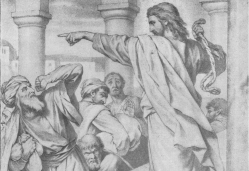 “And He entered the temple and began to drive out those who sold and those who bought in the temple, and he overturned the tables of the money-changers and the seats of those who sold pigeons. And He would not allow anyone to carry anything through the temple” (Mark 11:15-16).
Why did Jesus drive out those who sold and bought in the temple? Why did He flip over tables? That seems pretty extreme. Why was He so worked up?… Read More.
How to Evaluate Christian Leaders?

Recently, I’ve seen a lot of Christian leaders be criticized or criticize, and even call other Christian leaders names because of disagreement on such things as politics, the pandemic, and policies regarding justice. And not surprisingly, those who are not leaders are also jumping into the fray and lobbing grenades too.
How many people actually think through the appropriate way to evaluate Christian leaders?… Read More
*Photo by Aaron Burden



 in X
in X 