18 Quotes from Dave Harvey’s book Rescuing Ambition
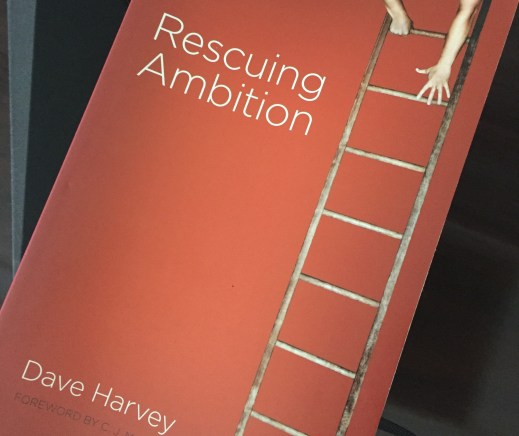
1. “Our search for approval is over. In Christ, we already have all the approval we need” (Dave Harvey, Rescuing Ambition, p. 56).
2. “My search for approval is over. In Christ I already have all the approval I need.
Because Christ’s righteousness has been transferred to me, all the time and energy I once squandered trying to be liked or praised or to achieve something to validate my existence can now be re-directed toward doing things for God’s glory. I no longer live for approval; I live from approval” (Harvey, Rescuing Ambition, p. 56).
3. “God loves good ambition. It brings him glory as he works through our desires to fulfill his purpose. God doesn’t need us, but amazingly he uses us. But to position us for fruitfulness, he’s continually working in our lives, turning our desires toward his ends and developing our ambitions and accordance with his will” (p. 74-75).
Insights from Hudson Taylor’s Spiritual Secret
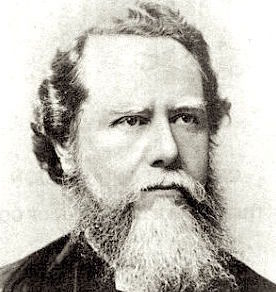
I really enjoyed reading Hudson Taylor’s Spiritual Secret. You should read it. Here are some observations from my reading…
Summary of the book: Trust. Trust and unreserved commitment to the Lord is how I would summarize Hudson Taylor and this book. Before he went to China he said: “‘I shall have no claim on anyone for anything. My only claim will be on God. How important to learn, before leaving England, to move man, through God, by prayer alone'” (33). And that’s what we see happen. He learned to trust God alone. He trusted God even with his children. He said, “‘I find it impossible to think that our heavenly Father is less tender and mindful of His children than I, a poor earthly father, am of mine. No, He will not forget us!'” (125). And in dark days, God enabled[1] Taylor to say: “The battle is the Lord’s, and He will conquer. We may fail—do fail continually—but He never fails” (p. 154).
Insights from the book:
- The impact that one person can have is tremendous when they trust the Lord and have an unreserved commitment to do His will (cite the number of believers in China now, p. 12).
- “We want, we need, we may have, Hudson Taylor’s secret and his success, for we have Hudson Taylor’s Bible and his God” (p. 16). That is such a good reminder. The same God that brought Israel out of Egypt, rose Jesus from the dead, and provided for Hudson Taylor is the same God who is Lord of all now.
- Hudson Taylor wore Chinese clothes even though this was unprecedented and looked down upon by some (cf. e.g. p. 65). This is an important reminder that God and His Word must govern us, not the expectations of others.
- Hudson Taylor had “the Lord’s own yearning of heart over the lost and perishing” (19 cf. p. 32, 112). “We may have more wealth in these days, better education, greater comfort in traveling and in our surroundings even as missionaries, but have we the spirit of urgency, the deep, inward convictions that moved those that went before us; have we the same passion of love, personal love for the Lord Christ? If these are lacking, it is a loss for which nothing can compensate” (p. 127). This reminds me that I need (God help me!) to develop at heart for the lost and love and passion for the Lord Jesus Christ who is their only hope.
- “It was not easy to keep first things first and make time for prayer. Yet without this there cannot but be failure and unrest” (p. 22). Prayer and delighting myself in God is vital.
- “The One Great Circumstance of Life, and of all lesser, external circumstances as necessarily the kindest, wisest, best, because either ordered or permitted by Him” (p. 79). I need to have a bigger view of God. This is vital in part because “The secret of faith that is ready for emergencies is the quiet, practical dependence upon God day by day which makes Him real to the believing heart” (p. 100).
- “’My father sought the Truth,’ he continued sadly, ‘and died without finding it. Oh, why did you not come sooner?’” (p. 95). This quote reminds me of the absolute importance of heralds going to share the good news of Jesus.
- “In these days of easy-going Christianity, is it not well to remind ourselves that it really does cost to be a man or woman whom God can use? One cannot obtain a Christlike work save at great price” (p. 27). This quote—and Hudson Taylor’s life—reminds me and reinvigorates me to seek hard after the Lord.
- “How then to have our faith increased? Only by thinking of all that Jesus is and all He is for us: His life, His death, His work, He Himself as revealed to us in the Word, to be the subject of our constant thoughts. Not a striving to have faith… but a looking off to the Faithful One seems all we need; a resting in the Loved One entirely, for time and for eternity” (p. 158). This quote answers a very important question. How to have more faith? Meditate on Jesus!
- “If God should place me in a serious perplexity, must He not give me much guidance; in positions of great difficulty, much grace; in circumstances of great pressure and trial, much strength? No fear that His resources are mine, for He is mine, and is with me and dwells in me” (p. 165). This is a good reminder that whatever I face, God will be there with me as my ever-present, every-ready, and all-powerful help.
Personal application:
- I need to trust the God who is simultaneously the Lord of the universe and my Father.
- I need to faithfully pray in reliance and desperation to the One who is Lord and Father.
- I need to renew my commitment to spend and be spent for the Lord. I need to renew my commitment to discipline myself for the sake of godliness.
- I need to meditate more on Jesus (His person and work).
- I need to trust that God can use one poor and needy sinner such as I to accomplish great things for His glory.
- I need to develop more of a heart for those who are without hope and without God in the world.
- I need to keep first things first and seek God above all things—even good, healthy, and productive things.
- I need to remember that whatever challenges are in front of me God’s grace is sufficient. God is all-powerful and He is with me. He is my Father!
____________________
[1] Taylor says, “I was enabled by His grace to trust in Him, He has always appeared for my help” (p. 153).
Books you should’ve read in 2017

I’m being facetious in the title.[1] But here are my favorite books that I read in 2017. They are in no particular order. That would be too difficult. If I could make you read just one book, however, it would be The Tech-Wise Family by Andy Crouch.
- John M. Perkins, Let Justice Roll Down
- William Lane Craig, Reasonable Faith
- Ben Sasse, The Vanishing American Adult
- Andy Crouch, The Tech-Wise Family
- Andrew T. Walker, God and the Transgender Debate
- Ishmael Beah, A Long Way Gone
- Tim Challies, Do More Better
- Nabeel Qureshi, Seeking Allah, Finding Jesus
- Frank Turek, Stealing from God
- John S. Dickerson, The Great Evangelical Recession
Ecclesiastes: Necessary Destruction

A treatise on vanity. That is basically the book of Ecclesiastes. What a depressing book. How is a book like that ever to be read and enjoyed, especially with our modern sensibilities? We need stuff that will make us feel good even if it is not the truth, right? Isn’t that what we need? That, at any rate, is what much of society would have us believe.
At first glance, it seems that the book of Ecclesiastes is a book that would throw you into nihilistic depression just short of suicidal. So what use has it in Scripture? Or, what, at least, use do we have for it today?
Well, it does no good to build upon a shoddy and cracked foundation. We can build all we want but all we do is for naught if the building will never truly stand. If we are to truly build something that is worth anything we must start anew. We must strip it down to the bedrock. To say that all is vanity is to say that all is cracked, you cannot build upon it. That is not to say that these things are inherently bad, they are not. But for us to understand these things, whatever they may be for you, we must first know they are desperately cracked. They can never hold anything of substance. They can truly never be built upon. They can’t hold the weight. Thus, if we experience discomfort from Ecclesiastes it is the doctor’s scalpel. It is the necessary pain for the healing of our life.
The Biblical Counseling Movement after Adams

Lambert, Heath. The Biblical Counseling Movement after Adams. Wheaton: Crossway, 2012. 220 pp. $17.99.
Introduction
The author is an appropriate candidate for this subject. He met Jay Adams and studied under Eric L. Johnson who previously evaluated the biblical (nouthetic) counseling movement. Heath Lambert has a unique perspective on the subject. Further, he is both a practicing biblical counseling professor and pastor. It is good to have someone address the situation from both a practical and professional mindset.
Summary
As the title states, the book is about the biblical counseling movement after Jay Adams. The book begins with a forward from David Powlison. Powlison says, “We ought to be good at counseling, the very best at both receiving and giving. No one else’s explanation of human misery goes as wide and long or as high and deep as the Christian explanation” (12). The author shows that he is in wholehearted agreement. That is what this book is mainly about, evaluating and analyzing the movement to be “the very best at both receiving and giving” counsel.
In the first chapter, it is shown that biblical counseling has existed, in a sense, for a very long time (for example the Puritans, 25). However, it suffered a long period of neglect. Many things affected this decline, nine of the most important are listed (26-34). There was over a hundred year gap in which there was no substantive biblical book put out to help people with their problems, until 1970, when Adams’ published Competent to Counsel (26, 35).
The next chapter talks about “Advances in How Biblical Counselors Think about Counseling.” Adams had a focus on sin which is necessary, and especially for what he was facing in his context at the time. However, suffering was not addressed as it should have been. This fault is presently being worked on; this is a clear advancement in the biblical counseling world. Another advancement is in regards to motivation. Instead of mainly regarding behavior there has been an emphasis from where those behaviors flow from, the heart. This has led to much healthy talk about “idols of the heart.”
The War of Art

I appreciate this from Steven Pressfield in The War of Art:
“The following is a list, in no particular order, of those activities that most commonly elicit Resistance:
1) The pursuit of any calling in writing, painting, music, film, dance, or any creative art, however marginal or unconventional.
2) The launching of any entrepreneurial venture or enterprise, for profit or otherwise.
3) Any diet or health regimen.
4) Any program of spiritual advancement.
5) Any activity who aim is tighter abdominals.
6) Any course or program designed to overcome an unwholesome habit or addiction.
7) Education of every kind.
8) Any act of political, moral, or ethical courage, including the decision to change for the better some unworthy pattern of thought or conduct in ourselves.
9) The Undertaking of any enterprise or endeavor whose aim is to help others.
10) Any act that entails commitment of the heart. The decision to get married, to have a child, to weather a rocky patch in a relationship.
11) The taking of any principled stand in the face of adversity.
In other words, any act that rejects immediate gratification in favor of long-term growth, health, or integrity. Or, expressed another way, any act that derives from our higher nature instead of our lower. Any of these will elicit Resistance.”
The Crash of the American Church?

Research shows that the “evangelical church” lost around 10 percent of her people in the last decade. There are many factors that are involved that have resulted in this decline. Further, most churches that are growing are just taking people from other churches, not converting people. The Great Evangelical Recession explores the factors involved in the decline of the church and offers suggestions for the future. I found the book helpful and thought-provoking.
Nabeel Qureshi, Seeking Allah, Finding Jesus (a book review)
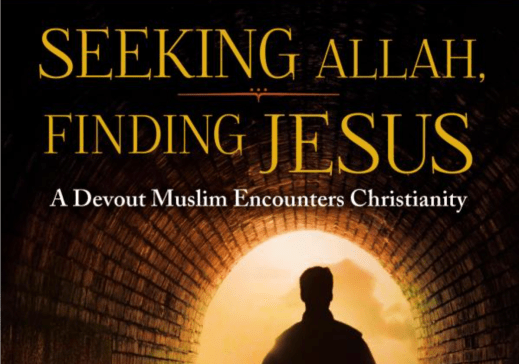
Hearing about Qureshi’ struggle as he thought about what it would mean to convert to Christianity was helpful. It will help me to be appropriately empathetic will discussing Christianity with Muslims. It is helpful to realize that “Muslims often risk everything to embrace the cross” (p. 253). I appreciated hearing his prayer: “O God! Give me time to mourn. More time to mourn the upcoming loss of my family, more time to mourn the life I’ve always lived” (p. 275). I also appreciated what he said about the cost of discipleship: “I had to give my life in order to receive His life. This was not some cliché. The gospel was calling me to die” (p. 278). Read More…
Mike Kuhn, Fresh Vision for the Muslim World (a book review)

[Kuhn, Mike. Fresh Vision for the Muslim World. Downers Grove, IL: Intervarsity Press, 2009.]
Author Background
Importance of the Book
Overview
Kuhn proceeds then to talk about the theological differences between Christianity and Islam. For instance, “the essence of the Christian faith—God became human being in Christ—is diametrically opposed to Islamic faith” (69). There is also a vast difference in the view of what constitutes humanities problem and thus our view of salvation is different. Islam teaches that “individuals are neither dead in sin nor in need of redemption; rather, they are weak, forgetful, and in need of guidance” (78). The heart of the difference between Islam and Christianity is how man is put right with their Creator (81).
In chapters seven through nine, Kuhn reminds us that Jesus’ concern was not with “the geopolitical state of Israel during his earthly ministry. His concern is with his kingdom—the kingdom of heaven” (120). The place of the state of Israel is a subject filled with tension for many Muslims and Christians alike but it is also a very important and practical subject. So, we must seek God and His Scripture for wisdom, we must understand Jesus’ words (130, 171). Kuhn points out that the need of the entire world is to see “the manifestation of the kingdom of Jesus in his people” (158, italics mine), not in an earthly nation. As we have seen, we are to love our neighbors and part of loving someone is understanding them, their history, their perspective, their past hurts.
Chapter ten talks about jihad and explains that not all Muslims understand jihad in the same way, some have a spiritualized understanding of jihad (e.g. 199). So, it is important to understand that Muslims, like Christians, are not all the same. In fact, “the primary concerns of most Muslims are similar to ours—raising their children, providing for their children’s education, saving for that new car or outfit… We must exercise care not to be monofocal in our understanding of Islam” (187). Chapter eleven challenges us to faithfully speak for Jesus and live for His Kingdom and not our own. In part 5, chapters twelve through thirteen, we see steps to incarnation and what it means to live missionally (see esp. 225).
Evaluation
Stylistically, I appreciate that Kuhn covered many different topics yet did not lose the focus of the book. For example, he introduced incarnation at the beginning (8) and then weaved it through the rest of the book (see e.g. 13, 16, 75, 85. 242). What is needed Kuhn pointed out, though sadly rare, “is an extended hand, a caring smile, someone who is willing to go the extra mile to help someone in need” (259) (cf. Matt. 5:13-16; Jn. 13:35; 1 Cor. 10:33).
I appreciate Kuhn’s reminder that “The kingdom of Jesus as opposed to empire is not concerned in the least about the political boundaries of a country. It is a reality that overlays the political boundaries” (256). We must remember that the Roman Empire came and went, but Jesus’ Kingdom is eternal (254) (cf. Jn. 18:36). Kuhn’s challenge is timely, he says, “if Western Christians are able to bid farewell to our fortress mentality, we will find that our countries have already become exceedingly accessible and potentially fruitful mission fields” (244). Kuhn further points out that if American Christians are overly aligned with their governments’ policies then their missional impact will likely be impacted (241). Instead, as Christians, Jesus should be our King and His policies should hold ultimate sway. The real hope of the Muslim world, and the Western world for that matter, is not democracy, it the diffusion of the good news of Jesus the Christ and the establishment of His reign (218).
Conclusion
As Muslims grow increasingly suspicious and fed up with the violent response of Islamists, they are beginning to look for alternatives. Some are finding their alternative in secularism. Others are turning to materialistic pleasure. Will we as Christ-followers have anything to offer them? (214-15)



 in X
in X 