Crying On Christmas Day

A lot of us know the cheery and upbeat Christmas song, “I Heard the Bells on Christmas Day.” Many people don’t know Henry Wadsworth Longfellow’s story and poem behind it. Longfellow heard the bells ringing out from a nearby church on Christmas Day, 1863, and heard the happy chatter of the crowds and composed his poem. But the world seemed anything but peaceful and cheery. It was shattered. He had recently lost his second wife to a fire, the Civil War was raging, and his son had just been wounded in battle.[1]
Longfellow said, “How inexpressively sad are all holidays!” “Perhaps some day God will give me peace.”[2] The song versions of Longfellow’s poem don’t capture the bleak despair he was facing but the Civil Wars version comes close. Here are the two last verses of the poem:
And in despair I bowed my head;
“There is no peace on earth,” I said;
“For hate is strong,
And mocks the song
Of peace on earth, goodwill to men!”Then pealed the bells more loud and deep:
“God is not dead; nor doth he sleep!
The Wrong shall fail,
The Right prevail,
With peace on earth, goodwill to men!”
Many bow their heads in despair and say, “There is no peace on earth.” Many people are sad on Christmas Day for various reasons—whether death, divorce, or some other devastation—but sadness is no stranger to Christmas.
Other than “It’s A Wonderful Life,” most Christmas movies are silly, not very serious, and not sad. But the original Christmas story, the true Christmas story, is anything but silly. Jesus was born in an animal troth and was thought by many to be an illegitimate child.
The very reason the Bible says Jesus had to come to earth is sad. Jesus’ very name means, “the Lord saves.” And that is indeed what Jesus came to do, save His people from their sins and the sad situation they had gotten themselves into.
Jesus came into the brokenness and blight of the world. As the Christmas song, “O Holy Night,” says,
The King of kings lay thus in lowly manger,
In all our trials born to be our Friend.
He knows our need— to our weakness is no stranger.
Jesus can sympathize with us (Hebrews 4:15). Jesus understands death and devastation, not just in the way that He knows everything as God, but by experience. Since human beings are made of flesh and blood, Jesus Himself became flesh and blood (John 1:14; Hebrews 2:14), and is acquainted with the stress and sorrow we face.
We don’t always have to be happy-clappy at Christmas. Rather, the Bible says:
There is a time for everything,
and a season for every activity under the heavens:
a time to weep and a time to laugh,
a time to mourn and a time to dance,
a time to tear and a time to mend,
a time to be silent and a time to speak (Ecclesiastes 3:1,4,7).
More Christmas songs than you might realize, understand our plight and pleas for rescue. Here are a few lines from one of my favorite songs, “O Come, O Come Immanuel”:[3]
…free Thine own from Satan’s tyranny
From depths of hell Thy people save
And give them victory o’er the grave
…Disperse the gloomy clouds of night
And death’s dark shadows put to flight
…open wide our heavenly home
Make safe the way that leads on high
And close the path to misery
…O come, desire of nations, bind
In one the hearts of all mankind
Bid Thou our sad divisions cease
And be Thyself our King of peace
We don’t know the exact timing of Jesus’ birth, but it would be fitting if it was a dark cold night. This world is often dark and cold. But Christmas is about Jesus coming into that cold black darkness, relating to us, and bringing life, light, and warmth. In Jesus, “The people who walked in darkness have seen a great light; those who dwelt in a land of deep darkness, on them has light shone” (Isaiah 9:2).
The reality is, that Christmas is about light in darkness and hope amid grief. But Christmas is not lite, and it’s not just about laughter and “ho, ho, ho.” The Bible tells a gritty, realistic story about this broken world. But it also gives hope. It gives:
a bell ringing out in the silence
a light in the midst of darkness
snow silently falling on the black muddied earth
sunrise cresting the top of the trees
reminders that there is change
a new day ahead.
The Bible says that God does not sit idly by, but rather enters the fray. Christmas proves that God so loves the world. We may not always feel light, but He gives the offer of life. When we feel heavy and hollow, He offers to lift our load and give purpose.
Longfellow was sorrowful. His life was shattered. But what if Jesus came to earth to be shattered so that one day you could be mended and whole? And what if He promises to help pick up the pieces and make a masterful mosaic?
What if, in our muddled mess, Jesus the Messiah came? Came to love us and help us heal? What if He loves us? And says, “Come to Me, all who are weary and heavy laden. Come to Me, I have walked the weary road of life, I get it, I understand your strife.” Jesus says, “Come to Me, all who are empty and exasperated. I will give you rest for your souls.”
May God bless each of you this Christmas and in time, help you make a beautiful mosaic out of the shattered shards of life.
Notes
[1] He lost his friend, Nathaniel Hawthorne, around a year later.
[2] See “I heard the bells on Christmas Day.”
[3] Immanuel means “God with us.”
Photo by Abigail
What is Christmas about?

Christmas is about the coming of the Christ. But, what does “Christ” mean? And why does it matter?
The word Christ comes from New Testament Greek. The Greek word is Christos (Χριστός), and it translates the Hebrew word Messiah (מָשִׁיחַ). Great. But what does Christ/Messiah mean? The simple answer is that Messiah means “anointed one.” But there is much more behind the meaning of the word Messiah than just “anointed one.” The Old Testament in various ways and in numerous writings promises that one would come and fulfill various promises. So, the expectation for the Messiah cannot be captured if we think it just means “anointed one.” It does mean that, but that is not all it means.
Do you know what a “honey-do-list” is? Have you ever seen one? I currently have a few things on the list: fix the leaky faucet, refinish the chair, and paint my son’s bedroom. A “honey-do-list” is a checklist of expectations. My wife, Leah, gave me a list and expects me to get everything done on the list. I am glad my wife is understanding and gracious, so the list isn’t very long.
As we think about the Jewish expectations for the Promised One, we are looking at a “honey-do-list” of sorts. We see from Scripture and history the “honey-do list” was not as small and understanding as my wife’s. The Jewish people had a huge list. And different people had different lists, but any list would be difficult to check off.
I think of the messianic expectations like water and oil. You don’t expect them to go together. How can the promised one be a king (2 Sam. 7:12-13; 1 Chron. 17:11-14) and a servant (Is. 52:13-53:12)? “One like the son of man” (Dan. 7:13) and also “Everlasting Father” (Is. 9:6)? How could the promised one suffer and die for His people and yet bring an eternal righteous reign? You don’t think of those things as going together. But sometimes things that you wouldn’t think go together, work quite nicely.
You wouldn’t think oil and vinegar make sense together. And you probably wouldn’t initially think it would make sense to have bacon with anything! It’s good enough on its own, right? But if you add spinach, candied pecans, cheese, oil, and vinegar (transformed into salad dressing), the bacon is elevated, and maybe even a little healthier.
If unexpected combinations result in delicious food, how great would the impact be on a spiritual level? A king who is also a servant?! Someone who has all power but is also all good? We don’t often think of these combinations, but if they could happen, it would be amazing.
The expectation presented in the Old Testament for the Promised One seems almost impossibly diverse. How could any one person fulfill the many expectations? How could it make sense for the “Ancient of Days” (Dan. 7:9, 13, 22) to be a descendant of king David (2 Sam. 7:12-16; Is. 11:1; Jer. 23:5-6)?
The New Testament authors, over and over, argue that Jesus is the Promised One, the long-awaited Messiah, who fulfills the prophecies, patterns, pointers, and promises of the Old Testament (2 Cor. 1:20). He will crush the serpent of old (Gen. 3:15) and lead the way back into Eden, He will bless all the nations of the earth, and He will set up His righteous and eternal Kingdom.
The messianic expectations appeared to be nothing more than unrelated and random shards of glass. But the New Testament helps us see they all work together to form an astounding, almost unbelievable, stained-glass picture of Jesus, the long-awaited, promised Messiah. That’s why understanding what Christ means matters. Without understanding the expectations for the Messiah, we’re left with broken glass, rather than a breath-taking mosaic.
Regarding prophecy, there are several Old Testament passages we could consider. I’ll give the Old Testament reference and then the New Testament reference.
- His appearance will be disfigured (see Isaiah 52:14 and Matthew 26:67).
- He will be despised and rejected (see Isaiah 53:3 and John 11:47-50).
- He will take sin upon Himself (see Isaiah 53:4-6, 8 and 1 Corinthians 15:3).
- He will be silent before His oppressors (see Isaiah 53:7 and Matthew14:60-61).
- He will be assigned a grave with the wicked and the rich in His death (Isaiah 53:9 and Mark 15:27-28, 43-46).
- He will be a descendant of king David (see 1 Chronicles 17:11-14 and Luke 3:23, 31).
- He will be born in Bethlehem (see Micah 5:2 and Matthew 2:1).
- He will be preceded by a messenger (see Isaiah 40:3-5 and Matthew 3:1-2).
- He will have a ministry of miracles (see Isaiah 35:5-6 and Matthew 9:35; 11:4-5).
- He will enter Jerusalem on a Donkey (see Zechariah 9:9 and Matthew 21:7-9).
- His hands and feet will be pierced (see Psalm 22:16 and Luke 23:33).
- He will be hated without reason (see Psalm 69:4 and John 15:25).
- His garments will be divided and lots will be cast for them (see Psalm 22:18; John 19:23-24).
- His bones will not be broken (see Psalm 34:20 and John 19: 33).
- His side will be pieced (see Zechariah 12:10 and Jn. 19:34).
- He, the Mighty God, will be born (see Isaiah 9:2-7 and Matthew 1:23; John 1:1-3, 14).
Christmas—the real meaning of the season—is about Christ, the fulfillment of God’s promises, and all the many things that means.
Photo by Jakob Owens
Is Christmas True?
Is Christmas true? Or should we assume Christmas is just a fairytale like Santa Claus?
Our starting places or assumptions have a big impact on the way we weigh evidence. For instance, in Harper Lee’s book, To Kill a Mockingbird the correct verdict could not have been given in that context (i.e., Maycomb’s racist white community) because people excluded the possibility that anyone other than the black man, Tom Robinson, was guilty. Despite the strong evidence that Atticus Finch put forward, Tom was still convicted. Why? Because people were prejudiced against the truth. The people’s a priori assumption, that Tom was guilty because he’s black, led them to not honestly look at the evidence and pronounce the correct verdict.
This sadly still happens. It happens in the court of law and it can happen when people consider evidence about Jesus too. But, if God exists and wants to be born as a baby, as Christmas says, then certainly God can do that.
The Bible says Christmas is true. It even says the “star” guiding the Wisemen is true. Are there actual reasons for believing in the historical accuracy of Christmas? I believe so. But will people openly weigh the evidence?
Honestly, there’s a lot to look at. Here I’ll just share two pieces to consider.
Jesus’ Biographies
Although the Gospel accounts in the Bible may not be exactly like our biographies today, they really are biographies. Or they certainly claim to be. They purport to give actual history about Jesus of Nazareth. The Bible has four historical biographies about Jesus, often referred to as the Gospels.[1] Two of them explicitly claim to tell us what Jesus actually did and said, and they claim to be based on eyewitness testimony (Luke 1:1-4; John 21:20-24). And so, Justin Martyr, a second-century Christian writer and philosopher, referred to the Gospels as “the memoirs of His apostles.”
This is what Luke says:
Inasmuch as many have undertaken to compile a narrative of the things that have been accomplished among us, just as those who from the beginning were eyewitnesses and ministers of the word have delivered them to us, it seemed good to me also, having followed all things closely for some time past, to write an orderly account for you, most excellent Theophilus, that you may have certainty concerning the things you have been taught (Lk. 1:1-4).
Luke is basically making the claim to be a journalist or historian.
The Gospels place themselves in a historical context. They don’t start with imaginary elements. There is no “once upon a time.” Instead, they give us identifiable time stamps. They say things like: “Augustus was emperor of Rome,” “Quirinius was governor of Syria,” “Pilate was governor of Palestine,” “Herod was king of the Jews,” and “Joseph of Arimathea was a member of the Sanhedrin” (e.g., Matt. 2:1; 27:2; Mk. 15:1, 43; Lk. 2:1-2; Jn. 19:38). These were not made-up people or made-up positions. They repeat historical realities because the Gospels claim to be historical documents.
Many of the events that the New Testament writers wrote about were well-known. The Apostle Paul could tell king Agrippa: I am persuaded that none of these things has escaped your notice, since these things have not been done in a corner(Acts 26:26). The early Jesus followers did not follow cleverly devised myths about the Lord Jesus Christ but claimed to be eyewitnesses (2 Pet. 1:16).
C.S. Lewis knew a lot about legends and he didn’t think the Gospels read like legends. In Lewis’ own words: “Now, as a literary historian, I am perfectly convinced that whatever else the Gospels are they are not legends. I have read a great deal of legend and I am quite clear that they are not the same sort of thing.”[2]
The “Star” of Bethlehem
Matthew’s telling of the story of Jesus includes a lot about a “star.” But if you read the account, he says things about the “star” that do not make sense if he is talking about a literal star. The way he describes what the “star”[3] does would not make sense unless he was knowledgeably aware of the peculiar movements it made. The star was “His star” and it “rose,” “appeared,” “went before them,” and rested “over the place where the child was.”
The sign in the heavens convinced the Babylonian magi—the NASA of the day—to pay a visit to Jesus. They were aware of the Jewish promise of a coming King and what was transpiring in the sky made them think something very significant was happening.[4]
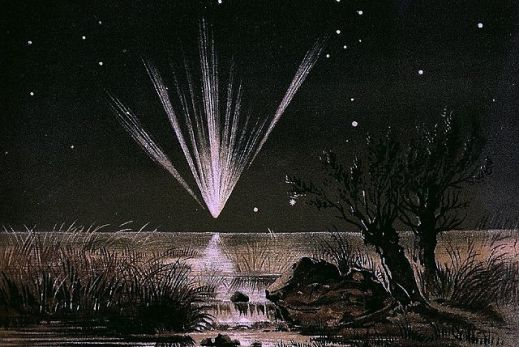
What did the Wisemen see? This would be super random to include in a story about Jesus unless the writer knew it to be factual and significant. Otherwise, the writer could have said something simpler: “a bright and mysterious light shown down on the blessed child.” Instead, the author describes the movements of a beautiful comet, something like the Great Comet of 1811. The potential issue with describing something so seemingly outrageous is that it’s visible to a lot of people. Many people could have come forward and said there was never anything in the sky like that. But that didn’t happen. Instead, later on, Origen rightly identifies the “star” as a comet.
Here’s what Origen said (circa 248):
The star that was seen in the east we consider to have been a new star, unlike any of the other well-known planetary bodies. Yet, it had the nature of those celestial bodies that appear at times, such as comets…. It has been observed that, on the occurrence of great events, and of mighty changes in earthly things, such stars are apt to appear, indicating either the removal of dynasties or the breaking out of wars. … There is a prophecy of Balaam recorded by Moses to this effect: ‘There will arise a star out of Jacob, and a man will rise up out of Israel.’
Ignatius said (circa 105), “The light from this star was inexpressible, and its uniqueness struck men with astonishment.”
So, unless this event with the Wisemen and Comet happened, what would one gain by fabricating the story? The Babylonian Wisemen would not be popular with the Jewish people. The Babylonians took Jewish people into exile and were idolaters and the Wisemen were seen as magicians who practiced sorcery against the LORD’s command (Deut. 18:10–12; Mal. 3:5; Gal. 5:19–21). And so, the God/child receiving charity from such people would probably not be seen positively.
If your premise is that the whole story was fabricated and made up to fool people, why would the author have risked claiming such a visible and verifiable phenomenon? On the other hand, if you look at Matthew as a historical work, there’s nothing that should be excluded outright. For one, Matthew certainly gets king Herod’s personality right. The historian Josephus recorded what a gruesome man Herod the Great was. He put his favorite wife to death as well as three of his sons and killed other family members too.
The slaying of the 15 to 35 babies, known as “the Massacre of the Innocents,” referred to in Matthew 2 may not be mentioned in other surviving historical accounts but it is in keeping with what we know of Herod.[5] And again, why mention this historical datum if it wasn’t accurate? Wouldn’t it be possible as the account of Jesus circulated for someone from Bethlehem to hear about the account of the massacre? Wouldn’t the story of Jesus be on unstable footing if just one lie was found out? Why then would the author take such risks?
Imagine I wanted to lie and make you think I’m good at baseball. There are all sorts of ways I could do that. I could say, “I’m really good at baseball.” I could say, “I played college baseball.” But the more specific and fantastic I get about my lie the higher the risk. If I say, “I played baseball for the Yankees” you’re going to have lots of questions and you’re probably going to seek out verification. A nondescript lie is a lot safer and can still accomplish my purpose of making you think I’m good at baseball. The claims about Jesus are not like that. They are distinctive. They—especially in the first century—are falsifiable.
The biographies of Jesus go beyond saying “Jesus was good at baseball,” and even beyond saying “Jesus played shortstop for the Yankees and batted cleanup.” They give loads of information that could have been found to be false but were never proved to be false. Again, why include so much fantastical false information? And remember, the Jesus movement didn’t take decades to form.
Anyhow, I’m trying to stop writing… There are many reasons to believe Christmas is a true story. We’ve very briefly considered two.
Notes
[1] Gospel means “good news.” In Greek, it is euangélion (εὐαγγέλιον) and it is where my daughter, Evangelina, gets her name from.
[2] C.S. Lewis, “What are we to make of Jesus Christ?,” 169 in God in the Dock.
[3] “Star” here is the English translation of the Greek word aster (ἀστήρ), and it’s where we get our English word “asteroid.” Aster can refer to various lights in the sky.
[4] See Colin R. Nicholl, The Great Christ Comet: Revealing the True Star of Bethlehem (Crossway: Wheaton, IL, 2015).
[5] Remember the infant mortality rate would have been high in that day and the massacre was all boys aged two and below so the number would have likely been relatively low for someone like Josephus to report
Pervasive Peace through the Second Advent

In Christmas, we celebrate the advent or coming of Christ. The first coming enabled a way for peace to be realized. Humans can, through Christ, have renewed fellowship with God. Yet, as Jesus Himself said, in the world we will have trouble and tribulation.
So, if that’s the case, if in the world we will have difficulty and distress, then how can we have peace? This Sunday I get to preach on the “Pathway to Peace” from Isaiah chapter 11. I’m excited and thankful to be able to do that.
I, however, have too much material. So, I thought I’d share here, part of how that peace is possible.
First, Isaiah paints a beautiful and powerful picture of peace (see Isaiah 11:1-9). A little baby can play with a king cobra without fear (v. 8). How is this possible?
Isaiah 11:9 tells us: the knowledge of God is intimately experienced. And so: nothing will “harm nor destroy on all [the Lord’s] holy mountain.” Instead of harm, “the earth will be filled with the knowledge of the Lord as the waters cover the sea.”
The Messiah will make it so not only the knowledge of the LORD is pervasive but intimacy with the LORD is too. Knowledge in the Old Testament is not merely head knowledge, but it is experiential (When Adam “knew” Eve, Genesis 4:1, it was not mere cognitive knowing, it was experiential).
Also, we should ask, how is it that the waters cover the sea? The waters cover the sea by filling it to the fullness of capacity. God and His goodness will be experienced and known to maximum capacity! We will have the strength together with all the saints to comprehend and know “the breadth and length and height and depth” of the “love of Christ that surpasses knowledge” and we will be “filled with all the fullness of God” (see Ephesians 3:18-19).
Look at what’s going to happen when Jesus reigns on earth!:
“Of the greatness of his government and peace
there will be no end.
He will reign on David’s throne
and over his kingdom,
establishing and upholding it
with justice and righteousness
from that time on and forever” (Isaiah 9:7).
Of peace, there will be no end!
Justice and righteousness forevermore!
Of course, this is not yet a reality. First, Christ came as a Lamb to be slain. Next, He’s coming as the Lion of the tribe of Judah (see Revelation 5:5).
In that day, when perfect peace comes upon the earth, the LORD says, “my chosen ones will long enjoy the work of their hands” (Is. 65:22). The most precious moments that we experience on earth—whether that’s a Thanksgiving dinner, a beautiful sunset, or being lost in a song or prayer of praise—will be multiplied infinitely.
“What no eye has seen, nor ear heard, nor the heart of man imagined, what God has prepared for those who love Him” (1 Corinthians 2:9).
How ironic, how sad, that the Rejected One, is the One who brings renewal of the whole earth.
Fellow Christians, please share the message that is so needed in these days of distress. And pray for your neighbors, that they would have peace that surpasses understanding.
Please pray that the Rejected One, the one alone who brings perfect and pervasive peace, would no longer be rejected.
Our Hope in the Midst of the Virus

This is a difficult time for many of us. Yet in the LORD we find comfort that transcends our earthly struggles. What hope do we have in the midst of this time of difficulty?
Zephaniah recounts for us a lot of really difficult things. Zephaniah is not a lighthearted read. It is heavy. If Zephaniah was a painter, he wouldn’t have used pastel colors. Instead, the canvas would be filled mainly with black and red.
Yet, there would be a glimmer of light, a glimmer of hope in the darkness. What hope is that and who is it for?
Ash Wednesday

It is when we weep and howl in the agonies of distress that our rescue is all the more rejoiced in. When we see the contrast of our mourning turned into dancing and our ashes replaced with a crown, it gives us a picture of where we came from and what we deserve and what we get through the free salvation of Christ Jesus.
Ash Wednesday is a day of penitence but it leads to a party—new life in Jesus! We see our dire state and we see our sweet salvation!
Ash Wednesday is a type of looking down. Looking at ourselves, the state that we’re in. But we look down so we can have the right perspective as we look up and out to Jesus.
Ash Wednesday is a tangible and powerful symbol of our need. And when we know our need we rejoice in the One that comes for the poor and needy.
What did Jesus accomplish on the Cross?

Jesus purchased His people (Jn. 6:36, 39; 1 Pet. 1:18-19). He showed God’s amazing love (Jn. 3:16; 15:13; 1 Jn. 3:16). He brought justification to all who would place their faith in Him (Rom. 5:18) by dying for their sins, in their place (1 Cor. 15:3; 1 Pet. 2:24; 3:18; Is. 53). He absorbed the wrath of God (1 Jn. 2:2). He became sin and made all who trust in Him the righteousness of God (2 Cor. 5:21). He canceled debt (Col. 2:14). He brought reconciliation (Rom. 5:10; Eph. 2:16; Col. 1:20-22). He defeated Satan, sin, and death and brought victory (Gen. 2:15; 1 Cor. 15; Col. 2:11-15; Heb. 2:14; Is. 53).
Jesus knew no sin, yet He became sin. We see the idea of someone bearing sin in the place of others attested to in both the Old Testament and New Testament (cf. Lev. 10:17; 16:21-22; Is. 53:6, 11-12; Jn. 1:29). Jesus is the Lamb without blemish that takes away our sin by dying in our place but He also rises; priest and lamb are not His only office. Jesus is also the coming King who reigns eternally. Consequently, the salvation that Christ brings through His work on the cross brings not only appeasement from wrath but also entrance back into the true Promised Land, the Garden of Eden. So, “the gospel is the good news of the Kingdom through the cross,” as Kevin DeYoung and Greg Gilbert say. The New City Catechism says, “Christ’s death is the beginning of the redemption and renewal of every part of fallen creation, as he powerfully directs all things for his own glory and creation’s good” (Q. 26).
Christ’s work and resurrection propels on this world new creation (cf. Rom. 8:29; 1 Cor. 15:20; Col. 1:18), it is the inevitable avalanche that will eventually encompass the whole earth (Ps. 72:19; Is. 11:9; Hab. 2:14) and those in Christ will be swallowed up in the effulgence of its glory, there to bask in eternal joy. Christ’s work on the cross and resurrection is the dawn, the first light, but soon the full splendor of the sun.
8 Reasons we need to learn from the Old Testament

If we have the New Testament why do we need the Old Testament?
- All Scripture is inspired by God and profitable (2 Tim. 3:16), not just the texts we like to read.
- All the promises of God find their answer in Jesus so it is important that we understand what the promises are (2 Cor. 1:20).
- When Paul preached to the Ephesian church he preached the whole counsel of God (Acts 20:27) and the whole counsel of God points us to Jesus (Lk. 24:27).
- When Stephen preached in Acts chapter seven he preached the Old Testament (see also the other sermons recorded in the New Testament) which demonstrates the vital importance of the Old Testament.
- The things in the Old Testament serve to instruct us and set an example for us (Rom. 15:4; 1 Cor. 10:11).
- When Paul ministered to churches one of his ministries was proving that Jesus was the Promised One, the Christ (Acts 9:22). Paul demonstrated the amazing truth that Jesus is the long-awaited Messiah by teaching the Old Testament. We see this all through Acts (Acts 9:22; 13:16ff; 16:13; 17:3, 17; 18:4-5, 19; 19:8ff; 24:25; 26:6, 22-26; 28:23, 31 cf. 18:28). We too must understand what it means that Jesus is the Messiah and that will require learning from the Old Testament.
- Much of the New Testament assumes knowledge of the Old Testament.
- Scripture is so good we need as much of it as we can get, Old Testament or New. Scripture is perfect (Ps. 19:7), true (Ps. 19:9), pure (Ps. 19:8), a light (Ps. 119:105,130), a sword (Eph. 6:17), a hammer (Jer. 23:29). It is better than gold (Ps. 19:10; 119:72) and we need it to live (Ps. 119:144). Scripture gives joy (Ps. 119:111; Jer. 15:16), makes wise (Ps. 19:7), guards (Ps. 119:9), guides (Ps. 73:24; 119:105), sanctifies (Ps. 119:9, 11).
Read and study the Old Testament along with the New. 🙂
How to Keep Christ Central this Christmas Season

Christians often say, “He is the reason for the season,” which is true. Yet, it is easy in the “hustle and bustle” of the holidays for that not to ring true in our homes. So, here are some suggestions I have complied to help you keep Christ central this holiday season…
Give God a Gift
The notion of giving God a gift may sound funny since it is He that is the “giver of every good gift” (James 1:17 cf. 1 Cor. 4:7). Yet the Bible certainly gives us precedence for giving God gifts, from Abel offering gifts to God (Gen. 4:4) to Paul’s exhortation in Romans 12 for us to offer our bodies as living sacrifices in light of all His goodness to us.
So, this holiday season give the LORD a gift. No, He does not need it. But He does deserve it and it is thoroughly biblical. When we give gifts to God it gets our mind on God (Matt. 6:21). Here are a few ideas: Fast. Fast one of the holiday feasts. Not for the purpose of limiting your caloric intake but because you want to focus and intentionally praise the one who is “the reason for the season.” You could also give a financial gift to your church or other good ministry. Use your creativity and give a gift that you believe God would appreciate.
Read the Christmas Story on Christmas Day
Reading the Christmas story on Christmas is a super good thing to do if the whole season is supposed to be about the coming of the Messiah Jesus. I would personally chose Luke 1:5-2:20. I would also suggest singing a hymn and offering a prayer of thanks too.
Set up a Nativity Scene in your Home
This is a helpful visual representation of what the holiday season is really all about. The One who created the world—the One who was in the beginning with God—the One who made all things and holds all things together—He became flesh and dwelt among us. When we see the nativity scene we can rejoice that God waded into this broken world to redeem it.
Why should I believe the Bible? (pt 7)

We have already looked at many reasons why we can believe the Bible. Yet, there are still many more. Here we briefly look at the Bible being trustworthy because it is…
Prophetic
The Bible contains all sorts of fulfilled prophecies (see e.g. “The Prophecy of Daniel 8”), particularly about Jesus. These attest to the Bible’s uniqueness, truthfulness, and authority.
“Whatever one may think of the authority of and the message presented in the book we call the Bible, there is a world-wide agreement that in more ways than one it is the most remarkable volume that has ever been produced in these some five thousand years of writing on the part of the human race.
It is the only volume ever produced by man, or a group of men, in which is to be found a large body of prophecies relating to individual nations, to Israel, to all the peoples of the earth, to certain cities, and to the coming of One who was to be the Messiah. The ancient world had many different devices for determining the future, known as divination, but not in the entire gamut of Greek and Latin literature, even though they use the words prophet and prophecy, can we find any real specific prophecy of a great historic event to come in the distant future, nor any prophecy of a Savior to arise in the human race…”[1]



 in X
in X 