The Resurrection

Peter refers to this Davidic Psalm in Acts chapter 2. He said: “Fellow Israelites, I can confidently speak to you about the patriarch David: He is both dead and buried, and his tomb is with us today” (Acts 2:29). In short, David’s dead and his body rotted. David did, however, as a prophet tell us that one of his descendants would sit on his throne (v. 30). So, David seeing that in advance “spoke concerning the resurrection of the Messiah: ‘His body was not abandoned to the realm of the dead, nor did His body see decay’” (v. 31).
Paul says it a little differently. He says King “David, after he had served the purpose of God in his own generation, fell asleep and was laid with his fathers and saw corruption” (Acts 13:36). King David saw corruption. His body decomposed. So, David is not the “Holy One” that the Psalm refers to.
Paul goes on to say, “But He whom God raised up did not see corruption” (v. 37). Ding, ding, ding! Jesus is the Holy One! He is the long-awaited Messiah and forever King!
David knew that the LORD would place one of his descendants on the throne. How did he know this? Because…
The Committal
Jesus’ life was bathed in the language of the Psalms. Yet, when Jesus quotes Psalm 31 He doesn’t quote it exactly. Instead, He says, “Father, into your hands I commit my spirit” (Lk. 23:46).[1] And so, Jesus’ dying moment was one of trust in His Father. Jesus trusted as He taught us to pray (“Our Father in heaven…”—Matt. 6:9-15). Jesus trusted as He brought a way for us too to go to the Father (Jn. 14:6).
And so we see that Jesus who cries out in despair—trusts God.[2] And we see He laid His life down. Jesus committed Himself into the care of His Father[3] and said, “It is finished” (Jn. 19:30) and breathed His last. Jesus was in control of His life, and He laid it down. The fact that no one took His life from Him but that He laid it down[4] also implies that He is able to “take it up again” (Jn. 10:17).
It is because Jesus trusted God His Father in His life and in His death, and because He freely laid His life down, that we have access to the Father. Jesus makes a way for us by being the perfect sacrifice. Jesus always perfectly trusted God.
So, through Jesus we can have God as our Father. We can go to Him in prayer as Jesus taught us (Matt. 6:9-15). We don’t have to be anxious like unbelievers because we know that we have a heavenly Father who knows all that we need (v. 32). And we can be assured of our Father’s love and care for us because He loved us so much that He sent Jesus (Jn. 3:16).
Jesus is Forsaken

Jesus is Forsaken
On the cross, Jesus cries out and quotes Psalm 22:1: “My God, my God,[1] why have Thou forsaken me?!”[2] This is especially pungent because Jesus, unlike all other humans, did not deserve to be forsaken.[3]
Jesus’ forsaken cry comes at the end of three hours of darkness (Matt. 27:45). This is in great contrast to other momentous occasions in Jesus’ life. At Jesus’ birth, the star led the way and angels announced His arrival (Lk. 2:8-14).[4] At Jesus’ baptism, the heavens were torn open and a voice from heaven said, “You are my beloved Son; with You I am well pleased” (Matt. 3:17). At Jesus’ transfiguration “a cloud overshadowed them,[5] and a voice came out of the cloud, ‘This is my beloved Son; listen to Him’” (Mk. 9:7).
Yet, when Jesus is on the cross crying out His forsaken cry the sky is dark and there is no voice from heaven.[6]
However, it is through Jesus being forsaken by God that a gentile centurion[7] says, “Truly this man is the Son of God” (Mk. 15:39). It is through Jesus being forsaken by God that the temple curtain is ripped in two (Mk. 15:38)[8] and we can now, through Jesus Christ, boldly go to God our Father (Heb. 9:2–3, 12; 9:24; 10:19–20).[9]
Jesus cried His forsaken cry so that all who trust in Him will not have to for all eternity.[10] Jesus died in agony, crying out, “My God, my God! Why have You forsaken me?!” so that we could die in peace. The voice that called out to Abraham to not touch Isaac is silent for the Son of God so that we too could be spared.
Later on, the psalmist says: “I am poured out like water, and all my bones are out of joint; my heart is like wax; it is melted within my breast; my strength is dried up like a potsherd, and my tongue sticks to my jaws; you lay me in the dust of death” (Ps. 22:14-15 cf. 69:17-21).
That too was Jesus’ experience. He was forsaken by God. His life was poured out like water as He drank the cup of God’s wrath and suffered severe thirst. John 19:28 says, “Jesus, knowing that all was now finished, said (to fulfill the Scripture), ‘I thirst.’”[11] And so we see, the One “who had made gallons of wine for a wedding party, who had spoken of living water that would quench all thirst forever” was dying with a parched tongue and the sour smell of vinegar on His beard.[12]
Jesus died in the dark. Thirsty. Forsaken by God.
Yet it is through Jesus being forsaken that He opens the way for whosoever will to come to God through the way that He made. Jesus is the way, He is the gate (Ps. 118:20; Jn. 14:6).
Reflections
- It’s helpful to realize in the midst of suffering that God takes our suffering seriously. In fact, “God takes our misery and suffering so seriously that he was willing to take it on himself.”[13]
- Jesus, because He Himself suffered when tempted, He is able to help those who are being tempted (Heb. 2:18). Jesus was “made like his brothers in every respect, so that He might become a merciful and faithful high priest in the service of God” (v. 17). So, as you struggle and strive in this fallen world, remember Jesus sympathizes with your weaknesses, because He was tempted in every way that we are, yet He never sinned (Heb. 4: 15).
Prayer
God, we are thankful and amazed that You are mindful of us. But we know that You are. And You even sent Jesus to bear the wrath that we deserve so we could be welcomed into friendship with You. Thank You, God. Be praised by our lives we ask, because You deserve it. We ask this through Jesus our once forsaken Great High Priest. Amen.
Notes
________
[1] Jesus said, “My God, my God” and so we see both Jesus’ personal relationship with God—even though He doesn’t say “My Father, my Father” here since He’s quoting the psalmist—and His continued trust in God (Bauckham, Jesus and the God of Israel, 258).
[2] Forsaken me in this context means “to cast off,” “reject,” “to be far from,” “to hide God’s face from,” “to turn in anger from,” “to forget” (Richard Bauckham, Jesus and the God of Israel: God Crucified and Other Studies on the New Testament’s Christology of Divine Identity, 256). “To be forsaken by God means that he has allowed this to happen and does nothing to help. So it is somewhat misleading to say—of the psalmist or of Jesus echoing his words—that he feels forsaken by God as though this were an understandable mistake. What Jesus experiences is the concrete fact that he has been left to suffer and die. God has, in this sense, abandoned him, not merely in psychological experience but in the form of the concrete situation that Jesus experiences” (Ibid., 257).
[3] So, we could read the text: “Why have You forsaken Me, Me of all people?!” We know the truth, however. We know that Jesus knew that it was God’s will that He bear the sins of many.
[4] See Colin R. Nicholl, The Great Christ Comet: Revealing the True Star of Bethlehem.
[5] God’s presence to bless is often seen in atmospheric symbols like clouds. We see this for example in the Exodus (Ex. 13:21).
[6] In Scripture darkness sometimes expresses God’s judgment as well as His nonappearance to bless and protect (see e.g. Ex. 10:21-22; Is. 8:22; Amos 5:20; Zeph. 1:15).
[7] This centurion would have observed many deaths and many crucifixions. And so, he is in a unique position to recognize the purity and power of Jesus. The centurion said, “Certainly this man was innocent!” (Lk. 23:47), after he saw Jesus call out and say, “It is finished. Father, into your hands I commit my spirit!” and breathe his last (Jn. 19:30/Lk. 12:46). The centurion must have been amazed by Jesus’ composure and everything else that had taken place surrounding Him. For example, the centurion may have seen the way Jesus treated His enemies (v. 34), His promise to the criminal on the cross (v. 43), His prayer to God (v. 46), not to mention the ominous darkness (v. 44).
[8] “The curtain between the Holy Place and the Most Holy Place was an elaborately woven fabric of 72 twisted plaits of 24 threads each. It was 60 feet (18 m) high and 30 feet (9.1 m) wide. No one was allowed to enter the Most Holy Place behind the curtain except the high priest, and he only once a year, on the Day of Atonement (Heb. 9:2–7). Torn in two signifies the removal of the separation between God and the people” (The ESV Study Bible note on Matt. 27:51).
[9] As D.A. Carson has said, “At the very moment when Jesus gives up his spirit (v. 50), Matthew reports, ‘The curtain of the temple was torn in two from top to bottom’ (v. 51a). This is not some mere datum of interesting destruction. The destruction of the curtain makes a theological statement” (D.A. Carson, Scandalous, 34).
[10] D.A. Carson, Scandalous, 36.
[11] Yet in Jesus’ thirst, He was given sour wine. So, “What David was offered in metaphor, Jesus was offered in fact” (Kidner, Psalms 1-72, 266). See Ps. 69:21; Matt. 27:34, 48; Jn. 19:28.
[12] Philip Yancey, The Jesus I Never Knew.
[13] Keller, The Reason for God, 31. “The cross is God’s act of self-identification with all people in that extremity of the human condition and that heart of all suffering that is the absence of God” (Richard Bauckham, Jesus and the God of Israel, 267).
The Forsaken
On the cross Jesus cries out and quotes from Psalm 22: “My God, my God,[1] why have Thou forsaken me?!”[2] This is especially pungent because Jesus, unlike all other humans, did not deserve to be forsaken.[3]
Jesus’ forsaken cry comes at the end of three hours of darkness (Matt. 27:45). This is in great contrast to other momentous occasions in Jesus’ life. At Jesus’ birth, the star led the way and angels announced His arrival (Lk. 2:8-14).[4] At Jesus’ baptism, the heavens were torn open and a voice from heaven said, “You are my beloved Son; with You I am well pleased” (Matt. 3:17). At Jesus’ transfiguration “a cloud overshadowed them,[5] and a voice came out of the cloud, ‘This is my beloved Son; listen to Him’” (Mk. 9:7).
The Insults

“But I am a worm and not a man,
scorned by mankind and despised by the people.
7All who see me mock me;
they make mouths at me; they wag their heads;
8’He trusts in the LORD; let him deliver him;
let him rescue him, for he delights in him!'”
—Ps. 22:6-8 (Matt. 27:35-44)
It is hard and painful to think of Jesus being mocked. And yet He was mocked and mocked ruthlessly. Jesus was mocked by the chief priests, the scribes, the elders (Matt. 27:41), by robbers (v. 44), and by soldiers (Lk. 23:36).
It didn’t stop there, though. The condemned would be crucified naked. The cross was an instrument of shame as well as pain. Much of the mocking that Jesus underwent occurred as He was vulnerable and stretched out on the cross.
The Righteous One becomes the Rejected One. The Great Exchange took place, the righteous for the unrighteous. Barabbas goes free and the beautiful Savior is bludgeoned. So in Barabbas’ deliverance, we see our own.[1]
The Crucifixion
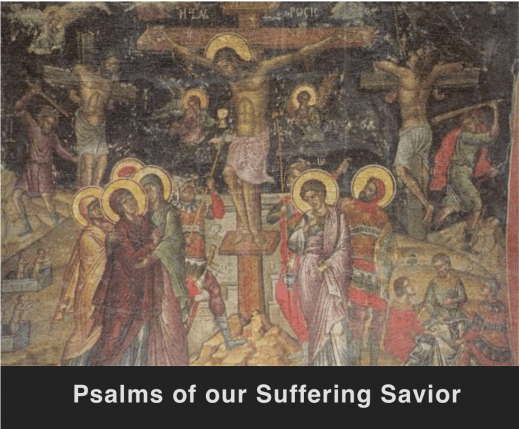
Psalm 22 has an amazing amount of parallels with Jesus’ experience on the cross on Good Friday. It says he is surrounded by rough enemies that want to harm him (v. 12), he is attacked by their words (v. 13), he is exhausted and close to death (v. 14), he experiences fatal dehydration (v. 15), his hands and feet are pierced (v. 16), his bony frame is exposed (v. 17), and his garments are divided and cast lots for (v. 18 cf. Matt. 27:35).[1]
Reading this Psalm you almost expect David to say something close to “Father, forgive them”[2] because the account of Jesus’ crucifixion is foreshadowed so many times (see also Ps. 69:4, 9, 21). Instead, in somewhat of a parallel passage to this Psalm and in great contrast to Jesus, David calls for God’s burning anger to overtake his enemies (69:24), he pleads that God would “add to them punishment upon punishment” (v. 27), and that they would be “blotted out of the book of the living” and “not be enrolled among the righteous” (v. 28).
Messiah Jesus instead Himself receives punishment upon punishment, His life is blotted out, and He joins the unrighteous on a cursed cross (see Is. 53:9 and Matt. 27:38) to save His enemies, those who are far from Him. Jesus is the perfect lamb of God, the lamb without blemish, that takes away the sin of the world (Jn. 1:29; 1 Pet. 1:19).[3]
The Betrayal and Rejection

Jesus came to His own people and they did not receive Him (Jn. 1:11). Jesus was hated, rejected, and persecuted (Is. 53:3; Jn. 15:18). His friends abandoned Him (Ps. 88:8, 18; Matt. 26:56), even after making a pledge of undying loyalty. Yet, even while He Himself was being betrayed He protected His friends (Jn. 18:7-8)
Jesus, as Hebrews says, can sympathize with us (Heb. 4:15). He knows what it is like to experience betrayal of the worst kind.
Jesus was troubled in His spirit because one of His dear friends would betray Him. And it’s no wonder that He was troubled. Have you ever been hurt by a close friend? It hurts.
Yet Jesus was betrayed, as the Scriptures said He would be (Jn. 13:18).
Judas, Jesus’ “familiar friend” (Ps. 55:13), betrayed Him with a kiss[1] (Matt. 26:48-49). Jesus used to walk with Judas in the very same garden in which He was betrayed (Jn.18:2-3). Jesus had also recently shared bread with Judas.[2]
Jesus felt the blow of a backstabber but His pain would be far worse than any knife could inflict.
The Cleansing of the Temple
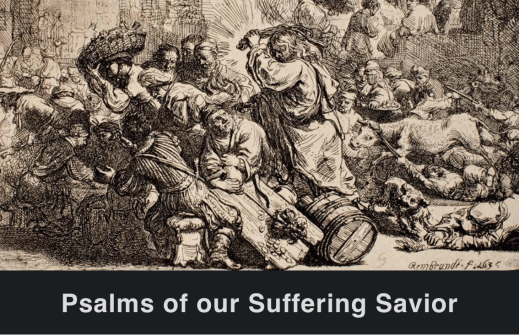
That’s exactly what happened to Jesus. He was consumed by zeal for the LORD’s house.
Can you imagine the scene? The whole city was frantic with excitement and expectation as Jesus came into Jerusalem.[1] Many expected that Jesus would soon bring freedom from Roman oppression and establish a reign of peace. People expected Jesus to ridicule Rome and inaugurate the Jewish state. Jesus, instead, condemns what’s going on in the Jewish temple.
If Jesus’ actions are unexpected it is because of misunderstanding or lack of zeal on our part. What Jesus did is in full agreement with Scripture (cf. Jer. 7:11; Zech. 14:21). The temple was to be a house of prayer, not a “den of robbers” (Is. 56:7). Specifically, the house of prayer is supposed to be “for all peoples” (v. 7). Because of all the selling, however, the court of the Gentiles would have been so filled with commotion that neither Jew nor Gentile would have been able to pray without distraction.
Jesus has concern for the poor, the sick, and the outsider. Jesus stands up for them even to the point of experiencing opposition. “Christ does more than denounce injustice—he takes action against it.”[2] That is good news!
The Hallel Psalms and the Supper

Psalm 115 is part of the Hallel Psalms. Hallel means, “praise.” Jesus would have sung the Hallel Psalms (Ps. 113-118) with His disciples on the eve of Passover.[1] Psalm 114 speaks directly of the exodus. From a New Testament perspective, we know that the salvation which began in Egypt would be finally filled in and through Jesus.
The Hallel Psalms were probably the last psalms Jesus sang before His suffering and death (Mk. 14:26). Jesus would have sung Psalm 115 knowing that He was Himself definitively showing God’s glory, love, and faithfulness. It is amazing also that Jewish people concluded the Hallel Psalms with the prayer:
“From everlasting to everlasting thou art God; beside thee we have no king, redeemer, or savior; no liberator, deliverer, provider; none who takes pity in every time of distress or trouble. We have no king but thee.”[2]
Truly! Apart from Messiah Jesus, there is no “no king, redeemer, or savior; no liberator, deliverer, provider.”
As we see in Psalm 115, idols are inept but God is a God of steadfast love and faithfulness. Whereas idols are inept God is involved. In fact, so involved that He came to this broken world in the form of Jesus Christ.
Idols are silver and gold but God came in flesh. Jesus has a mouth and with it, He spoke words of life. Jesus has eyes, and He saw this broken world and wept. Jesus has ears, and He heard the world’s bitter cries. Jesus has a nose, and He smelled the putrid smell of death. Jesus has human hands, and they were pierced. Jesus has feet, and they carried a cross, and were pinned to a cross. Jesus has a throat, and with it, He cried out: “my God, my God, why have Thou forsaken Me?!”
The Triumphant Entry

In Matthew’s passage about the Triumphant Entry, he quotes from and links to Psalm 118. It is likely that Jesus sang this Psalm, along with the other Hallel Psalms (Pss. 113-18), with the disciples after He instituted the Lord’s Supper (Mk. 14:26). That’s not surprising since Psalm 118 highlights God’s steadfast love and has many Christ connections.
Psalm 118 talks about the gate that the righteous enter through to go into the presence of God (v. 20). That is not a gate that we can open on our own because we cannot be righteous on our own (Rom. 3:10). Actually, the Bible says even the best we can do on our own is like filthy rags (Is. 64:6). We need the righteousness of Jesus Christ (Heb. 10:19-22). Jesus is the gate that gives us access to God the Father (Jn. 14:6), He is the one that makes us righteous.
Jesus was the rejected stone (Matt. 21:42) but He is the Messiah, the cornerstone (Ps. 118:22). All promises rest upon Him (2 Cor. 1:20). When Jesus made His way to Jerusalem, the people cried out: “Hosanna! Save us, we pray, O LORD!” (Matt. 21:9). The people spoke better than they knew. They cried out to Jesus who is God in flesh to save—and He soon would. He would fulfill their prayer to save by answering the next cry of the crowds, that He be crucified.
The Psalm says, “The LORD is God, and He has made His light to shine upon us” (Ps. 118:27). Truly. God in flesh dwelt among us. And yet He was the “festal sacrifice” (v. 27). Jesus is finally triumphant not by overthrowing the Roman government but by overthrowing Satan, sin, and death through His death and resurrection.



 in X
in X 