Our Wealth is a Stewardship, Not Just a Blessing

“Our wealth?” you ask. “What wealth do you mean? You may be wealthy, but I am just trying to scrape by.” I understand this attitude. And yet, I am one of the richest people in the whole world. In India, for instance, nearly 40 percent of the country’s 1 billion citizens live on less than $1.25 a day.[1] I bought a soda for more than that, and the white mocha I bought today was… well, even more than that.[2]
In the United States, the poverty level for a family of four is considered an annual income of approximately $32,000. However, from a global perspective, it is estimated that 1 billion people are living in abject poverty, and twice as many exist on less than $3 per day. While statistics may provide insight into this issue, many people believe that the absence of basic necessities to sustain life marks the beginning of true poverty.[3]
We can see from these statistics that though we may not feel wealthy, and in fact may not be in America, we are on a global scale. Today, there are all sorts of good organizations that enable us to give to gospel-focused ministries and churches all over the world. We are accountable not only for our wealth but also for the resources we have at our disposal. Everyone to whom much has been given, much will be required (Luke 12:48), and when over 80 percent of the world lives on less than $10 a day, we must see that we are among those who have been given much.
We who are wealthy (most Americans) are not to set our hopes on the uncertainty of riches, but on God, who richly provides us with everything to enjoy. We are to do good, be rich in good works, to be generous and ready to share, thus storing up true treasures for ourselves as a good foundation for the future, so that we may take hold of that which is true life (1 Tim. 6:17-19).
Imagine going on vacation and letting a teenage friend come over to stay at your house and watch over things while you are away. Now imagine that you get back and your house is destroyed, beer cans are all over, and your dog is dead. Do you think you would leave your real estate to him? If you had a business, do you think you could trust him with it? I assume, and hope, your answer is, “no.” Jesus agrees. He says, in Luke 16:11, “If then you have not been faithful in the unrighteous wealth, who will entrust to you true riches?” The implied answer is “no one will.”
1 Peter 4:10 says, “As each has received a gift, use it to serve one another, as good stewards of God’s varied grace. ” We must use whatever God has given us, spiritual gifts or monetary gifts, to “serve others.” Note, however, that we are “stewards of God’s varied grace,” so we cannot expect our serving to look the same. We will all steward differently depending on how God has graced us, but we must all strive to be good stewards.
The wealth we have is not merely meant for us and our selfish enjoyment. It is meant to serve God by blessing others. Look at Lydia in Acts. She had much, but she used it for the Kingdom of God, not her own kingdom. Look at Joseph. He gave his own burial spot for Jesus, although he did get it back! Look at Mary, who gave her costly ointment to Jesus. They gave not because someone told them to. They gave not only because they were stewards. They gave because it was a natural outworking of their relationship with Jesus. They gave because it was a natural result of their worship. No gimmicks, no games, they just gave–out of worship!
It is also important for us to remember, though, that we do not truly own anything. It all ultimately belongs to God (cf. Deut. 10:14; Lev. 25:23; 1 Chron. 29:11-12; Job 41:11; Ps. 24:1; Ps. 50:10-12; 1 Cor. 4:7; Rom. 11:35). We brought nothing into this world, and we can take nothing out of it. Everything we have is on loan from God, and we do not deserve it. What do we have that we did not receive (1 Cor. 4:7)?
We are stewards, and it is my prayer that we would be faithful stewards of all God has entrusted to us. We have been given so much more than so many, so is it not right that when the master comes to collect what is his, that he should expect more interest from those to whom he gave more? God calls us to be faithful with what he has given us. In the Parable of the Talents (Matt. 25:14-30), the master gave his servants money to invest when he was gone, and he expected a profit when he returned.
The first two servants were good stewards and made the master money, but the last one was unwise. He did not invest the money but instead buried it. The master’s response to the first two servants was “Well done, good and faithful servant.” That was not the response he gave to the servant who did not invest what he was entrusted with. The response instead was “You wicked and slothful servant,” and then he cast the servant into the outer darkness where there is weeping and gnashing of teeth.
We do not want to be the lazy, unfaithful servant. We want to invest all God has given us. We want to hear: “Well done, good and faithful servant. Now enter into your rest.”
If we are all the more blessed, then we are all the more accountable. Most in America are extremely blessed, thus we will be held to a very high standard. We have been given an investment. We invest and sow, but it is God who brings the increase. Yet it is very much our part to sow and invest; if we do not, there will be no harvest, and we will get paid no reward. However, if we labor and invest in God’s work and no fruit is found this side of heaven, it will surely be found on the other. God will repay those who sow and invest in His Kingdom. O’ if only we strived for greater dividends in the Kingdom to come instead of this kingdom.
If we are to be faithful servants of our master’s money, we must use our, or rather, His money for Him and not us. This flys in the face of what is acceptable in our day, because in our day we “deserve” better. The truth is, we don’t deserve better. In fact, we deserve far worse, so it is not as if we are merely commanded to wisely invest our master’s assets. It should be our delight because of all the grace and love He has shown us. This outlook should change us into men and women who are dressed and always ready with the lights on to open the door for the master when he comes (Luke 12:35-36).
If we have the wrong attitude and do not think the master is coming, or we no longer want to serve the Master, there will be grave consequences. If the servant becomes lax in what the master commanded him to do “the master of that servant will come on a day when he does not expect him and at an hour he does not know, and will cut him in pieces and put him with the unfaithful.” (Luke 12:46). “Everyone to whom much was given, of him much will be required, and from him to whom they entrusted much, they will demand the more” (Luke 12:48).
In 1980, the Lausanne Committee for World Evangelization commented on a simple lifestyle. They said,
So then, having been freed by the sacrifice of our Lord Jesus Christ, in obedience to his call, in heartfelt compassion for the poor, in concern for evangelism, development and justice, and in solemn anticipation of the Day of Judgement, we humbly commit ourselves to develop a just and simple life-style, to support one another in it and to encourage others to join us in this commitment.[4]
It is my prayer that we would share the same commitment to a simple lifestyle for the glory of God among all the nations. I am not saying, however, that everyone’s “simple lifestyle” needs to look the same. No, I am saying that we all must seek to be worthy stewards of all God has graciously entrusted to us. It is before God that we will be judged, not man (Rom. 14:10; 2 Cor. 5:10).
I believe both biblically and logically, we are called to a simple or wartime lifestyle. The evangelical commitment to a simple lifestyle is honest about the importance of the issue, but does not lay down any legalistic laws we must follow.
While some of us have been called to live among the poor, and others to open our homes to the needy, all of us are determined to develop a simpler life-style. We intend to reexamine our income and expenditure, in order to manage on less and give away more. We lay down no rules or regulations, for either ourselves or others. Yet we resolve to renounce waste and oppose extravagance in personal living, clothing and housing, travel and church buildings. We also accept the distinction between necessities and luxuries, creative hobbies and empty status symbols, modesty and vanity, occasional celebrations and normal routine, and between the service of God and slavery to fashion. Where to draw the line requires conscientious thought and decision by us, together with members of our family.[5]
There are no exact standards prescribed, so we should not proscribe them. We should stick with biblical principles. John Stott gives us three “isms” we would be wise to avoid: “materialism (an obsession with things), asceticism (an austerity which denies the good gifts of the Creator), and pharisaism (binding one another with rules).”[6]
I think a good way to end this is simply to say that we are stewards. I am not accountable to you, and you are not accountable to me. We are all accountable to God. We must all ask what God wants us to do with what He has given to us. We must realize that God calls different people to manage different things in different ways; the Bible is replete with examples of this. The common denominator between all managers is not that they manage the same amount of stuff, but that they are all accountable and must be faithful.
Be faithful.
Notes
[1] This is a little dated. “Dream and Reality,” World, October 9, 2010, by Jamie Dean, 36.
[2] I do believe we can enjoy the pleasures of food and drink with thanksgiving, but that does not mean that we are not to be stewards. Paul said he would refrain from eating meat if it caused his brother to sin (1 Cor.8:13). I am quite sure he would also have refrained from spending an excessive amount of money in order that he could also keep his brother or sister from starving.
[3] “Who Takes Care of the Poor?” Torch Fall-Winter 2010, by William E. Brown, 3.
[4] Lausanne Occasional Papers: “An Evangelical Commitment to Simple Life-Style” Accessed on February 9th, 2026.
[5] Ibid.
[6] John Stott, Issues Facing Christians Today, 317.
*Photo by Alexander Mils
Words to the Wealthy (from James 5)

What words does James have to say to the wealthy? In James 5:1-6 we see some of the roughest and most condemning verses in the Bible. Does James 5 have any relevance to us? If so, why? And if it does, what does it teach us?
James 5:1-6:
“Come now, you rich, weep and howl for the miseries that are coming upon you. 2 Your riches have rotted and your garments are moth-eaten. 3 Your gold and silver have corroded, and their corrosion will be evidence against you and will eat your flesh like fire. You have laid up treasure in the last days. 4 Behold, the wages of the laborers who mowed your fields, which you kept back by fraud, are crying out against you, and the cries of the harvesters have reached the ears of the Lord of hosts. 5 You have lived on the earth in luxury and in self-indulgence. You have fattened your hearts in a day of slaughter. 6 You have condemned and murdered the righteous person. He does not resist you.”
First, who is it wrote to? It says “you rich” in verse 1.
So, we should ask, ‘Are we rich?’ What do you think, are we rich?
Rich is a relative term. Compared to Elon Musk and Bill Gates I am not rich. If, however, you compare my wealth to what others have had throughout history, or what others have in developing countries, then I will seem quite rich.
Therefore, I don’t think we should automatically discount what this passage is saying. We shouldn’t naively think we’re not rich, so the passage doesn’t apply to us.
Rather, we should humbly consider what it’s saying. We should ask, ‘Why would the rich need to weep and howl for the miseries that are coming upon them?’ (v. 1)
I think it’s because…
1) Riches won’t save
It’s always been tempting to trust in wealth. We often feel like our security is connected to how much money we have. We may not come out and say it like that, but that’s what is often going on at the level of our hearts.
James, however, says,
“Your riches have rotted and your garments are moth-eaten.3 Your gold and silver have corroded, and their corrosion will be evidence against you and will eat your flesh like fire. You have laid up treasure in the last days.”
What’s happening is James is fast-forwarding for us. He’s showing us the future result of trusting in our treasure, trusting in our money rather than our Maker. What happens to riches? They inevitably rot. Even crypto will metaphorically corrode.
When the foundations shake, you’ll be found out. When what you thought was a foundation fails, it’ll be shown that you trusted in the wrong things. The failure of your treasure to last will be “evidence against you.”
In the Bible, “last days” has to do with the end and the coming judgment. So, when the passage talks about laying “up treasure in the last days” it should strike us a very odd and even supremely foolish.
It’d be like people in an apocalyptic movie—whether A Quiet Place, World War Z, or whatever—going out of their way to put money in the bank. At the end of the world, storing up money’s not really the priority.
Instead, James shows us that…
2) Riches are meant to be a stewardship
We are not meant to trust in money or hoard up money all for ourselves. Instead, we should care about justice and carry out justice. Look at James 5:4-6:
“Behold, the wages of the laborers who mowed your fields, which you kept back by fraud, are crying out against you, and the cries of the harvesters have reached the ears of the Lord of hosts. You have lived on the earth in luxury and in self-indulgence. You have fattened your hearts in a day of slaughter. You have condemned and murdered the righteous person. He does not resist you.”
Every good and perfect gift comes from God (James 1:17 cf. 1 Tim. 4:4). But, it is not just given to enjoy. Though, enjoying the gifts that God has given is right and honors Him. But, we are also given things to manage and invest. What we have is not just for us, but also the benefit of others.
Just as laborers deserve and should get their owned wages, we should justly steward our money. Our unjust selfishness does not go unnoticed by God. We don’t want to be found guilty of living “on the earth in luxury and in self-indulgence” (v. 5). We must remember that “the love of money is a root of all kinds of evils” (1 Tim. 6:10).
Jesus and James, of course, don’t say money is evil. Money itself is not evil. Even having money is not evil. It can actually be very good and useful. But, “the love of money is a root of all kinds of evils.”
How can we have the right relationship with wealth?
3) Riches should be submitted to our Savior
James essentially gives us an x-ray of our hearts, and the resulting picture is often ugly. It reveals a misaligned heart. One that often trusts in money and not the Maker.
What is the cure for our heart sickness? What is our cure for our naive trust of money?
I believe it’s seeing life for what it is, short and followed by eternity. We are in the Last Days. There is a coming judgment. The way we steward our money matters.
Further, we need to see Jesus. We need to love our Lord who freely gave up His wealth. Second Corinthians 8:9 says “For you know the grace of our Lord Jesus Christ, that though He was rich, yet for your sake He became poor, so that you by His poverty might become rich.”
When we know the amazing “grace of our Lord Jesus Christ” it loosens our grip on wealth. We, more and more, trust the Lord and willingly steward our wealth for Jesus’ Kingdom, not our kingdom.
Questions for Reflection
- What can money provide? In what ways do you trust in money?
- Is money evil? What are some blessings of having money and some challenges of having money?
- Why is the love of money so problematic (“a root of all kinds of evils”)?
- What does it mean for you to manage or steward money?
- What does Jesus have to do with how we think about and use money?
Photo by Jp Valery
Giving to the Church

“For you know the grace of our Lord Jesus Christ, that though He was rich, yet for your sake He became poor, so that you by his poverty might become rich” (2 Cor. 8:9).
Why do we give?
…because God gave
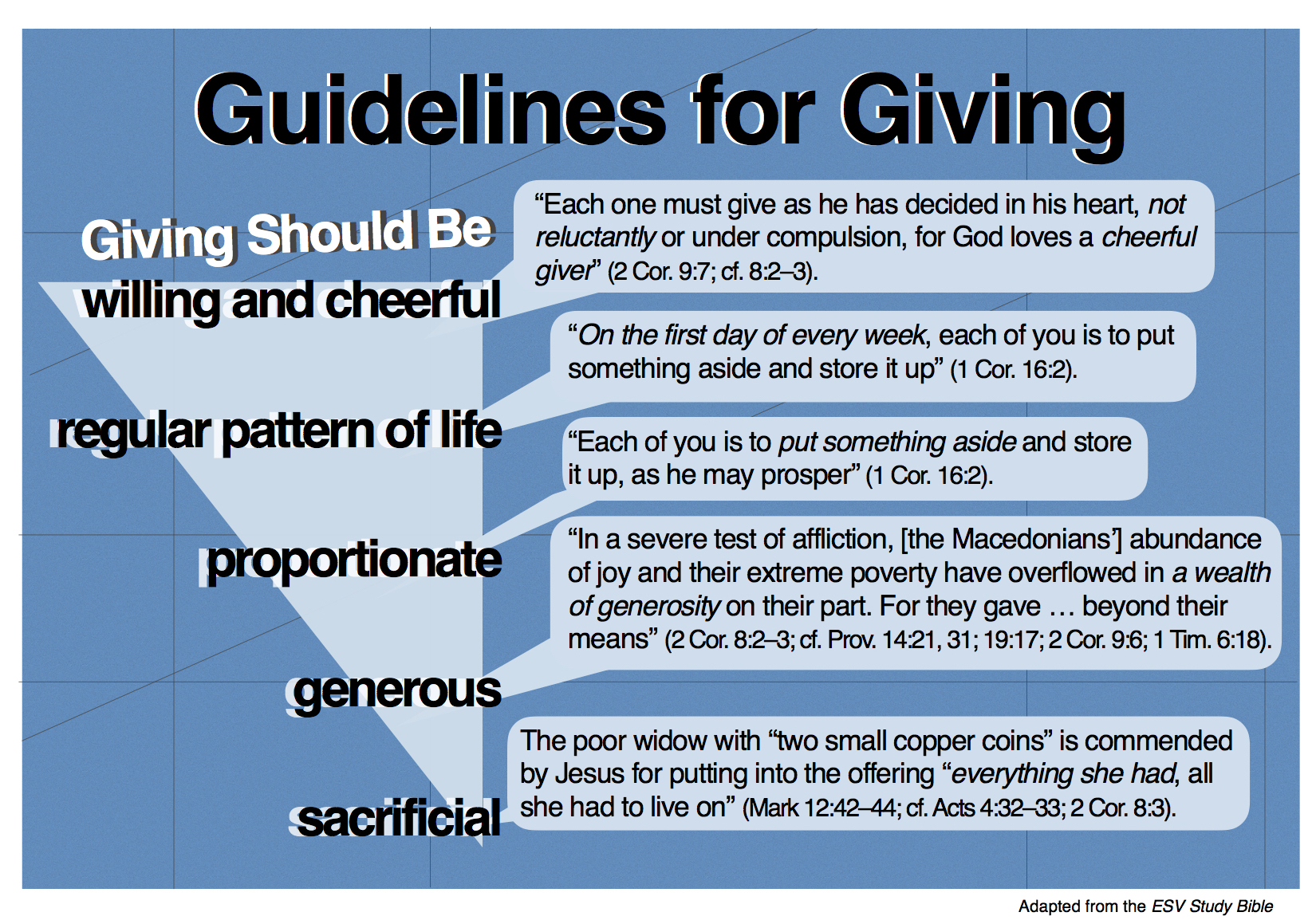
We are to give out of the abundance of joy that is produced in us as we remember what Christ gave for us (see 2 Cor. 8:1-9). So we give cheerfully what we have decided to give out of an overflow of worship, not because we have been constrained to give by a command (2 Cor. 9:7).[1]
…because the Lord is worthy
The expectation that we see for us in Scripture is whole life commitment. The Lord is worthy so we offer all we are, our own selves, as living sacrifices because that is a reasonable response to His abundant goodness (see e.g. Rom. 12:1). We count everything as trash compared to Him (Phil. 3:8).
…because it’s an eternal investment
“As for the rich in this present age, charge them not to be haughty, nor to set their hopes on the uncertainty of riches, but on God, who richly provides us with everything to enjoy. They are to do good, to be rich in good works, to be generous and ready to share, thus storing up treasure for themselves as a good foundation for the future, so that they may take hold of that which is truly life” (1 Tim. 6:17-19 cf. Matt. 6:19-21)
…because everything is God’s
All over Scripture, we see God owns everything. Everything has been graciously given (and entrusted) to us by God (Deut. 10:14; Job 41:11; Ps. 50:10-12; 1 Cor. 4:7; Rom. 11:35).
…because we are stewards
I am not accountable to you and you are not accountable to me. We are accountable to God. We must all ask what God wants us to do with what He has given to us. And we must realize that God calls different people to manage different things in different ways; the Bible is replete with examples of this. God has entrusted us with different levels of responsibility for the gifts He has given us (Matt. 25:14-30; Lk. 12:48; 1 Pet. 4:10).
The common denominator between managers is not that they manage the same amount of stuff but that they are accountable and must be faithful. It is before God that we will be judged, not man (Rom. 14:10; 2 Cor. 5:10). Be faithful. But realize there are no exact standards prescribed so we should not prescribe them.
Where should we give?
Our priority should be to give where we are fed (see 1 Cor. 9:7-11; Gal. 6:10, 17; 1 Tim. 5:17-18). This makes sense because if we eat at Chick-fil-A we don’t pay at Chipotle.
Helpful Resources
Randy Alcorn’s book, The Treasure Principle
Redeemer Presbyterian Church’s “A 20 Day Study in Stewardship”
Discussion/Application Questions
1) Does meditating on the gospel of Christ motivate you to want to give?
2) Do you typically give with a cheerful heart that flows out of joy from the gospel?
3) Do you think it is legalistic to say that you must give to the church?
4) What does it mean that we are stewards/managers? Do you ever reflect on whether or not you are being a good steward of what God has entrusted to you?
5) Why is giving to the local church important? Or, do you think it is? What responsibility do you have to the local church?
6) Are you aware that everything that you have is a gift from God?
7) Materialism may be the single greatest pull away from authentic Christianity (cf. Deut. 6 esp. v.10-13). What do you think?
8) How can we purposely invest in heaven and not drift into the service of other “gods”?
Note
[1] It is instructive to look at the practice of tithing in Scripture. In the New Testament, Jesus does not command that we tithe but he does tell the Pharisees that they ought to tithe (cf. Matt. 23:23). In the Old Testament there was a tithe for Priests and Levites (Lev. 27:30; Num. 18:21-24), community celebrations (Deut. 14:22-29), as well as a tithe for the poor every three years (Deut. 14:28-29; see also Lev. 19:9-10). This equals out not to 10-percent but 23.3%, averaged over a three-year period. This does not take into account the first fruit offerings (Lev. 19:23-25; Num. 15:17-21) and free will offerings (1 Chron. 29:1-9). However, it should be noted that we are in a different governmental and religious situation than the Israelites. All that being the case, the question should never be, “are we to tithe?” or “how much must we give?” but rather “how much will we have the privilege to give to Christ who gave all so that we might have all?”



 in X
in X 