30 Insights to remember from Preaching as Reminding
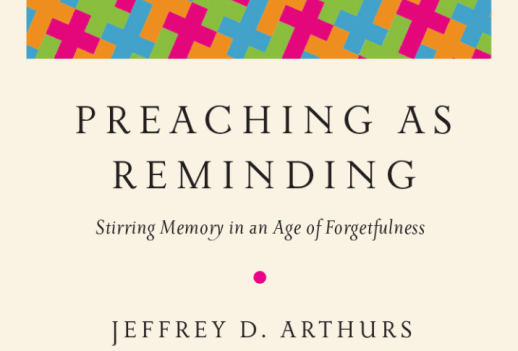
I really appreciated Jeffrey D. Arthurs’s book, Preaching as Reminding. Here are thirty things I especially want to remember…
“The Scriptures themselves are the invitation to remember: Remember Abraham, Isaac, and Jacob; remember the Exodus; make a pile of stones; remember the Sabbath. Come again to the table, break the bread, drink the cup. Remember” (Jeffrey D. Arthurs, Preaching as Reminding, p. ix).
Preachers “remind the faithful of what they already know when knowledge has faded and conviction cooled. We fan the flames. That’s what we see when we look at the work of Moses, the prophets, and the apostles” (p. 3). “Preachers are remembrancers” (p. ix). We see this for example through what Peter says in 2 Peter 1:12-13 (“…to stir you up by way of reminder…”). And so, “Ministers must learn to stir memory, not simply repeat threadbare platitudes” (p. 5).
“It matters that we preach. It matters that we call people to remember their God and their deepest values and their truest selves and the story that has maybe shaped their lives and for sure has shaped their world. It matters that we preach with all the fidelity and urgency and learning and purity and creativity that God allows us to muster” (p. ix-x).
“If we have no memory we are adrift, because memory is the mooring to which we are tied. Memory of the past interprets the present and charts a course for the future” (p. 1). “Without memory, we are lost souls. That is why the Bible is replete with statements, stories, sermons, and ceremonies designed to stir memory. Even nature—the rainbow after the flood—serves as a reminder of God’s faithfulness (Gen 9:13-17)” (p. 3).
Church Liturgy

We will worship so we must worship wisely. Intentional liturgy is vital. As the gathered church we purport to worship the Lord, we must do so in an intentionally biblical and wise way.
By my calculations, most Christians probably spend around half a year of their life participating in the gathered worship of the church. It’s important that we make the best use of that time! Especially when it’s time that’s intentionally set aside to worship the LORD. Further, the Sunday gathering is one of the primary ways that the church gathered can be equipped to be the church scattered.
It is of utmost importance that the liturgy of the gathered church be very deliberate.[1] Even simple, seemingly insignificant, things in worship communicate doctrine and teach people. This is true of terminology (e.g. “priest” or “pastor”), architecture (simple or elaborate; God’s people are the temple or the building is the temple), positioning (where the person stands when doing the Lord’s Supper or the prominence of the pulpit), and furniture (altar or table). These are all important things to consider and have implications because they communicate certain things even if not explicitly.
The Meaning of Liturgy
Liturgies have been in use in Christian worship from the earliest of times[2] so it’s important that we consider what liturgy means and its place in the life of the church. Allen P. Ross says “liturgy is a perfectly good biblical word and need not be avoided as something foreign to historic Christianity. The noun is leitourgia, literally ‘the work of the people’; it means a service or a ministry.”[3] The Pocket Dictionary of Theological Terms says, “Liturgy came to designate the church’s official (or unofficial) public and corporate ritual of worship, including the Eucharist (or Communion), baptism and other sacred acts. Certain ecclesiastical traditions (such as Roman Catholic, Eastern Orthodox, Anglican) follow a set pattern of worship (the liturgy), whereas many Protestant churches prefer a less structured style. This gives rise to the distinction sometimes made between ‘liturgical’ and ‘nonliturgical’ churches.”[4]
Spectrum of Liturgy
All churches have a liturgy but some churches seem to be less intentional about their liturgy. It seems some churches operate on a default liturgy. A pastor may inherit a liturgy from the previous pastor and it remains essentially unchanged for a few generations. That, however, is problematic for a few reasons. As Timothy C.J. Quill has said, “Worship practice reflects and communicates the beliefs of the church. Liturgy articulates doctrine.”[5]
The Crash of the American Church?

Research shows that the “evangelical church” lost around 10 percent of her people in the last decade. There are many factors that are involved that have resulted in this decline. Further, most churches that are growing are just taking people from other churches, not converting people. The Great Evangelical Recession explores the factors involved in the decline of the church and offers suggestions for the future. I found the book helpful and thought-provoking.
Woe to the wretched, me included!

Isaiah was a gifted preacher. He went around graciously telling the people of Judah to repent. We see an example of the way he called the people to repent in Isaiah 5.
Isaiah announces six woes upon the people of Judah (cf. 5:8, 11, 18, 20, 21, 22). Isaiah says “Woe to those who call evil good and good evil” (v. 20). “Woe to those who are wise in their own eyes” (v. 21). “Woe to those who are heroes at drinking wine” (v. 22).
After seeing the sixth “woe” we look for the climatic seventh woe. However, that seventh woe doesn’t come in chapter 5. Where is that seventh woe?
The seventh woe comes in the next chapter. Isaiah says, “Woe is me!” (6:5). Isaiah saw that the LORD is “holy, holy, holy” (v. 3) and so he saw his own dire need. He said, “I am lost.” When we see the LORD in His glory we see that we are all in need of grace. We must all be humbled before God.
Ultimately we see the ground is level at the foot of the cross. The problem isn’t just out there within someone else, the problem—sin—is within all of us. We all deeply need Jesus.
We must remember that we were separated from Christ, outsiders to the promises of God, and we had no hope. But now, in Christ Jesus, we who once were far off have been brought near by the blood of Christ (cf. Eph. 2:12-18). There is nothing inherently better or good about us more than anyone else. It is Christ Jesus that gives us hope and brings us near to God.
Woe to the wretched, me included!
Suffering and Christian Ministry

Did you tackle that trouble that came your way
With a resolute heart and cheerful?
Or hide your face from the light of day
With a craven soul and fearful?
Oh, a trouble’s a ton, or a trouble’s an ounce,
Or a trouble is what you make it,
And it isn’t the fact that you’re hurt that counts,
But only how did you take it?You are beaten to earth? Well, well, what’s that?
Come up with a smiling face.
It’s nothing against you to fall down flat,
But to lie there — that’s disgrace.
The harder you’re thrown, why the higher you bounce;
Be proud of your blackened eye!
It isn’t the fact that you’re licked that counts,
It’s how did you fight — and why?And though you be done to the death, what then?
If you battled the best you could,
If you played your part in the world of men,
Why, the Critic will call it good.
Death comes with a crawl, or comes with a pounce,
And whether he’s slow or spry,
It isn’t the fact that you’re dead that counts,
But only how did you die?(“How Did You Die?” by Edmund Vance Cooke)
Christian ministry whether pastoral or other is in large part about suffering. We follow the Lord. We deny ourselves. We die. Yet, it is in this way that gates of hell do not prevail against us. It is in this way that the gospel goes forth and prevails. It is in this way, the way of the cross, that we glorify our crucified Messiah and Lord. It is this long painful faithful suffering in the same direction that brings the reward.
And guys we’ll soon be dead, we do this, we labor to the point of exhaustion, we run on, not for an earthly wreath but a heavenly one. We run for the prize. We fight and suffer for the cause, because there is a cause, and it is great.
Look to the reward! Look to the reward! It is great. And go on. Fight the fight of faith. Your labor, though great and beyond your ability, is not in vain. And the God that holds the stars in orbit holds your hand.
Keep the reality of the resurrection before you. Keep Revelation 21 close by. Praise Jesus for drinking down to the dregs the cup of wrath and ask that you would continue to suffer faithfully. Brothers, here we have no home. We’re looking for the one to come.
O’ God, help us. We are weak and weary. We need need You.



 in X
in X 