The Regulative and Normative Principles of Worship

Brief History of the Principles
Humans have been worshiping and thinking about worship since the beginning. We see this, for instance, by looking at the narrative of Cain and Abel in Genesis 4. Further, all of life is about worship.[1] The question we are considering here, however, is how are we to formally worship God as the gathered church?
The two classic Protestant views of worship are the normative principle of worship and regulative principle of worship. There is a lot of confusion as to what these principals mean and how they are worked out in the life of the church. For example, an article online said that those who hold to the regulative view do not use instruments in their church services.[2]
Why celebrate the Lord’s Supper?
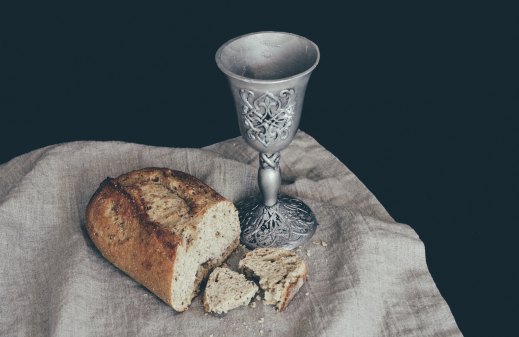
Jesus commands us to together partake of the bread and the cup in remembrance of Him, and so that is why we celebrate Lord’s Supper. We see this in a few different passages (Matt. 26:26-29; Mk. 14:22-25; Lk. 22:17-20; 1 Cor. 11:23-25).
We partake together and first remember Jesus’ propitiatory death for us and so the Lord’s supper causes us to reflect on the past. Second, the Lord’s Supper causes us to reflect on the current fellowship we together experience through union with Christ. And third, we look ahead to the future when we shall feast with Jesus after His return (we “proclaim the Lord’s death until he comes,” 1 Cor. 11:26). Scripture also points us to the importance of self-examination so that we do not take the Lord’s Supper in an unworthy manner and thus bring condemnation upon ourselves (1 Cor. 11:28ff).
The New City Catechism says, “Christ commanded all Christians to eat bread and to drink from the cup in thankful remembrance of him and his death. The Lord’s Supper is a celebration of the presence of God in our midst; bringing us into communion with God and with one another; feeding and nourishing our souls. It also anticipates the day when we will eat and drink with Christ in his Father’s kingdom” (Q46).
The Lord’s Supper is a beautiful and amazing picture of the gospel for us. Jesus’ body was broken and His life was poured out so that we could have life. When we partake of the Lord’s Supper we are reminded of the amazing truth that Jesus—God in flesh—is the Lamb of God who takes away our sin. The Holy Spirit uses the God-ordained and Christ instituted means of the Lord’s Supper to help us remember with thankfulness Christ’s finished work on the cross.
20 Observations from Genesis 1-3

Gen. 1:1—We see the answer to our and the universes origin (and logic, math, science, etc.).
Gen. 1:24-25—We see where the different “kinds” of animals came from. It sounds like God made each different “kind” or type of animal with enough genetic code to produce all the different types of that kind but that they would stay with that “kind” or genetic code. There are similar genetic trademarks between each “kind” yet don’t overstep their kind. This is because they are made by the same Maker and He left the same stamp of intelligence on each of them.
Gen. 1:26-27—Humans have worth and should not be disregarded. From here we see humans have great potential. We also see grounds here for the immorality of mistreating humans. (People have argued that the idea of human rights came from the Christian understanding that all humans are made in the image of God).
Gen. 1:28-30 cf. 2:15—We see a call to stewardship and industry; something that has always been important for survival and compassion.
As the church we are…

This is not an ecclesiology. But it does tell you a lot about the church. As the church we are…
Welcomed and Welcoming
We remember that Jesus Himself was criticized by religious leaders because of the type of people that He hung out with and helped (cf. Matt. 9:9-13; 11:19; 21:31-32; Mk. 2:15-17; Lk. 3:12-14; 5:29-32; 7:36-50; 15; 19:1-10). So, we’re not like the hypocritical religious leaders. Instead, we’re like our Leader, the One who reaches out to heal our brokenness.
Our Idolatry…

We could basically be the stars of any western, we have individualism, self-reliance, and self-sufficiency in our bones. The truth is, I know some pretty capable people. But with that capability can come idolatry. Self-idolatry. We, moderns in the west, don’t form gods out of gold, we are the gods. We have feet, mouths, and hands. We can deliver ourselves. At least, that’s what we think.
Our idolatry is often self-idolatry, we trust ourselves over against God. The New City Catechism says, “Idolatry is trusting in created things rather than the Creator for our hope and happiness, significance and security.” Often, we trust in ourselves. That, however, is not our only form of idolatry.
Our idols can be anything we…
- trust and look to more than God
- make more important than God
- give our attention to more than God
- expect to give us something that only God can give
- make so central and essential to life that if we lose it, life will no longer feel worth living
When something in our life is an absolute requirement for our happiness and self-worth, it is an idol. When that thing is threatened, whatever it is, we will act out. we will become anxious or angry when that thing is in possible danger.[1]
Practice Unproductivity (part 3)

Commanded to Rest
The concept of Sabbath is almost entirely gone.[1] It is one thing to enforce sabbatarian “blue laws” on a whole country,[2] it is another thing to think we are self-sufficient and have no need for any type of Sabbath.
This is not the place to have a big argument on the Sabbath so I don’t intend to do that here. But, I think it should be clear that we must honor the Sabbath in some way. We must at least set aside time to intentionally rest and reflect…
The Bible says we are commanded to rest.[3] It says, “Honor the Sabbath and keep it holy.” The Sabbath was primarily a day of rest. So, we could paraphrase, “Honor the day of rest, set it apart, keep it.” So, “We do not rest because our work is done; we rest because God commanded it and created us to have a need for it.”[4]
Practice Unproductivity (part 1)

“Practice unproductivity,” what?! The phrase, especially outside of DC, sounds almost heretical. You probably cringed when you read it and you’re probably tempted to stop reading.
It’s important to realize, when I say, “practice unproductiveness” that I’m not saying binge YouTube, play candy crush, or Fortnight. Please don’t do any of those things. I’m actually talking about Sabbath rest…
Sacrifice and Sabbath Rest
Aren’t we supposed to be living sacrifices? Isn’t that what Romans 12:1 says?
Living sacrifices don’t spend their time sitting around eating bonbons. They die. They give themselves away.
Charles Spurgeon essentially worked himself into the grave. And the Apostle Paul was absolutely willing to spend and be spent for the sake of the gospel.
So, what does the Bible say? Sacrifice or Sabbath rest?
A Brief Theology of Emotions

We all have emotions. How often do we consider emotions from a biblical perspective though?… Yet, what better place to turn than God’s word! So, what does the Bible say about emotions?
Emotions are part of God’s good design
First, it is important to realize that “Our emotional capacities are part of our nature as personal beings created in the image and likeness of God.”[1] Second, Emotions are part of God’s good design.[2] Third, We often don’t think about it but we are actually commanded to be emotional. For example, Psalm 2:11 says “Serve the LORD with fear, and rejoice with trembling.” And there’s a bunch of other examples (Deut. 28:47-48; Ps. 51:17; 97:10; 100:2; Matt. 6:25-34; Rom. 12:9, 15; Eph. 4:32; Col. 3:15).
So, Jay Adams says:
“The fact is that there are no damaging or destructive emotions per se. Our emotional makeup is totally from God. All emotions of which He made us capable are constructive when used properly (i.e., in accordance with biblical principles)… All emotions, however, can become destructive when we fail to express them in harmony with biblical limitations and structures.”[3]
You may have heard: “Don’t follow your emotions” or “don’t let your feelings get the best of you,” or “use your head.” But emotions are not bad in themselves. God created us with emotions.
Even our negative emotions are not always wrong. It’s not always bad to feel bad. Sometimes feeling sad and angry is good and right. It’s important to realize that in the Psalms the genre of lament is most common.[4] It is also important to remember that there is no book of Joys but there is a book of Lamentations.[5] We don’t always have just “good” feelings and that’s okay. On the other hand, God made us at least in part to experience profound joy and to experience this forever, Psalm 16:11 says. So, our first take away is for us to realize that emotions are not bad in themselves.
But what’s wrong with emotions? Or, why is it that sometimes we can’t or shouldn’t trust our emotions? Because…
Emotions are broken by sin
A lot of us remember the (true) story of Adam and Eve. John Frame has said, “the fall… was rebellion of the whole person—intellect as much as emotions, perception, and will—against God.”[6] After looking at Genesis 3:1-6 (notice the highlighting) we can agree with what Frame says:
“The Lesser of Two Evils”?

“Lesser of two evils” is a fairly common phrase but how helpful is it? Is there really a situation when we would have to choose between the lesser of two evils? That is a contested ethical issue and an important one.
In answering this difficult question we are dependent. We need wisdom outside of ourselves. John Frame points us in the right direction through his meditation on Scripture. He offers us some helpful theological reflections (See Frame, DCL, 230-34). I share just two of them.
7 Things for Universalists to Consider

Some have claimed that all people will be finally saved, even after torment in hell. However, there are all sorts of inherent problems with that view. Here’s a brief list of problems to consider.
Consider…
1. There Is No (Clear) Scripture That Teaches Universalism
The doctrine of universalism goes against the clear teaching of Scripture and finds no clear teaching supporting what it argues. Yes, I understand that there are a few passages that if you pull out of context and place into a certain system of thought, can seem to support the doctrine but it is not the texts natural meaning in context.