10 Quotes from Jonathan Pennington’s book, Jesus the Great Philosopher

I appreciated Pennington’s book. He did a good job showing that “Christianity is more than a religion. It is a deeply sophisticated philosophy” (Jonathan T. Pennington, Jesus the Great Philosopher: Rediscovering the Wisdom Needed for the Good Life, 159).
Here are 10 quotes that stuck out to me:
“When we try to live without knowledge of physics and metaphysics—how the would is and how works—then we are foolish, not wise, living randomly, haphazardly, without direction or hope for security, happiness, or peace” (Pennington, Jesus the Great Philosopher, p. 23).
“The Bible is addressing precisely the same questions as traditional philosophy” (p. 53).
“The Old and New Testaments teach people to act in certain ways, knowing that cognitive and volitional choices not only reflect our emotions but also affect and educate them” (p. 120-21).
“Without intentional reflection, we will live our lives without direction and purpose. Or worse, we will live with misdirected and distorted goals” (p. 124).
“Relationships aren’t an add-on to life, they make up our life” (p. 134).
“Jesus himself emphasized that his kingdom is not of this world (John 18:36). This does not mean Christians are free to ignore this world, but instead it frees Christians to relate in a gracious and humble way, knowing their citizenship is ultimately something more and greater and different” (p. 166-67).
“The reason Jesus was so infuriating to both religious and government leaders was not because he was taking up arms and trying to overthrow governments but because his radical teachings were so subversive to society. Jesus was subversive because he sought to reform all sorts of relationships. In his teachings and actions, Jesus continually subverted fundamental values of both Jewish and Greco-Roman society” (p. 172).
“Christianity is a deeply intentional and practical philosophy of relationships” (p. 173).
“Unlike sitcom relationships, the reality is that our lives are broken through sin—the brokenness not only of sin that has corrupted creation itself but also of personal acts of evil, foolishness, and harm. Thus, the Christian philosophy’s vision for relationships within God’s kingdom is not naive or idealistic” (p. 181).
Should Wives Work Outside the Home?

Titus 2:4-5 and 1 Timothy 5:14 talk about young wives working at home, is this the ideal role God ordained for women? Should women not work outside the home?
To answer those questions, it will be helpful to look at five considerations.
Principles from the Bible
First, it is important to glean principles from the Bible to answer this question. The first principle or truth that I think is relevant is that God made humans gendered. The Bible clearly teaches that males and females are both made in the image of God (Gen. 1:26-27) and yet males and females differ from one another in some respects to various degrees. Scripture also teaches that within the family and within the church God has given complementary roles and gifts. For example, see the table from God, Marriage, and Family by Andreas Kostenberger:
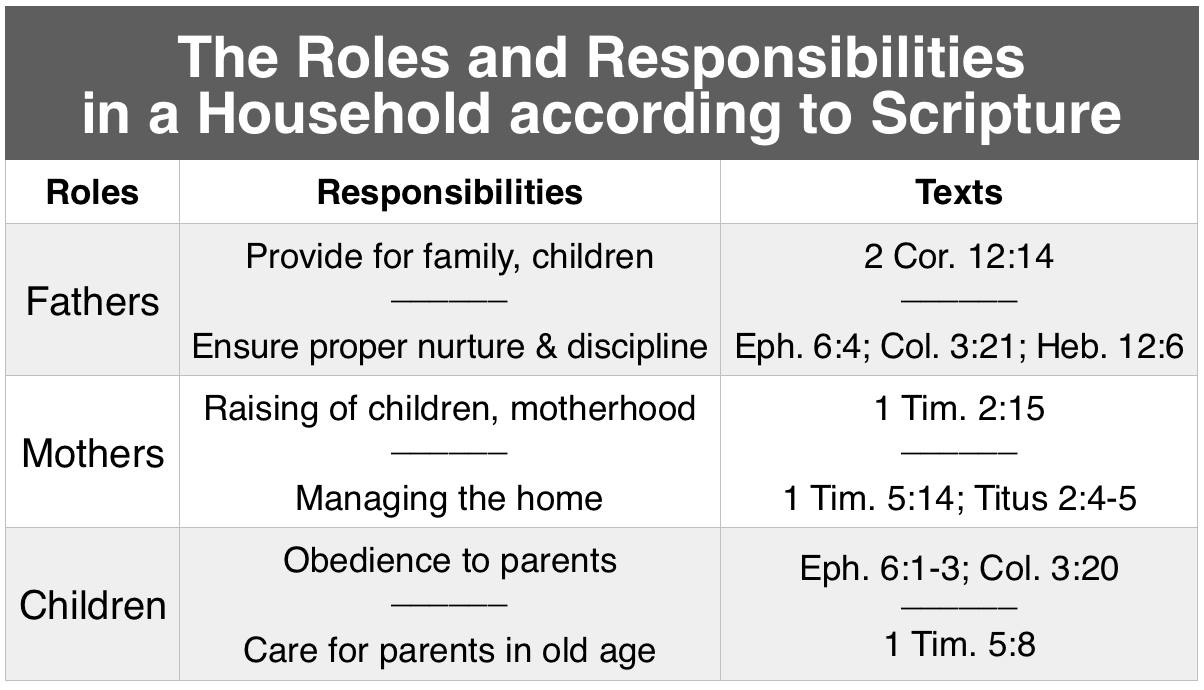
The way that Andreas Kostenberger says it, is that “Women are to place special priority on their God-given calling as mothers and homemakers.”[1] That, I agree, seems to be a biblical principle. Women are especially equipped for that task (even physiologically).
Priorities from the Bible
Next, it is important to consider priorities from a biblical perspective. We want our priorities to lineup with the priorities of Scripture. If they don’t we will have a problem with Scripture wherever it is at odds with our priorities. Our priorities, however, should be aligned with Scripture; we should not seek to align Scripture with our priorities.
Interestingly, “A 1982 Gallup poll showed that more than eight out of ten respondents (82 percent) assigned top priority… to the importance of family life. Families… rated as more important than the possession of material goods.”[2] Scripture agrees with what was the majority assessment in 1982 (see e.g. Deut. 11:19, 21; Ps. 127:3-5).
What, however, do we value?[3] Fortune or family?
Tacitcus, the Roman historian and politician writing around the same time as the Apostle Paul in A Dialogue on Oratory said,
“Our children are handed over at birth to some silly Greek servant maid… The parents themselves make no effort to train their little ones in goodness and self-control; they grow up in an atmosphere of laxity… they come to lose all sense of shame, and all respect for themselves and for other people.”
Tacitcus had a problem with that approach. And I think Christians should too.
We, however, haven’t answered our above question yet, but we’re getting there. But, it’s vital that we consider our motivation and priorities as we ask the question.
What if Satan wants to destroy the Church more than the country?

In the book of Revelation the Church is not called to react to the End or the antichrist by moralistic, militaristic, or political means. The Church is called to return to Messiah Jesus, remembering that those who continue faithful to the End will receive the “crown of life.” The way of resistance of evil, is the way of Christ. That is, loving Christ Jesus, and loving others. Taking up our crosses and following Jesus and loving others, even when it hurts, is a sure sign that we don’t and won’t have the “mark of the beast.”
What if the clearest mark of the beast is the mark of hatred and hostility? Many have thought it stood for Nero (the numerical value of 666), and perhaps it did in a way. He was, as history showed, marked by the beast. He was, as history showed, like his father the devil. He was proud and unloving, destructive and devilish.
Is not the mark of the Messiah, the mark of beatific love?1 Do not His followers, follow Him? If Jesus is love, should not His followers be loving?!2
“Love is patient, love is kind. It does not envy, it does not boast, it is not proud. It does not dishonor others, it is not self-seeking, it is not easily angered, it keeps no record of wrongs. Love does not delight in evil but rejoices with the truth. It always protects, always trusts, always hopes, always perseveres” (Corinthians 13:4-7).
And would it not make sense that the converse also follows? If the mark of the Messiah is true sacrificial love, is not the mark of the antichrist hatred? And what if the serpent of old, the father of lies, the great deceiver, is adept at what he does? And what if he wants to destroy and divide even what Messiah Jesus died to bring together? And what if he even uses the means of media and the marketplace and various views on certain medical opinions regarding COVID-19? What if?…
And what if the worst thing that can happen to Christians is not that they’d lose earthly freedom(s), but that they’d lose heavenly crowns? not that their earthly country would be divided, but that their heavenly one would be? not that they’d have to wear a mask, but that they’d have a mask put over their eyes? What if Satan’s not primarily trying to destroy a country, but what if he desires to destroy Christians and Christian witness? What if Satan doesn’t want the nation to descend into debauchery, but wants Christians to be desensitized to their hatred and fear?
Revelation also talks a lot about Babylon. Babylon was what a lot of people cared about and had their hopes fixed on. However, Christians, are marked by and are members of a different city. Christians have their hope wrapped up in a city, but it’s a different city, a city that comes down from heaven, a city that couldn’t be built here. It’s beyond and better than here.
Christians live, labor, and love in Babylon, but they’re waiting for something better. They’re waiting for Jerusalem to come down.
Christian brothers and sisters, are you showing the mark of your Savior? The characteristics of Christ? The mark of your true city? Or, are you too wrapped up here? Are you betting on Babylon3 or are you “looking forward to the city with foundations, whose architect and builder is God”?!
We, as Christians, are sojourners here in Babylon. Our time is short. Let’s be a blessing as Scripture exhorts us (Jeremiah 29:7). But, let’s remember, any castle we build with our hoarded cash, will soon wash away with the tide of time. Let’s not lay up hoards here or place our hope here. But in heaven.
1 Ephesians 1:13 tells us that all who are in Messiah Jesus have been sealed (or marked?!) with the promised Holy Spirit. Notice also that it is the Holy Spirit in Jesus followers who produces the fruits of the Spirit, one of those fruits being love.
2 God alone provides access to the Garden of Eden and the pathway there is through the Golgotha of sacrificial love.
3 If politics has you overly down, perhaps it’s because you placed your hope in a ship that must inevitably sink.
Morality and Politics in America

John Adams said a long time ago, “Our Constitution was made only for a moral and religious people. It is wholly inadequate to the government of any other.” And the conservative Edmund Burke said, “What is liberty without wisdom, and without virtue? It is the greatest of all possible evils; for it is folly, vice, and madness, without tuition or restraint.” Here are some similar insights Alexis de Tocqueville shared in his book, Democracy in America*:
“Liberty cannot be established without morality, nor morality without faith.”
“Society is endangered not by the great profligacy of a few, but by the laxity of morals amongst all.”
“Liberty cannot be established without morality, nor morality without faith.”
“When a nation[‘s] well of public virtue has run dry: in such a place one no longer finds citizens but only subjects.”
“The health of a democratic society may be measured by the quality of functions performed by private citizens.”
“A nation cannot long remain strong when every man belonging to it is individually weak.”
“What one must fear, moreover, is not so much the sight of the immorality of the great as that of immorality leading to greatness.”
“So religion, which among the Americans never directly takes part in the government of society, must be considered as the first of their political institutions; for if it does not give them the taste for liberty, it singularly facilitates their use of it.”
“Religion is much more necessary in the republic.”
“In order that society should exist, and a fortiori, that a society should prosper, it is required that all the minds of the citizens should be rallied and held together by certain predominant ideas.”**
“Despotism may govern without faith, but liberty cannot… How is it possible that society should escape destruction if the moral tie be not strengthened in proportion as the political tie is relaxed? and what can be done with a people which is its own master, if it be not submissive to the Divinity?”
No matter who ultimately gets elected, if what Adams and Tocqueville said were right, and I think they were, it’s only a matter of time before a pretty significant downfall of America. Many moral dominos have fallen, and I don’t so much mean abortion and gender confusion. I mean the more common and prevalent lack of virtue, which has precipitated more visible concerns. Now the only truth that is readily accepted is that there is no truth, only what is right for the autonomous self. Those were dominos. Those have been falling.
America needs: revival. Not of the Republican Party, but of people set on fire for the true Savior. Revival is what would make people “moral and religious,” as Adams spoke of and which our Nation rests or topples on.
Whatever happens, Christians trust the One who has the government on His shoulders. The One who is “called Wonderful Counselor, Mighty God, Everlasting Father, Prince of Peace.” The One of whom it can be said: “Of the greatness of His government and peace there will be no end. He will reign on David’s throne and over His kingdom, establishing and upholding it with justice and with righteousness from this time forth and forevermore” (Isaiah 9:6-7).
Whatever happens, Christians can trust that God is very adept at using a remnant for His good purposes to highlight His glory and goodness. Perhaps America won’t be saved, but perhaps millions of Americans will be?!
*As an aside, I think it is interesting to note what Tocqueville said about wealth in America remembering that Scripture says, that the love of money is the root of all kinds of evil (1 Tim. 6:10). Many have “noted the American obsession with work and the restless quest for the “almighty dollar” (Tocqueville, Democracy in America). Tocqueville also said, “The love of wealth is . . . to be traced, either as a principal or an accessory motive, at the bottom of all that the Americans do” (Ibid.). As well as, “One must go to America to understand what power material well-being exerts on political actions and even on opinions themselves, which ought to be subject only to reason” (Ibid.).
**Such as the reality of objective truth actually existing.
How to Evaluate Christian Leaders?

Recently, I’ve seen a lot of Christian leaders be criticized or criticize, and even call other Christian leaders names because of disagreement on such things as politics, the pandemic, and policies regarding justice. And not surprisingly, those who are not leaders are also jumping into the fray and lobbing grenades too.
How many people, however, actually think through the appropriate way to evaluate Christian leaders? And how many people know what reasons Scripture gives for concern? How many Christians have a sort of theological triage they use to evaluate and make these important decisions?
There are doctrines of “prime importance and great weight” that we must insist on.[1] “There is a time to fight. There are certain hills that must not be surrendered, even if the cost is losing our lives.”[2] Some of the hills that we must be willing to die on are the deity, life, death, resurrection, and Second Coming of the Lord Messiah Jesus.
Other doctrines, beliefs, and convictions are, or should be, a little further down the list of importance. Just as a doctor would jump to help the patient with a gunshot wound to the chest before she would help someone with a broken pinky finger. It is not that the pinky finger is not important; it is that the gunshot wound is more important and dire.
So, let’s look at some biblical criteria by which to evaluate Christian leaders. It should be understood that these criteria do not have the same weight. The criteria of “Christology,” for example, should be given more weight of importance than “Clarity.”
1. Christology (& sound doctrine)
Christian leaders have the duty to communicate God’s transforming truth, exalt Jesus Christ, teach the Bible so that people understand and apply what God has said, and encourage conformity to Christ (see e.g. Neh. 8:7-8; 1 Tim. 3:2). Faithfulness to the revelation of God and preaching Christ are paramount (Col. 1:28). If the word of God and Jesus the Messiah are not being preached then you have reason for concern.
If false or unhealthy things are said or taught about God, His word, or Jesus the Messiah then you have great reason for concern and should share your concern and likely leave that individual’s leadership. It is important that we are aware that leaders sometimes don’t preach the truth. Peter told us that there will be false teachers among us, who will secretly bring in destructive heresies, even denying the Master who bought us (2 Pet. 2:1).
“If anyone teaches a different doctrine and does not agree with the sound words of our Lord Jesus Christ and the teaching that accords with godliness, he is puffed up with conceit and understands nothing. He has an unhealthy craving for controversy and for quarrels about words, which produce envy, dissension, slander, evil suspicions” (1 Tim. 6:3-4).
So, in evaluating a Christian leader, ask yourself:
- “Does this person preach/teach true, healthy doctrine? Does this person preach/teach the goodness and glory of Messiah Jesus?”
Don’t ask:
- “Do I like the style etc. of the person?”
See also: Deut. 13:1-5; 1 Jn. 4:1-3; 1 Cor. 12:3; Col. 1:28; 2:8 2 Thess. 2:15; 1 Tim. 1:10; 2 Tim. 1:13; 4:3; Titus 1:9, 13.
2. Character
The leaders own life should be in order. That is, the leader should have Christ-like character. Leaders and teachers can “profess to know God” and yet “deny Him by their works” (Titus 1:16). That’s partly why it’s so important that Christian leaders meet the biblical qualifications (1 Tim. 3:1-13; Titus 1:1-9).
Disagreement Over Doctrine

Doctrine matters. Doctrine can cause delight or be very damaging. And sadly, false doctrine is more common than many people realize.
It’s not just me that says deception and damaging doctrine is prevalent though. That’s what Scripture says (see Matt. 24:11, 24; Mk. 13:22; Acts 28:31). False teaching is not a small concern. There is false teaching that is the doctrine of demons (1 Tim. 4:1). Remember, as Ephesians 6:12 says, we are at war not with humans but with unseen spiritual powers. This is serious. Paul says this will happen in “later times.” That’s where we are now. We are in the last days, the days in between the Ascension and the Return of Jesus Christ.
It’s helpful here, however, to consider that not everything we disagree with is the “doctrine of demons.” So, it helpful for us to consider “theological triage.” There are some teachings that are especially connected to the good news of Jesus Christ and there are other things that are further down the list of importance.

There are some things that are absolutes, like the deity and full humanity of Jesus Christ, the Trinity, and the authority of Scripture. There are, however, things that are less critical when it comes to theological triage. For example, what we believe about the end times is not as critical as what we believe about Jesus and how people are saved.
Read More…The Work of the Spirit | pt. 11
Questions, Concerns, and Cautions
Questions. The first question I think it is important to ask is, what should be our level of expectation regarding the gifts? Sometimes proponents of the continuation of the gifts reference John 14:12, in that passage Jesus said, “whoever believes in me will also do the works that I do; and greater works than these will he do.” Some take that verse to mean that we should expect more miraculous gifts of the Spirit than even seen through the ministry of Jesus.
What, however, are the works that Jesus is referring to? I tend to agree with William Hendriksen’s understanding. He says, as a result of Jesus’ “departure the disciples will perform not only the works which Jesus has been doing all along (miracles in the physical realm), but also even greater works than these, namely, miracles in the spiritual realm.”[1]
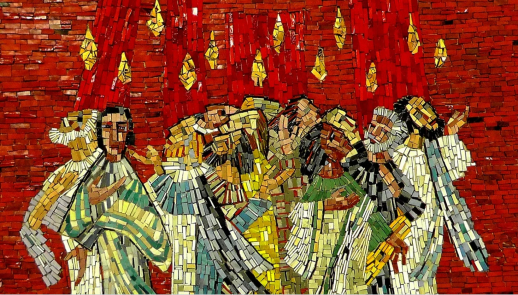
I believe that instead of always expecting the miraculous or never expecting it, we should understand that the miraculous is still possible. The gifts have not ceased. However, that does not mean that every Sunday will be a recreation of Pentecost.[2] I believe we see through Scripture and the history of the Church that the miraculous gifts of the Spirit are still given, yet they are not normative, they are not always given or to the same degree.
We are not to expect Pentecost but we are to expectantly pursue the gifts in accordance with Scripture for the upbuilding of the church. In the last days in which we are in, the actual outpouring of the grace gifts will look different at different geographical locations as well as different times throughout history. This is to be expected because in the New Testament there was no equal distribution of grace gifts and God’s mighty acts by the Spirit have in no way been evenly disbursed over the course of redemptive history.[3] The Spirit moves where He wills (John 3:8) but that does not in anyway preclude us from praying for His special empowering. All over Scripture, the Spirit empowered people in mighty ways, we are in no less need of that special empowering today. Although we cannot demand it and it does not seem to be normative.[4]
Second, why do so many unhealthy teachings and experiences go on within some churches that believe in the continuation of the grace gifts? There are various ways to answer this question but briefly, I think the issue shows a need for biblical leadership. That is not to say that biblical leadership has always been lacking in these churches. Paul himself had to provide correction to the Corinthian church that was dealing with various issues. But, he did provide that leadership, he did provide correction.[5] I think it is important to note that abuses seem to abound where there is need for biblical balance regardless of the doctrine. I think for example of hyper-Calvinism or the issue of having orthodoxy but not orthopraxy.
I appreciate this important advice from Carson:
When God graciously manifests himself in abnormal and even spectacular ways, the wisest step that the leaders participating in such a movement may take is to curb the excesses, focus attention on the center—on Christ, on loving discipleship, on self-sacrificing service and obedience, on God himself—and not on the phenomena themselves.[6]
Third, is the popular “open but cautious” view of the gifts a biblically tenable one? I do not believe so. If the grace gifts are still given then Scripture exhorts us to “earnestly desire” them for the upbuilding of the body (1 Cor 12:31; 14:1, 39). If the Lord Jesus cares enough about His church to give gifts and Spirit-empowered abilities to serve people, should we not care enough about the church to use those gifts for that purpose?[7] Are we okay with being merely open to these good gifts, and even cautious about them, when He has graciously given them for our corporate good?[8] That option does not seem open to me (although I understand that it may take some time to study and pray over the topic). Though, this issue should never be one of contention or disunity.
Earnestly desiring the gifts of the Spirit for the upbuilding of the body should never be allowed to cause division in the body. The Spirit wants us to and works so that we “grow up in every way into Him who is the head, into Christ, from whom the whole body, joined and held together by every joint with which it is equipped, when each part is working properly, makes the body grow so that it builds itself up in love” (Eph. 4:15-16). So, the gifts should never be pursued in a way that would cause disunity or disrepute.
Earnestly desiring the gifts of the Spirit for the upbuilding of the body should never be allowed to cause division in the body.
Tweet
I do believer, however, if someone is “open but cautious” then they should study Scripture in depth on the topic. If they are cautious it is important that they be informed on what particularly they should be cautious about. If they are open they should know why and what they are open too. If they are open, they should earnestly desire the grace gifts and lead the church to be built up through the operation of the full range of the grace gifts of the Spirit. This is important, because if the nose is missing, where would be the sense of smell (See 1 Cor 12:12ff)? In the same way we want each part of our body functioning, we should want every grace gift functioning within the church body.
May we long to impart spiritual gifts to strengthen each other as Paul did (Rom 1:11). “If, as Paul puts it, God’s various gifts are given ‘for the common good’ and ‘for the building up of the church,’ then we should expect to flourish to the extent that we receive, steward, and enjoy them.”[9] Thus, the “open but cautious” position is not, in my opinion, a biblical position. Though I believe it is appropriate to be “unsure but studying” even though I believe the correct view is “open and desirous.”
Concerns and Cautions. The Apostle Paul has some good words for us, both groups. He says earnestly desire to prophesy and do not forbid speaking in tongues (1 Cor 14:39). And he also says all things must be done in a proper and in an orderly manner (v. 40). He says I will pray with my spirit, I will sing with my spirit (v. 15). And he says, I will pray with my mind, I will sing with my mind (v. 15). Whatever our view on the continuation of the gifts, our churches should not be able to be labeled either “charismaniacs” or “the frozen chosen.” Because God is not a God of confusion (v. 33) but He is a God of new and exciting life and there is reason for us to respond to Him with visible affection. May we, both of us, worship the LORD, as He deserves, in spirit and in truth (John 4:24).
I believe there is a danger of emotionalism on one side and of distain for emotion on the other. The renowned philosopher, theologian, and pastor Jonathan Edwards said, “there is no true religion where there is nothing else but affection, so there is no true religion where there is no religious affection.”[10] Emotions are not bad in and of themselves but emotions must be guided by Scripture and governed by the self-control of the Spirit. Jay Adams has said,
There are no damaging or destructive emotions per se. Our emotional makeup is totally from God. All emotions of which He made us capable are constructive when used properly (i.e., in accordance with biblical principles)… All emotions, however, can become destructive when we fail to express them in harmony with biblical limitations and structures.[11]
It is also important that we realize that worship is to be a response to revelation, the glory and goodness of God, and not mere hype, lighting, and musical mood. When we respond with the correct emotions to God’s revelation it honors Him. There is a time to “rend our hearts,” for instance (Joel 2:13). As William Wilberforce said, “Scripture speaks with praise of the lively exercise of the passions towards their legitimate object.”[12]
The Christian and Missionary Alliance (C&MA), is a denomination that has a history of reckoning with this important and controversial topic, and they have wisely said, “in all periods of highly emotional religious issues, excesses are inevitable.”[13] The C&MA knows about both the “blessings and the mischief of the [charismatic] movement.”[14] Though it is true that mischief and even grave harm is done by those who teach falsely and wrongly emphasis certain gifts at the expense of others, it does not mean that the gifts themselves are bad. The apostle Paul himself showed that “the correct treatment for abuse is not disuse, but proper use.”[15]
As the C&MA states, “we must… remember that our ‘comfort zone’ is not the same as spiritual discernment, and at times even a gift manifested in love may make those ignorant of it uncomfortable. Therefore, patient teaching on the gifts and their manifestations is a necessity.”[16] Further, we must work very hard to distinguish between a work of the Spirit and what is merely a work of man or even Satan.[17]
Jonathan Edwards gives five evidences of a work of the Holy Spirit that we would be wise to consider.[18] First, the Spirit will work in such a way as to exalt Christ (1 Cor 12:3). Second, the Spirit will work against Satan and his work. Third, the Spirit will cause people to have a greater regard for Scripture and will establish them in God’s truth. Fourth, the Spirit will lead people in truth and convince them of what is true. Fifth, the Spirit will cause people to love God and man. Further, Edwards says,
The surest character of true divine supernatural love—distinguishing it from counterfeits that arise from a natural self-love—is, that the Christian virtue of humility shines in it; that which above all others renounces, abases, and annihilates what we term self… Love and humility are two things the most contrary to the spirit of the devil, of any thing in the world; for the character of that evil spirit, above all things, consists in pride and malice.[19]
The Spirit’s work in us, whatever form that work takes, should not produce pride but humility. Also, the fruits of the Spirit should always accompany the gifts of the Spirit to a high degree (Gal 5:22-23).[20]
It is also very important that we understand, as Jonathan Edwards says, “A work is not to be judged of by any effects on the bodies of men; such as tears, trembling, groans, loud outcries, agonies of body, or the failing of bodily strength.”[21] Thus, Allen Ross is correct in saying, “It is presumptuous for anyone to say that others do not have the joy of the Spirit if they do not dance and shout in a certain way… [or] have particular spiritual gifts. The Holy Spirit works differently in people.”[22]
As a last caution, it is important to hear from Cecil M. Robeck in his book The Azusa Street Mission and Revival. He says, “As a church historian, I have… come to realize that revival is not the normal state of affairs, nor is it intended to be so. Those of us who appreciate the role that revival plays often miss this.”[23] Robeck compares revival to smelling salts. Smelling salts have their purpose. They revive people and bring them back to consciousness. But they are not for everyday life. “Imagine a roomful of people convinced that they need to keep on inhaling smelling salts in order to keep on living.”[24]
Read More…Back to Virtue by Peter Kreeft

I recently read Peter Kreeft’s book Back to Virtue. Kreeft is a Roman Catholic philosopher, theologian, apologist, and a prolific author. He is a professor of philosophy at Boston College and The King’s College.
Here are some quotes from Back to Virtue that stuck out to me:
“We control nature, but we cannot or will not control ourselves. Self-control is ‘out’ exactly when nature control is ‘in’, that is, exactly when self-control is most needed” (Peter Kreeft, Back to Virtue, 23).
“Nothing is so surely and quickly dated as the up-to-date” (Peter Kreeft, Back to Virtue, 63).
“It is hard to be totally courageous without hope in Heaven. Why risk your life if there is no hope in Heaven. Why risk your life if there is no hope that your story ends in anything other than worms and decay” (Kreeft, Back to Virtue, 72).
“The only way to ‘the imitation of Christ’ is the incorporation into Christ” (Ibid., 84).
“There are only two kinds of people: fools, who think they are wise, and the wise, who know they are fools” (Ibid., 99).
“Humility is thinking less about yourself, not thinking less of yourself” (Ibid., 100).
“God has more power in one breath of his spirit than all the winds of war, all the nuclear bombs, all the energy of all the suns in all the galaxies, all the fury of Hell itself” (Ibid., 105).
“We can possess only what is less than ourselves, things, objects… We are possessed by what is greater than ourselves—God and his attributes, Truth, Goodness, Beauty. This alone can make us happy, can satisfy the restless heart, can fill the infinite, God-shaped hole at the center of our being” (Ibid., 112).
“The beatitude does not say merely: ‘Blessed are the peace-lovers,’ but something rarer: ‘Blessed are the peacemakers’” (Ibid., 146).
“There is only one thing that never gets boring: God… Modern man has… sorrow about God, because God is dead to him. He is the cosmic orphan. Nothing can take the place of his dead Father; all idols fail, and bore” (Ibid., 157).
“God’s single solution to all our problems is Jesus Christ” (Ibid., 172).
“An absolute being, an absolute motive, and an absolute hope can alone generate an absolute passion. God, love and Heaven are the three greatest sources of passion possible” (Ibid., 192).
Encouragement in Exile (A Sermon)
Intro
I want to say at the start that I understand it can be hard to sit there and be engaged. I’ve been there. I want to challenge you, however, to lean in and listen. The events we’re talking about here may be some 2500 years in the past but they have amazing significance today.
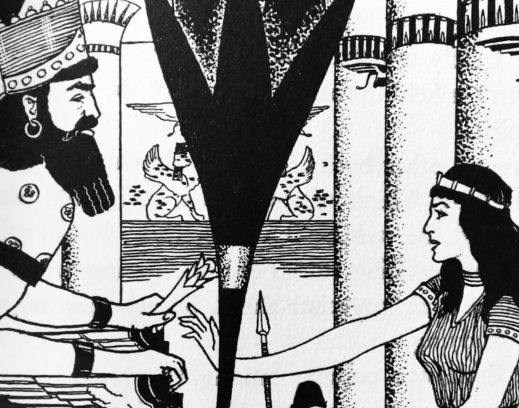
Plus, the book of Esther is an amazing book. It is a true work of literature. There is a heroine, suspense, irony, reversal, and surprising coincidences. Basically everything you’d want in a story.
Setting: Exile
The book of Esther tells “the story of events surrounding the rescue of the nation of Israel from the threat of extinction while it was in exile in Persia… The more profound and universal purpose of the story is to explain how God’s providence can protect his people.”[1]
Whoever you are, wherever you come from, and no matter where you are spiritually, this year has likely brought many challenges to you. I believe the book of Esther offers some much-needed perspective on things.
Chapters 1-2
As we saw the last two weeks, God’s people are in exile, under the reign of king Ahasuerus. Ahasuerus, as the King of Persia, has a ton of wealth. So he shows his wealth by having a party for 180 days (1:4).[2] With that much partying it is no wonder that he seems to be somewhat of a drunk and pushover. However, it appears that he’s trying to combat his pushover persona (but not his potential alcoholism!) with the help of his friends and so he makes an example of his wife Vashti who did not obey his every whim.
In Herodotus’ Histories, it says that that the “king of Persia could do anything he wished.”[3] And so, that’s what he did. He gets rid of his old wife and throws a lavish beauty pageant to find the most beautiful and pleasing bride in the kingdom (2:2-4). In somewhat of a Cinderella story, the king “fell in love” with Esther or at least more than all the other women and so he put the royal crown on her head and made her queen (v. 17).
Esther’s Exile
Israel is in Exile. God’s people are not in the Promised Land. They have a foreign ruler. And can you imagine, that ruler was allowed to do “anything he wished.”
Our Exile
We too are in exile, we too are not home. It may be different than Esther’s exile but we are in exile too. We see this truth in Scripture in various places. For instance, 1 Peter 1:1 talks about us being “elect exiles” and verse 17 tells us how we are to conduct ourselves throughout the time of our exile. First Peter 2:11 says, “Beloved, I urge you as sojourners and exiles to abstain from the passions of the flesh, which wage war against your soul.” Philippians 3:20 reminds us “our citizenship is in heaven, and from it we await a Savior, the Lord Jesus Christ.” Hebrews 13:14 says that “here we have no lasting city, but we seek the city that is to come.”
So, just as Esther was in exile, we as Christians are in exile too. This book is relevant and has a lot to encourage us in the midst of the challenges of exile.
More and more our exile is a very visible reality. The Public Religion Research Institute did a study on religious affiliation in America. Here are their findings:
“The American religious landscape has undergone substantial changes in recent years… One of the most consequential shifts in American religion has been the rise of religiously unaffiliated Americans… In 1991, only six percent of Americans identified their religious affiliation as ‘none,’ and that number had not moved much since the early 1970s. By the end of the 1990s, 14% of the public claimed no religious affiliation. The rate of religious change accelerated further during the late 2000s and early 2010s, reaching 20% by 2012. Today, one-quarter (25%) of Americans claim no formal religious identity, making this group the single largest ‘religious group’ in the U.S.”[4]

The study also found “about two-thirds (66%) of unaffiliated Americans agree ‘religion causes more problems in society than it solves.” They also “reject the notion that religion plays a crucial role in providing a moral foundation for children.”[5]
It is not just America, however, that is becoming increasingly less affiliated. The Church in America also has less and less commitment.
One recent study conducted by Barna Group for the book Faith for Exiles found that out of the around 1,500 people between the ages of eighteen and twenty-nine that grew up in the church (as Christians) the majority no longer go to church. 22% are now considered “ex-Christians.” 30% may identify themselves as Christians but they no longer go to church. 38% describe themselves as Christians and have attended church at least once in the last month but do not have the core beliefs or behaviors associated with being a disciple of Jesus. Only 10% were found to be regularly involved in the life of the church, trust in the authority of Scripture, affirm the death and resurrection of Jesus, and express a desire for their faith to impact their world.

Dedicated Christians are more in more considered odd. Christians are more and more on the fringes of society. If things don’t change, these trends will just continue in the future. The reality of our exile status will be felt more and more.
So, friends, Esther has a lot to teach us about our exile. Let’s go to the first scene…
1. Haman’s Plot (Ch. 3)
Scene 1 starts with Haman, the antagonist or bad guy of the story,[6] being promoted (3:1). It seems like he’s promoted because the beauty pageant was his idea.
Haman soon became furious at a Jewish man named Mordecai because he would not bow down to him. But instead of just taking it out on him, Haman wanted to destroy all the Jews throughout the whole kingdom (3:5-6). So, we see a big problem introduced in the plot.
Haman decided which day the Jews should be destroyed on by casting a lot. Lot is the word “pur,” so that’s where the name Purim, the Jewish holiday, comes from. Because Haman cast lots to decide what day the Jews would be destroyed on. However, as Proverbs 16:33 reminds us the lot (pur) is cast into the lap, but its every decision is from the Lord. And so we see, even when the name of the LORD is not mentioned we see God is sovereign over human affairs and He will keep His promises to protect and bless His people. He will not let His people be wiped out.
Haman was so eager to destroy the Jews that he offered to pay the king ten thousand silver talents, the
equivalent of eighteen million dollars today,[7] of his own money if the king would allow him to destroy the Jews. The king agreed and a decree was sent and Haman and the king sat down to drink (again).
Then in Esther 3:13-15 it says, “Letters were sent by couriers to all the king’s provinces with instruction to destroy, to kill, and to annihilate all Jews, young and old, women and children, in one day, the thirteenth day of the twelfth month, which is the month of Adar, and to plunder their goods. A copy of the document was to be issued as a decree in every province by proclamation to all the peoples to be ready for that day. The couriers went out hurriedly by order of the king, and the decree was issued in Susa the citadel.”
Things clearly are not looking good. What can possibly be done? Let’s look next at…
2. Esther’s Plan (Ch. 4-5)
In scene 2 we see Mordecai appeal to Esther (Ch. 4). Mordecai hears about Haman’s plot to kill the Jews and so he talks to Esther about it. Mordecai says, in Esther 4:12-14, “Do not think that in the king’s palace you will escape any more than all the other Jews. If you keep silent at this time, relief and deliverance will come for the Jews from another place, but you and your father’s house will perish. And who knows whether you have not come to the kingdom for such a time as this?” (4:12-14)
Imagine how scary that must have been for Esther. She could be totally rejected, she could be killed. Yet she moved forward. She just had one thing to say to Mordecai. She said: “Hold a fast on my behalf, and do not eat or drink for three days, night or day. I will also fast. Then I will go to the king, though it is against the law, and if I perish, I perish” (4:15-16).
In the next scene, scene 3, we see Esther before the king (Ch. 5:1-8). Esther has her first banquet with the King. Esther goes to the king and says, “Please join me for a feast that I prepared and invite your friend Haman too” (5:4). Then, at the feast, Esther says let’s feast again tomorrow and we’ll talk more then (5:8).
(It’s funny, is Esther delaying? Is she nervous? Is she buttering him up? We don’t know…)
In scene 4 we see Haman’s exaltation and anger (Ch. 5:9-14). After the feast, Haman leaves and he is joyful and glad. But then he sees Mordecai on the way home and he doesn’t rise in respect before him or tremble before him. And so Haman is ticked off and his wrath is renewed (5:9).
Haman was able to contain himself, however, and made it home. When Haman was home he had his friends over and was talking with them and his wife. He was recounting how good everything was going and he told them that he even got to hangout with the king and his new bride (5:12). “However,” he said, “It’s all pointless to me, so long as I see Mordecai still alive” (cf. 5:13).
So, his wife and friends said, “Build a frame six-stories high and have Mordecai executed on it.” When Haman heard that idea, he said, “That’s it!” And with great excitement he had the structure built so that the entire city could see Mordecai his enemy impaled.
Haman was haughty. He thought he could have Mordicai and all the Jews murdered and get away with it. But, next we see…
3. Haman’s Downfall (Ch. 6-7)
In scene 5 we see Mordecai’s triumph and Haman’s fall (Ch. 6-7). As we flash to scene 5, we see Esther getting herself together and preparing for her talk with the king.
But, the king couldn’t sleep. So, he did what any self-respecting king would do, he asked for a bedtime story.
The king gave orders for the book of memorable deeds to be brought and read to him (6:1).[8] And before the
king got bored and fell asleep the story was recounted how Mordecai protected the king from an assassination attempt (6:1-2).
And the king said, “What honor or distinction has been given to Mordecai for what he did?” The king was told that “Nothing had been done” (v. 3).
That’s when, guess who walked in?…
Haman walks into the king’s palace to speak to the king about having Mordecai impaled.
However, before Haman could ask his question, the king asked him a question. The king said to Haman: “What should be done to the man whom the king wants to honor?” (v. 6)
And Haman thought to himself, “Who would the king want to honor more than me?!” (v. 6).
So Haman said to the king, in 6:6-9, “For the man whom the king wants to honor, I would get the royal robes out, and the best horse that the king has, and your favorite royal crown. And I would give it to him. And I would have a parade for him and lead him through the street and say: ‘This is what happens to the person that the king wants to honor!’”
Then the king said to Haman, “Great! Good ideas! Now hurry; and go do all that you just said for Mordecai the Jew! Do everything that you just said! (v. 10)
Wow.
Haman clearly is not doing very well.
Haman eventually goes home (“rough day at the office”). And his wife and friends concur that this is not a good situation… Obviously.
Haman can’t hide in shame. He has a feast to attend, Esther’s special feast to which he is a very special guest.
At the feast, Esther makes a request of the king. She says, in chapter 7 verse 4, “Please let me keep my life and the life of my people.” “For we have been sold, I and my people, to be destroyed, to be killed, and to be annihilated” (7:4).
Then king Ahasuerus said to queen Esther, “Who is he, and where is he, who has dared to do this?!” And Esther said, “A foe and enemy! [Pause for effect…] This wicked Haman!” (7:6)
Then Haman was terrified before the king and the queen.
The king stood up in his anger from his wine-drinking and went into the palace garden, but Haman stayed to beg for his life from queen Esther. But, the king returned from the garden just as Haman was falling on
the couch where Esther was. And the king said, “Will he even assault the queen in my presence?!” (7:8)
At this point, Haman had no hope.
One of the servants said, “The six-story structure that Haman prepared for Mordecai is standing at Haman’s house ready to go.” (7:9)
And so, Haman was executed on the stand that he had prepared for Mordecai (7:10).[9]
Wow. What a reversal. What unexpected deliverance. Of course, the stories not quite through but that’s all we’re covering until next week. So, let’s look at the…
Closing Scene (Takeaways Until Next Time)
There is so much to be gleaned. There are four takeaways I want to spend the remainder of time looking at.
1. God uses People
Esther is the unexpected star of the story. Ironically, Esther means, “star” and she was the star. There are 37 references to Esther by name. “Esther is an orphaned, exiled female. She is a most unlikely leader. Her only qualification is that she has won a beauty contest. Yet she joins a long line of unlikely heroes in the history of Israel.”[10]
God uses unlikely people and deliverers in unexpected ways. It’s actually kind of His standard operating procedure. God used Moses, a man with a stammering tongue. God anointed David to be king, the youngest and most unexpected of his brothers. God uses small armies to bring deliverance. God puts His treasure in jars of clay so that it will be clear that the power and glory belong to Him (see e.g. 2 Cor. 4:7). And God uses the foolishness of the cross to bring salvation and shame the “wise” (see 1 Cor. 1:18-31).
Where did the rescue come from? Esther? Mordecai? Xerxes? God? God uses means to accomplish His ends!
What we do matters. Our lives and our decision matter eternally. They ripple through the corridors of time. There was and never will be a meaningless moment. John S. Dickerson in his book,The Great Evangelical Recession, has said:
“The stakes are eternal. The victims or victors are not organizations or churches, but souls that will live forever… We can feel a bit like Frodo, the hobbit, in The Lord of the Rings. We are tiny creatures entrusted with an impossible task—to rescue humanity from unthinkable evil… All we have to decide is what to do with the time that is given to us.”[11]
My family used to live in the D.C. area. We saw where the plane hit the Pentagon on September 11th. Leah and I have been to New York city and have seen where the Twin Towers used to be. We have been by the monument in Pennsylvania that commemorates the passengers in the plane that went down in on September the 11th instead of careening into the White House.
Think about the decisions that were made in that plane on that fateful day. Think about the weightiness of those decisions. Think about the effect of those decisions upon themselves and upon all of America.
We don’t often see the impact of our decisions that starkly but what we do or don’t do matters. It matters for us. It matters for others.
What we do matters. It matters eternally. God uses mere humans as His mouthpiece. God uses humans to do His will.
Friends, our lives matter, our actions matter, our voices matter.
If we knew a millionth of the magnitude of our lives we’d be moved to wonder. Our lives and our every action have significance because this world and this life is not all there is.
And for Christians, this is multiplied ten-fold. We are mouthpieces, ambassadors, commissioned by the one true God.
God gives us wit, wisdom, and human will. Will we use what God has given us? Will we rise to the occasion and work to reach this lost world with the good news of Jesus? Or, will we just sit back? As we’ve seen with Esther, it won’t be easy and it will be scary but who knows whether you have not come to this place in your life and this place in history for such a time as this (cf. 4:14)?!
Friends, let’s live fierce purposeful lives because we have purpose. Our lives matter more than we can know.
That, too me, is very challenging and very encouraging. The other side of the coin, however, is very comforting and encouraging too. Let’s look at that now…
2. God is Sovereign
Haman has such hatred of the Jews he contrives of a pogrom and even bribes the king the modern equivalent of somewhere around $18,000,000 so that he can exterminate them. It does not look like rescue is going to come. How could it when the wicked one in power is willing to go to such lengths to destroy?! What hope was there really?…
Friends, if God’s not sovereign and He doesn’t save then that leaves it to you to save and be sovereign. If God is not Lord, then you have to be lord. It falls to you. Everything falls to you. You then have to govern the universe, at least your universe. You then have to rescue yourself or there will be no rescue…
In Esther there are 250 appearances of the Hebrew word for “king” or “to rule” and zero explicit references to God. The only other book that doesn’t explicitly mention God is the Song of Songs. In Esther it looks like Satan, “the ruler of this world” (Jn. 12:31 cf. Eph. 2:2), is in charge. But, he’s not. There’s someone unseen and unmentioned who really rules. And it’s Yahweh, the Creator and all-powerful One. He is God. He is in charge. We may not see Him. But we know Him. And we know He’s the boss.
The truth is though, from our perspective God is often not in view. We don’t see Him. And it looks like there is no hope. No rescue. We only see ourselves and earthly rulers. We either tremble in fear or we place our hope in them or we do both. We often think about earth and those who seemingly rule on earth. But the reality is, as Esther shows us, that there is someone orchestrating everything behind the veil…
In the book of Esther we see that God is present even when it seems like He’s not. “The book of Esther asks us to trust in God’s providence even when we can’t see it working. That requires a posture of hope, to believe that, no matter how horrible things get, God is committed to redeeming his good world and overcoming evil.”[12]
And so, we need to trust like Mordecai. We must not bow down to any earthly powers. And we need to fast and pray and ask others to fast and pray in times of need. We need to rely on God even when He seems absent. We need to lay our lives down in service to God with a heart that says, “If I perish, I perish” (Esther 4:16). Especially as we consider that Jesus did perish to purchase our salvation.
As Mark Dever has said, “How could little orphan Esther end up as queen, Mordecai as prime minister, and the exiled Jewish people in prosperity, popularity, and safety!”[13] Only because God is the one truly on the throne of the universe. How could salvation come through the death of Messiah Jesus, because Jesus is Lord and the Son of God.
Our hope is in a Ruler, in a King. But, He is no earthly ruler. He is the King of kings, and Lord of lords. He is the one and only Sovereign. As David Platt has said, “This world is not a democracy. This world is a monarchy, and God is the King.”
Sometimes when things look the worst, is when God shows His power the most. Actually, at the end of all things, when Jesus comes back, things are going to look very bad and be very bad. But then Jesus is going to show up on the scene. And He’s going to vanquish His foes. He will arrive not on a lowly donkey but on a white horse of war. He will destroy His enemies with the sword of His mouth (Rev. 1:16; 19:15, 21). There will be no Haman, no human, and no supernatural force to stand in His way.
Elliot Clark said this in his helpful book, Evangelism as Exiles:
“Hope for the Christian isn’t just confidence in a certain, glorious future. It’s hope in a present providence. It’s hope that God’s plans can’t be thwarted by local authorities or irate mobs, by unfriendly bosses or unbelieving husbands, by Supreme Court rulings or the next election. The Christian hope is that God’s purposes are so unassailable that a great thunderstorm of events can’t drive them off course. Even when we’re wave-tossed and lost at sea, Jesus remains the captain of the ship and the commander of the storm.”[14]
That leads us to our next consideration…
3. God Punishes His Enemies
Another important thing Esther teaches us is that God always punishes His enemies. We also see that God will certainly deliver His people.[15] Therefore, we can be comforted in our struggles, courageous in our obedience, and confident and joyful in our waiting.[16]
It must be said, however, that if you are an enemy of God, that is bad news. The worst news.
But we can have hope. Even though we’re all naturally enemies of God because of our wrongdoing. We can have hope because…
4. God Saves in Unexpected Ways
The book of Esther amazingly goes from fast to feast! God brings about all sorts of unlikely plot twists. Here’s a picture that shows us the plot of Esther:

God rescues in unexpected ways. He always has.
The story of Esther is intricately and intrinsically linked to the cosmic story of rescue. It is through the deliverance that happens in the book of Esther that the deliverance from Messiah Jesus can happen. If Haman’s pogrom would have succeeded then God’s promise would not have. God, however, keeps His promises. He did and will provide the rescue we all need. Jesus, the Messiah, the Promised One, was born of a woman, as a Jew, and a descendent of David. Jesus did strike a death blow to Satan, the serpent of old, when He died on the cross and rose victorious over death and sin, and He soon will send Satan to the fiery pit.
So, just as Esther brought rescue, Jesus brings eternal rescue. Esther and Jesus are similar in some ways but also very different. Unlike Esther, Jesus had “no beauty that we should desire Him. He was despised and rejected” (Is. 53.2-3). And unlike Esther who brought an amazing plot reversal akin to resurrection, Jesus actually brought resurrection, and final victory over Satan, sin, and death. So, Esther is good and we’re thankful for her but Jesus is clearly much better.
Esther brought reversal—from Jewish destruction to Jewish deliverance, from Mordecai being impaled high above the crowd to Haman being impaled high above the crowd, from a pogrom against the Jews to Jewish peace. But Jesus brings ultimate reversal. The dead shall rise. In the end, the last shall be first, and the first last. Those who weep will be comforted and rejoice.
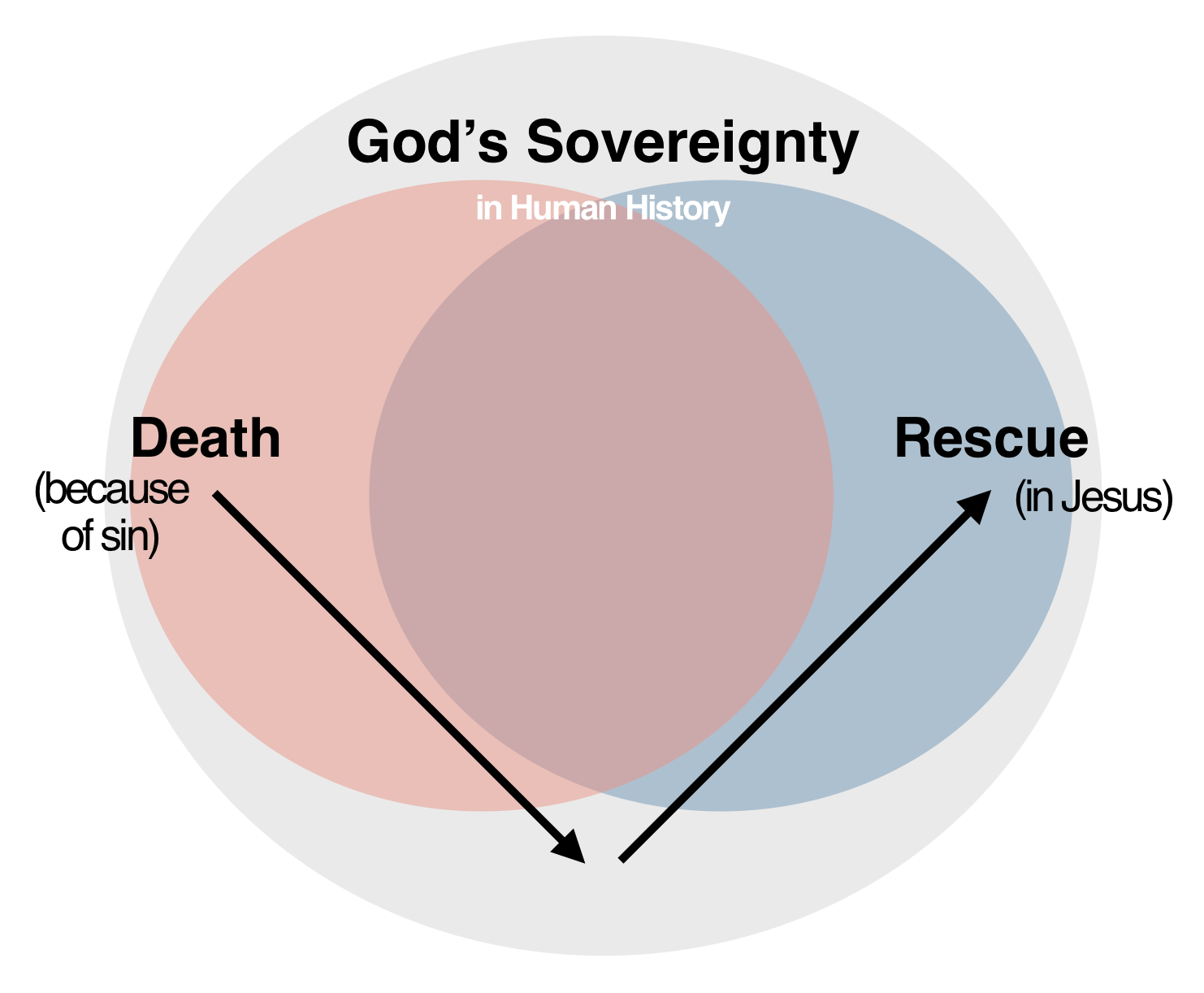
The ultimate reversal is that victory comes through the cross. God works, and has always worked, in unexpected and glorious ways.
Lee Beach, the author of The Church in Exile, has said, God “is able to use marginalization and weakness for his missional purposes, and the church in the post-Christendom age needs to embrace this very Esther-like perspective at its core as it seeks to be the people of God in a foreign culture.”[17]
Conclusion
So friends, even as we face challenges in the changing world that we find ourselves in, we know that we serve the LORD who is all-powerful even when we can’t see Him. Even when we can’t see Him present, we can trust His promise. He will be with us. He will help us.
We know that He, in Messiah Jesus, has already provided the rescue we most need. So, we continue to live faithful lives in hope and trust.
Lastly, I have a challenge for you. One recent study by the Pinetops Foundation has said, “The next 30 years will represent the largest missions opportunity in the history of America. It is the largest and fastest numerical shift in religious affiliation in the history of this country… 35 million youth raised in families that call themselves Christians will say that they are not by 2050.”[18] What if God strategically raised you up for such a time as this? What if God want you to be on mission in exile?
To be honest, I don’t know what God is calling me to do about this. I don’t know what he’s calling you to do about this. But, perhaps, God has brought you to this point for such a time as this (cf. 4:14)? I want to take some time for us to pray and reflect on what God is leading us to do about the 35 million youth raised in Christian homes that are projected to leave the path of life for the path of destruction.
Esther took her life in her own hands, risked it all. What might God be calling you to?
Let’s take some time and ask our Father what He would have us do.
[1] Ryken, Ryken, Wilhoit, Ryken’s Bible Handbook, 207.
[2] Of course, it may not mean that the party was 180 consecutive days.
[3] Herodotus, Histories, 3.31.
[4] https://www.prri.org/wp-content/uploads/2016/09/PRRI-RNS-Unaffiliated-Report.pdf.
[5] Ibid.
[6] Haman is an Agagite which means he was a Canaanite which were longtime enemies of the Israelites. This comes into the plot of the story later on but this point is not made explicit.
[7] Charles F. Pfeiffer, Old Testament History, 489. That book, however, was published in 1973 so the figure would be higher today.
[8] Herodotus talks about such a book in Histories 8.85, 90.
[9] “Reversal seems the most important structural theme in Esther” (Dumbrell, Faith of Israel, 300 as quoted in Schreiner, The King in His Beauty, 224).
[10] Lee Beach, The Church in Exile, 79.
[11] John S. Dickerson,The Great Evangelical Recession, 126.
[12] Illustrated Summaries of Biblical Books by the Bible Project. “Even though God is never mentioned, Yahweh is King, and the Jews are his people. No plot to annihilate them will ever succeed, for Yahweh made a covenant with Israel and will fulfill his promises to them. The serpent and his offspring will not perish from the earth until the final victory is won, but they will not ultimately triumph. The kingdom will come in its fullness. The whole world will experience the blessing promised to Abraham” (Thomas R. Schreiner, The King in His Beauty, 225).
[13] Dever, The Message of the Old Testament, 462.
[14] Elliot Clark, Evangelism as Exiles, 42.
[15] See Dever, The Message of the Old Testament, 457ff.
[16] See Ibid.
[17] Beach, The Church in Exile, 79.
[18] “The Great Opportunity: The American Church in 2050,” 9. This is a study put out by the Pinetops Foundation.
A few helpful resources before you vote…

Here are some resources and quotes I’ve found helpful in thinking about this years election…
I highly suggest that you check out Jonathan Leeman’s article: “What Makes a Vote Moral or Immoral? The Ethics of Voting.” And I found Justin Taylor’s article “The Case Against Pro-Lifers Voting for Joe Biden” helpful too. Taylor quotes John Piper: “No endorsement of any single issue qualifies a person to hold public office. Being pro-life does not make a person a good governor, mayor, or president. But there are numerous single issues that disqualify a person from public office.”
I recently read David Platt’s helpful book, Before You Vote: Seven Questions Every Christian Should Ask. You should buy it right now on Kindle. Here are a bunch of quotes from that book:
“This world is not a democracy. This world is a monarchy, and God is the King.”
“In the end, what’s most important, and what I am definitively advocating for based on God’s Word, is the realization that how we use our vote is a matter of faithfulness before God. For our vote is a unique privilege and responsibility that God has entrusted to us by his grace, and God calls us to use every means of grace he grants us to love him above all and love our neighbors as ourselves.”
“Even if we lose every freedom and protection we have as followers of Jesus in the United States, and even if our government were to become a completely totalitarian regime, we could still live an abundant life as long as we didn’t look to political leaders, platforms, or policies for our ultimate security and satisfaction. We can still have hope, peace, joy, and confidence regardless of what happens in our government, as long as… we look to Jesus alone for these things, and all of our hope hinges on him.”
“We are not worried or panicked about elections, no matter how important they may seem… Instead, we seek the kingdom of Jesus and his sinless righteousness with true peace and total confidence in his supreme reign. After all, we know that throughout history, leaders have risen and fallen. Presidents have come and gone. Through it all, one King alone has remained constant, and he is not up for election. Regardless of what president is chosen in our country, Jesus will be in control of it all.”
“According to God,… my concern in voting should not just be for me and my children but also for others and their children.”
“A clear takeaway from the book of Jonah is that we are to work for the spread of God’s love in all nations more than we are to seek safety, security, prosperity, and comfort in our own nation.”
“By God’s grace, we have been given so much as citizens of the United States of America. For all that God has granted us, we should be deeply grateful. At the same time, we follow a King who commands us to lay down our rights and use the grace he has given to love our neighbors as ourselves. This, after all, is the essence of the gospel that has saved us.”



 in X
in X 