Why celebrate the Lord’s Supper?

Jesus commands us to together partake of the bread and the cup in remembrance of Him, and so that is why we celebrate Lord’s Supper. We see this in a few different passages (Matt. 26:26-29; Mk. 14:22-25; Lk. 22:17-20; 1 Cor. 11:23-25).
We partake together and first remember Jesus’ propitiatory death for us and so the Lord’s supper causes us to reflect on the past. Second, the Lord’s Supper causes us to reflect on the current fellowship we together experience through union with Christ. And third, we look ahead to the future when we shall feast with Jesus after His return (we “proclaim the Lord’s death until he comes,” 1 Cor. 11:26). Scripture also points us to the importance of self-examination so that we do not take the Lord’s Supper in an unworthy manner and thus bring condemnation upon ourselves (1 Cor. 11:28ff).
The New City Catechism says, “Christ commanded all Christians to eat bread and to drink from the cup in thankful remembrance of him and his death. The Lord’s Supper is a celebration of the presence of God in our midst; bringing us into communion with God and with one another; feeding and nourishing our souls. It also anticipates the day when we will eat and drink with Christ in his Father’s kingdom” (Q46).
The Lord’s Supper is a beautiful and amazing picture of the gospel for us. Jesus’ body was broken and His life was poured out so that we could have life. When we partake of the Lord’s Supper we are reminded of the amazing truth that Jesus—God in flesh—is the Lamb of God who takes away our sin. The Holy Spirit uses the God-ordained and Christ instituted means of the Lord’s Supper to help us remember with thankfulness Christ’s finished work on the cross.
4 Reasons Sermons are Essential

Why are sermons such a big deal? The Bible tells us to sing as the gathered church. The Bible also tells us to celebrate the Lord’s Supper and baptisms. But why are sermons essential?
Sermons are essential because they teach God’s truth so as to exalt Christ, encourage and build up, and exhort the gathered church.
First, the teaching aspect of the sermon is important. Its importance is seen all over Scripture (e.g. Neh. 8:7-8; 1 Tim. 3:2). God has spoken and so helping people understand and apply the revelation from Him is life-changing. God’s people, however, are able to understand His truth. This is because all believers are indwelt by the Holy Spirit (Eph. 2:22; 1 Cor. 3:16; 2 Cor. 6:16), Jesus has made all those in Him priests (1 Pet. 2:5, 9; Rev. 1:5-6), and Scripture is clear on the things which are “necessary to be known, believed, and observed, for salvation” (The Westminster Confession of Faith, ch. 1). Qualified teachers are still vital, however, because sound (or healthy) doctrine is vital. That is, in part, why pastors must be “able to teach” (1 Tim. 3:2; 2 Tim. 2:24) and defend the truth (2 Tim. 2:25; Titus 1:9). We also see in Scripture that right teaching leads to maturity and the body of Christ being equipped for every good work. Believers may be able to subsist on milk but teachers are able to provide needed meat (2 Cor. 3:2; Heb. 5:12-13).
Second, communicating God’s truth in sermons is vital because the Bible is the authoritative word of God and it is uniquely profitable (2 Tim. 3:16-17). It is our sole authority for faith and practice. Scripture is a light (Ps. 119:105,130), a sword (Eph. 6:17), a hammer (Jer. 23:29), and a surgeon (Heb. 4:12). Scripture is more essential than bread (Matt. 4:4), better than gold (Ps. 19:10; 119:72), and we need it to live (Ps. 119:144). Scripture is perfect (Ps. 19:7), true (Ps. 19:9), pure (Ps. 19:8), and eternal (1 Pet. 1:25). Scripture contains the words of life (Jn. 6:68) and the words that are breathed out by God (2 Tim. 3:16). Scripture gives joy (Ps. 119:111; Jer. 15:16), makes wise (Ps. 19:7), equips (2 Tim. 3:17), guards (Ps. 119:9), guides (Ps. 73:24; 119:105), saves (1 Pet. 1:23), sanctifies (Ps. 119:9,11; Jn. 17:17), and satisfies because by it we know God (1 Pet. 2:3 cf. Ps. 16:11; Jn. 17:3).
8 Reasons we need to learn from the Old Testament

If we have the New Testament why do we need the Old Testament?
- All Scripture is inspired by God and profitable (2 Tim. 3:16), not just the texts we like to read.
- All the promises of God find their answer in Jesus so it is important that we understand what the promises are (2 Cor. 1:20).
- When Paul preached to the Ephesian church he preached the whole counsel of God (Acts 20:27) and the whole counsel of God points us to Jesus (Lk. 24:27).
- When Stephen preached in Acts chapter seven he preached the Old Testament (see also the other sermons recorded in the New Testament) which demonstrates the vital importance of the Old Testament.
- The things in the Old Testament serve to instruct us and set an example for us (Rom. 15:4; 1 Cor. 10:11).
- When Paul ministered to churches one of his ministries was proving that Jesus was the Promised One, the Christ (Acts 9:22). Paul demonstrated the amazing truth that Jesus is the long-awaited Messiah by teaching the Old Testament. We see this all through Acts (Acts 9:22; 13:16ff; 16:13; 17:3, 17; 18:4-5, 19; 19:8ff; 24:25; 26:6, 22-26; 28:23, 31 cf. 18:28). We too must understand what it means that Jesus is the Messiah and that will require learning from the Old Testament.
- Much of the New Testament assumes knowledge of the Old Testament.
- Scripture is so good we need as much of it as we can get, Old Testament or New. Scripture is perfect (Ps. 19:7), true (Ps. 19:9), pure (Ps. 19:8), a light (Ps. 119:105,130), a sword (Eph. 6:17), a hammer (Jer. 23:29). It is better than gold (Ps. 19:10; 119:72) and we need it to live (Ps. 119:144). Scripture gives joy (Ps. 119:111; Jer. 15:16), makes wise (Ps. 19:7), guards (Ps. 119:9), guides (Ps. 73:24; 119:105), sanctifies (Ps. 119:9, 11).
Read and study the Old Testament along with the New. 🙂
20 Observations from Genesis 1-3

Gen. 1:1—We see the answer to our and the universes origin (and logic, math, science, etc.).
Gen. 1:24-25—We see where the different “kinds” of animals came from. It sounds like God made each different “kind” or type of animal with enough genetic code to produce all the different types of that kind but that they would stay with that “kind” or genetic code. There are similar genetic trademarks between each “kind” yet don’t overstep their kind. This is because they are made by the same Maker and He left the same stamp of intelligence on each of them.
Gen. 1:26-27—Humans have worth and should not be disregarded. From here we see humans have great potential. We also see grounds here for the immorality of mistreating humans. (People have argued that the idea of human rights came from the Christian understanding that all humans are made in the image of God).
Gen. 1:28-30 cf. 2:15—We see a call to stewardship and industry; something that has always been important for survival and compassion.
How should Christian art be informed by the Christian worldview? (part 5)

We have made some important observations about how the Christian worldview impacts Christian art. Most recently we considered the crash and the impact that the view of the Fall of humanity has on our perspective of art. In this post, we are going to briefly…
Consider Christ
After the crash of creation, after the curse was introduced, there was a promise of a deliverer that would set all right again. At first, the promised offspring (Gen. 3:15) was vague; in fact, Eve rejoiced because she thought she had the offspring (4:1) but it was all for naught because Cain was the offspring of the serpent and killed his brother.
However, later on, we see Him who even the prophets longed to see (Matt. 13:17), we know that all Scripture finds its fulfillment in Jesus who is the long awaited Messiah (2 Cor. 1:20). The one that will crush the curse and bring in the new creation.
The Bible is a true story about God making the world, man messing it up, and God becoming a man to fix the world by not messing up. It is a story of Eden—exile—repeat. It is not until the true Adam, the true and righteous Son of God—Jesus—comes that this process is broken. All of Christ’s predeceases fell short; Adam, Noah, Abraham, Saul, David, Solomon, and the lambs, priests, and prophets could not fill Christ’s role.
Through Christ we see what God has done to put things right. Christ hung, outstretched on the tree, and bore the curse and will come again to bring His eternal reign when peace will be pervasive and joy will be tangible.
Jesus is the hero of the story. He takes upon Himself the curse and brings the new creation and friendship with God that we all yearn for.
The Cosmic Creator that flung the stars in place and knows them all by name cares to the point of crucifixion. He is the author that writes Himself into the story. He makes, He comes, He dies, and He rises again. And He’s coming back to recreate the world.
Observation: In Christ, first we see our Savior, but we see also see a profound example. Christ’s character as seen in the Gospels is one of creativity and compassion. He is expressive and real. He is harsh and gentle.
Christ was honest about the reality of our current condition. He didn’t lighten the realities of the crash and the catastrophes that it created. However, He wasn’t hopeless either. He brought the world the solution it needed: Himself.
We too must understand our current condition and honestly and creatively communicate truth to the world.
Jesus’ death was ugly, anything but physically beautiful. It was gruesome, even embarrassing. Yet, in His death and resurrection Jesus composed the best victory in the history of literature—The God Man died for the sins of the world and rose again in victory.
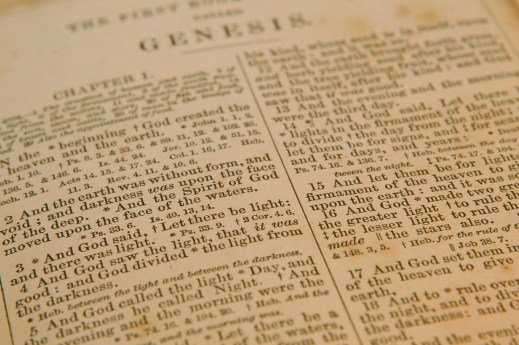
Genesis
Introduction
I use to do construction and I remember my boss telling me that if you get something plumb, straight up and down, then it would go all the way up to the moon forever. But if you get it wrong by just a little bit than you are going to be off by a lot in the end. What you do in the beginning has a big impact on where you end up. It is the same with the Bible. The book of Genesis is very foundational. Without a good grasp of Genesis the rest of our theology will likely crumble to the ground and be worth nothing. So much is built on it. If we are off here, we are going to be way off down the road of the Bible.
There are many “plot conflicts” in the book of Genesis. They will serve as our compass to find our way through the huge book that is Genesis. Leland Ryken has wisely said “Stories are always built around plot conflicts. These conflicts progress toward some type of resolution… Noting plot conflicts is one of the best ways to organize a story, either in the actual process of reading or when talking about the story” (How to Read the Bible as Literature, 41). So, there are three things I want to pay careful attention to and note their expansion in the rest of Scripture and their fulfillment through or in Jesus the Christ.
Here are a few of the themes that are the building blocks of the theology of Genesis (NDBT, 140) and in many ways the whole Bible: (1) The promise of seed, i.e. offspring, (2) the promise of land, and (3) the promise of being a blessing to the nations (see esp. 12:1-3). All of these themes are in embryonic form in Genesis chapter three and expand through the rest of the book. They continue to expand through the Old Testament but don’t find their true fulfillment until the New Testament and the coming of the Promised One. Truly, even then, in the New Testament, there is still an element of the “not yet” until in Revelation all things are made new.
Practice Unproductivity (part 3)

Commanded to Rest
The concept of Sabbath is almost entirely gone.[1] It is one thing to enforce sabbatarian “blue laws” on a whole country,[2] it is another thing to think we are self-sufficient and have no need for any type of Sabbath.
This is not the place to have a big argument on the Sabbath so I don’t intend to do that here. But, I think it should be clear that we must honor the Sabbath in some way. We must at least set aside time to intentionally rest and reflect…
The Bible says we are commanded to rest.[3] It says, “Honor the Sabbath and keep it holy.” The Sabbath was primarily a day of rest. So, we could paraphrase, “Honor the day of rest, set it apart, keep it.” So, “We do not rest because our work is done; we rest because God commanded it and created us to have a need for it.”[4]
Why should I believe the Bible? (pt 9)
Some doubt the authority of the Bible but as we have already seen there are actually a lot of reasons to believe the Bible. The Bible itself also claims to be necessary and…
Authoritative
The Bible claims repeatedly to be more than mere human words. The Bible says it is inspired—breathed out—by God (2 Tim. 3:16-17). The Bible has the authority, not as words from men, but as words from God (1 Thess. 2:13). “When the Bible speaks, God speaks.”[1] Wayne Grudem says, “The authority of Scripture means that all the words of Scripture are God’s words in such a way that to disbelieve or disobey any word of Scripture is to disbelieve or disobey God.”
The Bible is not merely a record of what God has said in the past but a means of God speaking today. That is a good thing. We need to hear what God has to say. We need God’s guidance and we need an authority. God alone is equipped to be that authority.
A Brief Theology of Emotions

We all have emotions. How often do we consider emotions from a biblical perspective though?… Yet, what better place to turn than God’s word! So, what does the Bible say about emotions?
Emotions are part of God’s good design
First, it is important to realize that “Our emotional capacities are part of our nature as personal beings created in the image and likeness of God.”[1] Second, Emotions are part of God’s good design.[2] Third, We often don’t think about it but we are actually commanded to be emotional. For example, Psalm 2:11 says “Serve the LORD with fear, and rejoice with trembling.” And there’s a bunch of other examples (Deut. 28:47-48; Ps. 51:17; 97:10; 100:2; Matt. 6:25-34; Rom. 12:9, 15; Eph. 4:32; Col. 3:15).
So, Jay Adams says:
“The fact is that there are no damaging or destructive emotions per se. Our emotional makeup is totally from God. All emotions of which He made us capable are constructive when used properly (i.e., in accordance with biblical principles)… All emotions, however, can become destructive when we fail to express them in harmony with biblical limitations and structures.”[3]
You may have heard: “Don’t follow your emotions” or “don’t let your feelings get the best of you,” or “use your head.” But emotions are not bad in themselves. God created us with emotions.
Even our negative emotions are not always wrong. It’s not always bad to feel bad. Sometimes feeling sad and angry is good and right. It’s important to realize that in the Psalms the genre of lament is most common.[4] It is also important to remember that there is no book of Joys but there is a book of Lamentations.[5] We don’t always have just “good” feelings and that’s okay. On the other hand, God made us at least in part to experience profound joy and to experience this forever, Psalm 16:11 says. So, our first take away is for us to realize that emotions are not bad in themselves.
But what’s wrong with emotions? Or, why is it that sometimes we can’t or shouldn’t trust our emotions? Because…
Emotions are broken by sin
A lot of us remember the (true) story of Adam and Eve. John Frame has said, “the fall… was rebellion of the whole person—intellect as much as emotions, perception, and will—against God.”[6] After looking at Genesis 3:1-6 (notice the highlighting) we can agree with what Frame says:
Is Homosexuality Part of God’s Good Design?

“Why does a person’s sexual preference matter? If a guy loves another guy why can’t they hook up? Why would God have a problem with that? God created everything, right? So, did He create homosexuality?”
I appreciate those questions. They are important because sex and sexual identity are deeply personal as well as powerful.[1] So, the main question seems to be: Did God create homosexuality, is it part of God’s good design? In order to answer this question, I need to ask you a question. Do you consider yourself a tolerant person?[2] Will you hear me out and listen to my perspective?
If you answered that you are a tolerant person, that’s great. That will be helpful as we look at this controversial subject. So, I ask you to kindly consider my perspective on this question.
I want to be faithful to what I believe the Bible teaches because through it God shows His love and grace. So, as we consider this question, I deeply want the love and compassion of Christ to come through. He loves us all and wants us to have abundant life here and now and forever. Yet, life holds many struggles and temptations.[3]
As we consider this question, we are all caught up in God’s story, a story that can be summed up as creation, fall, redemption and new creation. What does the Bible have to say about this issue? The Bible provides directions to protect us and help us thrive. This is part of God’s good design. The directions include prohibitions against certain types of sexual activity. Those that violate the directions God has given often suffer for it. Individuals that struggle with homosexuality need to realize that natural disposition does not justify it any more than any other sin. And the fact that society elevates sexual fulfillment to the point of communicating that it is the purpose of life does not exempt it from God’s prohibition any more than any other sin. If you are struggling with this issue, then join the rest of us sinners and turn to Christ, who is good. God has given us the means to live within His good design.