In the shelter of the Most High

Sunday morning in church we were looking at Luke chapter one and my attention was drawn to verse 35. The angel said to Mary, “the power of the Most High will overshadow you.”1
This phrase brings us to Psalm 91 verse 1: “Those who live in the shelter of the Most High will find rest in the shadow of the Almighty. “
If we go on and read the entire Psalm. We have some serious food for thought regarding the present situation we are in regarding COVID.
“For he will rescue you from every trap and protect you from deadly disease” (v. 3).
“Do not dread the disease that stalks in darkness” (v. 6).
“No plague will come near your home” (v. 10).
“The Lord says, “I will rescue those who love me” (v. 14).
There are many other promises in this powerful Psalm but the one regarding disease and plague stands out. These promises are contingent on sheltering in the shadow of the Almighty.
So does this mean no true believers in the Almighty will get COVID? We know this is not true. Many believers have contracted COVID and been healed—100% recovery rate. Some recovered on this planet in this time and space and others are now experiencing the ultimate recovery and healing—instant healing—in eternity. In thinking of a friend with COVID, he will be healed; it is a confirmed fact, one way or the other he will be healed. The Almighty has said so—Psalm 91 ends with the final and ultimate shelter: “and give them my salvation”.
So what does it mean to shelter in the shadow of the Almighty? To me sheltering in the shadow of the Almighty means being always conscious of God’s presence and “shadow” around me. He is always there and by faith, I see His shadow. He has said, “I will never live you nor forsake you.”
Isaiah put it this way, “You will keep in perfect peace all who trust in You, all whose thoughts are fixed on You! Trust in the Lord always, for the Lord God in the eternal Rock” (Is. 26:3-4).
To abide in the shadow of the Almighty means to have our heart, minds, and faith fixed, fastened securely to the promises of the Almighty. Not fixed ultimately on medical science, our insurance policy, the government, our diet and health regiment, a vaccine, but fixed on the Almighty.
My prayer for all of us this season will be that we are sheltering under the Almighty—not mainly sheltering in place but under the shadow of the Almighty.
1 Using the New Living Translation for all of this.
What Made Mary Special?

What made Mary special? Was there something in her background that made God choose her? Did she have a high place in society?
Let’s look at some background to try to answer those questions.
Mary was a young girl (maybe as young as thirteen) from an obscure town. Actually, when one of Jesus’ future disciples heard where Jesus was from he said, “Nazareth?! Can anything good come from there?”
The person Mary was engaged to be married to was a not a wealthy man. He was a carpenter. Mary likely had a hard but normal upbringing. Mary’s name in Hebrew (“Miriam”) could be connected to the Hebrew word for “bitter.” It’s not hard to imagine that Mary had already faced much in her life that was bitter and in her lifetime she certainly would.
So, Mary’s background, upbringing, and social status did not make Mary special. What made Mary special? What does the Bible say?
Luke chapter 1 (specifically verses 26-56) is where we see the most about Mary. We can make a few observations from this passage and see why Mary was special.
1) Mary was Favored by God
Mary was favored by God (Lk. 1:28,29,30). What does that mean? The word favored here means that Mary received grace, not that she is a source of grace for others. The favor Mary received was unmerited.
So, was Mary normal? In some ways, yes. You might even say, plain. Mary herself says that she was of “humble estate” (Lk. 1:48; 52).[1] However, as John MacArthur says, “She was the one sovereignly chosen by God—from among all the women who have ever been born—to be the singular instrument through which He would at last bring the Messiah into the world.”[2] So, was she normal? Yes and no.
Quotes from The Christian Faith by Michael Horton
“A mystery is inexhaustible, but a contradiction is nonsense. For example, to say that God is one in essence and three in persons is indeed a mystery, but it is not a contradiction. Believers revel in the paradox of the God who became flesh, but divine and human natures united in one person is not a contradiction. It is not reason that recoils before such miracles as ex nihilo creation, the exodus, or the virginal conception, atoning death, and bodily resurrection of Jesus Christ. Rather, it is the fallen heart of reasoners that refuses to entertain even the possibility of a world in which divine acts occur” (Michael Horton, The Christian Faith, 101).
“Faithful reasoning neither enthrones nor avoids human questioning. Rather, it presupposes a humble submission to the way things actually are, not the way we expect them to be. Faithful reasoning anticipates surprise, because it is genuinely open to reality. If reality is always exactly what we assumed, then the chances are good that we have enclosed ourselves in a safe cocoon of subjective assertions. Unbelief is its own form of fideism, a close-mindedness whose a priori, untested, and unproven commitments have already restricted the horizon of possible interpretations” (Horton, The Christian Faith, 102).
“Ethical imperatives are extrapolated from gospel indicatives. The gospel of free justification liberates us to embrace the very law that once condemned us” (Ibid., 640).
“In the Greek language we must differentiate between the indicative mood, which is declarative (simply describing a certain state of affairs), and the imperative mood, which sets forth commands). For example, in Romans Paul first explains who believers were in Adam and their new status in Christ (justification) and then reasons from this indicative to the imperatives as a logical conclusion: ‘Do not present your members to sin as instruments for unrighteousness, but present yourselves to God as those who have been brought from death to life…’ (Ro 6:13). He concludes with another imperative (command), but this time it is really an indicative: ‘For sin will have no dominion over you, since you are not under law but under grace’ (v.14)” (Ibid., 649).
“Where most people think that the goal of religion is to get people to become something that they are not, the Scriptures call believers to become more and more what they already are in Christ” (Ibid., 652).
“Although we cannot work for our own salvation, we can and must work out that salvation in all areas of our daily practice. When God calls, ‘Adam, where are you?’ the Spirit leads us to answer, ‘In Christ’ (Ibid., 662).
“It is crucial to remind ourselves that in this daily human act of turning, we are always turning not only from sin but toward Christ rather than toward our own experience or piety” (Ibid., 663).
Pervasive Peace through the Second Advent

In Christmas, we celebrate the advent or coming of Christ. The first coming enabled a way for peace to be realized. Humans can, through Christ, have renewed fellowship with God. Yet, as Jesus Himself said, in the world we will have trouble and tribulation.
So, if that’s the case, if in the world we will have difficulty and distress, then how can we have peace? This Sunday I get to preach on the “Pathway to Peace” from Isaiah chapter 11. I’m excited and thankful to be able to do that.
I, however, have too much material. So, I thought I’d share here, part of how that peace is possible.
First, Isaiah paints a beautiful and powerful picture of peace (see Isaiah 11:1-9). A little baby can play with a king cobra without fear (v. 8). How is this possible?
Isaiah 11:9 tells us: the knowledge of God is intimately experienced. And so: nothing will “harm nor destroy on all [the Lord’s] holy mountain.” Instead of harm, “the earth will be filled with the knowledge of the Lord as the waters cover the sea.”
The Messiah will make it so not only the knowledge of the LORD is pervasive but intimacy with the LORD is too. Knowledge in the Old Testament is not merely head knowledge, but it is experiential (When Adam “knew” Eve, Genesis 4:1, it was not mere cognitive knowing, it was experiential).
Also, we should ask, how is it that the waters cover the sea? The waters cover the sea by filling it to the fullness of capacity. God and His goodness will be experienced and known to maximum capacity! We will have the strength together with all the saints to comprehend and know “the breadth and length and height and depth” of the “love of Christ that surpasses knowledge” and we will be “filled with all the fullness of God” (see Ephesians 3:18-19).
Look at what’s going to happen when Jesus reigns on earth!:
“Of the greatness of his government and peace
there will be no end.
He will reign on David’s throne
and over his kingdom,
establishing and upholding it
with justice and righteousness
from that time on and forever” (Isaiah 9:7).
Of peace, there will be no end!
Justice and righteousness forevermore!
Of course, this is not yet a reality. First, Christ came as a Lamb to be slain. Next, He’s coming as the Lion of the tribe of Judah (see Revelation 5:5).
In that day, when perfect peace comes upon the earth, the LORD says, “my chosen ones will long enjoy the work of their hands” (Is. 65:22). The most precious moments that we experience on earth—whether that’s a Thanksgiving dinner, a beautiful sunset, or being lost in a song or prayer of praise—will be multiplied infinitely.
“What no eye has seen, nor ear heard, nor the heart of man imagined, what God has prepared for those who love Him” (1 Corinthians 2:9).
How ironic, how sad, that the Rejected One, is the One who brings renewal of the whole earth.
Fellow Christians, please share the message that is so needed in these days of distress. And pray for your neighbors, that they would have peace that surpasses understanding.
Please pray that the Rejected One, the one alone who brings perfect and pervasive peace, would no longer be rejected.
10 Quotes on Preaching

“Expository preaching is the best method for displaying and conveying your conviction that the whole Bible is true… A careful expository sermon makes it easier for the hearers to recognize that the authority rest not in the speaker’s opinions or reasoning but in God, in his revelation through the text itself… Expository preaching enables God to set the agenda for your Christian community… Expository preaching lets the text set the agenda for the preacher as well… Exposition can prevent us from riding our personal hobbyhorses and pet issues… A steady diet of expository sermons also teaches your audience how to read their own Bibles” (Timothy Keller, Preaching, 32-38).[1]
“Expository sermons help us let God set the agenda for our lives…. Secondly, expository preaching treats the Bible as God treated it, respecting particular contexts, history and style of the human authors” (Peter Adams, Speaking God’s Words: A Practical Theology of Preaching, 128).
Read More…“An expository sermon may be defined as a message whose structure and thought are derived from a biblical text, that covers the scope of the text, and that explains the features and context of the text in order to disclose the enduring principle for faithful thinking, living, and worship intended by the Spirit, who inspired the text” (Bryan Chapell, Christ-Centered Preaching, 31).
10 Quotes from John Piper’s book, Future Grace

“The commandments of God are not negligible because we are under grace. They are double because we are under grace” (John Piper, Future Grace, 168).
“The way to fight sin in our lives is to battle our bent toward unbelief” (Piper, Future Grace, 219).
“The faith that justifies is a faith that also sanctifies… The test of whether our faith is the kind of faith that justifies is whether it is the kind of faith that sanctifies” (Ibid., 332).
“The blood of Christ obtained for us not only the cancellation of sin, but also the conquering of sin. This is the grace we live under—the sin-conquering, not just sin-canceling, grace of God (Ibid., 333).
“The problem with our love for happiness is never that its intensity is too great. The main problem is that it flows in the wrong channels toward the wrong objects, because our nature is corrupt and in desperate need of renovation by the Holy Spirit” (Ibid., 397).
“The role of Gods Word is to feed faith’s appetite for God. And, in doing this, it weans my heart away from the deceptive taste of lust” (Ibid., 335)
“It is this superior satisfaction in future grace that breaks the power of lust. With all eternity hanging in the balance, we fight the fight of faith. Our chief enemy is the lie that says sin will make our future happier. Our chief weapon is the Truth that says God will make our future happier. We must fight it with a massive promise of superior happiness. We must swallow up the little flicker of lust’s pleasure in the conflagration of holy satisfaction” (Ibid., 336).
“There are no closed countries to those who assume that persecution, imprisonment and death are the likely results of spreading the gospel. (Matthew 24:9. RSV)” (Ibid., 345).
“Perseverance in faith is, in one sense, the condition of justification; that is, the promise of acceptance is made only to a persevering sort of faith, and the proper evidence of it being that sort is its actual perseverance” (Piper, Future Grace, 26 quoting Jonathan Edwards).
“Humility follows God like a shadow” (Ibid., 85).
10 Quotes from Jonathan Pennington’s book, Jesus the Great Philosopher

I appreciated Pennington’s book. He did a good job showing that “Christianity is more than a religion. It is a deeply sophisticated philosophy” (Jonathan T. Pennington, Jesus the Great Philosopher: Rediscovering the Wisdom Needed for the Good Life, 159).
Here are 10 quotes that stuck out to me:
“When we try to live without knowledge of physics and metaphysics—how the would is and how works—then we are foolish, not wise, living randomly, haphazardly, without direction or hope for security, happiness, or peace” (Pennington, Jesus the Great Philosopher, p. 23).
“The Bible is addressing precisely the same questions as traditional philosophy” (p. 53).
“The Old and New Testaments teach people to act in certain ways, knowing that cognitive and volitional choices not only reflect our emotions but also affect and educate them” (p. 120-21).
“Without intentional reflection, we will live our lives without direction and purpose. Or worse, we will live with misdirected and distorted goals” (p. 124).
“Relationships aren’t an add-on to life, they make up our life” (p. 134).
“Jesus himself emphasized that his kingdom is not of this world (John 18:36). This does not mean Christians are free to ignore this world, but instead it frees Christians to relate in a gracious and humble way, knowing their citizenship is ultimately something more and greater and different” (p. 166-67).
“The reason Jesus was so infuriating to both religious and government leaders was not because he was taking up arms and trying to overthrow governments but because his radical teachings were so subversive to society. Jesus was subversive because he sought to reform all sorts of relationships. In his teachings and actions, Jesus continually subverted fundamental values of both Jewish and Greco-Roman society” (p. 172).
“Christianity is a deeply intentional and practical philosophy of relationships” (p. 173).
“Unlike sitcom relationships, the reality is that our lives are broken through sin—the brokenness not only of sin that has corrupted creation itself but also of personal acts of evil, foolishness, and harm. Thus, the Christian philosophy’s vision for relationships within God’s kingdom is not naive or idealistic” (p. 181).
Should Wives Work Outside the Home?

Titus 2:4-5 and 1 Timothy 5:14 talk about young wives working at home, is this the ideal role God ordained for women? Should women not work outside the home?
To answer those questions, it will be helpful to look at five considerations.
Principles from the Bible
First, it is important to glean principles from the Bible to answer this question. The first principle or truth that I think is relevant is that God made humans gendered. The Bible clearly teaches that males and females are both made in the image of God (Gen. 1:26-27) and yet males and females differ from one another in some respects to various degrees. Scripture also teaches that within the family and within the church God has given complementary roles and gifts. For example, see the table from God, Marriage, and Family by Andreas Kostenberger:
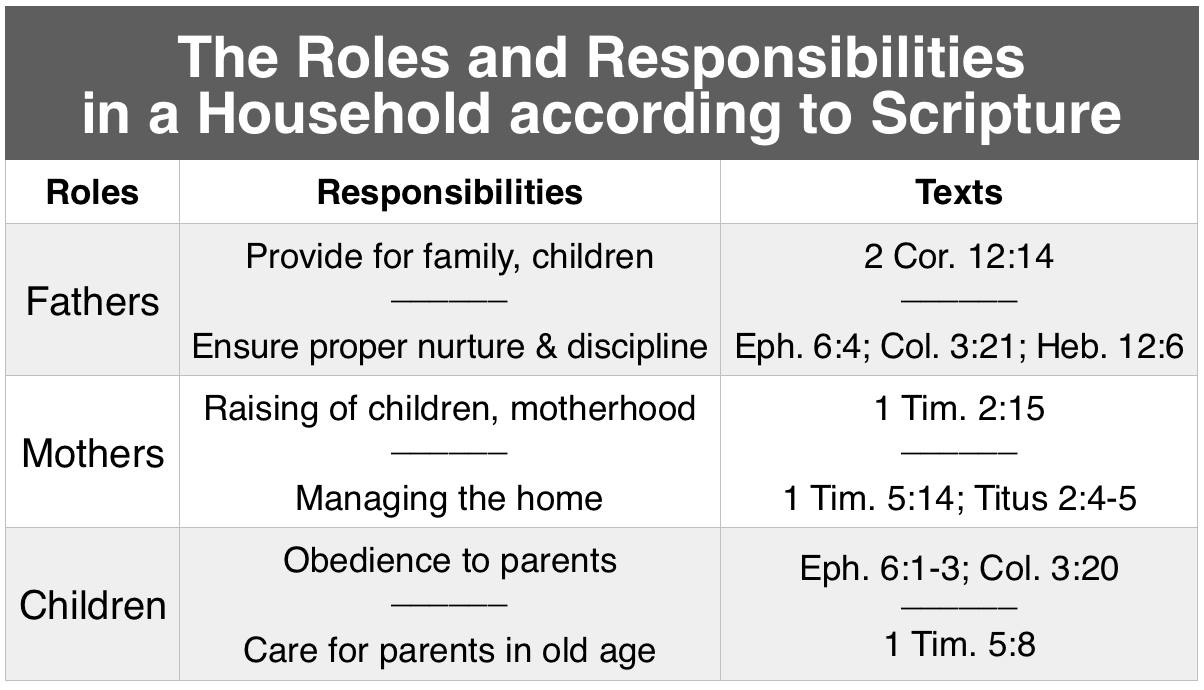
The way that Andreas Kostenberger says it, is that “Women are to place special priority on their God-given calling as mothers and homemakers.”[1] That, I agree, seems to be a biblical principle. Women are especially equipped for that task (even physiologically).
Priorities from the Bible
Next, it is important to consider priorities from a biblical perspective. We want our priorities to lineup with the priorities of Scripture. If they don’t we will have a problem with Scripture wherever it is at odds with our priorities. Our priorities, however, should be aligned with Scripture; we should not seek to align Scripture with our priorities.
Interestingly, “A 1982 Gallup poll showed that more than eight out of ten respondents (82 percent) assigned top priority… to the importance of family life. Families… rated as more important than the possession of material goods.”[2] Scripture agrees with what was the majority assessment in 1982 (see e.g. Deut. 11:19, 21; Ps. 127:3-5).
What, however, do we value?[3] Fortune or family?
Tacitcus, the Roman historian and politician writing around the same time as the Apostle Paul in A Dialogue on Oratory said,
“Our children are handed over at birth to some silly Greek servant maid… The parents themselves make no effort to train their little ones in goodness and self-control; they grow up in an atmosphere of laxity… they come to lose all sense of shame, and all respect for themselves and for other people.”
Tacitcus had a problem with that approach. And I think Christians should too.
We, however, haven’t answered our above question yet, but we’re getting there. But, it’s vital that we consider our motivation and priorities as we ask the question.



 in X
in X 