Is the world broken?

Have you ever thought about the problem of evil and suffering? Have you ever asked, “Why is the world so cruel?”
My daughter came to me crying. “Why do Mom and Lyla have to be sick? If God exists and is good, why is there suffering?”
As I thought about how to answer, tears came to my eyes and an image came to my mind, a shattered platter. By looking at the shattered shards you could tell the platter used to be ornate and beautiful. Upon reflection, that seems like an accurate picture of the world. It certainly seems broken, but yet it has clear traces of beauty.
What happened? How did the platter get that way? If the platter is broken, it seems to make sense that it was previously whole. Otherwise, it would not be broken; it would just be. The shattering, the brokenness, is just the way the world is. There, then, was no previous better state, nor should we expect a future better state.
So either the brokenness of the world assumes a previous state of the world that was whole and good, or there is no wholeness, only shattered shards that were never part of a whole and never will be. Everything is either light with little pockets of darkness, or everything is darkness with little pockets of light.1
Are beauty, goodness, and love innate, or are they random meaningless sparks in a universe that is growing cold? A world without God may have a few pockets of light, but chaos should be expected.2 If God exists, however, and Christianity is true, then chaos is not the final state of the world.
We intuitively sense that the world is broken. We feel it in our bones metaphorically, and some of us feel it literally. How could the world be broken if it was not at some point whole? It seems, therefore, we can make a deduction from the broken state of the world to the original good design. Or else our hope and intuitive sense that something is wrong is wrong.
Whole
The Bible says God created the world whole. The original creation was very good (Genesis 1:31). The platter was ornate and beautiful, so to speak. No disease or need for dentures. No sin or suffering. No turmoil or tears. No fighting or fears. No death and no destruction.
Christians believe “the bedrock reality of our universe is peace, harmony, and love, not war, discord, and violence. When we seek peace, we are not whistling in the wind but calling our universe back to its most fundamental fabric.”3 Christians believe in evil, and they believe it’s a problem. The world was not supposed to be a place of suffering. Evil and suffering are not a hoax, but they don’t have a place in God’s good intentions. The world is broken.
Broken
The platter shattered. The world broke. Sin unleashed suffering, disease, destruction, and death. The brokenness of the world and the messed up nature of humans are teachings of Christianity that can be confirmed by turning on the news.
Christianity explains the origin of the problem of evil and suffering and makes it clear that it is a problem. That is, Christianity says suffering is not innate in the way the world was supposed to be. And Christianity traces the problem of suffering to a historical cause.
Christianity not only says there’s something wrong with the world, it says there is something wrong with humans, with you, and with me.4 It’s not easy to admit our faults, but to deny there is anything wrong with humanity is to say that this is as good as it gets.5 That, also, is not a happy conclusion. Better to face reality head-on than to stumble in a land of make-believe.
Naturalism, in contrast, does not seem to give a sufficient answer, other than suffering is just the way of the world. We’re essentially animals, so we’re going to be animalistic, and so suffering will result. We’re in a world of chaos and chance, so the world will be chaotic. There is no real problem of suffering, there’s an expectation of suffering. Or, there should be. And for naturalists, there is no category for evil.6 Evil gives off no kinetic energy. There is no entity to evil. Various people may have opinions, likes, and dislikes, but from a strictly naturalistic perspective, there is no evil.
Another problem is that “modernity cannot understand suffering very deeply because it does not believe in suffering’s ultimate source.”7 Modernity will then never find the true answer to suffering. If I fix a leaky sink in my house because I notice a puddle and mold, that may be helpful, but it will not fix the problem if the problem is a leak in the roof. If we don’t know the origin of a problem, there is no hope of fixing the problem. We will be left with external shallow bandages. As I say elsewhere, naturalism cannot truly identify evil as a problem because evil, for naturalism, does not exist. If evil is not seen as a real problem then it certainly can’t be solved.
As Peter Kreeft has said, “If there is no God, no infinite goodness, where did we get the idea of evil? Where did we get the standard of goodness by which we judge evil as evil?”8 Or here’s how C.S. Lewis said it: “My argument against God was that the universe seemed so cruel and unjust. But how had I got this idea of just and unjust? A man does not call a line crooked unless he has some idea of a straight line. What was I comparing the universe to when I called it unjust.”9
The Bible says sin and suffering are not original to the world; sin and suffering have a beginning in history, and they are not a feature of humanity or the world as originally created.10 That is good news. We do not have to be left in our broken state. We sense that not all is right in the world or in our own hearts and lives. The Bible agrees. Yet, that is not all; it says there is a solution.
The Broken Healer
While writing this, my daughter came into the room and said her bones hurt. That is part of her condition. She has CRMO, which stands for chronic recurrent multifocal osteomyelitis. Basically, her body attacks her own bones, inflammation causes liaisons and fractures her bones, which can lead to deformity. It could stop harming her body when she stops growing, or it could continue her whole life. She currently gets infusions at Nationwide Children’s Hospital in hopes of putting it in remission.
How does Jesus relate to her pain? As Jesus’ biographies relate, “Jesus on the night that He was betrayed took the bread and broke it and said, ‘This is my body which is broken for you’” (1 Corinthians 11:23-24). Jesus was broken for her. Jesus’ bones did not break (John 19:36; Exodus 12:46; Psalm 34:20), but His body did. He did writhe in pain. Jesus may not heal all our brokenness now, but He was broken so that the fractured world could be healed.
The Bible says God took on human flesh (John 1:1-3, 14) partly to experience suffering Himself. God, therefore, understands suffering, “not merely in the way that God knows everything, but by experience.”11 Jesus became fully human in every way so that He could be faithful and merciful, and provide rescue and forgiveness to people (Hebrews 2:17). The Bible may not completely answer the mystery of suffering and evil, but it does give an answer: Jesus. Amid the struggles and psychological storms of life, the cross of Christ is a column of strength and stability. It signals out to us in our fog: “I love you!” The cross is the lighthouse to our storm-tossed souls.
Christianity teaches that the Potter made the platter and was heartbroken over it breaking. So, because of His love for the platter, the Potter allowed Himself to be broken to fix the broken platter (John 3:16). The Bible does stop with the Potter being broken. The Bible concludes with resurrection. Jesus dies, yes. But He does not stay dead. The shattered shards are mended and whole. Jesus is the foretaste, and His rising proves that the whole world will be put back together.
Healed and Whole
The mathematician, scientist, and philosopher Blaise Pascal wrote this thought, which, at first, is a little confusing: “Who would think himself unhappy if he had only one mouth, and who would not if he had only one eye? It has probably never occurred to anyone to be distressed at not having three eyes, but those who have none are inconsolable.”
What does Pascal mean by this? He means that we only miss something if it’s missing. We only miss something if it’s gone. We don’t notice an absence of things that were never there. Hunger points to food, thirst points to water, and a sense of brokenness points to a previous wholeness. As Peter Kraft has said, “We suffer and find this outrageous, we die and find this natural fact unnatural.” Why do we feel this way? “Because we dimly remember Eden.”12
Within our very complaint against God, there is a pointer to God and the reality of Christianity. Christianity gives a plausible explanation as to how the brokenness of the world happened in space and time history. But it also gives us a credible solution; the Potter who made the world and died for the world, promises to one day fix the world.
Christianity gives a logically consistent explanation for the brokenness of the world. And it supplies the solution. We certainly long to be healed and whole. Every dystopia, true and fictional, starts with a desire for utopia. But inevitably dissolves into dystopia. Jesus, however, is not only all-powerful and thus able to bring about a different state of things, He is also all-good so He actually can bring about a utopia. He can heal and make the world whole.
The Bible says that the Potter who formed the platter will reform and remake it in the end. The shattered shards will be put back in place, and everything will be mended and whole. The last book of the Bible says this:
‘Look! God’s home is now among people! God will live together with them. They will be his people. God himself will be with them and he will be their God. God will take away all the tears from their eyes. Nobody will ever die again. Nobody will be sad again. Nobody will ever cry. Nobody will have pain again. Everything that made people sad has now gone. That old world has completely gone away.’ God, who was sitting on the throne, said, ‘I am making everything new!’ (Revelation 21:3-5)
For now, we make mosaics out of the shattered shards of life. We paint as best we can with the canvas and colors we have.
Conclusion
We started with a few questions. Here are a few to consider at the end. What if you are not the only one that has walked your path of pain? What if you are not the only one that has faced your terrible trauma? What if there was someone who, because of their experience, knowledge, wisdom, empathy, sympathy, and their own suffering of trauma, could relate to all that you have gone through? What if that person loved you? What if they wanted to help you heal from your pain and protect you? What if they would go to any length to free you from what you have suffered?
What if the problem of evil gives a plausible argument for the reality of Christianity? What if naturalism does not even have a way to believe in the reality of evil? What if we do not like God because of all the bad things in the world, but God Himself actually took the bad things of the world on Himself to fix the broken world?
What if Jesus was shattered so that one day you could be mended and whole? And what if He promises to help pick up the pieces and make a masterful mosaic?
Photo by Evie S.
- Peter Kreeft, Making Sense Out of Suffering. ↩︎
- As Christopher Watkin has said, “in a world without the sort of god the Bible presents, there is no necessary stability to reality because nothing underwrites or guarantees the way things are” (Biblical Critical Theory: How the Bible’s Unfolding Story Makes Sense of Modern Life and Culture, 225). ↩︎
- Watkin, Biblical Critical Theory: How the Bible’s Unfolding Story Makes Sense of Modern Life and Culture, 55. ↩︎
- As N. T. Wright has said, “The ‘problem of evil’ is not simply or purely a ‘cosmic’ thing; it is also a problem about me” (N. T. Wright, Evil and the Justice of God, 97). ↩︎
- Watkin, Biblical Critical Theory, 166. ↩︎
- Consider that “Physics can explain how things behave, but it cannot explain how they ought to behave. If the universe is the result of randomness and chance, there’s no reason to think things ought to be one way as opposed to another. Things just are.” (Michael J. Kruger, Surviving Religion 101: Letters to a Christian Student on Keeping the Faith in College, 116-17). ↩︎
- Peter Kreeft, Making Sense out of Suffering. ↩︎
- Ibid. ↩︎
- C. S. Lewis, Mere Christianity (London: Fontana, 1959), 42. ↩︎
- See Watkin, Biblical Critical Theory, 168. ↩︎
- D.A. Carson, How Long, O Lord?: Reflections on Suffering & Evil, 179. ↩︎
- Kreeft, Making Sense out of Suffering. ↩︎
Can someone who committed suicide still go to heaven?

Can someone who committed suicide still go to heaven? Is suicide unforgivable? How could someone trust Jesus for the next life and not trust Jesus to get them through this life?
My Friend’s Story
I’ve done a few funerals for friends who committed suicide. It doesn’t get easier; they were people I loved and tried to help. I was devasted when they died.
I could share many good stories about them. But I’ll focus on “Steve.” Steve had grit and determination. He had stubborn persistence and a strong work ethic. His work ethic was seen, for example, when he worked through a sandstorm on a mission trip. I remember many talks with Steve about the Lord. Steve professed faith in Jesus and shared the good news of Jesus with others even when he had a lot he was going through. He had a kind smile and a compassionate heart.
Steve, however, was also struggling. He was fighting to hold on to hope and to hold on to life. I visited him in a hospital after a suicide attempt a few weeks before his passing. I came into his room, and he was sleeping. A nurse was in the room with him, and I asked her if I could wake him. She said it was fine. So, I woke him up. I remember his sleepy smile… We talked for a little bit, and I asked him what he thought about God and what he thought God thought about him. He said, rather weakly, “I still think He loves me.”
Steve said with every suicide attempt, he’d pray: “God, if this isn’t Your will, protect me.” I told Steve that he did not have to ask God’s will in this regard. God had made it clear it is not His will that he take his own life. The Bible says, “Thou shall not murder.” The Bible also tells you that you are a precious treasure made in His image (Gen. 1:27). And God has demonstrated His love for you. He didn’t just say it, He showed it.
John 3:16 says, “For God so loved the world that He did something about it, He gave His only Son so that whoever believes in Him will not perish but have eternal and abundant life.” The Bible says all that and the Bible says, that in Christ Jesus, you are God’s workmanship, God’s work of art, that He prepared beforehand for good works (Eph. 2:10). I encouraged him that God has good works for him to do. “God has a purpose for your life… God can use your struggles to help others…”
We also read Isaiah 61:1-3 together:
“The Spirit of the Lord GOD is upon me,
because the LORD has anointed me
to bring good news to the poor;
he has sent me to bind up the brokenhearted,
to proclaim liberty to the captives,
and the opening of the prison to those who are bound;
to proclaim the year of the LORD’s favor,
and the day of vengeance of our God;
to comfort all who mourn;
to grant to those who mourn in Zion—
to give them a beautiful headdress instead of ashes,
the oil of gladness instead of mourning,
the garment of praise instead of a faint spirit;
that they may be called oaks of righteousness,
the planting of the LORD, that he may be glorified.”
Steve was in a dark place. There was a deepening darkness over him. Even while many people were striving to help him, regular people in his community and professionals. Yet, he was still in turmoil.
Steve should not have taken his own life. But I’m thankful that our sins and struggles do not nullify Jesus’ saving work. The mortal sin, the one unforgivable sin, is the sin of not trusting Jesus for salvation. Yes, suicide is a sin but so is selfishness. If I selfishly speed on the highway and get struck by a semi-truck, my sin at the time of death does not in any way negate the salvation of Jesus. I praise the Lord that even when we are faithless, He remains faithful, for He cannot deny Himself, He cannot deny His own character (2 Tim. 2:13).
Our World is Broken but Jesus was Broken for the Broken World
I want to say a few things about death, suffering, and the difficult complexities we face. Ecclesiastes, an Old Testament book in the Bible, says, “It is better to go to a funeral than a feast. For death is the destiny of every person, and the living should take this to heart” (7:2). That is a strange thing to say. But it is true. Because it is at a funeral that we consider things that we would not consider at a feast.
So, why death? Why suffering? For us to consider those questions, we need to go all the way back to the very beginning…
We all experience loss and grief. But it wasn’t meant to be this way. We sense that don’t we? We know death does not feel right. It feels foreign and wrong. Because it is. The Bible explains the origin of death and confirms it wasn’t meant to be this way. When God made the world, He made everything and it was good, even “very good” (Gen. 1:31). Why then is the world no longer completely good? Why is their death, suffering, mental illness?
The first humans, our ancestors Adam and Eve, dwelt in perfect fellowship with God in the Garden of Eden but after they sinned, they were separated from God (Gen. 3). In that same chapter, there was relational conflict as Adam and Eve blamed each other and the curse of suffering and pain was introduced. And so, Romans 8 says that the whole creation is groaning. This world was once a paradise, but it is a paradise that got polluted and poisoned by sin and so in life, we experience both great joys and great sorrows. We live in a broken world. A broken world in which sadly the second leading cause of death for persons aged 25-34 is suicide. Death is an unnatural thing that even in the best of circumstances causes great grief. It causes grief and is unnatural because it was not part of God’s original good design.
So then, is there any hope or help? Praise the LORD there is! Even in Genesis 3:15, it’s foreshadowed. Jesus! Jesus will crush Satan, sin, and death. Christianity acknowledges the emptiness and brokenness of the world and offers hope, newness, and abundant life. Jesus shared in humanity’s pain and suffering and He provides the redemption and restoration we need.
Why could someone who trusted Jesus for the next life not trust Him to get him through this life?
Why could someone who trusted Jesus for the next life not trust Him to get him through this life? Because this world is broken, and we are broken. Thankfully, however, sinlessness does not save us. Jesus saves us.
The Bible speaks to the difficult subject of suicide and many other difficult topics. We have examples in Scripture and history where saints have sometimes struggled with depression and wanted to die. Jonah, Elijah, and Moses each asked God to kill them (Num. 11:12-15; 1 Kings 19:4; Jonah 4:1-11) and Jesus Himself was tempted by Satan to take His own life (Matt. 4:4:5-6; Lk. 4:9-11). We know that Jesus can sympathize with our weaknesses because, as Hebrews 4:15 says, He was tempted in every way that we are, yet He never sinned.
God has a heart of a loving father for us. He knows life is hard. He knows sin has deeply ruined the world and wrecked our bodies in many ways. God gets we’re broken, and He longs to fix us, that’s why He sent Jesus. Jesus came for the suicidal.
In the song, “It Is Well With My Soul,” we’re reminded that through Jesus’ sacrifice on the cross, all those who trust in Him have their sin—all their sin—paid for. The song says, “My sin, not in part, but the whole, was nailed to the cross and I bear it no more.”
Jesus saves. So, can someone who committed suicide still go to heaven? It depends. Did they trust Jesus for salvation? That’s the question.
Photo by Emma Steinhobel
What is the difference between self-confidence and pride?

Theologically what is the difference between self-confidence and pride?
Self-confidence
God does gift individuals. And it is good to acknowledge that truth. The manager in Jesus’ parable that invested his talents and earned a good return for the owner had to have a type of confidence (Matt. 25:14-30).
Further, God created us as a “work of art” to carry out the good deeds and mission He wants us to accomplish (Eph. 2:10). So, in a sense, we can have confidence in the self that God intended us to be. Therefore, self-confidence is not in itself bad.
Of course, these truths need to be balanced by the humbling reality that we are sinners and that every good thing we have is a gift. What do we have that we did not receive (1 Cor. 4:7)? And we should always recall that every good gift and every perfect gift comes from God (James 1:17). It’s not innately ours.
Self-confidence can mean prideful evaluation of one’s ability. It does not, I don’t think, have to be understood that way though. It could mean something like: confidence in who God made you to be and in your God-given abilities. If understood that way, perhaps “God-confidence” or “God-acknowledgment” would be better.
Either way, it does not seem to me that self-confidence is inherently bad. I also think considering the opposite term can be helpful to consider: “self-skepticism” or “self-suspicion.” The Bible does say that our hearts are desperately wicked (Jer. 17:9). So, does “self-skepticism” better describe what the view of ourselves should be?
I don’t think so. I don’t think self-confidence or self-skepticism gives us the whole picture. And if left with just one of them or even a balance of both of them together, we still miss something huge! We miss our self in relation to God.
If we consider ourselves without relation to or thought of God, we’re going to get it wrong. We’ll error on either over-confidence or over-suspicion about our self. Yet, when we consider ourselves with reference to what God can and does do, we can be confident in who He has made us to be. While at the same time not obsessing about our self, because we’re focused on Him. We can have a healthy suspicion of our self but that’s not crushing. Because we know that God can and does overcome our sin.
Pride
“Pride,” at least how I think about it, has to do with what one has done. In my mind, it means someone is proud of what they themselves have accomplished. Pride is less an evaluation of one’s ability and more so a belief that’s one’s ability is simply a result of one’s own efforts. There’s no grace in pride, given or received; all is earned.
So, with pride, there is a fundamental misunderstanding of who humans are and who God is. God is the giver we, as humans, are receivers. God is, and we are contingent. Pride is a foolish misunderstanding of ontology. God is independent, humans are dependent.
Notice, King Nebuchadnezzar was humbled after he praised himself and all he thought he himself had accomplished. Nebuchadnezzar found out that God humbles those who walk in pride (Dan. 4:37). When pride comes, then comes disgrace (Prov. 11:2).
We should, however, understand that there is a difference between “pride” and “pleasure.” King Nebuchadnezzar didn’t just take pleasure in his kingdom and in all that God had entrusted to him, he took pride in it. That is, he acted as if he was responsible for it all himself. He exalted himself and failed to exalt God.
I believe it is good to take pleasure in the abilities God has given us—whether preaching, building cabinets, or whatever. In a movie about Eric Liddel, a Christian Olympic runner, he says, “God made me fast. And when I run, I feel His pleasure.” There’s nothing wrong with taking pleasure in what God has given us to do. But, notice an important point: Liddel said, “God made me fast.” Liddel acknowledged God even in his abilities.
But wait, didn’t Liddel run? Didn’t Liddel sweat? Didn’t Liddel sacrifice? He showed amazing discipline to be an Olympic runner, right? Yes. And every good gift is from God. Including Liddel’s ability to do each of those things and also his ability to breathe and his very existence was from God.
So, I believe one could evaluate themself as very good at what they do and that it required a lot of work on their part to become effective, without being prideful. How so? They acknowledge that it is all a gift. Discipline—a gift. Breathing—a gift. Etc.—a gift.
Conclusion
Perhaps the fundamental difference between “pride” and “self-confidence” as we are considering the terms is this: One is an exaltation of self without reference to God, the other can be confidence in God with reference to who He has made you to be.
The apostle Paul had a sort of confidence—we see it demonstrated through his letters and missionary work—but he also said it was not him but Christ in him (Gal. 2:20). Paul, after He met and was radically transformed by Christ, was not so much confident in himself as what God was able to do through him, though he was a mere disposable jar of clay (2 Cor. 4:7).
So, I believe it is right and good to have a kind of self-confidence in who God has made us to be even while we work at killing pride.
*Photo by Nicolas I.
Deconstruction

Deconstruction is in vogue
I recently looked at #exchristian posts on Instagram. There are a lot of them. It’s pretty popular to recount what is wrong with the Church. Why? And how far should it go?
What’s deconstruction?
Deconstruction is more than just saying what’s wrong with church. A lot of times it’s saying what’s wrong with the Christian faith. It’s saying Christianity is essentially stupid. That’s often what deconstructionists say. But, they don’t so often set out to prove their claims.
Memes in no way prove that a worldview has no meaning or validity. And proving that there are problems with a church, the Church, or particular people in the Church is not the same as proving that Christianity gives an inaccurate picture of the world.
Deconstruction has happened before
Deconstruction is not new. The hashtags are new but deconstruction has actually been happening since the beginning of Christianity.
For example, the apostle Paul and other early Christians argued for the truthfulness of Christianity while others sought to disprove it (see Luke 1:3; Acts 1:3; 9:22; 17:3; 18:4-5, 28; 19:8; 24:25; 26:22-26; 28:23).
People have sought to deconstruct all sorts of aspects of Christianity. Early Christians were accused of cannibalism because of confusion over the Lord’s Supper. They were accused of atheism because they didn’t believe in the pantheon of Greek gods. And they were accused of political disloyalty because they wouldn’t give ultimate allegiance to the empire or offer sacrifices to the emperor.
There are things that should deconstruct
Many memes convey important messages, important critiques that should be taken to heart. There are many sad and despicable things that happen in the church. My family and I have experienced some of those things.
Spiritual abuse, sexual abuse, making idols of pastors, legalism, pridefulness, inhospitality, just to mention a few, are unacceptable and should be condemned as such. Many movements have important things that should be gleaned from them. There are things that can be learned from #exchristians. There are also things that should be confessed and cried over.
Jesus Himself “deconstructed” things
Jesus criticized the religious leaders. He was a rebel with a cause. He reached out and welcomed the Samaritan woman even when that was socially unacceptable (Jn 4). Jesus tipped tables in the Temple. He composed a letter through the hands of John partially to critique and challenge the Church (Rev. 2-3).
Jesus wasn’t silent. He brought up stuff but also proposed solutions. The apostle Paul modeled the same approach.
I believe church leaders should take the same approach. They should take the opportunity to listen, learn, and lovingly address problems.
How does one know what should be deconstructed?
Friedrich Nietzsche, the famous and influential German philosopher, came from a very devout family. Yet, he ended up a very articulate deconstructionist. He very poetically and memorably said: God is dead and we killed him.[1]
Nietzsche didn’t stop there, though. He spelled out what that means for our lives. He reasoned, and I think rightly, that if God is dead, then there is no actual meaning or morality. It is might that makes right. The strong slay and the strong say what is right and what is wrong.
Nietzsche lit a fuse and dynamited God and with Him all basis for morality and actual meaning.[2] So, how much should be deconstructed and destroyed? How do we know? On what basis can we judge what is right and wrong?
If we’re going to prune for the sake of health and good fruit, how much do we cut back? If we cut back too far do we not lose all hope of fruit and flourishing?
There is a point to pruning but if we prune back the very existence of purpose that seems like a cut too far. It seems to me that’s not going to serve the purpose of the pruning.
If one of the problems we’re critiquing is people’s failure to love it seems foolish and unproductive to cut off the possibility of the existence of actual love. And yet, that seems to be what many are doing. Richard Dawkins, the famous atheist said in his book, The God Delusion, that morality and love are simply a “blessed precious mistake;” a happenstance of evolution.[3]
Yet, as G.K. Chesterton said, if we rebel against everything we lose the grounds and ability to rebel against anything. So, is there a basis for actual truth? If so, what? And how does one know? If not, how does one know what should be deconstructed?
What are the reasons for deconstruction?
“Christian” Hypocrisy
Christians and so-called “Christians” often fail to live the Christian ethic. They fail to live a life of love. Often they even carry out evil actions. Sexual abuse seems to have even become prevalent. And so people reason, not so unreasonably, that Christianity is pointless if not also a plague on society.
Problems with people acting immorally, of course, don’t actually prove that Christianity is a shallow or wrong worldview though. This is especially the case if people are using Christian criteria to critique Christianity. Yuval Noah Harari has said,
“Americans got the idea of equality from Christianity, which argues that every person has a divinely created soul, and that all souls are equal before God. However, if we do not believe in the Christian myths about God, creation and souls, what does it mean that all people are “equal”?[4]
It doesn’t make sense to say Christianity is wrong and yet also use Christian morality as a measurement of what is morally wrong. If someone is to critique Christianity they must have an epistemological basis to do so. That is, they must have knowledge of what is right and wrong.
Is that knowledge just innate? If so, why? And how does it work?
Empty Dogmatism
Some people grew up attending a church that only offered empty platitudes and forced dogmatism. Their genuine questions were not able to be asked and certainly weren’t honestly answered. And so, when they confronted challenges or hostility with their beliefs they give it up. They don’t feel they have solid grounds for continuing to be committed to it.
Morality
Some “former Christians” deconstruct Christianity not because of reasoned augmentation but because of Christian morality. Some people don’t like what Christianity says about sexuality or other moral issues.[5] So, they criticize Christianity on moral grounds although they may have no warranted ground for their sense of morality.
Notes
[1] See his work Thus Spoke Zarathustra.
[2] Nietzsche grounded meaning in a doctrine he called “eternal recurrence.” He essentially proposed living in such a way that if your life was to eternally reoccur that you would be living in such a way that it would be less terrible. Nietzsche grounded purpose in this fictitious notion. Fictitious because Nietzsche did not actually believe in God or in the reoccurrence of our lives.
[3] Dawkins says, “Could it be that our Good Samaritan urges are misfirings”? By Dawkins account we have “programmed into our brains altruistic urges, alongside sexual urges, hunger urges, xenophobic urges and so on…. We can no more help ourselves feeling pity when we see a weeping unfortunate (who is unrelated and unable to reciprocate) than we can help ourselves feeling lust for a member of the opposite sex (who may be infertile or otherwise unable to reproduce). Both are misfirings, Darwinian mistakes: blessed, precious mistakes”). (Richard Dawkins, The God Delusion, 252-53).
But, if we are brutes, why shouldn’t we be brutal? Nietzsche, for instance, promotes the strong acting like “large birds of prey” and freely abusing the weak “lambs” because after all that’s what comes naturally and there is no God to impose morals. He said, “I expressly want to place on record that at the time when mankind felt no shame towards its cruelty, life on earth was more cheerful than it is today,… The heavens darkened over man in direct proportion to the increase in his feeling shame at being man” (See par. 7 of the Second Essay in On the Genealogy of Morality).
Jean-Paul Sartre said, “The existentialists… thinks it very distressing that God does not exist, because all possibility of finding values in a heaven of ideas disappears along with Him; there can no longer be an a priori Good, since there is not infinite and perfect consciousness to think it. Nowhere is it written that the Good exists, what we must be honest, that we must not lie; because the fact is we are on a plane where there are only men” (Jean-Paul Sartre, Existentialism and Human Emotions, 22).
If we don’t acknowledge God then the moral laws that flow from His character are gone as well, and we are left with blind skepticism and relativism; every person doing whatever is right in their own eyes. As we consider this we should never forget that, as Martin Luther King Jr. exhorted, “everything Adolf Hitler did in Germany was ‘legal.’”
[4] Harari, Sapiens: A Brief History of Humankind (New York: Harper, 2015), 109.
[5] As Romans 1 says, “people suppress the truth in unrighteousness.”
Photo by Aaron Burden
Will sin be possible in heaven?

To answer the question will sin be possible in heaven, there are a number of passages we should look at.
“…the assembly of the firstborn who are enrolled in heaven, and to God, the judge of all, and to the spirits of the righteous made perfect“ (Hebrews 12:23).
“…those whom He foreknew He also predestined to be conformed to the image of His Son…” (Romans 8:29).
“No longer will there be anything accursed, but the throne of God and of the Lamb will be in it, and his servants will worship Him” (Revelation 22:3).
“…nothing unclean will ever enter it, nor anyone who does what is detestable or false, but only those who are written in the Lamb’s book of life” (Revelation 21:27).
“The one who conquers, I will make him a pillar in the temple of my God. Never shall he go out of it, and I will write on him the name of my God…” (Revelation 3:12).
“I will plant them on their land, and they shall never again be uprooted out of the land that I have given them…” (Amos 9:15).
Christians will be made “made perfect” (Heb. 12:23). They will be “conformed into the image” of Jesus (Rom. 8:29). It may be that Christians can sin, but won’t sin because they will not want to sin.
When Christians see Jesus, they shall be like Him (1 John 3:2). That is the sense in which Christians will be unable to sin (non posse peccare, as Augustine said). Christians will be like Christ!
So, no. Ultimately, Christians will not be able to sin in heaven. But it won’t be from an external constraint but from internal renewal.
Christians will finally completely have their affections rightly aligned with reality. Christians will love the LORD their God with all their heart, soul, mind, and strength.
Should Wives Work Outside the Home?

Titus 2:4-5 and 1 Timothy 5:14 talk about young wives working at home, is this the ideal role God ordained for women? Should women not work outside the home?
To answer those questions, it will be helpful to look at five considerations.
Principles from the Bible
First, it is important to glean principles from the Bible to answer this question. The first principle or truth that I think is relevant is that God made humans gendered. The Bible clearly teaches that males and females are both made in the image of God (Gen. 1:26-27) and yet males and females differ from one another in some respects to various degrees. Scripture also teaches that within the family and within the church God has given complementary roles and gifts. For example, see the table from God, Marriage, and Family by Andreas Kostenberger:
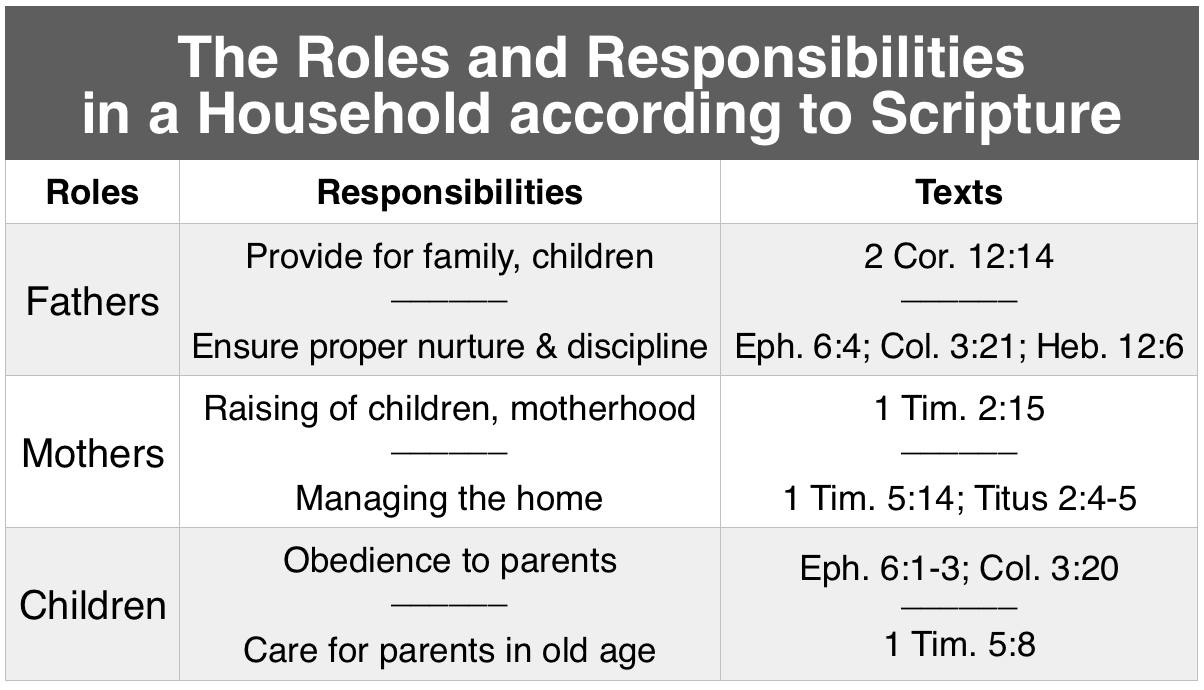
The way that Andreas Kostenberger says it, is that “Women are to place special priority on their God-given calling as mothers and homemakers.”[1] That, I agree, seems to be a biblical principle. Women are especially equipped for that task (even physiologically).
Priorities from the Bible
Next, it is important to consider priorities from a biblical perspective. We want our priorities to lineup with the priorities of Scripture. If they don’t we will have a problem with Scripture wherever it is at odds with our priorities. Our priorities, however, should be aligned with Scripture; we should not seek to align Scripture with our priorities.
Interestingly, “A 1982 Gallup poll showed that more than eight out of ten respondents (82 percent) assigned top priority… to the importance of family life. Families… rated as more important than the possession of material goods.”[2] Scripture agrees with what was the majority assessment in 1982 (see e.g. Deut. 11:19, 21; Ps. 127:3-5).
What, however, do we value?[3] Fortune or family?
Tacitcus, the Roman historian and politician writing around the same time as the Apostle Paul in A Dialogue on Oratory said,
“Our children are handed over at birth to some silly Greek servant maid… The parents themselves make no effort to train their little ones in goodness and self-control; they grow up in an atmosphere of laxity… they come to lose all sense of shame, and all respect for themselves and for other people.”
Tacitcus had a problem with that approach. And I think Christians should too.
We, however, haven’t answered our above question yet, but we’re getting there. But, it’s vital that we consider our motivation and priorities as we ask the question.
Why do Black Lives & LGBTQ+ Lives Matter?

Why do black lives and LGBTQ+ lives matter? This is an important question because some people have views that don’t support the idea of lives mattering. For example, Charles Darwin, the most famous proponent of evolution titled his book, On the Origin of Species by Means of Natural Selection, or the Preservation of Favored Races in the Struggle of Life. And in his book, The Decent of Man, he says,
“The Western nations of Europe… now so immeasurably surpass their former savage progenitors [that they] stand at the summit of civilization…. The civilized races of man will almost certainly exterminate and replace the savage races through the world.”
Does a strict Darwinian view of the world lead to all lives mattering? It does not appear so. That’s why this question is important. Why do black lives and LGTBQ+ lives matter?
If we cut off our objective moral legs, we have no way to stand. If we say morality doesn’t matter, then it doesn’t matter. We can’t pick and choose. We can’t both say people are the way they are and have the desires they have and it’s fine and say it’s not okay for people to be certain ways and do certain things. That’s the crucial thing we need to consider.
Black lives matter. LGBTQ+ lives matter. White lives matter. Yes, yes, yes, and yes. But why?
That is a super important question and one that sadly isn’t receiving a lot of sustained thought. Why do black lives matter? Why do lives matter at all? Where do we get this concept? Is it true?
Jesus said, black lives matter.[1] Jesus said, LGBTQ+ lives matter. Jesus said, all lives matter.
“You shall love your neighbor as yourself” (Matthew 22:37-38).
But does Jesus matter? And if He doesn’t on what basis then are we saying all these lives matter? This may seem like a stupid question. We just know all types of lives matter, right? But do we?
The common view that many have is Darwinian evolution, that we came from nothing and we are going to nothing; from purposelessness to purposelessness. Where is meaning, morality, and lives mattering to be found?[2] Is there a basis for human rights?
Also, did the Roman culture, in whose hands Jesus was murdered say, all lives matter?[3] Did Joseph Stalin say all lives matter? Did Friedrich Nietzsche? Did Adolf Hitler? Did Mao Zedong? Is it even possible to say all lives matter or any lives matter when the highest maximum is have it your way and do what’s right for you? Could it be that “just as long as no one gets hurt” has been trampled upon and obliterated by “you can do whatever you want”?  If God is dead, and we killed him, as Nietzsche said, what follows? Perhaps Nietzsche was right, perhaps that makes all things permissible? Each person doing what is right in their own eyes, whatever that might be. Who is anyone, who or what is God, to restrain? …We are who we are and we want what we want and that’s nobodies business, right?
How or where, then, do we get the concept of lives, any lives, ultimately mattering? The concept of lives mattering would be merely imaginary (a social construct). Perhaps good for America right now but not for all people at all times and places.
We can’t deconstruct everything and still have a basis which to say lives matter or to say that we must love others. We can’t both say we can do whatever we want and you can’t do certain things (like be racist or homophobic).
Is Jesus Really the Only Way?

A lot of people believe that all “good” people go to heaven.
“After all, isn’t being good[1] what really matters? If someone is good and sincere in their beliefs then they should go to heaven. Plus, aren’t all religions basically the same?”[2]
“How could a good God allow people to go to hell?”
However, it should be asked, does God want those people to go to hell?[3] And has God provided a way for them to be saved? The answer to the first question we’ll see is no[4] and the answer to the second question is yes.
First, Scripture repeatedly says things like God desires all humans to be saved and come to the knowledge of the truth (1 Tim. 2:4). Here are three more:
“The Lord is… not wishing that any should perish, but that all should reach repentance” (2 Pet. 3:9).
“Have I any pleasure in the death of the wicked, declares the Lord God, and not rather that he should turn from his way and live?… For I have no pleasure in the death of anyone, declares the Lord God; so turn, and live” (Ezek. 18:23, 32).
“Say to them, As I live, declares the Lord God, I have no pleasure in the death of the wicked, but that the wicked turn from his way and live; turn back, turn back from your evil ways, for why will you die, O house of Israel?” (Ezek. 33:11).
So, God’s desire is for people to come to a knowledge of the truth of salvation in Jesus Christ and repent of their sins and be saved. That is God’s desire. However, that’s not it.
Second, God has also provided the way of salvation. The one God has provided the one way of salvation through the man Christ Jesus who is the one mediator between God and man (1 Tim. 2:5).
Imagine we were all on an island that a very wealthy and magnificent man owns. It is on fire and we all have to get off or we will die. Now, imagine that the owner of the island built a very large and sturdy bridge to the mainland so that people could escape. And in making the bridge he himself died.



 in X
in X 