Free e-Book
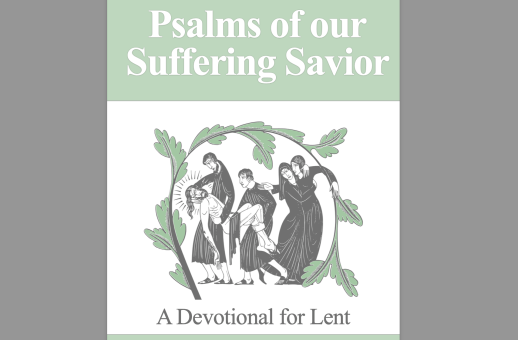
In preparation for Easter, I put together a devotional book. If you don’t have something to go through, I encourage you to check it out.
Here’s the link to the free e-book, I hope you find it helpful: Psalms of Our Suffering Savior
Crying On Christmas Day

A lot of us know the cheery and upbeat Christmas song, “I Heard the Bells on Christmas Day.” Many people don’t know Henry Wadsworth Longfellow’s story and poem behind it. Longfellow heard the bells ringing out from a nearby church on Christmas Day, 1863, and heard the happy chatter of the crowds and composed his poem. But the world seemed anything but peaceful and cheery. It was shattered. He had recently lost his second wife to a fire, the Civil War was raging, and his son had just been wounded in battle.[1]
Longfellow said, “How inexpressively sad are all holidays!” “Perhaps some day God will give me peace.”[2] The song versions of Longfellow’s poem don’t capture the bleak despair he was facing but the Civil Wars version comes close. Here are the two last verses of the poem:
And in despair I bowed my head;
“There is no peace on earth,” I said;
“For hate is strong,
And mocks the song
Of peace on earth, goodwill to men!”Then pealed the bells more loud and deep:
“God is not dead; nor doth he sleep!
The Wrong shall fail,
The Right prevail,
With peace on earth, goodwill to men!”
Many bow their heads in despair and say, “There is no peace on earth.” Many people are sad on Christmas Day for various reasons—whether death, divorce, or some other devastation—but sadness is no stranger to Christmas.
Other than “It’s A Wonderful Life,” most Christmas movies are silly, not very serious, and not sad. But the original Christmas story, the true Christmas story, is anything but silly. Jesus was born in an animal troth and was thought by many to be an illegitimate child.
The very reason the Bible says Jesus had to come to earth is sad. Jesus’ very name means, “the Lord saves.” And that is indeed what Jesus came to do, save His people from their sins and the sad situation they had gotten themselves into.
Jesus came into the brokenness and blight of the world. As the Christmas song, “O Holy Night,” says,
The King of kings lay thus in lowly manger,
In all our trials born to be our Friend.
He knows our need— to our weakness is no stranger.
Jesus can sympathize with us (Hebrews 4:15). Jesus understands death and devastation, not just in the way that He knows everything as God, but by experience. Since human beings are made of flesh and blood, Jesus Himself became flesh and blood (John 1:14; Hebrews 2:14), and is acquainted with the stress and sorrow we face.
We don’t always have to be happy-clappy at Christmas. Rather, the Bible says:
There is a time for everything,
and a season for every activity under the heavens:
a time to weep and a time to laugh,
a time to mourn and a time to dance,
a time to tear and a time to mend,
a time to be silent and a time to speak (Ecclesiastes 3:1,4,7).
More Christmas songs than you might realize, understand our plight and pleas for rescue. Here are a few lines from one of my favorite songs, “O Come, O Come Immanuel”:[3]
…free Thine own from Satan’s tyranny
From depths of hell Thy people save
And give them victory o’er the grave
…Disperse the gloomy clouds of night
And death’s dark shadows put to flight
…open wide our heavenly home
Make safe the way that leads on high
And close the path to misery
…O come, desire of nations, bind
In one the hearts of all mankind
Bid Thou our sad divisions cease
And be Thyself our King of peace
We don’t know the exact timing of Jesus’ birth, but it would be fitting if it was a dark cold night. This world is often dark and cold. But Christmas is about Jesus coming into that cold black darkness, relating to us, and bringing life, light, and warmth. In Jesus, “The people who walked in darkness have seen a great light; those who dwelt in a land of deep darkness, on them has light shone” (Isaiah 9:2).
The reality is, that Christmas is about light in darkness and hope amid grief. But Christmas is not lite, and it’s not just about laughter and “ho, ho, ho.” The Bible tells a gritty, realistic story about this broken world. But it also gives hope. It gives:
a bell ringing out in the silence
a light in the midst of darkness
snow silently falling on the black muddied earth
sunrise cresting the top of the trees
reminders that there is change
a new day ahead.
The Bible says that God does not sit idly by, but rather enters the fray. Christmas proves that God so loves the world. We may not always feel light, but He gives the offer of life. When we feel heavy and hollow, He offers to lift our load and give purpose.
Longfellow was sorrowful. His life was shattered. But what if Jesus came to earth to be shattered so that one day you could be mended and whole? And what if He promises to help pick up the pieces and make a masterful mosaic?
What if, in our muddled mess, Jesus the Messiah came? Came to love us and help us heal? What if He loves us? And says, “Come to Me, all who are weary and heavy laden. Come to Me, I have walked the weary road of life, I get it, I understand your strife.” Jesus says, “Come to Me, all who are empty and exasperated. I will give you rest for your souls.”
May God bless each of you this Christmas and in time, help you make a beautiful mosaic out of the shattered shards of life.
Notes
[1] He lost his friend, Nathaniel Hawthorne, around a year later.
[2] See “I heard the bells on Christmas Day.”
[3] Immanuel means “God with us.”
Photo by Abigail
Is Christmas True?
Is Christmas true? Or should we assume Christmas is just a fairytale like Santa Claus?
Our starting places or assumptions have a big impact on the way we weigh evidence. For instance, in Harper Lee’s book, To Kill a Mockingbird the correct verdict could not have been given in that context (i.e., Maycomb’s racist white community) because people excluded the possibility that anyone other than the black man, Tom Robinson, was guilty. Despite the strong evidence that Atticus Finch put forward, Tom was still convicted. Why? Because people were prejudiced against the truth. The people’s a priori assumption, that Tom was guilty because he’s black, led them to not honestly look at the evidence and pronounce the correct verdict.
This sadly still happens. It happens in the court of law and it can happen when people consider evidence about Jesus too. But, if God exists and wants to be born as a baby, as Christmas says, then certainly God can do that.
The Bible says Christmas is true. It even says the “star” guiding the Wisemen is true. Are there actual reasons for believing in the historical accuracy of Christmas? I believe so. But will people openly weigh the evidence?
Honestly, there’s a lot to look at. Here I’ll just share two pieces to consider.
Jesus’ Biographies
Although the Gospel accounts in the Bible may not be exactly like our biographies today, they really are biographies. Or they certainly claim to be. They purport to give actual history about Jesus of Nazareth. The Bible has four historical biographies about Jesus, often referred to as the Gospels.[1] Two of them explicitly claim to tell us what Jesus actually did and said, and they claim to be based on eyewitness testimony (Luke 1:1-4; John 21:20-24). And so, Justin Martyr, a second-century Christian writer and philosopher, referred to the Gospels as “the memoirs of His apostles.”
This is what Luke says:
Inasmuch as many have undertaken to compile a narrative of the things that have been accomplished among us, just as those who from the beginning were eyewitnesses and ministers of the word have delivered them to us, it seemed good to me also, having followed all things closely for some time past, to write an orderly account for you, most excellent Theophilus, that you may have certainty concerning the things you have been taught (Lk. 1:1-4).
Luke is basically making the claim to be a journalist or historian.
The Gospels place themselves in a historical context. They don’t start with imaginary elements. There is no “once upon a time.” Instead, they give us identifiable time stamps. They say things like: “Augustus was emperor of Rome,” “Quirinius was governor of Syria,” “Pilate was governor of Palestine,” “Herod was king of the Jews,” and “Joseph of Arimathea was a member of the Sanhedrin” (e.g., Matt. 2:1; 27:2; Mk. 15:1, 43; Lk. 2:1-2; Jn. 19:38). These were not made-up people or made-up positions. They repeat historical realities because the Gospels claim to be historical documents.
Many of the events that the New Testament writers wrote about were well-known. The Apostle Paul could tell king Agrippa: I am persuaded that none of these things has escaped your notice, since these things have not been done in a corner(Acts 26:26). The early Jesus followers did not follow cleverly devised myths about the Lord Jesus Christ but claimed to be eyewitnesses (2 Pet. 1:16).
C.S. Lewis knew a lot about legends and he didn’t think the Gospels read like legends. In Lewis’ own words: “Now, as a literary historian, I am perfectly convinced that whatever else the Gospels are they are not legends. I have read a great deal of legend and I am quite clear that they are not the same sort of thing.”[2]
The “Star” of Bethlehem
Matthew’s telling of the story of Jesus includes a lot about a “star.” But if you read the account, he says things about the “star” that do not make sense if he is talking about a literal star. The way he describes what the “star”[3] does would not make sense unless he was knowledgeably aware of the peculiar movements it made. The star was “His star” and it “rose,” “appeared,” “went before them,” and rested “over the place where the child was.”
The sign in the heavens convinced the Babylonian magi—the NASA of the day—to pay a visit to Jesus. They were aware of the Jewish promise of a coming King and what was transpiring in the sky made them think something very significant was happening.[4]
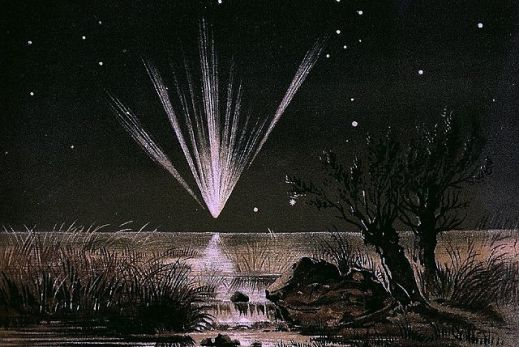
What did the Wisemen see? This would be super random to include in a story about Jesus unless the writer knew it to be factual and significant. Otherwise, the writer could have said something simpler: “a bright and mysterious light shown down on the blessed child.” Instead, the author describes the movements of a beautiful comet, something like the Great Comet of 1811. The potential issue with describing something so seemingly outrageous is that it’s visible to a lot of people. Many people could have come forward and said there was never anything in the sky like that. But that didn’t happen. Instead, later on, Origen rightly identifies the “star” as a comet.
Here’s what Origen said (circa 248):
The star that was seen in the east we consider to have been a new star, unlike any of the other well-known planetary bodies. Yet, it had the nature of those celestial bodies that appear at times, such as comets…. It has been observed that, on the occurrence of great events, and of mighty changes in earthly things, such stars are apt to appear, indicating either the removal of dynasties or the breaking out of wars. … There is a prophecy of Balaam recorded by Moses to this effect: ‘There will arise a star out of Jacob, and a man will rise up out of Israel.’
Ignatius said (circa 105), “The light from this star was inexpressible, and its uniqueness struck men with astonishment.”
So, unless this event with the Wisemen and Comet happened, what would one gain by fabricating the story? The Babylonian Wisemen would not be popular with the Jewish people. The Babylonians took Jewish people into exile and were idolaters and the Wisemen were seen as magicians who practiced sorcery against the LORD’s command (Deut. 18:10–12; Mal. 3:5; Gal. 5:19–21). And so, the God/child receiving charity from such people would probably not be seen positively.
If your premise is that the whole story was fabricated and made up to fool people, why would the author have risked claiming such a visible and verifiable phenomenon? On the other hand, if you look at Matthew as a historical work, there’s nothing that should be excluded outright. For one, Matthew certainly gets king Herod’s personality right. The historian Josephus recorded what a gruesome man Herod the Great was. He put his favorite wife to death as well as three of his sons and killed other family members too.
The slaying of the 15 to 35 babies, known as “the Massacre of the Innocents,” referred to in Matthew 2 may not be mentioned in other surviving historical accounts but it is in keeping with what we know of Herod.[5] And again, why mention this historical datum if it wasn’t accurate? Wouldn’t it be possible as the account of Jesus circulated for someone from Bethlehem to hear about the account of the massacre? Wouldn’t the story of Jesus be on unstable footing if just one lie was found out? Why then would the author take such risks?
Imagine I wanted to lie and make you think I’m good at baseball. There are all sorts of ways I could do that. I could say, “I’m really good at baseball.” I could say, “I played college baseball.” But the more specific and fantastic I get about my lie the higher the risk. If I say, “I played baseball for the Yankees” you’re going to have lots of questions and you’re probably going to seek out verification. A nondescript lie is a lot safer and can still accomplish my purpose of making you think I’m good at baseball. The claims about Jesus are not like that. They are distinctive. They—especially in the first century—are falsifiable.
The biographies of Jesus go beyond saying “Jesus was good at baseball,” and even beyond saying “Jesus played shortstop for the Yankees and batted cleanup.” They give loads of information that could have been found to be false but were never proved to be false. Again, why include so much fantastical false information? And remember, the Jesus movement didn’t take decades to form.
Anyhow, I’m trying to stop writing… There are many reasons to believe Christmas is a true story. We’ve very briefly considered two.
Notes
[1] Gospel means “good news.” In Greek, it is euangélion (εὐαγγέλιον) and it is where my daughter, Evangelina, gets her name from.
[2] C.S. Lewis, “What are we to make of Jesus Christ?,” 169 in God in the Dock.
[3] “Star” here is the English translation of the Greek word aster (ἀστήρ), and it’s where we get our English word “asteroid.” Aster can refer to various lights in the sky.
[4] See Colin R. Nicholl, The Great Christ Comet: Revealing the True Star of Bethlehem (Crossway: Wheaton, IL, 2015).
[5] Remember the infant mortality rate would have been high in that day and the massacre was all boys aged two and below so the number would have likely been relatively low for someone like Josephus to report
Less than our Sins Deserve

“What has happened to us is a result of our evil deeds and our great guilt, and yet, our God, you have punished us less than our sins deserved” (Ezra 9:13).
I remember throwing the football in the house as a kid. I was throwing the touchdown pass to my sister but she didn’t catch it. I threw it over her head. And hit my mom’s collection of fancy things. And I broke a bowl that her mom had passed down to her.
What happened was my fault. I couldn’t blame it on my sister and I certainly couldn’t blame it on my mom. And yet my mom was not angry with me. She was upset that the bowl was broken. It was special to her. But she didn’t take it out on me. And she even cleaned up the mess I made, the broken shards of her bowl I broke.
I’m thankful my mom showed kindness even though I didn’t deserve it. But I’m especially thankful that God shows kindness even when we don’t deserve it. God, since the beginning, has punished us less than our sins deserve.
God even takes the consequences of our sin upon Himself in the form of His Son, Jesus Christ. Upon Him was the punishment that brings us peace (See Isaiah 53). The wages of sin is death and eternal separation from God in whom alone there is life, yet Jesus takes the wages upon Himself and pays the price we owed.
God has compassion on us and through Jesus casts our sin into the depth of the sea (Micah 7:19). Jesus removes our sin from us, as far as the east is from the west (Psalm 103:12). God does not give us as our sins deserve. He gives grace.
We deserve to be paid death for the sin and ruin we’ve worked (Romans 6:23). That’s our due. Yet, God has “punished us less than our sins deserved” (Ezra 9:13).
Every day and every good thing is an undeserved gift of God. From the smile of a dog to the sip of cider, it’s all an undeserved gift from God. Every good and perfect gift comes from our Father above (James 1:17). And it’s a gift because it is underserved. We did not earn it.
*Photo by Alvan Nee
Noah’s Ark and the Bible’s Narrative Arc

“…the whole earth was filled with violence. And God saw the earth, and behold, it was corrupt, for all flesh had corrupted their way on the earth” (Gen. 6:11b-12).
The story of Noah and his ark has always been a difficult story. Knowing the context of the story is helpful though.
So, what was going on before God destroys the world with a flood?
Well, just a few chapters earlier we see that God made an incredibly good and beautiful creation (see e.g. Gen. 1:31). We see God made people–all people–with dignity and worth (Gen. 1:26-27; 5:1-2). We see God gave people good things to do (Gen.1:28).
But, we also see, humans didn’t listen. We see that in the Fall of humanity (Gen. 3), the first murder (Gen. 4:8), and the growing corruption and violence (Gen. 6:5). In Genesis, we go from God and good creation to growing corruption very quickly (that’s also representational of my own tendency).
It was not God who “paved paradise and put up a parking lot.” That’s what humans had already done. Humans damaged and defiled the very thing that would have brought them endless delight. Humans turn from fresh fulfilling water to putrid puddles.
But, that’s not it. Humans also hate. They hate humans that were made with the dignity of God. They hate and they hurt. They abuse and injure. And even kill.
Before God destroyed the world in the flood, humans destroyed the world with their sin. In God’s act of destruction, He was actually bringing a type of deliverance. He could have, and in a sense considered, destroying the world completely (Gen. 6:6-7).[1]
Yet, God worked through Noah, a mediator (Gen. 6:8ff)[2], as He does, to bring salvation through judgment.[3] God provided a type of rescue when wrath was deserved.
Ultimately we know, the God-Man, Jesus Christ, took the wrath of God and the violence of the world on Himself. When we understand the whole context of the story of Noah’s ark, we see it is not God at fault. He is not the guilty party for the destruction of the world.
Instead, we see we are at fault. We carry out atrocities. We turn from God, where alone there is life, to trifles and trivialities. We hate humans, who have eternal value and being, and love things that perish in a moment.
When the story of Noah’s ark is understood in context, from the perspective of the whole of redemptive history, we see how amazing it is that the LORD is both just and the justifier of the one who trusts in Jesus alone for rescue (see Rom. 3:25-26).
Societal Analysis

It’s very interesting and perplexing to me that as a society we want and we are begging for and demanding what is good. We are acknowledging that things are very wrong in society. That seems to be the case no matter where you are politically, whatever side you find yourself on.
We acknowledge there’s a problem, but as Plato pointed out a very long time ago, good people make for a good society. That seems to make clear sense. Yet, society seems soiled. Thus, we have found the problem, and it’s me.
When someone is sick there’s a medical analysis. This entails five different elements:
- The Ideal (of what’s healthy)
- Observation (of symptoms/signs)
- Diagnosis (or analysis of disease/disorder)
- Prognosis (or prediction of cure/remedy)
- Prescription (or instruction for treatment/action for a cure)
I believe that society is in need of an analysis. What are we observing? What’s the problem? Can it be fixed? If so, how?
We are observing a lot of problems or symptoms: violence, racism, inability to patiently discuss important issues, pride, etc. What is the disease? The disease seems to be a problem with people. Many people lack goodness. What’s the cure? We must be good. What then is the solution? We must learn to be good. That is the prescription. That is the treatment.
This seems very shallow and very simple. But it is not. Stick with me.
If we want a good society, we must have good people. Yet, I’m not sure we even have an understanding of what “good” or healthy even is. Do we even have a starting place for what constitutes good or healthy? If not, how could we possibly arrive at a prognosis or prescription let alone be in a place to give a diagnosis?!
The English writer and philosopher, G.K. Chesterton, once said, “What is wrong is that we don’t ask what is right.” We have no way by which to measure what is wrong and what is right. That is an obvious problem. You can’t build much with a standard that’s not standard.
If good individuals make for a good society, as seems to make sense. Perhaps the first and foundational prescription is to return to the conviction that there is such a thing as “good.” And not merely what is good for the subjective individual, but a good beyond and above us that corrects us.
In any field of work you have to have a standard, a means to measure; a way to know what is healthy and what is not. We have an idea of when one is overweight because we understand that there is a range of healthy weight. How can we prescribe a cure when there is no standard for what is good or healthy? And how can there be hope when there is no standard of healthy?
We, as a society, for the most part, don’t have a clear way to say what is good. And we don’t have a pathway to make good people. If anything, we have many conflicting things shaping people. Porn is prevalent and it makes objects of people and materialism is too and it plays down the importance of people in place of the value of objects. Ours is a conflicted society.
I believe the disorder in society comes from a plague more destructive than any pandemic, and that plague is sin. Its signs are everywhere. In my heart and actions, and yours too.
The diagnosis is deadly if not dealt with. The plague exponentially increases if not dealt with. It wreaks havoc on the scale of the Tsar Bomb. It leaves devastating effects on generations. It leaves gaping holes in individuals and is the downfall of society if not dealt with.
The prognosis, however, thankfully reveals that progress is possible. But it will be slow and painful. And it entails admitting there’s a problem; a problem, a plague, not just out there in the world, out there in others, but in me.
When someone observes a ghastly problem and knows the cure we inherently know the right thing to do in that case. It is to cure. Humans often fumble around talking about problems and we hustle around trying to cure. But all the while only grasping at what it meant to be truly healthy. We half see and so we get the diagnosis, prognosis, and prescription wrong. We always have.
I believe, however, that hope is not lost. I believe Messiah Jesus, the Healthy One, has brought the cure. He who did not have the plague took our problems, our sin, upon Himself on the cross. He showed us the cure, it is Himself. It is love. Death is the only answer. Death to self. We must die to self, we must love.
We must turn from our prideful and sinful ways and trust in Jesus our loving cure. Jesus gives us 1) the ideal of healthy, 2) the observation about what’s wrong, 3) the diagnosis, 4) the prognosis, and 5) the prescription. Without the provision of those five elements the only prognosis is death.
The Gospel Ripple

“Let the thief no longer steal, but rather let him labor, doing honest work with his own hands, so that he may have something to share with anyone in need” (Ephesians 4:28).
How does the good news of Jesus impact individuals, families, neighborhoods, and cities? Does the gospel make people prideful begets? Does it make people unloving and judgmental?
Ephesians 4:28 gives us a case study of what the impact of the good news of Jesus is supposed to have. It should change individuals. If they steal, it should change them so that they no longer do so. In the same way, the employer who is a jerk and does not treat people well is to change and instead be kind and care for their employees. The employee is also addressed, they are to do honest work and work as unto the Lord Jesus Himself.
So, we see the thief, the employer, the employee, the soldier (Lk. 3:14), and all types of people in all sorts of positions, are exhorted to not take part in wrong and destructive practices. That is the negative command. That is the, “Don’t do…” But there is also a positive command. Something we are told we must do. And that is labor. Whoever we are and whatever we do, there is something we must do. We must engage in labor, we must do the work before us in honesty. So the Christian is to work their best whether someone is watching or no one is watching.
Proof of God’s Grace #1: Planned Grace

The Bible shows us over and over again proof of God’s abundant grace. Here we are going to look at the acronym PROOF[1] to look at God’s grace. We are going to look at: Planned grace, Resurrecting grace, Outrageous grace, Overcoming grace, and Forever grace.
Why is it important that we consider the proof of grace? First, because when we understand all the proof of God’s grace we praise and glorify God for His abundant grace. Second, anything that is the teaching of Scripture is important and profitable for us to understand (2 Tim. 3:16-17). Third, when we understand the extent of God’s grace it humbles us. Fourth, when we understand more of the extent of our desperation we will (or should) love God more (Lk. 7:47).
Is Jesus Really the Only Way?

A lot of people believe that all “good” people go to heaven.
“After all, isn’t being good[1] what really matters? If someone is good and sincere in their beliefs then they should go to heaven. Plus, aren’t all religions basically the same?”[2]
“How could a good God allow people to go to hell?”
However, it should be asked, does God want those people to go to hell?[3] And has God provided a way for them to be saved? The answer to the first question we’ll see is no[4] and the answer to the second question is yes.
First, Scripture repeatedly says things like God desires all humans to be saved and come to the knowledge of the truth (1 Tim. 2:4). Here are three more:
“The Lord is… not wishing that any should perish, but that all should reach repentance” (2 Pet. 3:9).
“Have I any pleasure in the death of the wicked, declares the Lord God, and not rather that he should turn from his way and live?… For I have no pleasure in the death of anyone, declares the Lord God; so turn, and live” (Ezek. 18:23, 32).
“Say to them, As I live, declares the Lord God, I have no pleasure in the death of the wicked, but that the wicked turn from his way and live; turn back, turn back from your evil ways, for why will you die, O house of Israel?” (Ezek. 33:11).
So, God’s desire is for people to come to a knowledge of the truth of salvation in Jesus Christ and repent of their sins and be saved. That is God’s desire. However, that’s not it.
Second, God has also provided the way of salvation. The one God has provided the one way of salvation through the man Christ Jesus who is the one mediator between God and man (1 Tim. 2:5).
Imagine we were all on an island that a very wealthy and magnificent man owns. It is on fire and we all have to get off or we will die. Now, imagine that the owner of the island built a very large and sturdy bridge to the mainland so that people could escape. And in making the bridge he himself died.
The Ascension

As we saw in the previous post on the resurrection, Peter looked at Psalm 16 and showed how Jesus’ resurrection was foretold. In Acts 2 Peter goes on to show that Jesus is now at God’s right hand, as Psalm 110 foretold. Jesus Himself had quoted from Psalm 110 and stomped His critics (see e.g. Matt. 22:41-46). And when you look at 110:1 it’s not surprising that they were stomped.
So, we see that Jesus is at God’s right hand until… Until He makes His enemies His footstool. That means that Jesus is coming back—and the New Testament repeatedly says soon—to bring judgment, and pervasive peace through that judgment.[1]
Jesus’ death and resurrection shows that He is indeed the Lord and Messiah.[2] As the Lord and Messiah, He is coming back soon to vanquish every foe and establish His forever reign of peace. In His second coming, He will bring the Kingdom that was expected at His first coming. Read More…



 in X
in X 